
Quick Answer
The complete Navagraha collective mantra:
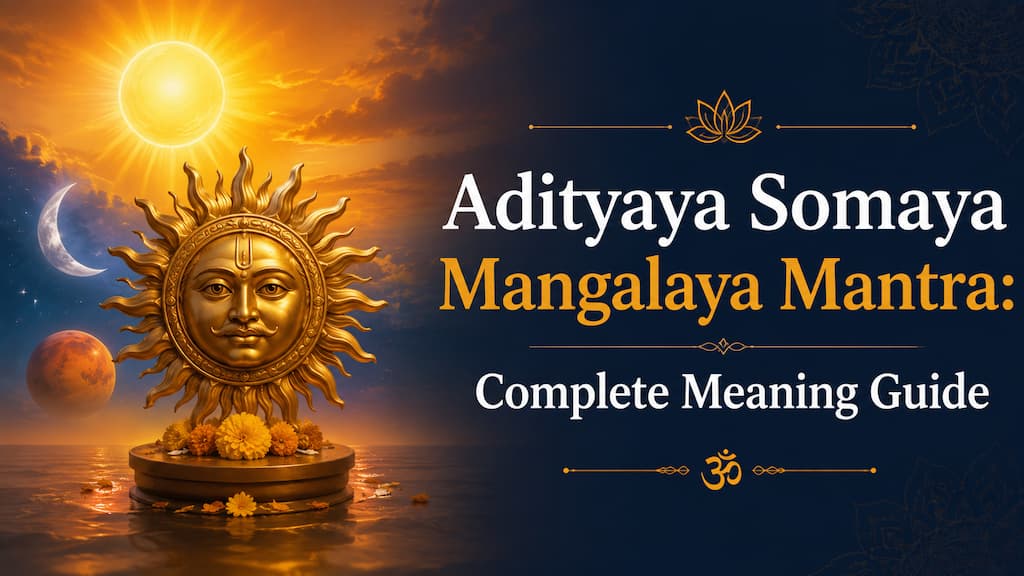
Adityaya Somaya Mangalaya Buddhaya Cha
Guruve Shukraya Shanibhyashcha Rahave Ketave Namah
Devanagari:
आदित्याय सोमाय मंगलाय बुधाय च।
गुरवे शुक्राय शनिभ्यश्च राहवे केतवे नमः॥
Complete meaning: Salutations to Aditya (Sun), Soma (Moon), Mangala (Mars), Budha (Mercury) : and to Guru (Jupiter), Shukra (Venus), Shani (Saturn), Rahu and Ketu.
Method: 108 times daily, facing east. This single mantra invokes all nine planets simultaneously. Chant before individual planet mantras to establish the complete planetary field.
Who This Article Is For
This article is for you if you want to understand the complete word-by-word meaning of the Navagraha collective mantra | you want to know why the nine planets appear in this specific order and not another | you want to know the classical source of this mantra.
Also see: Navagraha Mantra: all 9 individual planet mantras with complete guide
The Adityaya Somaya Mangalaya mantra is the most concise of all the Navagraha prayers: two lines, nine planetary names, one complete invocation. It appears in the Navagraha Stotram attributed to Rishi Vedavyasa : the same sage who compiled the Vedas and composed the Mahabharata. Understanding the mantra word by word and understanding why the nine planets appear in the specific order they do transforms it from a memorised recitation to a conscious act of planetary alignment.
Here is what almost no Navagraha mantra article explains: the order of the nine planets in this mantra is not random and not simply traditional habit. The order follows the Vedic weekday sequence : the same sequence that gives us Sunday, Monday, Tuesday, Wednesday, Thursday, Friday and Saturday in the modern week. This sequence is embedded in the Navagraha mantra and understanding it reveals the mantra’s cosmological intelligence.
The Mantra Word by Word
| Sanskrit name | Planet | Literal meaning | Day governed |
|---|---|---|---|
| Adityaya | Sun (Surya) | To Aditya: the son of Aditi, the infinite mother. Aditya is the Sun as the child of boundless space : the light born from the infinite. | Sunday (Ravi-vara) |
| Somaya | Moon (Chandra) | To Soma: the nectar-carrier. Soma is the Moon as the vessel of nectar (Amrita) : the life-sustaining fluid that the Moon carries and releases through its cycle. | Monday (Soma-vara) |
| Mangalaya | Mars (Kuja) | To Mangala: the auspicious one, the son of Earth (Bhoomi Putra). Despite Mars’s fierce reputation, his classical name Mangala means auspicious : his energy is auspicious when directed correctly. | Tuesday (Mangala-vara) |
| Buddhaya | Mercury (Budha) | To Budha: the intelligent one, the awakened one. Budha is Mercury as pure intelligence : the planet of the discriminating mind. | Wednesday (Budha-vara) |
| Cha | (conjunction) | And : connecting the first four to the next five | |
| Guruve | Jupiter (Brihaspati) | To the Guru: the heavy one, the teacher of the gods. Guru literally means heavy (from the Sanskrit root Gur, weight) because wisdom carries weight. Jupiter is the planetary teacher. | Thursday (Guru-vara) |
| Shukraya | Venus (Shukra) | To Shukra: the bright one, the radiant one. Shukra means brightness and purity. Venus as the brightest planet in the sky embodies this quality in the Vedic understanding. | Friday (Shukra-vara) |
| Shanibhyashcha | Saturn (Shani) | And to Shani: the slow-moving one. Shani + bhyah (plural dative) + cha (and). The plural is notable : some classical interpretations include Shani’s two shadow companions (Rahu and Ketu were originally considered Saturn’s associates before they were given full independent status). | Saturday (Shani-vara) |
| Rahave | Rahu (North Node) | To Rahu: the seizer, the one who grasps. From the Sanskrit root Rah meaning to take, to seize. Rahu is the north lunar node : the point that seizes the Sun during solar eclipses. | Shares Saturday in some traditions |
| Ketave | Ketu (South Node) | To Ketu: the comet, the banner, the sign. Ketu is the south lunar node : appearing in the sky as a comet or bright tail-like phenomenon. | Shares Tuesday in some traditions |
| Namah | (salutation) | I bow, I salute. The complete surrender before all nine planetary forces simultaneously. |
Why the Planets Appear in This Order
The order Sun, Moon, Mars, Mercury, Jupiter, Venus, Saturn is the Vedic planetary weekday sequence : the same sequence embedded in the modern week’s day names. This is not coincidence: the modern weekday names come directly from the Roman adoption of the Vedic planetary system via Hellenistic astrology.
In the Vedic system, each hour of the day is governed by one of the seven traditional planets (not Rahu and Ketu, which do not have own days in the primary system). The first hour of Sunday is governed by the Sun : so Sunday is the Sun’s day. The first hour of Monday is governed by the Moon : Moon’s day. Tuesday is Mars’s day (in Hindi: Mangal-var). Wednesday is Mercury’s day (Budh-var). Thursday is Jupiter’s day (Guru-var). Friday is Venus’s day (Shukra-var). Saturday is Saturn’s day (Shani-var). The mantra follows exactly this sequence.
How to Use This Mantra
Complete Practice
As a standalone daily practice: 108 times facing east, morning. This addresses all nine planets simultaneously and is the complete Navagraha practice for those who cannot maintain nine separate planetary mantras.
As an opening before individual planet mantras: Chant the collective mantra 9 or 27 times first. Then chant the specific planet mantra (Shani, Rahu, Jupiter, etc.) 108 times. The collective mantra establishes the full planetary field; the individual mantra then addresses the specific planet needing attention.
Before birth chart analysis: Chanting this mantra 108 times before a Jyotisha consultation or before reviewing your own chart is the traditional preparation. It invokes all nine planets’ presence and creates a sattvic atmosphere for planetary study.
For Navagraha puja: The collective mantra is chanted at the beginning and end of any Navagraha puja before and after the individual planet mantras. It is the frame within which the specific planetary work occurs.
From Our Practice
From Our Practice
In my Jyotisha practice, I recommend the Adityaya Somaya Mangalaya mantra to clients who want to begin a Navagraha practice but find the nine separate mantras (one for each planet, each on its own day) too complex to establish as a consistent habit. The collective mantra : two lines, 108 repetitions, one sitting : is a complete practice that addresses all nine planets without requiring the practitioner to remember which mantra to chant on which day.
I also recommend it specifically before and after any significant astrological transit. When Saturn is crossing a sensitive point in the chart, or when Rahu-Ketu are changing signs, the collective Navagraha mantra addresses the complete planetary field rather than just the transit planet. This is the mantra’s specific advantage over single-planet mantras: it maintains harmony across all nine planets simultaneously, so no single planet’s temporary intensification disrupts the whole system’s balance.
Frequently Asked Questions
❓ Is this mantra from the Vedas or from a Purana?
The Adityaya Somaya Mangalaya mantra is the opening shloka of the Navagraha Stotram, attributed to Rishi Vedavyasa (Vyasa). It appears in the Puranic tradition rather than directly in the four Vedas. Vyasa himself is considered a Vedic figure : the compiler of the Vedas and the Mahabharata : so the mantra carries significant classical authority even though it is technically a Puranic rather than a Shruti (directly revealed Vedic) text.
❓ Does this one mantra replace all nine individual planet mantras?
For general planetary harmony and as a daily foundation practice: yes, it is complete. For targeted planetary remedies (a specific Sade Sati remedy, a Rahu Mahadasha protocol, a specific weakness in the chart): no. The collective mantra addresses all nine simultaneously but cannot provide the concentrated remedial energy of a specific planet’s Beej Mantra chanted 108 times on its day. Think of the collective mantra as the foundation and the individual mantras as the targeted treatments.
❓ Why do Rahu and Ketu not have their own days in the weekday sequence?
Rahu and Ketu are shadow planets : mathematical points where the Moon’s orbit intersects the ecliptic, not physical celestial bodies with their own light. The original seven-planet Vedic system (Sun, Moon, Mars, Mercury, Jupiter, Venus, Saturn) predates the incorporation of Rahu and Ketu as full Navagraha members. The seven-day week emerged from the seven-planet system. Rahu and Ketu were incorporated into the nine-planet Navagraha system later, inheriting associations with existing days: Rahu is associated with Saturday in some traditions, Ketu with Tuesday. The mantra includes them fully even though they have no independent weekdays.
❓ Can I chant this mantra on any day or is there an ideal day?
Any day. This is one of the mantra’s key advantages: because it addresses all nine planets, it is appropriate on every day of the week. Sunday’s Sun energy, Monday’s Moon energy, Tuesday’s Mars energy : the collective mantra is resonant with all of them simultaneously. Chant every morning facing east, 108 times. The consistency of daily chanting is more important than any specific day selection.
❓ What is the difference between this mantra and the Navagraha Stotram?
This mantra (Adityaya Somaya Mangalaya Buddhaya Cha…) is the opening shloka : the single collective invocation. The full Navagraha Stotram consists of this opening shloka plus nine individual verses for each planet (the Dhyana shlokas: Japakusuma Sankasham for the Sun, Dadhi Shankha Tusharagam for the Moon, etc.). Chanting the opening shloka alone is a complete daily practice. Chanting the full Stotram includes the opening plus the nine individual planetary Dhyana shlokas : a more complete practice of approximately 15 to 20 minutes.
❓ The mantra I have seen online says Bhudayacha instead of Buddhaya Cha. Which is correct?
Both are the same. Bhudayacha and Buddhaya Cha are different transliteration conventions for the same Sanskrit. Budha (Mercury) in the dative case is Buddhaya. When followed by Cha (and), the two words are sometimes written as Buddhaya Cha separately or run together as Bhudayacha in common usage. The meaning is identical: to Mercury (Budha), and… The same applies to Shanibhyashcha which combines Shani + bhyah + cha (to Saturn + plural dative + and). Different transliteration systems produce different spellings of the same Sanskrit sound.
Begin Tomorrow Morning
Tomorrow morning, before any other activity, face east. Chant Adityaya Somaya Mangalaya Buddhaya Cha : Guruve Shukraya Shanibhyashcha Rahave Ketave Namah : 108 times. 10 to 12 minutes. All nine planets addressed. The complete Navagraha field established for the day.
This is the simplest complete daily planetary practice the tradition provides. Two lines. Nine names. One bow. Begin tomorrow.
Sources
- Wikipedia : Navagraha: the nine planets in Hindu astrology, their classical names and the weekday association system
- Wikipedia : Vyasa: Vedavyasa as author of Navagraha Stotram, Mahabharata and compiler of the Vedas
- Wikipedia : Week: the seven-day week’s origin in the Vedic-Hellenistic seven-planet system and the planetary weekday sequence
- Navagraha Stotram Sanskrit text and commentary. BhaktiNidhi. Vyasa authorship; complete nine-verse structure; Adityaya Somaya opening shloka as standalone mantra
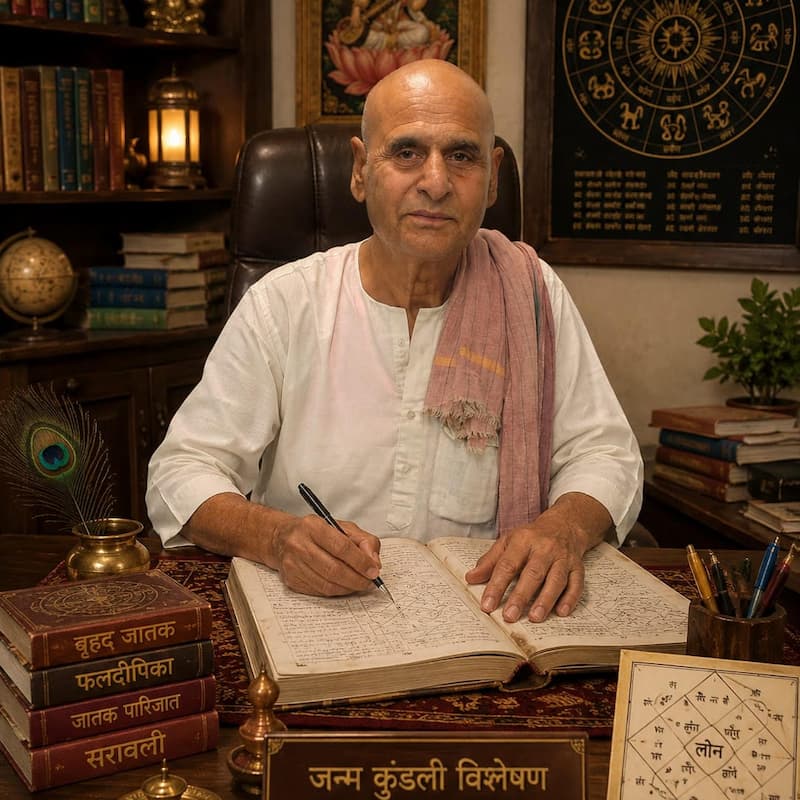
Narendra Kumar Chaubey is a Jyotisha Acharya with over 30 years of experience, based in Bihar and serving clients across India in Vedic astrology, mantra shastra, Vastu and ritual practice.
He completed his formal training at Kameshwar Singh Darbhanga Sanskrit University (KSDSU), one of India’s oldest and most respected institutions for Vedic and Sanskrit scholarship, where he studied Jyotisha shastra, mantra vidya and related classical sciences. KSDSU’s tradition of rigorous Sanskrit education tracing directly to the Mithila region’s centuries-old pandit lineage forms the foundation of his practice.
Over three decades, Narendra Kumar Chaubey has worked with thousands of individuals and families across Bihar and across India, offering guidance in:
- Kundli (birth chart) analysis: Identifying karmic patterns, planetary periods and life path guidance through classical Jyotisha
- Palmistry (Hasta Samudrika): Reading the hand according to the classical Samudrika Shastra tradition
- Vastu Shastra: Assessment and correction of living and working spaces according to directional and elemental principles
- Mantra and Pooja vidhi: Performing and guiding all categories of puja, havan, and mantra sadhana for personal, family and business situations
- Predictive Jyotisha: Transit analysis, muhurta (auspicious timing) selection and remedial guidance
He works across four languages Sanskrit, Hindi, English and Bhojpuri making classical knowledge accessible to practitioners across educational backgrounds and regions.
His writing for ABMantra brings the precision of classical Vedic training to practical mantra guidance: not general advice but specific prescriptions grounded in shastra, lineage and 30 years of direct practice with real situations.
For more info follow on: