


Quick Answer
The Beej Mantra for Saturn (Shani Beej Mantra) is:
Om Praam Preem Praum Sah Shanaischaraya Namah
ॐ प्रां प्रीं प्रौं सः शनैश्चराय नमः
Meaning: Through the three seed sounds of Saturn (Praam Preem Praum), I bow to Shanaicharaya : the slow-moving one (Saturn).
Short daily form: Om Sham Shanicharaya Namah (ॐ शं शनिचराय नमः)
When to chant: Saturday evenings after sunset, facing west, on a Rudraksha or iron mala. 108 times per session.
Duration: Sade Sati: entire period | Mahadasha: 19,000 repetitions minimum | Weak Saturn in chart: 40 consecutive Saturdays
Who This Article Is For
This article is for you if you are going through Sade Sati or Saturn Mahadasha and need the correct mantra and complete practice | you have seen different versions online (Praam, Sham, or Dram) and are confused about which is correct | you want to understand the difference between weak Saturn and malefic Saturn and why each needs a different approach.
Also see: Shani Mantra for Sade Sati: complete practice and what to expect and Navagraha Mantra: all 9 planet mantras with meaning
If you are searching for the beej mantra for Saturn, you likely already know why: Shani’s influence in the birth chart or through an active transit is producing delays, obstacles, health challenges, or a persistent quality of heaviness that effort alone cannot dissolve. The Saturn Beej Mantra : Om Praam Preem Praum Sah Shanaischaraya Namah : is the tradition’s primary sonic tool for navigating this influence. But there is one fundamental misunderstanding about it that most people carry, and correcting it changes everything about how the mantra works.
The misunderstanding: Most people approach the Saturn Beej Mantra hoping to weaken Saturn’s influence. The tradition is clear that this is not how the beej mantra works. You cannot weaken Saturn with his own seed sound. The Beej Mantra asks Saturn to work with you rather than through you blindly. This shift : from fighting Saturn to aligning with him : is what the practice actually produces, and understanding it before you begin is what makes the difference between a practice that produces results and one that does not.
The Mantra Text: Which Version Is Correct?
If you have searched online for the Saturn Beej Mantra, you have almost certainly seen three different versions. This is one of the most widespread sources of confusion in Navagraha mantra practice today.
| Version | Text | Correct? |
|---|---|---|
| Version 1 (Primary : use this) | Om Praam Preem Praum Sah Shanaischaraya Namah ॐ प्रां प्रीं प्रौं सः शनैश्चराय नमः |
Yes. This is the classical Shani Beej Mantra from the Navagraha tradition. Use this for all formal Saturn sadhana. |
| Version 2 (Short form : also valid) | Om Sham Shanicharaya Namah ॐ शं शनिचराय नमः |
Yes. Sham is Saturn’s single planetary beej syllable. Use this for daily informal chanting throughout the day. |
| Version 3 (Wrong : do not use for Saturn) | Om Dram Dreem Droum Sah Shanaischaraya Namah | No. Dram Dreem Droum are the beej syllables of the Sun (Surya), not Saturn. This version has been copied incorrectly across hundreds of websites. If you have been chanting this for Saturn, stop and switch to Version 1 immediately. |
Saturn Beej Mantra at a Glance
| Detail | Information |
|---|---|
| Full Beej Mantra | Om Praam Preem Praum Sah Shanaischaraya Namah |
| Sanskrit | ॐ प्रां प्रीं प्रौं सः शनैश्चराय नमः |
| Short form | Om Sham Shanicharaya Namah |
| Shani Gayatri Mantra | Om Ravisutaya Vidmahe Manda Grahaya Dhimahi Tanno Shanih Prachodayat |
| Deity | Lord Shani (Saturn) : son of Surya and Chhaya |
| Planet governed | Saturn (Shani): karma, discipline, justice, longevity, service |
| Best day | Saturday (Shanivar) |
| Best time | After sunset on Saturdays (evening to night) |
| Direction | West (Saturn’s direction) |
| Mala | Rudraksha mala or iron mala (black mala) |
| Chanting count | 108 times per session (one mala round) |
| Mahadasha count | 19,000 repetitions minimum (at 108 daily: approximately 176 days) |
| Colour | Black or dark blue clothing during practice |
| Offering | Black sesame seeds (til), sesame oil lamp |
| Companion practice | Hanuman Chalisa daily; Saturday donation (oil, black cloth) |
Complete Word-by-Word Meaning
Om Praam Preem Praum Sah Shanaischaraya Namah: Every Syllable Explained
Om (ॐ): The primordial cosmic sound. The foundation of all mantras. Om opens the practitioner’s consciousness to receive Saturn’s specific energy. Without Om, the beej syllables that follow lack their cosmic ground.
Praam (प्रां): The first of Saturn’s three beej syllables. Praam corresponds to Saturn’s initiating, confronting quality: the phase in which Saturn begins its work by stripping away what is false, inessential, or not genuinely earned. Praam is Saturn at the beginning : uncompromising, reality-revealing, the cause of the initial disruption that his periods typically produce. In the body, this syllable resonates with the Muladhara (root chakra) : the foundation that Saturn tests first.
Preem (प्रीं): The second of Saturn’s three beej syllables. Preem carries the quality of sustained teaching : Saturn holding the lesson in place until it is genuinely integrated, not merely endured. This is the dimension of Saturn that most people do not expect: a quality of patient, sustained compassion beneath the difficulty. Saturn does not repeat his lessons indefinitely; Preem is the energy of Saturn waiting for genuine learning to occur.
Praum (प्रौं): The third of Saturn’s three beej syllables. Praum is Saturn in his fully mature expression: the earned wisdom, the rock-solid inner stability, the unshakeable patience of the person who has genuinely come through Saturn’s fire. Praum corresponds to what Saturn is working toward in every practitioner who comes to him with honesty : the indestructible inner strength that only his specific quality of teaching can produce.
Sah (सः): The pranava of Shani : the identifying seed that names Saturn’s essential nature and connects the three beej syllables to their cosmic source. Sah is the affirmative completion of the beej invocation before Saturn’s name is spoken.
Shanaischaraya (शनैश्चराय): To Shanaicharaya : to the slow-moving one (dative case). Shani = slowly, gradually. Chara = moving. Shanaicharaya is Saturn’s classical Vedic name: the one who moves slowly through the zodiac (approximately 2.5 years per sign). The name itself contains the primary teaching about Saturn: patience. Everything in Saturn’s domain moves slowly, teaches slowly, and produces results slowly : but permanently.
Namah (नमः): I bow. I surrender. The complete yielding of the fearful, karma-burdened self to Saturn’s ultimately just and compassionate authority. Namah is the practitioner’s acknowledgement that Saturn’s lessons, however difficult, are for their genuine benefit.
Complete meaning: Through the three seed sounds of Saturn : the initiating (Praam), the sustaining (Preem), and the completing (Praum) : I bow to Shanaicharaya, the slow-moving one. May Saturn’s full karmic process, from its challenging beginning to its wisdom-producing completion, work in alignment with my genuine growth.
The Critical Distinction: Weak Saturn vs Malefic Saturn
This distinction is entirely absent from most Saturn mantra articles, and it is the most important thing to understand before beginning the practice.
| Saturn condition | What it looks like in life | What the Beej Mantra does |
|---|---|---|
| Strong and well-placed Saturn (own signs: Capricorn, Aquarius; exalted in Libra; good houses: 3rd, 6th, 10th, 11th) |
Natural discipline, sustained success through consistent effort, good career, ability to delay gratification for long-term gain, strong sense of justice | Deepens these positive qualities. Strengthens patience and sustained commitment further. The practice here is gratitude and reinforcement, not remedy. |
| Weak Saturn (debilitated in Aries; combust; in dusthana; low Shadbala) |
Difficulty maintaining discipline, inconsistency, poor relationship with authority figures, inability to sustain effort, chronic health issues related to cold, joints, or nervous system | Most effective here. The Beej Mantra strengthens Saturn’s positive qualities so they become available. You are building Saturn’s strength, not pacifying his negativity. |
| Malefic Saturn (active Sade Sati, Dhaiyya, Shani Mahadasha, or afflicting key houses) |
Sustained periods of difficulty, delays despite consistent effort, the feeling that external forces are blocking progress, obstacles appearing from unexpected directions | Pacifies and aligns. The Beej Mantra does not weaken Saturn or ask him to stop his work. It asks him to fulfill his function through teaching rather than through punishment : the difference between a difficult teacher who wants you to succeed and a difficult teacher who does not care. |
The Most Important Principle: Saturn Cannot Be Bypassed
Saturn is the planet of karma and justice. The Beej Mantra does not make his tests easier or shorter. What it does is open the practitioner to the genuine learning within the test : making it possible to pass the test rather than repeat it indefinitely.
The practitioner who chants Om Praam Preem Praum daily while refusing to examine what Saturn is asking them to face honestly will find the mantra produces nothing. Saturn rewards genuine self-examination and punishes self-deception, regardless of how many repetitions are completed.
Benefits of Chanting the Saturn Beej Mantra
The tradition’s documented benefits, with the mechanism behind each:
- Relief from Sade Sati difficulty: The 7.5-year Saturn transit is the most sustained karmic review most people face in a lifetime. The Beej Mantra does not end the Sade Sati early : it changes the quality of the practitioner’s experience within it from resistance (which makes Saturn’s teaching more intense) to willingness (which makes the lessons more efficient and less harsh).
- Discharge of karmic debts: Saturn governs the principle of karmic accounting : that every cause produces its corresponding effect. Sincere Beej Mantra practice combined with genuine ethical action accelerates the discharge of karmic debts that have been accumulating over multiple lifetimes.
- Development of genuine patience: This is Saturn’s specific gift when aligned with rather than fought. The patience that Saturn’s Beej Mantra produces is not passive waiting. It is the active, informed patience that knows what it is waiting for and why : the patience of a practitioner who understands the purpose of the delay.
- Career and professional stability: Saturn governs sustained effort, consistent work, and the reward that comes from genuine contribution over time. Strengthening Saturn through the Beej Mantra increases the practitioner’s capacity for the kind of disciplined, long-term effort that produces genuine professional achievement.
- Health benefits related to Saturn’s domain: Saturn governs the bones, teeth, joints, skin, and nervous system. Practitioners who maintain the Beej Mantra practice consistently report improvement in chronic conditions affecting these systems : particularly those that are cold, slow-moving, or long-duration in nature.
- Protection during Saturn transits: The Beej Mantra establishes a consistent energetic relationship with Saturn that provides a degree of protection during difficult transits : specifically Dhaiyya (2.5-year transit of 4th or 8th from natal Moon) and the three phases of Sade Sati.
Complete Practice: Situation-Wise Protocols
| Your situation | Practice | Duration |
|---|---|---|
| Sade Sati (7.5-year Saturn transit) | Om Praam Preem Praum Sah Shanaischaraya Namah : 108 times every Saturday evening + Hanuman Chalisa daily | Entire Sade Sati period without stopping. Do not pause between phases. |
| Dhaiyya / Kantaka Shani (2.5-year transit of 4th or 8th from natal Moon) | 108 times every Saturday evening | Entire Dhaiyya period |
| Saturn Mahadasha (19-year Vimshottari period) | 108 times daily (not only Saturdays). The traditional complete count for Saturn Mahadasha is 19,000 repetitions : at 108 per day, approximately 176 days for the minimum count, then maintain Saturday practice for the full Mahadasha. | 19,000 repetitions minimum, then weekly Saturday practice for the Mahadasha duration |
| Weak Saturn in birth chart (no active transit) | 108 times every Saturday. Begin on a Saturday in Shukla Paksha (waxing moon). | 40 consecutive Saturdays minimum. Repeat annually. |
| General daily maintenance practice | Om Sham Shanicharaya Namah : the short form : 108 times any morning plus 108 full Beej Mantra on Saturdays | Ongoing, indefinitely |
The Complete Saturday Practice: Step by Step
Full Saturday Shani Beej Mantra Practice
1. Preparation (before beginning):
Bathe. Wear black or dark blue clothing. Light a sesame oil lamp (til tel diya) in an iron diya. Place black sesame seeds (til) in a small bowl. Face west : Saturn’s direction in the Vedic system.
2. Opening:
Chant Om Namah Shivaya 3 times : Shiva is Saturn’s presiding deity and his invocation opens the Saturnian practice. Then Hanuman Chalisa once if time permits : Hanuman specifically pacifies Saturn and their combined invocation is among the most powerful Saturn remedies in the tradition.
3. Main practice:
Om Praam Preem Praum Sah Shanaischaraya Namah : 108 times on a Rudraksha mala, held in the right hand. One bead per complete mantra. Do not cross the Meru bead : reverse direction when you reach it.
4. Closing:
Om Sham Shanicharaya Namah : 11 times. Then sit in silence for 3 minutes. Do not immediately stand or begin activity.
5. The Saturday donation (essential : do not skip):
Before the day ends: offer black sesame seeds, black cloth, mustard oil, or cooked food (especially khichdi or dal) to a person in genuine need, at a Shani temple, or at a Peepal tree. The tradition is explicit: the Beej Mantra practice is incomplete without the Saturday charitable offering. Saturn governs the poor and dispossessed : the donation is the practical expression of the mantra’s teaching.
Total time: 25 to 35 minutes for the complete practice.
All Forms of the Shani Mantra and When to Use Each
| Mantra | Sanskrit text | Best for | When |
|---|---|---|---|
| Shani Beej Mantra (primary) | Om Praam Preem Praum Sah Shanaischaraya Namah | Serious Saturn afflictions: Sade Sati, Mahadasha, Dhaiyya, Shani Dosha | Saturday evenings 108 times. Daily during Mahadasha. |
| Shani Mool Mantra (simple daily) | Om Sham Shanicharaya Namah | Daily maintenance, informal continuous chanting throughout the day | Any time, daily, 108 times or informal |
| Shani Gayatri | Om Ravisutaya Vidmahe Manda Grahaya Dhimahi Tanno Shanih Prachodayat | Invoking Saturn’s positive qualities: discipline, career success, long-term achievement | Saturday morning 108 times |
| Shani Vedic Mantra (Dhyana shloka) | Nilanjana Samabhasam Raviputram Yamagrajam Chhaya Martanda Sambhutam Tam Namami Shanaischaraam | Formal Saturn puja: chanted as the meditation shloka before worship | Once at the beginning of any Saturn puja |
Who Is Shani? The Mythology Behind the Mantra
Saturn (Shani) is the son of Surya (the Sun) and Chhaya (Shadow). His birth from the Shadow goddess gives him a quality no other Navagraha possesses: he sees what others wish to remain in shadow. This is why Saturn governs karma, truth, and the patient exposure of what has been avoided or concealed.
His vehicle is the crow : the bird associated with ancestors, the past, and messages from the forgotten. His colour is black or dark blue, the colours of depth and the night that conceals as much as it reveals. His grain is black sesame (til) and his metal is iron : both symbols of endurance, weight, and the long, slow process of transformation that Saturn governs.
The story most often told about Saturn’s power involves his gaze: it is said that even Lord Ganesha suffered when Shani’s direct gaze fell upon him as an infant, causing his head to be replaced with an elephant’s head. This story is not a warning about Saturn’s cruelty but an illustration of the truth that Saturn’s direct seeing, however uncomfortable, is always transformative. Ganesha did not become less with an elephant’s head. He became the remover of obstacles : which is what all of Saturn’s encounters, when met honestly, produce.
From Our Practice
From Our Practice
In 30 years of Jyotisha practice, Sade Sati clients are among those I work with most frequently and most carefully. Saturn’s 7.5-year transit is the period most people fear most and understand least : and the two things are directly connected. The fear amplifies what is already difficult. The understanding reduces it.
A client came to me at the beginning of her Sade Sati two years into a very successful corporate career. Within three months, she had been made redundant. She came wanting a mantra that would help her find another corporate job quickly. I prescribed the Saturn Beej Mantra but gave her one instruction that surprised her: do not chant it with the intention of getting another corporate job. Chant it with the intention of understanding what Saturn is showing you.
She chanted 108 repetitions every Saturday for six months and also sat with the question: what has this career been costing me that I have refused to look at? The answer came slowly over those months. The career had been consuming her health, her family relationships, and her genuine interests for years. Saturn had not taken something good from her. He had removed something that had already become hollow.
By the end of that first year she had begun working independently in a field she had dismissed as impractical for 15 years. The Sade Sati had two more years remaining. She described those two years as the most genuinely productive of her life. The Saturn Beej Mantra did not bring back the corporate job. It brought her the clarity to see why that was not what she actually needed.
This is what the Saturn Beej Mantra actually does when practiced correctly. Not a shortcut around Saturn’s tests. A companion through them that makes the learning real rather than merely painful.
Saturn Remedies That Complement the Beej Mantra
- Hanuman Chalisa daily: The tradition holds a specific relationship between Hanuman and Saturn : when Shani attempted to afflict Hanuman, Hanuman defeated him. Saturn thereafter agreed to be gentle with genuine Hanuman devotees. Daily Hanuman Chalisa recitation is among the most consistent and universally recommended Saturn remedies across all Jyotisha traditions.
- Peepal tree worship on Saturdays: Light a mustard oil lamp at the base of a Peepal tree every Saturday evening and chant the Beej Mantra there. The Peepal is Saturn’s tree.
- Saturday fasting: Partial fast on Saturdays (one meal, or fruit only). Saturn responds specifically to voluntary austerity that demonstrates the practitioner’s willingness to accept limitation consciously rather than having it imposed externally.
- Service to the elderly and disadvantaged: Saturn governs the dispossessed, the old, the poor, and those whose work is unrecognised. Regular service to these groups : beyond the Saturday donation : specifically earns Saturn’s goodwill in the tradition’s understanding.
- Blue sapphire (Neelam): Saturn’s gemstone, prescribed only after birth chart analysis by a qualified Jyotisha. Blue sapphire amplifies Saturn’s energy : highly beneficial when Saturn is weak and well-placed, potentially harmful when Saturn is already strongly malefic. Never wear without qualified chart analysis.
Frequently Asked Questions
❓ Which is correct: Om Praam Preem Praum or Om Sham Shanicharaya Namah?
Both are correct but for different purposes. Om Praam Preem Praum Sah Shanaischaraya Namah is the full Beej Mantra for formal Saturn sadhana: Sade Sati, Mahadasha and serious Saturn affliction. Chant it 108 times on Saturdays with the full ritual protocol. Om Sham Shanicharaya Namah is the short-form planetary beej for daily informal chanting throughout the day. Both invoke Saturn genuinely. The full form is more concentrated. The short form is more accessible for continuous daily use. For serious Saturn periods, use both: the full form on Saturdays and the short form daily.
❓ I am in Sade Sati. Is the Beej Mantra alone enough or do I need other practices?
The Beej Mantra is the core Saturn-specific practice. The tradition recommends three complementary practices for Sade Sati: the Beej Mantra 108 times on Saturdays, the Hanuman Chalisa daily (Hanuman specifically pacifies Saturn), and the Saturday donation of sesame oil, black cloth or food to those in need. These three address the astrological, devotional and karmic dimensions of Sade Sati simultaneously. If you can maintain only one, make it the daily Hanuman Chalisa : it is the most universally effective Saturn remedy across all Jyotisha traditions.
❓ I have been chanting Om Dram Dreem Droum for Saturn. Is that correct?
No. Om Dram Dreem Droum Sah is the Beej Mantra for the Sun (Surya), not Saturn. This is one of the most widespread errors in online mantra content : the Surya Beej Mantra was incorrectly labelled as a Saturn mantra on several sites and then copied thousands of times. If you have been using this form for Saturn, stop immediately and switch to Om Praam Preem Praum Sah Shanaischaraya Namah. Chanting the Sun mantra when you intended Saturn mantra does not produce Saturn effects; it produces Surya effects, which may not address your Saturn-related situation at all.
❓ How long before I feel the effect of the Saturn Beej Mantra?
Saturn operates on Saturn’s timeline : slow and cumulative. Most practitioners report the first internal shifts between Saturday 7 and Saturday 21. These are typically internal: a quality of greater patience appearing, a perspective on a previously closed situation, a reduction in the specific anxiety the Saturn period was generating. External results follow internal shifts, typically over 3 to 6 months of consistent Saturday practice. Do not assess results after 2 or 3 sessions. Saturn does not move quickly. The practice requires the same quality : patience : that Saturn’s greatest gift also is.
❓ My Saturn is strong and well-placed. Should I still chant the Beej Mantra?
Yes, but the intention shifts. For a strong and well-placed Saturn, the Beej Mantra deepens the positive qualities he already provides: greater discipline, more sustained patience, stronger capacity for long-term commitment. You are not pacifying a difficult Saturn but inviting a cooperative Saturn to work more fully through you. The Saturday practice of 108 repetitions remains the prescription, but without the urgency of a Sade Sati or Mahadasha context. Many successful practitioners maintain a lifelong Saturday Saturn Beej Mantra practice regardless of Saturn’s transits : building the Saturnian qualities of discipline and sustained effort as ongoing life practice rather than only as a crisis remedy.
❓ Can women chant the Saturn Beej Mantra? Are there any restrictions?
Yes, women can chant the Saturn Beej Mantra without restriction. Saturn’s karmic influence applies equally to all people regardless of gender. The Saturday Shani temple practice and the sesame oil offering are open to all. There are no gender restrictions in any classical Jyotisha tradition for the Saturn Beej Mantra. The question of practice during menstruation varies by family tradition : many women maintain the practice throughout and many pause during their cycle. Follow your family tradition if one exists; if not, continuing the practice throughout is fully valid.
Begin This Saturday
The next Saturday evening is your starting point. After sunset: sesame oil lamp lit. Facing west. Hanuman Chalisa once (or Om Namah Shivaya 3 times if time is limited). Then Om Praam Preem Praum Sah Shanaischaraya Namah : 108 times. Then Om Sham Shanicharaya Namah 11 times. Three minutes of silence. Then the donation before the day ends.
Saturn does not respond to urgency or desperation. He responds to consistency, patience, and genuine honesty about what you are learning from the difficulties he is presenting. Begin this Saturday with that understanding : not “make this stop” but “help me understand what this is teaching me” : and maintain it, without gap, every Saturday thereafter.
Saturn is not your enemy. He is the most honest teacher in your chart. The Beej Mantra is how you introduce yourself to him as a willing student rather than a reluctant subject. That introduction, made with genuine sincerity and maintained consistently, changes the quality of his instruction from punishment to wisdom.
Sources
- Wikipedia : Shani: Saturn in Vedic astrology, classical iconography (son of Surya and Chhaya, crow vehicle, black colour), Puranic sources and the nine Navagrahas
- Wikipedia : Sade Sati: the 7.5-year Saturn transit, its three phases, and classical remedies including mantra and charitable giving
- Brihat Parashara Hora Shastra : Saturn as Ayushkaraka (karaka of longevity), Shani Mahadasha duration of 19 years in the Vimshottari system, Saturn’s significations across the 12 houses
- Skanda Purana, Shani Mahatmya : the mythology of Saturn’s birth from Surya and Chhaya, his relationship with Hanuman, and the classical Saturday remedies of sesame offering and charitable giving
Also Read on ABMantra
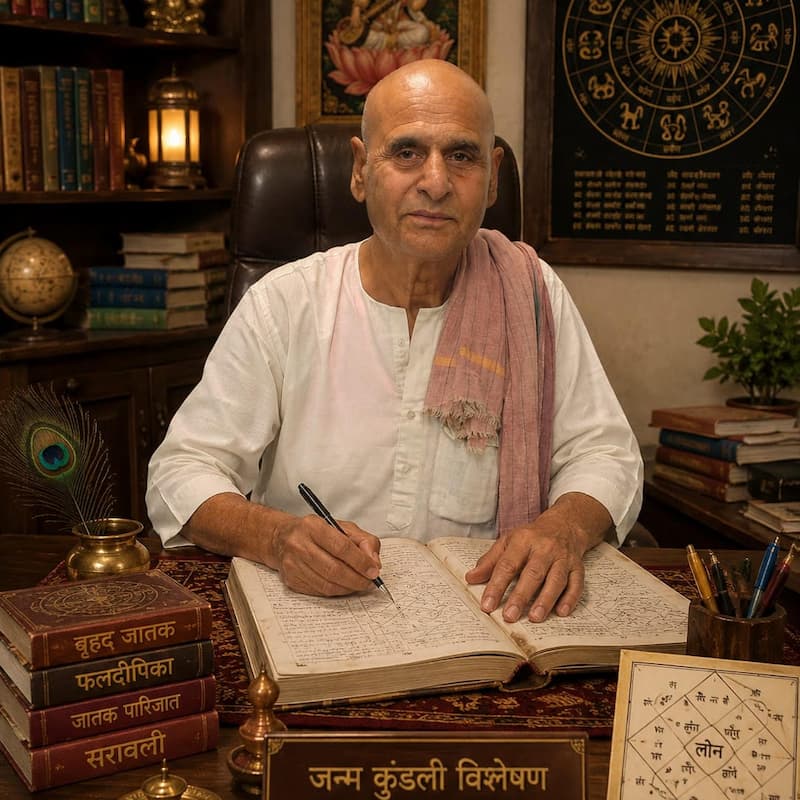
Narendra Kumar Chaubey is a Jyotisha Acharya with over 30 years of experience, based in Bihar and serving clients across India in Vedic astrology, mantra shastra, Vastu and ritual practice.
He completed his formal training at Kameshwar Singh Darbhanga Sanskrit University (KSDSU), one of India’s oldest and most respected institutions for Vedic and Sanskrit scholarship, where he studied Jyotisha shastra, mantra vidya and related classical sciences. KSDSU’s tradition of rigorous Sanskrit education tracing directly to the Mithila region’s centuries-old pandit lineage forms the foundation of his practice.
Over three decades, Narendra Kumar Chaubey has worked with thousands of individuals and families across Bihar and across India, offering guidance in:
- Kundli (birth chart) analysis: Identifying karmic patterns, planetary periods and life path guidance through classical Jyotisha
- Palmistry (Hasta Samudrika): Reading the hand according to the classical Samudrika Shastra tradition
- Vastu Shastra: Assessment and correction of living and working spaces according to directional and elemental principles
- Mantra and Pooja vidhi: Performing and guiding all categories of puja, havan, and mantra sadhana for personal, family and business situations
- Predictive Jyotisha: Transit analysis, muhurta (auspicious timing) selection and remedial guidance
He works across four languages Sanskrit, Hindi, English and Bhojpuri making classical knowledge accessible to practitioners across educational backgrounds and regions.
His writing for ABMantra brings the precision of classical Vedic training to practical mantra guidance: not general advice but specific prescriptions grounded in shastra, lineage and 30 years of direct practice with real situations.
For more info follow on: