
Quick Answer
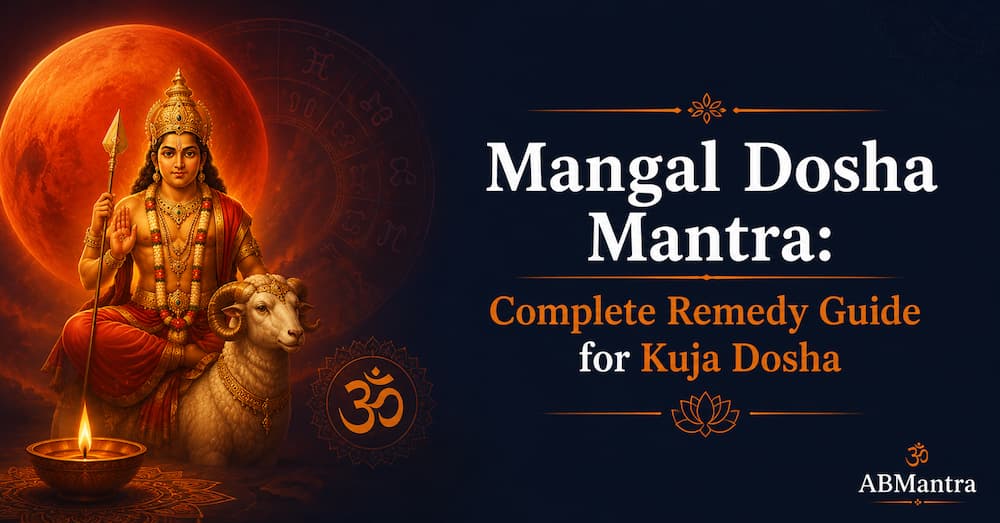
The primary mantra for Mangal Dosha remedy is the Mangal Beej Mantra:
Om Kraam Kreem Kraum Sah Bhaumaya Namah
ॐ क्रां क्रीं क्रौं सः भौमाय नमः
Meaning: Om. Through the three beej sounds of Mars (Kraam Kreem Kraum) I salute Bhauma : the son of Earth (Mars).
Method: 108 times every Tuesday. Red flowers, sesame seeds, ghee lamp. Face south (Mars’s direction). Continue for 40 consecutive Tuesdays minimum for established Mangal Dosha.
Also chant daily: Om Angarakaya Namah (108 times) : the simpler daily form of the Mars mantra for general Mangal Dosha pacification.
Who This Article Is For
This article is for you if: your Jyotisha practitioner has confirmed Mangal Dosha in your birth chart | you are facing marriage delay and want to know if the Mars mantra applies to your situation | you want to know exactly which houses create Mangal Dosha and which do not | you are already married and experience persistent marital conflict that your astrologer attributes to Mangal Dosha.
Important note: Mangal Dosha is one of the most misunderstood concepts in Vedic astrology. Not everyone told they are “Manglik” actually has a significant Mangal Dosha. This article explains how to assess severity and which remedy applies to which level.
Of all the astrological conditions that create anxiety for families and marriage-seeking individuals in India, Mangal Dosha is the most feared and the most misunderstood. Every year, thousands of families reject marriage proposals based on a Mangal Dosha diagnosis that may not even be valid in the classical texts, or that is present in such a mild form as to require no significant remedy. This article gives you the classical understanding of which Mars placements actually constitute Mangal Dosha, the severity levels, and the specific mantras for each.
Here is what most Mangal Dosha articles miss: the classical Vedic texts do not agree on which houses create Mangal Dosha. The 6-house version (1st, 2nd, 4th, 7th, 8th and 12th) is the most common modern version, but the original classical texts (Brihat Parasara Hora Shastra) list 5 houses (1st, 4th, 7th, 8th and 12th : the 2nd house was added later in the Puranic tradition). The 7th and 8th house placements are the most serious. The 1st and 4th house placements are the mildest and often self-correcting by the time the native reaches marriage age. This hierarchy of severity is what determines which mantra you need and for how long.
Which Mars Placements Create Mangal Dosha
| Mars house | Dosha level | Primary effect | Mantra intensity |
|---|---|---|---|
| 7th house | Most severe | Direct opposition between Mars and the marriage house. Most likely to cause conflict in marriage itself. | Full 40-Tuesday Beej Mantra sadhana + Katyayani Mantra for marriage |
| 8th house | Very severe | Mars in the house of longevity : traditionally associated with danger to spouse’s health or longevity. | Full 40-Tuesday sadhana + Hanuman Chalisa daily + Kumbh Vivah if marriage planned |
| 1st house | Moderate | Mars in the ascendant : the person carries Martian energy strongly, can be aggressive or conflict-prone. | Tuesday Beej Mantra 108 times. Hanuman Chalisa twice weekly. |
| 4th house | Mild to moderate | Mars affecting the home environment : domestic conflicts, difficulty in settled home life. | Tuesday Beej Mantra 108 times. Saturday Hanuman Chalisa. |
| 12th house | Mild | Mars in the house of losses : expenditure, isolation, possible conflict around sexuality or intimacy. | Tuesday Beej Mantra 108 times. |
| 2nd house | Disputed | Not in the original BPHS list. Added later in the Puranic tradition. Most classical astrologers consider this the mildest form and often do not prescribe the full dosha remedy. | Tuesday Mantra as a precaution. Assess with a qualified Jyotisha. |
Cancellation Conditions: When Mangal Dosha Does Not Apply
The classical texts also specify conditions under which Mangal Dosha is cancelled (Dosha Nashana) even when Mars is in one of the above houses. This is the information most modern interpretations ignore entirely:
- Mutual Mangal Dosha: When both partners have Mars in the same houses, the doshas cancel each other. This is the basis of the traditional rule that two Mangliks can marry each other without issue.
- Mars in its own sign or exaltation: Mars in Aries or Scorpio (own signs) or Capricorn (exaltation) in the 7th or 8th house reduces the dosha significantly.
- Mars aspected by Jupiter: Jupiter’s aspect on Mars in any of the above houses neutralises much of the Mangal Dosha effect. Jupiter is the natural mitigator of Mars’s aggression.
- Age cancellation: Many classical texts state that Mangal Dosha loses most of its force after the native reaches 28 years of age. Mars’s aggressive immaturity is considered to mature with time.
- Navamsa cancellation: If Mars is well-placed in the Navamsa (the 9th divisional chart used specifically for marriage analysis), the Rasi-chart Mangal Dosha is significantly mitigated.
Always have your chart assessed by a qualified Jyotisha before concluding you have significant Mangal Dosha. Many people labelled as Manglik have one or more of these cancellation conditions present.
The Mangal Beej Mantra: Complete Guide
Mangal Beej Mantra : The Primary Remedy Mantra
Sanskrit: Om Kraam Kreem Kraum Sah Bhaumaya Namah
Devanagari: ॐ क्रां क्रीं क्रौं सः भौमाय नमः
Word by word:
Om: primordial invocation
Kraam Kreem Kraum: the three Mars beej sounds corresponding to the three states of Mars energy (creation, sustaining, dissolving)
Sah: so it is (affirmative seal)
Bhaumaya: to Bhauma : son of Earth (Bhoomi Putra), the Vedic name of Mars
Namah: I bow, I surrender
Tuesday practice: 108 times. Red flowers (red hibiscus or any red flower). Sesame (til) seeds offered to a ghee lamp. Face south. Begin the first Tuesday after the Beej Mantra is confirmed with a qualified Jyotisha.
Duration: 40 consecutive Tuesdays for 7th or 8th house Mangal Dosha. 21 consecutive Tuesdays for 1st, 4th or 12th house.
The Three Mangal Dosha Mantras and When to Use Each
| Mantra | Sanskrit | Use when | Day and count |
|---|---|---|---|
| Mangal Beej Mantra | Om Kraam Kreem Kraum Sah Bhaumaya Namah | Confirmed Mangal Dosha in 7th or 8th house. The primary astrological remedy. | 108 times every Tuesday |
| Om Angarakaya Namah | ॐ अंगारकाय नमः | Daily maintenance practice once the Beej Mantra sadhana is established. Also for mild Mangal Dosha in 1st, 4th or 12th house. | 108 times daily or 27 times if time is limited |
| Mangal Gayatri | Om Kshitiputraya Vidmahe Lohitangaya Dhimahi Tanno Bhoumah Prachodayat | For astrological strengthening of Mars where it is weak or needs balancing (as opposed to pacification of strong malefic Mars). Consult a Jyotisha before using this form. | 108 times on Tuesdays |
Complete Tuesday Practice for Mangal Dosha
What You Need
- Red flowers : red hibiscus is traditional for Mars worship
- Sesame seeds (til) : Mars’s grain offering
- Ghee lamp or sesame oil lamp
- Red cloth for the altar
- Red coral mala (most auspicious for Mars mantras) or any mala of 108 beads
- Image of Lord Hanuman : Hanuman is the deity who governs and pacifies Mars energy
The Practice
- Tuesday morning, ideally before sunrise or in the early morning hours.
- Bathe. Sit facing south on a red cloth.
- Light the ghee lamp. Offer red flowers and sesame seeds.
- Begin with the Hanuman Chalisa once : Hanuman pacifies Mars’s aggressive energy before the Mars mantra is chanted.
- Chant the Mangal Beej Mantra 108 times: Om Kraam Kreem Kraum Sah Bhaumaya Namah.
- Close with Om Angarakaya Namah 11 times.
- Donate something red on Tuesday : lentils (masoor dal), red cloth or jaggery to someone in need. The donation is the completing act of the Mars remedy. The mantra without the Tuesday donation is incomplete in the classical tradition.
Hanuman Chalisa as the Core Mangal Dosha Remedy
Multiple classical sources confirm that daily Hanuman Chalisa recitation is the most important remedy for Mangal Dosha : more important than the Beej Mantra and significantly more broadly recommended in the tradition. Hanuman is the deity who governs Mars (both are associated with the colour red, with strength, courage and Tuesday). The Hanuman Chalisa is Mars energy expressed in its highest form: strength in service of dharma. Chanting it daily redirects the Manglik native’s Mars energy from conflict and aggression toward purposeful strength.
The complete Mangal Dosha remedy in order of importance: (1) Daily Hanuman Chalisa, (2) Tuesday Beej Mantra 108 times, (3) Tuesday donation of red items. This combination addresses all three dimensions of the dosha: energy, planetary influence and karma.
From Our Practice
From Our Practice
In my Jyotisha practice I have assessed hundreds of Mangal Dosha cases. The first thing I tell every client who comes to me after being told they are Manglik is this: let me see the full chart before we discuss remedy.
The reason is straightforward. In my experience, approximately 40 to 50 percent of people told they have Mangal Dosha either do not have it in its classical form or have it with one or more cancellation conditions that significantly reduce its severity. The anxiety that comes with the Manglik label often exceeds the actual astrological problem.
For those who do have genuine, significant Mangal Dosha : particularly the 7th or 8th house placement : the remedy I have seen produce the most consistent results is not the Beej Mantra alone. It is the combination: daily Hanuman Chalisa plus Tuesday Beej Mantra 108 times plus Tuesday donation. The three practices address the three levels at which Mars operates: the psychological (daily Chalisa calms the aggressive Mars temperament), the planetary (Tuesday Beej Mantra pacifies the astrological Mars placement) and the karmic (Tuesday donation creates the energetic opposite of Mars conflict by actively giving).
Clients who maintain this three-part combination consistently for 40 Tuesdays report measurable improvement in the marital atmosphere : either a softening of existing conflict or, for unmarried Mangliks, the appearance of suitable proposals that had previously not been arriving.
Frequently Asked Questions
❓ I have been told I am Manglik. Do I absolutely have to marry another Manglik?
No. This is one of the most common Mangal Dosha myths. Marrying another Manglik is one traditional remedy, not the only one. The Kumbh Vivah ritual (marriage to a tree or Vishnu idol before the human marriage) is the classical ritual remedy that neutralises the dosha without requiring the partner to also be Manglik. The Beej Mantra sadhana combined with Hanuman Chalisa daily is the mantra-based equivalent. Consult a qualified Jyotisha to assess your specific chart and determine which remedy is most appropriate for your level of Mangal Dosha.
❓ My astrologer says I have Mangal Dosha but I am 32 years old and unmarried. Is the dosha still active?
Many classical texts state that Mangal Dosha loses most of its force after age 28. In Vedic astrology, age-based cancellations are recognised in multiple classical sources including Parasara’s tradition. At 32, the 1st, 4th and 12th house Mangal Doshas are generally considered substantially reduced. The 7th and 8th house Mangliks retain more residual dosha past age 28 but even this is significantly reduced. Continue the Tuesday Beej Mantra practice and daily Hanuman Chalisa : not because the dosha is fully active but because the practice continues to pacify Mars energy and remove any residual karmic pattern.
❓ I am already married and my spouse and I have constant conflict. My astrologer now says my Mangal Dosha is the cause. What do I do?
Begin the Hanuman Chalisa daily immediately. This is the first and most important step. Then add the Tuesday Beej Mantra 108 times. For marital conflict that is ongoing, the Katyayani Mantra on Fridays is also strongly recommended : Katyayani specifically addresses obstacles and conflict in existing partnerships, not just delay in finding a partner. The combination of daily Hanuman Chalisa, Tuesday Beej Mantra and Friday Katyayani addresses the Mars energy at its three principal levels. Alongside the mantra practice, both partners working with a qualified counsellor is strongly recommended : the mantra addresses the astrological dimension; the counselling addresses the interpersonal patterns.
❓ How do I know if my Mangal Dosha has a cancellation condition?
You cannot assess this yourself without a full birth chart analysis by a qualified Jyotisha. The cancellation conditions : mutual Mangal Dosha, Mars in own or exalted sign, Jupiter’s aspect on Mars, age cancellation, Navamsa cancellation : require looking at multiple dimensions of the chart simultaneously. The Rasi chart alone, which is all that most online calculators assess, is insufficient for a proper Mangal Dosha evaluation. Get a complete chart analysis from a Jyotisha practitioner who is familiar with all classical cancellation conditions before concluding that you have a significant dosha requiring full remedy.
❓ Can women chant the Mangal Beej Mantra or is it only for men?
Women chant the Mangal Beej Mantra equally effectively. Mangal Dosha affects women and men equally in the Vedic astrological tradition. The Tuesday practice, the donation and the daily Hanuman Chalisa are all open to women without restriction. There is no gender difference in the remedy.
❓ What is the Kumbh Vivah and is it necessary?
Kumbh Vivah is a ritual in which the Manglik individual is first married to a sacred tree (typically Peepal or Banana) or to an idol of Lord Vishnu before proceeding with the human marriage. The tradition holds that this ritual marriage absorbs and neutralises the Mangal Dosha’s effect on the subsequent human marriage. It is one of the classical remedies, not a requirement. Many families with Manglik children perform the Kumbh Vivah alongside the mantra practice as a belt-and-braces approach. However, consistent mantra practice (Beej Mantra + Hanuman Chalisa) over 40 Tuesdays is itself the complete mantra-based equivalent of the Kumbh Vivah remedy.
Begin This Tuesday
The next Tuesday is your starting point. Obtain red flowers and sesame seeds. Sit facing south in the early morning. Chant the Hanuman Chalisa once. Then chant Om Kraam Kreem Kraum Sah Bhaumaya Namah 108 times. Donate something red before the day ends.
Return the following Tuesday. And every Tuesday after that for 40 weeks.
Mars is the planet of energy, courage and decisive action. The Mangal Dosha remedy is not about suppressing Mars : it is about redirecting his energy from conflict and aggression toward purposeful strength. The Hanuman Chalisa is the most direct expression of this: strength in total service of dharma. Chant it daily and watch how the quality of your Mars energy begins to shift.
Sources
- Mangal Dosha: Remedies and Effects. Puja Home, May 2024. 6 houses that cause Mangal Dosha; specific pujas and mantras; Mars Mangal Mantra Siddhi Japa
- Remedies for Mangal Dosha: Effective Solutions for Marriage. AstroSight, April 2026. Hanuman Chalisa as primary remedy; Brihat Parashara Hora Shastra classical source; Tuesday fasting and donation
- Mangal Dosh Puja: Remedies and Rituals. Jyotish Gher, July 2025. Om Kraam Kreem Kraum Sah Bhaumaya Namah text; 108 times daily or Tuesday practice; red flowers and sesame offering
- Kuja Dosha Remedies. Dixit Hinc, October 2024. Mangal Gayatri Sanskrit text; Puranokt Mangal mantra; full Kuja mantra list with Gayatri form
Narendra Kumar Chaubey is a Jyotisha Acharya with over 30 years of experience, based in Bihar and serving clients across India in Vedic astrology, mantra shastra, Vastu and ritual practice.
He completed his formal training at Kameshwar Singh Darbhanga Sanskrit University (KSDSU), one of India’s oldest and most respected institutions for Vedic and Sanskrit scholarship, where he studied Jyotisha shastra, mantra vidya and related classical sciences. KSDSU’s tradition of rigorous Sanskrit education tracing directly to the Mithila region’s centuries-old pandit lineage forms the foundation of his practice.
Over three decades, Narendra Kumar Chaubey has worked with thousands of individuals and families across Bihar and across India, offering guidance in:
- Kundli (birth chart) analysis: Identifying karmic patterns, planetary periods and life path guidance through classical Jyotisha
- Palmistry (Hasta Samudrika): Reading the hand according to the classical Samudrika Shastra tradition
- Vastu Shastra: Assessment and correction of living and working spaces according to directional and elemental principles
- Mantra and Pooja vidhi: Performing and guiding all categories of puja, havan, and mantra sadhana for personal, family and business situations
- Predictive Jyotisha: Transit analysis, muhurta (auspicious timing) selection and remedial guidance
He works across four languages Sanskrit, Hindi, English and Bhojpuri making classical knowledge accessible to practitioners across educational backgrounds and regions.
His writing for ABMantra brings the precision of classical Vedic training to practical mantra guidance: not general advice but specific prescriptions grounded in shastra, lineage and 30 years of direct practice with real situations.
For more info follow on: