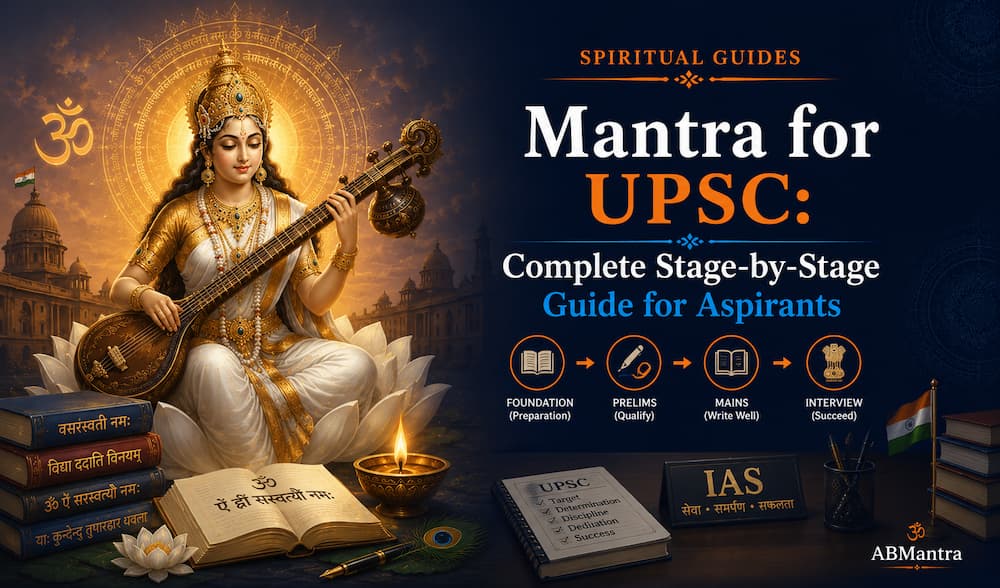

Quick Answer
The three primary mantras for UPSC preparation:
For government service authority and Jupiter’s blessings (most directly UPSC-specific):
Om Brim Brihaspataye Namah (Jupiter governs dharmic authority, wisdom and government service)
For Mains expression and essay writing:
Saraswati Gayatri : Om Vageeshwaryai Vidmahe Vagwadeenyai Dhimahi Tannah Saraswati Prachodayat
For Prelims retention and recall of enormous syllabus:
Hayagriva Mantra : Om Hayagrivaya Namah (chant before every study session)
Daily foundation practice: Gayatri Mantra 108 times at Brahma Muhurta : non-negotiable for any UPSC aspirant. Begin on your first day of preparation and do not stop until you receive your posting.
Who This Article Is For
This article is for you if: you are preparing for the UPSC Civil Services Examination (IAS, IPS, IFS, IRS) | you want a stage-specific mantra practice matched to Prelims, Mains and Interview | you have been preparing for 2 or more years and want to understand whether your birth chart has specific planetary support or obstruction for government service | you have cleared Prelims but struggle with Mains expression and answer writing.
Honest note: UPSC is a 1 to 4 year journey with a 0.1 to 0.2 percent selection rate. Mantras do not substitute for this preparation. What they do is address the specific psychological and astrological dimensions of a long-duration high-stakes competitive process that no amount of studying alone can fully address.
UPSC is different from every other examination in India. It tests memory (Prelims general studies), analytical reasoning and written expression (Mains), and personality under pressure (Interview) : three completely different cognitive skills across three stages that play out over 12 to 18 months after the initial preparation period of 1 to 3 years. Most students who fail UPSC are not underprepared in knowledge. They are underprepared in one of the following: retention under syllabus volume, expression under writing pressure, or composed presence under interview conditions.
Here is what no other mantra for UPSC article tells you: the most important mantra for UPSC is not the Saraswati Mantra. It is the Jupiter Mantra. Jupiter (Brihaspati/Guru) is the planetary karaka (significator) of government service, dharmic authority, wisdom in leadership and the capacity to serve the public good. An afflicted or weak Jupiter in the birth chart directly correlates with difficulty entering government service regardless of preparation. Before beginning any mantra practice for UPSC, have your Jupiter assessed in your birth chart. If Jupiter is strong, your path is supported astrologically. If Jupiter is weak or afflicted, the Jupiter mantra is your primary remedy and must precede all other practices.
Why Jupiter Is the Primary UPSC Deity
| Planet | What it governs in UPSC context | Mantra | Day |
|---|---|---|---|
| Jupiter (Guru/Brihaspati) | Government service, dharmic authority, wisdom in public life, the capacity to lead with justice. Strong Jupiter is the primary astrological indicator of success in competitive government examinations. | Om Brim Brihaspataye Namah | Thursday |
| Mercury (Buddhi) | Intelligence, analytical reasoning, speed in Prelims, accuracy in multiple-choice, quality of Mains answer writing. UPSC Prelims tests Mercury-type intelligence: fast, accurate, fact-based. | Om Bum Budhaya Namah | Wednesday |
| Sun (Surya) | Authority, leadership, the state and its representatives, confidence in the Interview. The Sun governs one’s relationship with authority figures : directly relevant to the UPSC Interview where the candidate faces senior IAS officers. | Om Hraam Hreem Hraum Sah Suryaya Namah | Sunday |
| Saturn (Shani) | Discipline, sustained effort over years, the capacity to continue without immediate reward. UPSC preparation is fundamentally a Saturnine endeavour: years of sustained effort, delayed gratification, systematic work. A strong Saturn helps. A weak Saturn makes the multi-year preparation period psychologically unsustainable. | Om Sham Shanicharaya Namah | Saturday |
The Complete Stage-by-Stage Mantra Practice
Foundation Practice: Daily for the Entire Preparation Period
Daily Non-Negotiable Practice
Brahma Muhurta (before sunrise every day):
Gayatri Mantra 108 times
This is not optional. The Gayatri Mantra at Brahma Muhurta is the foundational practice of all Vedic learning. It develops all the intellectual faculties that UPSC tests : memory, reasoning, expression : through sustained daily practice. The effect is cumulative. 3 months of daily Brahma Muhurta Gayatri practice produces a measurable shift in the quality of the study experience. One year of daily practice produces a transformation in intellectual capacity that is genuinely difficult to explain by any factor other than the practice itself.
Begin this on Day 1 of preparation. Do not stop until you receive your posting order. Not for Prelims. Not for Mains. For the entire journey, however long it takes.
Stage 1: Prelims Preparation
The Prelims tests breadth of factual knowledge across a massive syllabus and speed of recall under MCQ conditions. The primary challenge is retention of enormous volume. Hayagriva is the deity for this.
Prelims Mantra Protocol
Before each study session: Hayagriva Mantra : Om Hayagrivaya Namah : 21 times
Weekly: Jupiter Mantra : Om Brim Brihaspataye Namah : 108 times on Thursday
Weekly: Mercury Mantra : Om Bum Budhaya Namah : 108 times on Wednesday
Why Mercury on Wednesdays: UPSC Prelims Paper 1 tests general studies across 100 questions in 120 minutes : one question every 72 seconds. Mercury governs speed, accuracy and the ability to discriminate between closely similar options. Strengthening Mercury specifically addresses the time-pressure dimension of Prelims that preparation alone cannot fully address.
Stage 2: Mains Preparation
The Mains tests depth of understanding and the capacity to express complex analysis clearly in writing under time pressure. Nine papers over multiple days. The challenge is no longer retention : it is expression, structure and the capacity to produce quality written output under extreme time pressure.
Mains Mantra Protocol
Daily: Saraswati Gayatri : Om Vageeshwaryai Vidmahe Vagwadeenyai Dhimahi Tannah Saraswati Prachodayat : 108 times. Add this to the Gayatri Mantra foundation practice.
Before every answer writing session: Saraswati Vandana once : Saraswati Namastubhyam Varade Kamarupini Vidyarambham Karishyami Siddhir Bhavatu Me Sada
Weekly: Jupiter Mantra 108 times on Thursday.
Why Saraswati Gayatri for Mains specifically: Vageeshwari means sovereignty over speech and its organisation. Mains is fundamentally a test of organised expression : can you structure what you know into a coherent, progressive answer in 7 to 12 minutes? Vageeshwari is the deity for exactly this capacity. The tradition describes her as the one who reveals language and organisation of thought. In the Mains context this means: answers that flow, arguments that progress logically, conclusions that feel inevitable rather than tacked on.
Stage 3: Interview Preparation
The UPSC Personality Test (Interview) is the most psychologically demanding stage. The candidate faces a board of senior IAS officers for 30 to 45 minutes. The questions range from personal background to current affairs to philosophical positions. The assessors are evaluating not just knowledge but personality : the quality of presence, composure, leadership potential, and authenticity.
Interview Mantra Protocol
40 days before the Interview:
Surya Mantra : Om Hraam Hreem Hraum Sah Suryaya Namah : 108 times every morning, facing the rising sun
Night before the Interview:
Saraswati Vandana 108 times. Then silence. Do not review notes after 9 PM.
Morning of the Interview:
Surya Mantra 11 times at sunrise, facing east.
Ganesha Mantra 11 times: Om Gam Ganapataye Namah
Before entering the Interview room:
Saraswati Vandana once, silently.
Why Surya for the Interview: The Sun governs confidence, presence and the capacity to function with composure before authority figures. The Interview board are authority figures in the exact sense that Surya governs. Chanting the Surya Mantra for 40 days before the Interview specifically addresses the psychological dimension of facing a senior government panel with composure rather than anxiety.
The Weekly UPSC Mantra Schedule
| Day | Mantra | Count | Purpose |
|---|---|---|---|
| Daily | Gayatri Mantra at Brahma Muhurta | 108 | Foundation : develops all intellectual faculties over time |
| Before each session | Hayagriva (Prelims) or Saraswati Vandana (Mains) | 21 or once | Stage-specific activation |
| Wednesday | Mercury Mantra : Om Bum Budhaya Namah | 108 | Intelligence, analytical speed, Prelims accuracy |
| Thursday | Jupiter Mantra : Om Brim Brihaspataye Namah | 108 | Government service karaka : the primary UPSC planetary mantra |
| Saturday | Saturn Mantra : Om Sham Shanicharaya Namah | 108 | Sustained discipline and consistent effort across the long preparation period |
| Sunday | Surya Mantra (especially 40 days before Interview) | 108 | Authority, leadership presence, confidence before senior officials |
The Astrological Check: Is Government Service in Your Chart?
In Vedic astrology, the 10th house governs career, the 6th house governs competitive examinations, and Jupiter governs dharmic authority and government service. When a qualified Jyotisha practitioner examines a UPSC aspirant’s chart, they look at: the strength of Jupiter, the 10th house lord and its placement, any planets influencing the 6th house, and the current Dasha (planetary period) and whether it supports competitive examination success.
If your chart shows a debilitated or afflicted Jupiter, or if your current Dasha period is of a planet hostile to Jupiter, the traditional prescription is the Jupiter mantra as the primary daily practice alongside the academic preparation. 108 repetitions every Thursday for a minimum of one complete Jupiter transit (approximately 12 months).
This is not fatalism. The tradition does not say a weak Jupiter prevents government service. It says a weak Jupiter requires more sustained mantra work to overcome the astrological obstruction. The preparation effort remains the same. The mantra addresses what the preparation cannot.
For Repeated UPSC Attempters
If you have cleared Prelims multiple times but not made it through Mains, or cleared Mains multiple times but not cleared the Interview, the pattern is diagnostic. Each stage tests a different set of capacities and a different set of planetary faculties.
| Failure pattern | Likely astrological cause | Specific addition to practice |
|---|---|---|
| Cannot clear Prelims despite extensive preparation | Mercury affliction : difficulty with speed and discrimination under MCQ pressure | Mercury mantra Wednesday + Mercury Havan on Vijaya Dashami |
| Clears Prelims repeatedly but Mains marks are insufficient | Jupiter or Saraswati : inability to express what is known in organised writing | Saraswati Gayatri daily + daily answer writing practice (both needed simultaneously) |
| Clears Mains but falls at Interview stage | Sun affliction : difficulty with composure and confidence before authority | Surya mantra 40 days before Interview + Aditya Hridayam recitation daily |
| Keeps falling short across all stages despite years of effort | Saturn or Rahu : sustained blockage of effort from producing result | Shani puja Saturday + Rahu mantra Wednesday + consult qualified Jyotisha for chart analysis |
From Our Practice
From Our Practice
I have worked with UPSC aspirants in my Jyotisha practice for many years. The pattern I observe most consistently is this: the candidates who fail despite strong preparation are almost never failing because of insufficient knowledge. They are failing because of one specific mismatch between their preparation and the examination’s demands.
An aspirant consulted me after his fourth attempt. He had cleared Prelims four times. He had cleared Mains once. He had not cleared the Interview. His chart showed the Sun placed in the 12th house : the house of dissolution and hidden things. In this position, the Sun makes a person internally strong but unable to project that strength in public or formal settings. The Interview board was seeing someone who looked uncertain, even though internally the candidate was very clear. The mismatch between internal competence and external projection was the specific problem.
I prescribed the Surya Mantra 108 times daily for 40 days before the next Interview, combined with the Aditya Hridayam recitation each morning. I also worked with him on the specific breathing practice that precedes the Surya Mantra in the traditional sequence.
On his fifth attempt, he cleared the Interview. His mark was in the top quarter of that year’s Interview scores. He told me afterwards that inside the Interview room he felt different from all his previous attempts: settled, present and not performing. That quality of settledness is what the Surya Mantra specifically develops for this type of 12th-house Sun placement. The practice did not make him more knowledgeable. It made his existing knowledge and character visible.
Frequently Asked Questions
❓ I am on my third UPSC attempt. Which mantra should I start with today?
Begin the Jupiter Mantra (Om Brim Brihaspataye Namah) today : 108 times. Jupiter is the primary karaka of government service and repeated attempts despite preparation often indicate a Jupiter affliction. Also begin the Gayatri Mantra at Brahma Muhurta if you have not already. These two together are the foundation. Then identify which stage is your bottleneck : Prelims, Mains or Interview : and add the specific stage mantra from this guide.
❓ I cleared Prelims but my Mains answer writing quality is poor. I know the content but cannot structure it. Which mantra specifically?
This is a Saraswati Vageeshwari problem. The capacity to organise knowledge into structured progressive writing is governed by Vageeshwari : Saraswati as the queen of organised speech. Chant the Saraswati Gayatri Mantra (Om Vageeshwaryai Vidmahe Vagwadeenyai Dhimahi Tannah Saraswati Prachodayat) 108 times daily. Also chant the Saraswati Vandana once before every answer writing practice session. The mantra will not substitute for daily answer writing practice : you need both simultaneously. The mantra addresses what practice alone cannot fix: the psychological block that produces the gap between what you know and what appears on the page.
❓ Is the Gayatri Mantra enough for UPSC or do I need all the planetary mantras too?
The Gayatri Mantra at Brahma Muhurta is the non-negotiable foundation. For many aspirants with strong astrological charts, the Gayatri alone alongside diligent preparation is sufficient. The planetary mantras (Jupiter, Mercury, Sun, Saturn) address specific weaknesses that the Gayatri does not target precisely enough on its own. If your preparation is strong and your chart is well-placed for government service, the Gayatri is enough. If you are a multi-attempt candidate with unexplained failure patterns, the planetary mantras target the specific obstruction that Gayatri alone has not resolved.
❓ I am a female UPSC aspirant. Are there any restrictions on these mantras for women?
No. All mantras in this guide : Gayatri, Saraswati, Jupiter, Mercury, Sun, Saturn, Hayagriva : can be chanted by women without restriction. The Gayatri Mantra’s personal japa is open to all regardless of gender. The planetary mantras have no gender restriction. The Saraswati mantras have no gender restriction. Female civil services aspirants chant all of these. The tradition is clear: the grace of the deity and the remedial effect of the mantra are available to any sincere practitioner.
❓ How early should I begin the mantra practice before my UPSC attempt?
Begin the Gayatri Mantra at Brahma Muhurta on the first day of your preparation : which ideally is 18 to 24 months before your planned Prelims attempt. The Gayatri builds cumulative intellectual effect. Its strongest impact is seen at the 6 to 12 month mark, not in the first few weeks. Begin it immediately. Add the Jupiter and Mercury mantras on their respective days from the beginning. The Saraswati Gayatri is most valuable during the Mains preparation phase. The Surya Mantra’s 40-day protocol begins 40 days before the Interview. But the Gayatri foundation : begin it today, regardless of how far away the exam is.
❓ Can I chant while studying or does it have to be a separate sitting?
Brahma Muhurta practice is a separate sitting : no studying simultaneously. The morning mantra session is its own dedicated time. The Saraswati Vandana (before each study session) and the Hayagriva Mantra (21 times before each study block) are chanted immediately before study begins but not during it. During study breaks, the Aim beej (Om Aim) can be chanted silently while resting : this is the only mantra appropriate for simultaneous or break-time use. Manasik japa (silent mental chanting) of any mantra while commuting or doing physical activity is valid at any time.
Begin the Jupiter Practice This Thursday
The next Thursday is your starting point. 108 repetitions of Om Brim Brihaspataye Namah. This is the mantra that directly addresses the planetary karaka of the goal you are working toward.
Every morning before that: 108 Gayatri Mantras at Brahma Muhurta. Every Wednesday: Mercury Mantra 108 times. Every Saturday: Saturn Mantra 108 times for the discipline this preparation demands.
UPSC preparation is measured in years. The mantra practice should match that timeline. Begin it as a permanent daily practice, not as a pre-exam ritual. The Gayatri you begin today will produce its deepest effects 6 to 12 months from now. The aspirant who begins it with the examination 18 months away will chant it 540 times before the exam. That is a different level of preparation from the aspirant who begins it 3 weeks before.
Begin today. The examination will come when it comes. The practice, begun today, will be there waiting for it.
Sources
- Maa Saraswati Mantra for Success in Education and Exams. Lal Kitab Upay, January 2018. Saraswati Beej Mantra, Vidyarambham mantra for students before exams; Om Aim Hreem Kleem Maha Saraswati form
- Top 7 Exam Mantras for Success: Powerful Saraswati Mantras. Aniruddhacharya, July 2024. Saraswati Gayatri activates Ajna chakra; reduces anxiety and improves memory; Brahma Muhurta timing
- Best Mantras for Exams and Success. Mahakatha, March 2026. Ganesha and Saraswati roles, 40-day recommendation for major exams; manasik japa while commuting
- 10 Powerful Saraswati Mantras for Acquiring Knowledge. The Power of Mantra, January 2019. Saraswati Vandana for beginning study; Om Aim Hreem Kleem form; mantra for speech and confidence
Also Read on ABMantra
Narendra Kumar Chaubey is a Jyotisha Acharya with over 30 years of experience, based in Bihar and serving clients across India in Vedic astrology, mantra shastra, Vastu and ritual practice.
He completed his formal training at Kameshwar Singh Darbhanga Sanskrit University (KSDSU), one of India’s oldest and most respected institutions for Vedic and Sanskrit scholarship, where he studied Jyotisha shastra, mantra vidya and related classical sciences. KSDSU’s tradition of rigorous Sanskrit education tracing directly to the Mithila region’s centuries-old pandit lineage forms the foundation of his practice.
Over three decades, Narendra Kumar Chaubey has worked with thousands of individuals and families across Bihar and across India, offering guidance in:
- Kundli (birth chart) analysis: Identifying karmic patterns, planetary periods and life path guidance through classical Jyotisha
- Palmistry (Hasta Samudrika): Reading the hand according to the classical Samudrika Shastra tradition
- Vastu Shastra: Assessment and correction of living and working spaces according to directional and elemental principles
- Mantra and Pooja vidhi: Performing and guiding all categories of puja, havan, and mantra sadhana for personal, family and business situations
- Predictive Jyotisha: Transit analysis, muhurta (auspicious timing) selection and remedial guidance
He works across four languages Sanskrit, Hindi, English and Bhojpuri making classical knowledge accessible to practitioners across educational backgrounds and regions.
His writing for ABMantra brings the precision of classical Vedic training to practical mantra guidance: not general advice but specific prescriptions grounded in shastra, lineage and 30 years of direct practice with real situations.
For more info follow on: