
Quick Answer
Three mantras for three moments before your exam:
Night before: Saraswati Gayatri Mantra 108 times : Om Vageeshwaryai Vidmahe Vagwadeenyai Dhimahi Tannah Saraswati Prachodayat
Morning of exam: Ganesha Mantra 11 times : Om Gam Ganapataye Namah (removes obstacles before the examination hall)
At the exam hall door, before entering: Saraswati Vandana once : Saraswati Namastubhyam Varade Kamarupini Vidyarambham Karishyami Siddhir Bhavatu Me Sada
The Saraswati Vandana is the specific mantra for the moment before beginning any academic task. Chant it once, with full attention, before picking up your pen.
Who This Article Is For
This article is for you if: you are preparing for a board exam, competitive exam (UPSC, JEE, NEET, SSC, CAT) or any significant assessment | you want to know exactly which mantra to chant at which moment and in what sequence | you want the complete 21-day or 40-day pre-exam mantra sadhana.
Important note from the tradition: The Saraswati mantra tradition is explicit on this point : chanting mantras without studying does not work. The mantra is a complement to preparation, not a substitute for it. One article in our research sources states this directly: “Chanting mantras and not studying never helps.” This is the honest position of the tradition.
Exam pressure affects even well-prepared students. The convergence of accumulated material, performance anxiety and the weight of outcome creates a mental state that can undermine preparation that is genuinely solid. The Vedic tradition has a specific understanding of this: the problem is not the lack of knowledge but the obscuration of knowledge already present : the mind’s inability to access what it has learned under the pressure of the examination environment.
Here is what most mantra before exam articles miss: they give you one mantra to chant and leave you to figure out when, how and for how long. The tradition is far more precise. Different mantras are prescribed for different moments in the examination process: the 21 days of preparation, the night before, the morning of the exam and the specific moment before entering the hall. Each moment requires a different mantra because each moment involves a different dimension of the challenge.
The Two Deities for Exam Success and Their Distinct Roles
| Deity | What they govern | When to invoke |
|---|---|---|
| Ganesha | Removal of obstacles. Beginning of new endeavours. Clearing the path before any important task. Ganesha does not give knowledge : he clears the obstacles that block the expression of what you already know. | Before any study session. Before the exam day begins. At the exam hall entrance. |
| Saraswati | Knowledge, memory, intelligence, clarity of expression, eloquence in writing. Saraswati does not give knowledge you do not have : she illuminates and makes accessible the knowledge you have already worked to acquire. | Daily during study period. Night before exam. At the moment before picking up the pen. |
The correct sequence is always Ganesha first, Saraswati second. Ganesha clears the path. Saraswati walks it. Beginning with Saraswati without invoking Ganesha first is like trying to use a road that has not been cleared.
The Five Mantras
Mantra 1: Saraswati Vandana : Chant Before Beginning Any Study or Exam
Saraswati Vandana : The Opening Prayer
Sanskrit:
Saraswati Namastubhyam Varade Kamarupini
Vidyarambham Karishyami Siddhir Bhavatu Me Sada
Devanagari:
सरस्वति नमस्तुभ्यं वरदे कामरूपिणि।
विद्यारम्भं करिष्यामि सिद्धिर्भवतु मे सदा॥
Meaning: O Saraswati, I bow to you, the giver of boons, the one who fulfills desires. I am about to begin my studies. May success be mine always.
Key phrase: Vidyarambham Karishyami : I am about to begin learning. This mantra is specifically prescribed for the moment of beginning: before opening a textbook, before starting an exam, before sitting down to write anything important. Chant it once with full attention at that specific moment. One sincere recitation is the traditional prescription.
Mantra 2: Saraswati Gayatri : The Daily Study Mantra
Saraswati Gayatri Mantra
Sanskrit:
Om Vageeshwaryai Vidmahe Vagwadeenyai Dhimahi
Tannah Saraswati Prachodayat
Devanagari:
ॐ वागीश्वर्यै विद्महे वाग्वादिन्यै धीमहि।
तन्नः सरस्वती प्रचोदयात्॥
Meaning: We know the queen of speech (Vageeshwari). We meditate on the one who speaks (Vagwadini). May that Saraswati illuminate our intellect.
Vageeshwari means sovereignty over speech : Saraswati’s mastery over Vak (speech and its expression). In the examination context, this means the ability to express clearly and precisely what you know. Many students fail not because they do not know the answer but because they cannot express it under pressure. This mantra specifically addresses that gap.
When: 108 times during Brahma Muhurta (before sunrise) daily during the 21 or 40 days of preparation. Also chant 108 times the night before the exam for the specific pre-exam protocol.
Mantra 3: Saraswati Beej Mantra : For Concentration During Study
Saraswati Beej Mantra
Sanskrit: Om Aim Saraswatyai Namah
Devanagari: ॐ ऐं सरस्वत्यै नमः
Meaning: Om. Aim (Saraswati’s beej : the seed sound of all knowledge and speech). Salutations to Saraswati.
Aim is the beej of Saraswati and by extension the beej of all learning, intelligence and articulate expression. Chanting this short mantra 21 times before each study session creates a focused mental state that makes the study period more productive. Unlike the full Gayatri which is a morning practice, the Beej Mantra can be chanted at any time of day as needed.
Commuting practice: The Saraswati Beej Mantra can be chanted silently (manasik japa) while commuting to school, college or the examination centre. This is a valid practice and produces the same concentration benefit as audible chanting.
Mantra 4: Ganesha Mantra : Before Every Study Session and Exam
Ganesha Mantra for Obstacles
Sanskrit: Om Gam Ganapataye Namah
Devanagari: ॐ गं गणपतये नमः
Meaning: Om. Gam (Ganesha’s beej). Salutations to Ganapati, the Lord of the Ganas.
Specific use for exam failure history: If you have failed a competitive exam multiple times despite preparation, the Ganesha Mantra is the primary mantra to begin with before adding Saraswati mantras. Repeated failure despite effort is a sign of obstacle energy (Vighna) in the chart or in the karmic pattern. Ganesha as Vighna Harta (obstacle remover) addresses this specifically.
When: 11 times before every study session. 21 times on the morning of the exam before leaving home. 3 times at the exam hall entrance.
Mantra 5: Gayatri Mantra : Long-Term Intellect Development
Gayatri Mantra for Students
Sanskrit:
Om Bhur Bhuvah Swah Tat Savitur Varenyam
Bhargo Devasya Dhimahi Dhiyo Yo Nah Prachodayat
Devanagari:
ॐ भूर्भुवः स्वः तत्सवितुर्वरेण्यम्।
भर्गो देवस्य धीमहि धियो यो नः प्रचोदयात्॥
Meaning: We meditate on the divine light of Savitr (the sun). May that divine light illuminate our intellect.
For students: The Gayatri Mantra is the long-term intellect development mantra. Its effect is not immediately felt before a single exam. Its effect builds over months and years of consistent Brahma Muhurta practice. Students who chant the Gayatri daily for one year report a genuine and measurable shift in the quality of their concentration and comprehension. For immediate pre-exam benefit, use the Saraswati Gayatri and Vandana above. For long-term academic development, the Gayatri Mantra is the foundation practice.
The Complete Pre-Exam Schedule
21 Days Before the Exam (Minimum Preparation Period)
| Time | Practice | Count |
|---|---|---|
| Brahma Muhurta (before sunrise) | Saraswati Gayatri Mantra | 108 times |
| Before each study session (any time) | Ganesha Mantra + Saraswati Vandana | 11 times Ganesha, then Vandana once |
| During study breaks or commuting | Saraswati Beej Mantra (Om Aim Saraswatyai Namah) silently | As many times as comfortable |
Night Before the Exam
- Complete your final revision by 9 PM.
- Sit quietly. Chant the Saraswati Gayatri Mantra 108 times.
- Close with the Saraswati Vandana once.
- Do not study after 10 PM. Sleep is more valuable at this point than any revision. The mantra has been given, the preparation has been done. Trust both.
Morning of the Exam
- Wake at the same time you have been waking during the preparation period. Do not disrupt your sleep pattern.
- Bathe. Sit for 10 minutes.
- Chant the Ganesha Mantra 21 times.
- Chant the Saraswati Vandana once.
- Eat a light breakfast. Leave with sufficient time to arrive calmly.
At the Examination Hall : The Most Important Moment
- At the entrance to the examination hall, before entering: stand for 10 seconds. Breathe once slowly.
- Chant the Saraswati Vandana once silently: Saraswati Namastubhyam Varade Kamarupini Vidyarambham Karishyami Siddhir Bhavatu Me Sada.
- Enter. Sit. When the paper is placed before you and before reading the first question: chant Om Aim Saraswatyai Namah three times silently.
- Begin.
The Blank Mind Problem: What Mantras Actually Address
Many students experience what the Hindu Mirror source calls “blank mind syndrome” : walking into the exam hall with thorough preparation and feeling the knowledge vanish under pressure. This is not a knowledge problem. It is an access problem: the stress response (fight-or-flight) narrows the mind’s available bandwidth and makes retrieval of stored information difficult.
The Saraswati Gayatri Mantra chanted in the Gayatri metre creates a specific rhythmic breathing pattern that physiologically activates the parasympathetic nervous system : the rest-and-digest state that is the opposite of the stress response. This is not mystical. It is the practical effect of rhythmic chanting at the specific cadence of the Gayatri metre. The mantra’s practical function in the exam context is to keep the mind in its receptive state rather than its defensive state.
From Our Practice
From Our Practice
I worked with a student some years ago who was preparing for his third attempt at a major civil services examination. He had cleared the Preliminary examination twice but had not made it through the Mains. His preparation was strong : his mock test scores were consistently in the range required. The problem was clearly not knowledge.
When I looked at his kundli, Mercury (Buddhi : the planet of intellect and expression) was in a weak position and under the aspect of Rahu, which creates a specific pattern of anxiety and mental agitation during high-pressure situations. The person knows but cannot access what they know when the pressure peaks.
I prescribed the Saraswati Gayatri at Brahma Muhurta daily for 40 days before the next attempt, the Ganesha Mantra before each study session, and specifically the Saraswati Vandana at the exam hall entrance. He also began the Mercury mantra (Om Bum Budhaya Namah) on Wednesdays to address the planetary weakness.
On his third Mains attempt, he cleared with a rank that placed him in his first-choice service. He told me afterwards that what had changed was not his preparation : his preparation had always been adequate. What changed was the quality of his mental state inside the examination hall. He could access what he knew. The blank mind problem did not occur.
That is what the Saraswati mantra practice does when done correctly. It does not add knowledge. It removes what was preventing the knowledge already there from being expressed.
Frequently Asked Questions
❓ My exam is tomorrow and I have not been chanting for 21 days. What do I do tonight?
Chant the Saraswati Gayatri Mantra 108 times tonight. Chant the Saraswati Vandana once after. Chant the Ganesha Mantra 21 times tomorrow morning. At the exam hall entrance chant the Vandana once silently. These four practices done sincerely in the time available will produce some benefit. The 21-day or 40-day sadhana produces a stronger effect because it builds cumulative resonance, but even one sincere session before an important moment is not wasted. Make sure you also sleep well tonight : sleep is at least as important as the mantra for exam performance.
❓ Which mantra is best for JEE or NEET specifically?
The Saraswati Gayatri Mantra is the correct primary mantra for any exam that tests analytical intelligence, scientific reasoning and problem-solving (JEE, NEET, CAT). For exams that test writing, general knowledge and expression (UPSC, SSC), the Saraswati Vandana is equally important. For JEE and NEET specifically, also add the Hayagriva Mantra (Om Hayagrivaya Namah) : Lord Hayagriva is the horse-headed avatar of Vishnu who governs scientific knowledge and memory retention, and is specifically worshipped by South Indian students before science examinations.
❓ Can I chant these mantras during periods?
Yes. Saraswati and Ganesha mantras have no menstruation restriction in any major tradition. The Gayatri Mantra’s formal Sandhyavandanam is traditionally paused during periods, but personal japa continues. If an exam falls during your cycle, the Saraswati Vandana at the exam hall entrance and the Beej Mantra silently during the exam are both valid practices without restriction.
❓ Is it disrespectful to chant a mantra silently inside the examination hall?
No. Manasik japa (mental chanting) is a recognised and valid form of mantra practice in all Vedic traditions. The tradition actually holds that manasik japa produces a stronger internal effect than audible chanting because the entire mental energy is directed inward without the distraction of vocalization. Chanting the Saraswati Beej or Vandana silently inside the examination hall is both permitted by the tradition and appropriate to the context.
❓ I failed my exam despite chanting regularly. What went wrong?
Two possibilities. First, if preparation was genuinely insufficient, the mantra cannot compensate. The tradition is clear: the mantra illuminates what is there. If the knowledge was not built through study, there is nothing to illuminate. Second, if preparation was solid and failure still occurred, look at the birth chart. A specific planetary affliction to Mercury, Jupiter (Guru, the planet of wisdom and education) or the 4th and 5th houses (houses of education) may be creating a structural obstruction. In this case, add the specific planetary mantra for the afflicted planet to your practice alongside the Saraswati mantras.
❓ When is the best time to begin the pre-exam mantra sadhana?
40 days before a major career-defining exam (UPSC, JEE, NEET, Bar exam). 21 days before board examinations and semester exams. The tradition holds that 21 days is the minimum for a mantra to establish its resonance in the practitioner’s system. For very high-stakes examinations, 40 days allows a more complete integration of the practice with the preparation. Begin the Saraswati Gayatri at Brahma Muhurta on the day you decide to begin. Start immediately, not on an auspicious day in the future.
Begin Tomorrow Morning
Tomorrow before sunrise, sit for 15 minutes. Chant the Ganesha Mantra 11 times. Then chant the Saraswati Gayatri 108 times. Then open your books.
Do this every morning until your exam. The consistency matters far more than the count on any single day. 21 mornings of 108 repetitions each is the minimum complete practice. If you begin today, that is 3 weeks from today. Most significant exams have preparation periods measured in months. Begin the mantra practice as soon as you begin the study.
Saraswati does not add to what you know. She makes available what you have worked to learn. Give her the working. She will give you the access.
Sources
- Best Mantras for Exams and Success. Mahakatha, March 2026. Ganesha and Saraswati distinct roles; Ganesha morning, Saraswati evening combination; 40-day pre-exam recommendation
- 10 Saraswati Mantras for Students. Hindu Mirror, January 2026. Saraswati Gayatri Mantra for exam panic; blank mind syndrome; 108 times night before exam protocol
- 15 Saraswati Mantras for Students, Exams and Success. Litairian, November 2025. Saraswati Vandana Sanskrit text; Vidyarambham Karishyami meaning; Aim beej mantra of Saraswati
- Best Hindu Mantras for Students and Academic Success. Hindutone, February 2026. Manasik japa while commuting; Wednesday fasting optional; Ganesh mantra for repeated failure
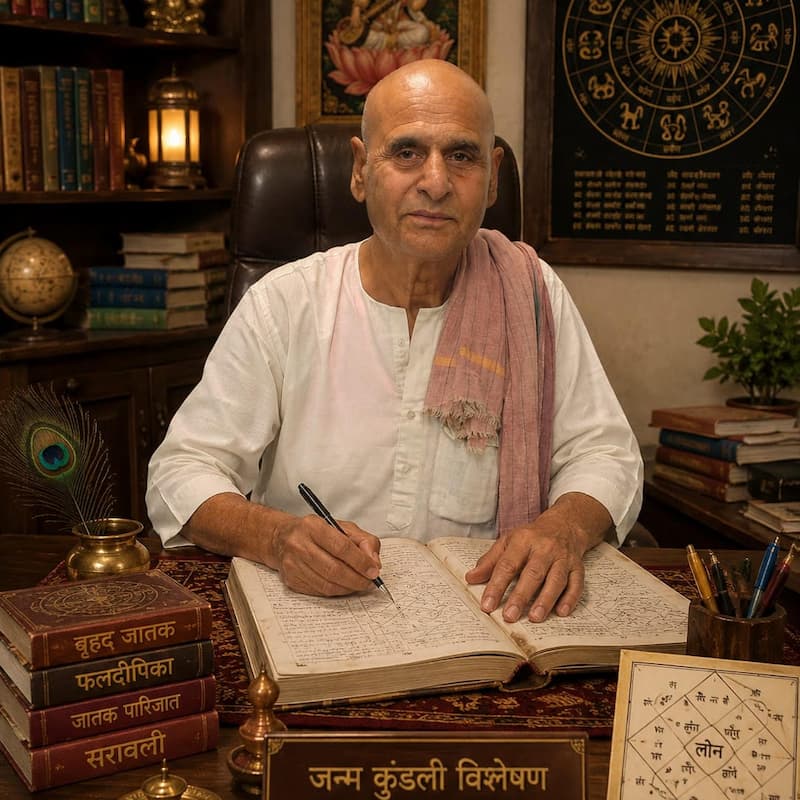
Narendra Kumar Chaubey is a Jyotisha Acharya with over 30 years of experience, based in Bihar and serving clients across India in Vedic astrology, mantra shastra, Vastu and ritual practice.
He completed his formal training at Kameshwar Singh Darbhanga Sanskrit University (KSDSU), one of India’s oldest and most respected institutions for Vedic and Sanskrit scholarship, where he studied Jyotisha shastra, mantra vidya and related classical sciences. KSDSU’s tradition of rigorous Sanskrit education tracing directly to the Mithila region’s centuries-old pandit lineage forms the foundation of his practice.
Over three decades, Narendra Kumar Chaubey has worked with thousands of individuals and families across Bihar and across India, offering guidance in:
- Kundli (birth chart) analysis: Identifying karmic patterns, planetary periods and life path guidance through classical Jyotisha
- Palmistry (Hasta Samudrika): Reading the hand according to the classical Samudrika Shastra tradition
- Vastu Shastra: Assessment and correction of living and working spaces according to directional and elemental principles
- Mantra and Pooja vidhi: Performing and guiding all categories of puja, havan, and mantra sadhana for personal, family and business situations
- Predictive Jyotisha: Transit analysis, muhurta (auspicious timing) selection and remedial guidance
He works across four languages Sanskrit, Hindi, English and Bhojpuri making classical knowledge accessible to practitioners across educational backgrounds and regions.
His writing for ABMantra brings the precision of classical Vedic training to practical mantra guidance: not general advice but specific prescriptions grounded in shastra, lineage and 30 years of direct practice with real situations.
For more info follow on: