
Quick Answer
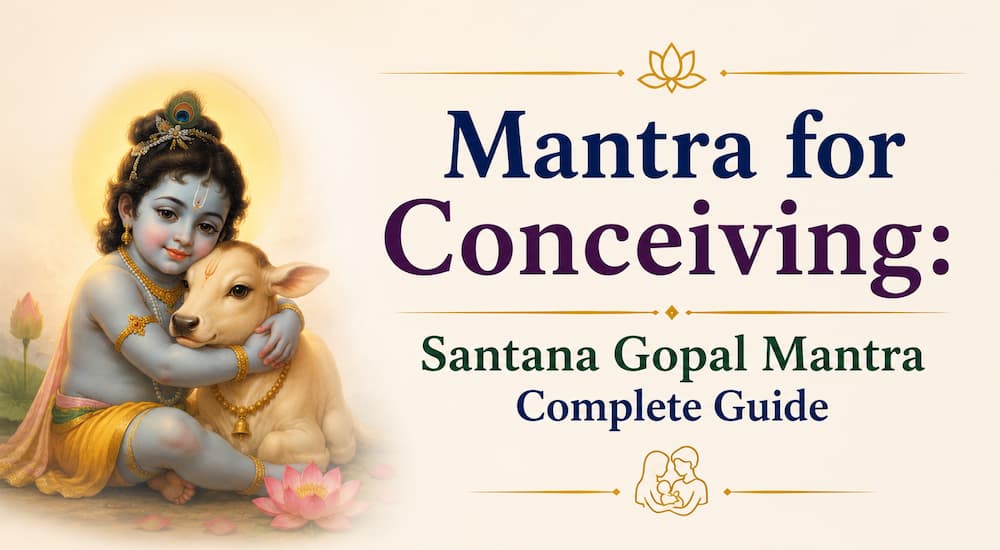
The primary mantra for conceiving a child in the Vedic tradition is the Santana Gopal Mantra:
Om Shreem Hreem Kleem Glaum Devakisut Govind Vasudev Jagadpate Dehi Me Tanayam Krishna Tvaamaham Sharanam Gatah
ॐ श्रीं ह्रीं क्लीं ग्लौं देवकीसुत गोविन्द वासुदेव जगत्पते देहि मे तनयम् कृष्ण त्वामहं शरणं गतः
Meaning: O Govinda, son of Devaki, Vasudeva, Lord of the universe : grant me a child. O Krishna, I take refuge in you.
Method: Chanted by the wife 108 times daily for 40 days. Begin on a day when the Moon is in a favourable position. A qualified Jyotisha can determine the most auspicious starting date based on the birth chart.
Who This Article Is For
This article is for you if you and your partner have been trying to conceive and want the specific mantra the Vedic tradition prescribes for fertility | you want to understand the astrological dimension of conception delay (which planet, which house) alongside the mantra practice | you want the complete practice including which additional mantras support the primary Santana Gopal practice.
Important note: This article addresses the spiritual and astrological dimension of conception. It complements, and does not replace, qualified medical evaluation and treatment for fertility issues. If you have been trying to conceive for more than 12 months (or 6 months if over 35), please consult a fertility specialist alongside this practice.
Difficulty in conceiving a child is one of the most painful experiences a couple can face. The longing for a child, combined with the medical uncertainty, the physical demands of fertility treatment and the social pressure many Indian families still apply : this combination creates a form of suffering that is both very personal and very common. The Vedic tradition has addressed this situation with specific mantras, specific rituals and a specific astrological framework for many centuries.
Here is what most mantra for conceiving articles miss: the Santana Gopal Mantra is the primary mantra, but the tradition also prescribes understanding the astrological root of the delay. The 5th house of the birth chart governs children and fertility. Jupiter is the karaka (significator) of children for both men and women. A 5th house affliction or a weak Jupiter in the chart is the most common astrological indicator of fertility difficulty. The mantra addresses the energetic dimension; the Jyotisha analysis identifies the specific planetary cause.
The Santana Gopal Mantra: Word by Word
Santana Gopal Mantra: Complete Meaning
Om: primordial invocation
Shreem: Lakshmi beej : abundance and auspiciousness. The child as the supreme gift.
Hreem: Mahalakshmi beej : creative power, the force of manifestation
Kleem: Kamakala beej : the power of attraction, the magnetic force that draws the soul of the child
Glaum: Ganesha’s beej : specifically the form that removes obstacles to conception
Devakisut: son of Devaki (Krishna as the perfectly born child)
Govind: the one who nourishes and protects
Vasudev: the all-pervading divine
Jagadpate: Lord of the universe
Dehi Me Tanayam: give me a child (Tanaya = child/son, though the mantra is used for a child of any gender)
Krishna Tvaamaham Sharanam Gatah: O Krishna, I take complete refuge in you
The structure: The mantra begins with four beej syllables that activate the specific energies needed for conception (Shreem = auspiciousness, Hreem = creative power, Kleem = attraction of the soul, Glaum = removal of obstacles), then invokes Krishna specifically in his form as the perfectly born divine child, then makes the specific request (Dehi Me Tanayam) and closes with complete surrender.
Supporting Mantras
| Mantra | Purpose | Day and count |
|---|---|---|
| Santana Gopal Mantra (primary) | Directly invokes the grace of the divine for conception | 108 times daily by wife, ideally 40 days |
| Om Brim Brihaspataye Namah (Jupiter) | Jupiter is the karaka of children : strengthening Jupiter addresses the astrological root | 108 times by husband every Thursday |
| Durga Mantra (Om Dum Durgayai Namah) | Durga governs the female reproductive system and is invoked for safe and successful conception and pregnancy | 108 times by wife on Tuesdays and Fridays |
| Om Gam Ganapataye Namah (Ganesha) | Remove obstacles : both known (medical) and unknown (karmic) : that prevent conception | 11 times daily by both partners before breakfast |
The Astrological Dimension
In Jyotisha, the 5th house governs children, creative progeny, and the capacity to bring a new soul into the world. Jupiter is the primary karaka (significator) of children for both men and women. When the 5th house is afflicted or Jupiter is weak, debilitated or in difficult placement, conception may be delayed or difficult regardless of the couple’s physical health.
Common astrological patterns associated with difficulty conceiving:
- Saturn in or aspecting the 5th house : delays are Saturn’s nature; this does not prevent children but can significantly delay them
- Jupiter debilitated (in Capricorn) or in dusthana houses (6th, 8th, 12th)
- Rahu or Ketu in the 5th house : unconventional path to parenthood; sometimes indicates adoption or medical assistance is how children come
- Pitra Dosha with 5th house involvement : ancestral karma dimension requiring the Pitra Dosha remedy alongside the Santana Gopal practice
From Our Practice
From Our Practice
In my Jyotisha practice, couples seeking a child are among the clients for whom I have the deepest concern. The longing is so pure and the suffering so real that I am always careful to be both helpful and honest.
Helpful means giving them the most effective mantra practice the tradition prescribes and analyzing their charts thoroughly for the astrological indicator of the delay. Honest means telling them that the mantra practice addresses the spiritual and karmic dimension of conception : it does not override medical reality. I always encourage couples to pursue medical evaluation in parallel.
That said, I have observed over many years that the Jupiter and Santana Gopal mantra practice, maintained with genuine sincerity and devotion over 40 to 90 days, consistently correlates with improved outcomes : both in couples undergoing medical treatment (where the mantra practice seems to improve the emotional quality of the experience and in some cases the physiological response to treatment) and in couples with unexplained fertility challenges where medical investigation has found no specific cause.
The most consistent pattern I observe: when both partners chant : the wife the Santana Gopal Mantra and the husband the Jupiter Mantra on Thursdays : the combined practice is considerably more effective than when only one partner participates.
Frequently Asked Questions
❓ Should both husband and wife chant the Santana Gopal Mantra?
The tradition primarily prescribes the Santana Gopal Mantra for the wife, with the husband performing the Jupiter Mantra on Thursdays as his specific contribution. This division reflects the tradition’s understanding of the different energetic roles each partner plays in conception. However, both partners chanting the Santana Gopal together in the morning : a shared daily practice : is also valid and many families do this. Shared mantra practice has the additional benefit of aligning both partners emotionally and spiritually during what is often a very stressful process.
❓ We are undergoing IVF. Can we still do the mantra practice?
Yes. The mantra practice is entirely compatible with medical fertility treatment including IVF. Many couples going through IVF find that the daily mantra practice reduces the anxiety and emotional strain of the treatment process, which is itself beneficial : sustained high cortisol (stress hormone) is associated with reduced IVF success rates. The Santana Gopal Mantra daily, combined with simple Ganesha mantra for obstacle removal, is particularly appropriate during IVF cycles. Inform your fertility specialist that you are maintaining a daily meditation and mantra practice : most will be supportive.
❓ How long should we chant the Santana Gopal Mantra before expecting results?
The tradition prescribes 40 days as the minimum complete practice (one Purashcharan cycle). For couples who have been trying for over a year, three full 40-day cycles (120 days) is the realistic timeframe for the mantra practice to have established its full karmic effect. Do not expect conception to result from 10 or 20 days of chanting. The tradition asks for sustained commitment, not brief experiments. Continue the practice alongside medical care for as long as the desire for a child is present.
❓ The Santana Gopal Mantra mentions a son (Tanayam). What if I want a daughter or just any child?
Tanaya in Sanskrit means child generically : the masculine grammatical form does not restrict the mantra’s effect to male children. The tradition uses Tanayam as the standard request for a child, not specifically a son. Chant the mantra with the intention of welcoming the child the divine sends, regardless of gender. The mantra is not a tool for choosing the sex of a child, and the tradition is clear that attempting to use any mantra for sex selection is both ineffective and karmically inappropriate.
❓ We have been told we cannot conceive naturally. Can mantra still help?
The tradition holds that the Santana Gopal Mantra opens paths to parenthood : not necessarily through natural conception. Many couples who have chanted this mantra consistently have become parents through IVF, surrogacy or adoption, in circumstances that had previously not seemed available or possible to them. The mantra does not specify the path. It invites the soul of the child and asks for the divine’s assistance in bringing that soul into the family by whatever means is possible. Maintain the practice regardless of the medical prognosis.
❓ Should the mantra be chanted at a specific time of the menstrual cycle?
The tradition recommends beginning the 40-day practice in the post-menstrual phase : after the period ends and before ovulation. This is the phase in which the body is most receptive and the tradition considers it the most auspicious window for beginning a fertility-related mantra practice. During the menstrual period itself, the tradition recommends pausing the formal seated practice and maintaining silent mental chanting. After the period ends, resume the full practice.
Begin With Devotion
The Santana Gopal Mantra is a prayer. Not a demand or a technique : a prayer. It is the sincere expression of the desire for a child, placed in the hands of the divine that the tradition holds has authority over the timing and circumstances of new life.
Begin the practice with this understanding: you are asking. The divine responds to sincere asking with genuine grace. How and when that grace arrives may not be what you expect. Trust the practice and trust the process. The tradition’s accumulated experience with this mantra over centuries is its own form of evidence.
Sources
- Bhagavata Purana (Srimad Bhagavatam) : Santana Gopal Mantra source; Krishna as Devakisut (son of Devaki); the tradition of invoking Krishna specifically for progeny
- Wikipedia : Brihaspati: Jupiter as the karaka (significator) of children in Vedic astrology
- Brihat Parashara Hora Shastra : on the 5th house as the house of children, and Jupiter’s role as karaka of progeny
- Wikipedia : Ganesha: Ganesha as Vighna Harta (remover of obstacles) and his role before any important endeavour
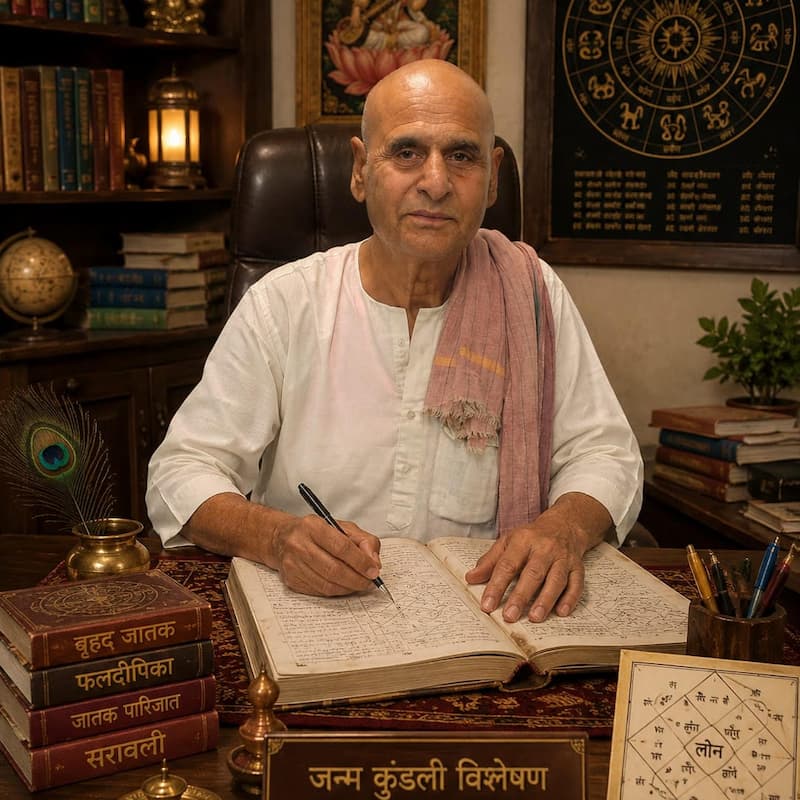
Narendra Kumar Chaubey is a Jyotisha Acharya with over 30 years of experience, based in Bihar and serving clients across India in Vedic astrology, mantra shastra, Vastu and ritual practice.
He completed his formal training at Kameshwar Singh Darbhanga Sanskrit University (KSDSU), one of India’s oldest and most respected institutions for Vedic and Sanskrit scholarship, where he studied Jyotisha shastra, mantra vidya and related classical sciences. KSDSU’s tradition of rigorous Sanskrit education tracing directly to the Mithila region’s centuries-old pandit lineage forms the foundation of his practice.
Over three decades, Narendra Kumar Chaubey has worked with thousands of individuals and families across Bihar and across India, offering guidance in:
- Kundli (birth chart) analysis: Identifying karmic patterns, planetary periods and life path guidance through classical Jyotisha
- Palmistry (Hasta Samudrika): Reading the hand according to the classical Samudrika Shastra tradition
- Vastu Shastra: Assessment and correction of living and working spaces according to directional and elemental principles
- Mantra and Pooja vidhi: Performing and guiding all categories of puja, havan, and mantra sadhana for personal, family and business situations
- Predictive Jyotisha: Transit analysis, muhurta (auspicious timing) selection and remedial guidance
He works across four languages Sanskrit, Hindi, English and Bhojpuri making classical knowledge accessible to practitioners across educational backgrounds and regions.
His writing for ABMantra brings the precision of classical Vedic training to practical mantra guidance: not general advice but specific prescriptions grounded in shastra, lineage and 30 years of direct practice with real situations.
For more info follow on: