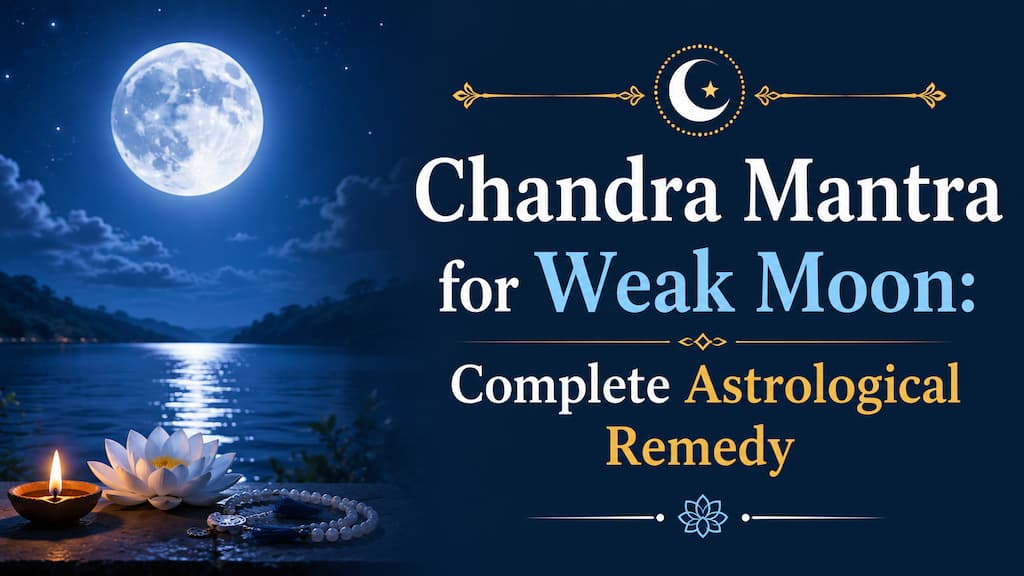

Before prescribing any Chandra mantra for weak Moon, a qualified Jyotisha does one thing first: identifies which type of Moon weakness exists in the chart. “Weak Moon” is not a single condition. It is four distinct astrological situations, each with different symptoms, different severity, and different remedy emphasis. Prescribing the same mantra for all four – as most articles do – produces partial results for some and no results for others. This article begins where it should: with the diagnosis.
Step 1: Diagnosing Your Moon – Which Type of Weakness Do You Have?
These four conditions are distinct in the chart and distinct in their life manifestation. Read each carefully and identify which applies to your situation.
| Type | Chart indicator | Life manifestation | Severity |
|---|---|---|---|
| Type 1 – Low Shadbala (Weak but not debilitated) |
Moon’s Shadbala (six-fold planetary strength score) is below the required minimum. This happens when Moon is in enemy signs (Capricorn ruled by Saturn; Leo ruled by Sun), in the 6th, 8th or 12th house, born during Krishna Paksha (waning Moon), or waning and approaching Amavasya. | Mild emotional instability, average memory, adequate but not strong intuition, moderate relationship difficulties, the sense that one’s emotional life works but never quite flourishes. Not dramatically dysfunctional but consistently below potential. | Mild to moderate. This type responds well to consistent mantra practice and lifestyle adjustment. Pearl gemstone is often effective here. |
| Type 2 – Debilitated Moon (Moon in Scorpio) |
Moon placed in Scorpio (Vrishchika) – its sign of debilitation. Moon’s qualities are most suppressed in Scorpio because Scorpio’s intense, secretive, transformative energy is incompatible with the Moon’s need for open nourishment and receptive flow. | Deep emotional secretiveness, difficulty expressing vulnerability, intense inner emotional life that is rarely visible to others, emotional extremes that shift between suppression and overwhelm, complicated relationship with the mother figure, difficulty with emotional intimacy despite a deep need for it. | Moderate to significant. The Moon is genuinely weakened in Scorpio. Consistent Beej Mantra practice, Pearl (after assessment), and Monday Vrat produce measurable improvement over 90+ days. |
| Type 3 – Afflicted Moon (Malefic conjunction or aspect) |
Moon conjunct or aspected by Saturn (Visha Yoga), Rahu (Shakata Yoga), Ketu, or Mars. Each malefic afflicts differently: Saturn = emotional suppression; Rahu = obsessive distortion; Ketu = detachment and disconnection; Mars = emotional volatility and reactive aggression. | Depends on the afflicting planet (see the pattern guide in the mental peace article). The common thread: the Moon’s natural nourishing function is being actively disrupted rather than simply being weak. | Moderate to severe. The most complex type – requires addressing both the Moon’s strengthening and the afflicting planet’s pacification. Single mantra remedies are usually insufficient. |
| Type 4 – Combust Moon (Moon too close to the Sun) |
Moon within approximately 12 degrees of the Sun in the chart. The Sun’s intense light “burns” the Moon – a phenomenon called combustion (Maudhya) in Jyotisha. This most commonly occurs around Amavasya (new Moon) births. | Difficulty distinguishing one’s own feelings from what others expect (the ego-Sun overwhelms the emotional-Moon), identity confusion, the sense that one’s emotional needs are invisible or illegitimate, difficulty with self-care and nourishment, the pattern of consistently putting others’ needs before one’s own to the point of emotional depletion. | Moderate. Combustion reduces the Moon’s visibility in the chart but does not eliminate it. The remedy specifically needs to re-establish the Moon’s independent voice alongside the Sun’s strong presence. |
These four types are like four different injuries to the same joint. The treatment principle is the same (Chandra mantra, Pearl, Monday Vrat), but the emphasis and the companion remedies differ based on which type you have.
Step 2: The Paksha Dimension – Were You Born in Waxing or Waning Moon?
Every competitor article ignores this factor. It is one of the most practical and immediately actionable diagnostics in Jyotisha, and it directly affects how you should time your mantra practice.
Shukla Paksha birth (waxing Moon – from Amavasya to Purnima): The Moon was growing at the time of your birth. The Moon’s strength in Shukla Paksha increases progressively – a Moon born close to Purnima is at maximum strength; a Moon born just after Amavasya is still weak even in Shukla Paksha. Generally: Shukla Paksha births have a Moon that is gaining and growing – emotionally, this often manifests as a capacity for genuine emotional recovery after difficulty. The wound heals.
Krishna Paksha birth (waning Moon – from Purnima to Amavasya): The Moon was declining at the time of your birth. The Moon’s Shadbala is lower in Krishna Paksha; a Moon born close to Amavasya (new Moon) has minimum strength even if otherwise well-placed. Generally: Krishna Paksha births may carry a Moon that, even when recovering from emotional difficulty, takes longer to return to its full nourishing quality. The wound heals but more slowly.
How Paksha affects your practice:
- Shukla Paksha birth: Begin new Chandra mantra sadhanas on Shukla Paksha Monday (after Amavasya, before Purnima). Your Moon responds most strongly to the waxing energy. The Shraam (waxing) Beej syllable is your most potent entry point.
- Krishna Paksha birth: Begin sadhanas on Purnima itself – when the Moon is at its annual maximum regardless of your natal Paksha. Your Moon needs the full-Moon amplification. The Shraum (completing, releasing) Beej syllable supports your Moon’s releasing quality that needs strengthening.
Step 3: The Moon’s Nakshatra – Does It Change the Remedy?
The Moon’s Nakshatra (one of 27 lunar mansions) at birth determines which form of Chandra mantra is most resonant for that individual. The Nakshatra is the Moon’s specific address within the zodiac – and each Nakshatra has its own deity, quality and sonic resonance.
| Moon Nakshatra group | Nakshatra names | Nakshatra deity | Mantra emphasis |
|---|---|---|---|
| Soma’s own Nakshatras (Moon most at home) |
Rohini, Hasta, Shravana | Prajapati (Rohini), Savita/Sun (Hasta), Vishnu (Shravana) | Om Som Somaya Namah – the Soma form is most resonant for Moon in its own comfortable Nakshatras. The nourishing quality flows most naturally here. |
| Mercury-ruled Nakshatras | Ashlesha, Jyeshtha, Revati | Sarpa (Ashlesha), Indra (Jyeshtha), Pushan (Revati) | Chandra Beej Mantra + Budh Mantra (Om Braam Breem Braum Sah Budhaya Namah) – Moon-Mercury interaction at the Nakshatra level requires addressing both planets for the most complete remedy. |
| Mars-ruled Nakshatras | Mrigashira, Chitra, Dhanishtha | Soma/Moon (Mrigashira), Vishvakarma (Chitra), Ashta Vasu (Dhanishtha) | Chandra Beej Mantra – the Moon’s energy in Mars-ruled Nakshatras benefits from the concentrated strengthening of the full Beej form. Mars’s energy in these Nakshatras can be either supportive or agitating to the Moon depending on the overall chart. |
| Saturn-ruled Nakshatras | Pushya, Anuradha, Uttara Bhadrapada | Brihaspati/Jupiter (Pushya), Mitra (Anuradha), Ahir Budhnya (Uttara Bhadrapada) | Chandra Beej Mantra + Shani Mantra (Om Shanaishcharaya Namah) on Saturdays – Saturn rules the Nakshatra while also being the potential Visha Yoga planet. Addressing both creates the most complete remedy. |
| Rahu-ruled Nakshatras | Ardra, Swati, Shatabhisha | Rudra (Ardra), Vayu (Swati), Varuna (Shatabhisha) | Chandra Beej Mantra + Rahu Mantra (Om Bhraam Bhreem Bhraum Sah Rahave Namah) – Rahu’s Nakshatra influence on the Moon amplifies the Shakata Yoga risk even without a direct conjunction. Both mantras address this interaction. |
The Complete Chandra Dosh Nivaran Mantra Protocol
Primary Mantra: Chandra Beej Mantra
Count prescriptions by severity:
Type 1 (Low Shadbala): 108 times every Monday for 40 consecutive Mondays. Purnima: 1,008 times. This count is sufficient for mild weakness.
Type 2 (Debilitated – Scorpio): 108 times daily (not only Monday) for 90 days minimum. Monday and Purnima: 1,008 times each. The debilitation requires daily sustained practice – not weekly.
Type 3 (Afflicted): 108 times daily. Secondary planet’s mantra 108 times on Saturdays. The combined protocol is maintained for the duration of the afflicting planet’s Dasha if that Dasha is active.
Type 4 (Combust): 108 times daily. Monday: 1,008 times. Also: 11 times Om Suryaya Namah before the Chandra mantra each morning – to acknowledge the Sun’s legitimate strength while creating space for the Moon’s independent voice to emerge alongside it.
Complete Purashcharan (for all types – the formal completion): 11,000 repetitions. At 108 daily: approximately 102 days (just over 3 months). The IndAstro tradition prescribes starting this count on a Monday and completing it continuously until finished – at 1,008 per day: approximately 11 days. After completion: donate white items and perform the Chandra Homa if possible.
Chandra Dosha Nivaran Shloka
नमामि शशिनं भक्त्या शम्भोर्मुकुटभूषणम्।।
Namami Shashinam Bhaktya Shambhor Mukuta Bhushanam
Role in the remedy protocol: This Dhyana Shloka is chanted once at the beginning of every practice session as the meditation verse – establishing the visual and vibrational image of Chandra Dev before the Beej Mantra count begins. For the Chandra Dosh Nivaran specifically, it also serves as the mantra for the Monday Arghya (water offering at dawn, facing east): chant it 3 times while offering water to the rising Moon’s direction. This opening shloka is particularly important for Type 2 (debilitated) practitioners – the visual of Chandra as cool, white, luminous and crowned on Shiva’s head counteracts the Scorpio energy’s tendency to pull the Moon into darkness and hiddenness.
The Five-Part Chandra Dosh Remedy: Complete Protocol
The mantra alone is one of five components. All five working together produce the most complete result. Each can be done independently with partial results; together, they form the traditional comprehensive Chandra Graha Shanti.
| Component | What it is | Prescription | Effect |
|---|---|---|---|
| 1. Mantra Japa | Chandra Beej Mantra chanting | 108 times daily minimum (see type-specific counts above) | Direct vibrational strengthening of Moon energy at the subtle body level |
| 2. Somavar Vrat (Monday Fast) |
Fasting on Mondays – from sunrise to moonrise (or sunrise to evening puja completion). White foods only or full fast depending on capacity. | Every Monday throughout the remedy period. 16 consecutive Mondays is the classical Somavar Vrat cycle. | Creates the physical-level alignment with Chandra’s day. The voluntary restriction of food on Monday generates karmic credit (Punya) specifically offered to Chandra. |
| 3. Dana (Charity) | Monday donation of white items to those in need | Rice, white cloth, milk, sugar, silver, white flowers – given freely every Monday before evening | The tradition holds that each planet’s negative karmic influence is reduced by donating that planet’s specific items with genuine generosity. Chandra’s items are white and nourishing. |
| 4. Gemstone | Pearl (Moti) – Chandra’s specific gemstone | Natural sea pearl, minimum 3 Ratti (0.55 grams), set in silver, worn on the little finger of the right hand, consecrated on Monday morning after Beej Mantra chanting. Only after chart assessment by qualified Jyotisha. | Amplifies Moon’s positive qualities consistently through physical contact with the body. Works in combination with the mantra – each amplifies the other’s effect. |
| 5. Puja and Homa | Chandra Graha Shanti Puja – formal worship with specific ritual protocol; Chandra Homa – fire offering with Moon’s specific herbs and offerings | Performed once by a qualified priest at the beginning of the remedy period, ideally on a Purnima or a Monday in Shukla Paksha. If possible at a Shiva temple (Chandra wears the Moon as his crown – Shiva temples are Chandra’s most potent location). | Creates the ritual formal intention and invokes divine witness for the remedy. The Homa’s fire offering specifically clears the karmic dimension of the Moon’s weakness at a depth that individual mantra practice alone cannot reach as quickly. |
Moon Mahadasha (10 Years): The Extended Remedy
When someone enters Moon Mahadasha (the 10-year Vimshottari Dasha period governed by Chandra), every Moon-related theme in the chart becomes the primary lived experience for a decade. If the Moon is well-placed: 10 years of emotional richness, creative flourishing and deepening relationships. If the Moon is weak or afflicted: 10 years of that weakness or affliction being the dominant experience of daily life.
The Chandra mantra during Moon Mahadasha is not optional – it is the primary astrological tool for the entire decade. The recommended approach:
- At the beginning of Moon Mahadasha: Perform the Chandra Graha Shanti Puja and Homa. This formal commencement remedy sets the tone for the entire Mahadasha period.
- Throughout the Mahadasha: Daily Beej Mantra 108 times. Purnima 1,008 times. Monday Vrat maintained.
- Complete Purashcharan within the first year: 11,000 repetitions completed before the first anniversary of the Mahadasha’s start.
- During Moon-Moon Antardasha (the sub-period of the Moon within the Moon’s own Mahadasha – typically the first 10 months): the most intense period, requiring maximum practice intensity.
The most frequently misdiagnosed Moon situation I encounter in consultations is Type 4 – the combust Moon. Clients with Moon conjunct Sun (within 12 degrees) are often told simply that they have a “weak Moon” and prescribed the standard Beej Mantra practice. This is partially correct but misses the specific dynamic that combustion creates. The combust Moon’s issue is not simply weakness – it is invisibility. The Sun is so dominant in the chart that the Moon’s needs, feelings and voice are literally difficult to perceive, both for the person themselves and for others around them.
The specific complaint these clients articulate is this: “I don’t know what I feel.” They are not emotionally numb; they have deep feelings. But the feelings are obscured by the Sun’s constant presence – the ego’s busyness, the external identity, the doing and achieving – to the point where the emotional life (Moon’s domain) has been systematically pushed to the periphery. The remedy is not only Moon-strengthening but specifically Moon-differentiating: helping the Moon establish its own voice alongside the Sun’s legitimate strength. This is why I add the 11 repetitions of Om Suryaya Namah before the Moon mantra for these clients – acknowledging the Sun honourably, then creating space for the Moon’s independent expression to emerge.
Of the four types, Type 2 (debilitated Moon in Scorpio) takes the longest to show measurable results – typically 60 to 90 days of daily practice before the practitioner notices the first consistent shift. The quality that shifts first is almost always the same: they begin to feel safe enough to let someone close. The Moon in Scorpio’s characteristic protection of the emotional self starts to relax, and the natural nourishing connection that the Moon wants to create – which Scorpio’s intensity has been guarding against – begins to be available. This is the Moon’s remedy working exactly as intended: not making the Scorpio Moon less intense, but making the intensity safe to share rather than necessary to hide.
Frequently Asked Questions
- Brihat Parashara Hora Shastra – Shadbala (six-fold strength) calculation for the Moon; Moon’s debilitation in Scorpio and exaltation in Taurus; combustion (Maudhya) definition and effects; Kemadruma Yoga; Moon Mahadasha (10 years) in Vimshottari Dasha; prescribed remedies including Pearl (Moti) gemstone, Monday Vrat (Somavar Vrat) and Chandra Graha Shanti
- Wikipedia – Chandra: the Moon’s 27 Nakshatra wives and the Nakshatra-deity correspondences; Soma as divine nourishment; Chandra’s relationship with Shiva (worn as crown ornament)
- Wikipedia – Nakshatra: the 27 lunar mansions, their ruling planets and deities, and their significance in Vedic astrology as the Moon’s specific positional address
- Wikipedia – Vimshottari Dasha: the Moon Mahadasha (10-year period), its sub-periods (Antardashas), and the classical prescription for remedial practice during Moon-ruled Dasha periods
Moon Mantra Benefits: complete Chandra Mantra guide for mind, emotions and healing
Chandra Beej Mantra: Om Shraam Shreem Shraum complete meaning and practice
Moon Mantra for Mental Peace: the 3am mind, Visha Yoga and Shakata Yoga guide
Astrological Benefits of Maha Mrityunjaya Mantra: planet-by-planet complete guide
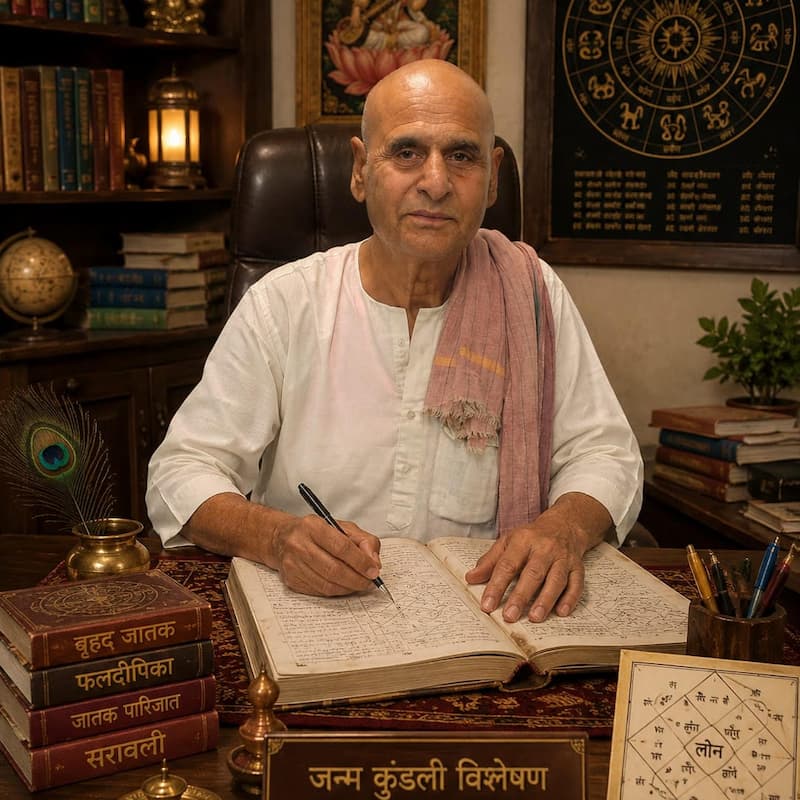
Narendra Kumar Chaubey is a Jyotisha Acharya with over 30 years of experience, based in Bihar and serving clients across India in Vedic astrology, mantra shastra, Vastu and ritual practice.
He completed his formal training at Kameshwar Singh Darbhanga Sanskrit University (KSDSU), one of India’s oldest and most respected institutions for Vedic and Sanskrit scholarship, where he studied Jyotisha shastra, mantra vidya and related classical sciences. KSDSU’s tradition of rigorous Sanskrit education tracing directly to the Mithila region’s centuries-old pandit lineage forms the foundation of his practice.
Over three decades, Narendra Kumar Chaubey has worked with thousands of individuals and families across Bihar and across India, offering guidance in:
- Kundli (birth chart) analysis: Identifying karmic patterns, planetary periods and life path guidance through classical Jyotisha
- Palmistry (Hasta Samudrika): Reading the hand according to the classical Samudrika Shastra tradition
- Vastu Shastra: Assessment and correction of living and working spaces according to directional and elemental principles
- Mantra and Pooja vidhi: Performing and guiding all categories of puja, havan, and mantra sadhana for personal, family and business situations
- Predictive Jyotisha: Transit analysis, muhurta (auspicious timing) selection and remedial guidance
He works across four languages Sanskrit, Hindi, English and Bhojpuri making classical knowledge accessible to practitioners across educational backgrounds and regions.
His writing for ABMantra brings the precision of classical Vedic training to practical mantra guidance: not general advice but specific prescriptions grounded in shastra, lineage and 30 years of direct practice with real situations.
For more info follow on: