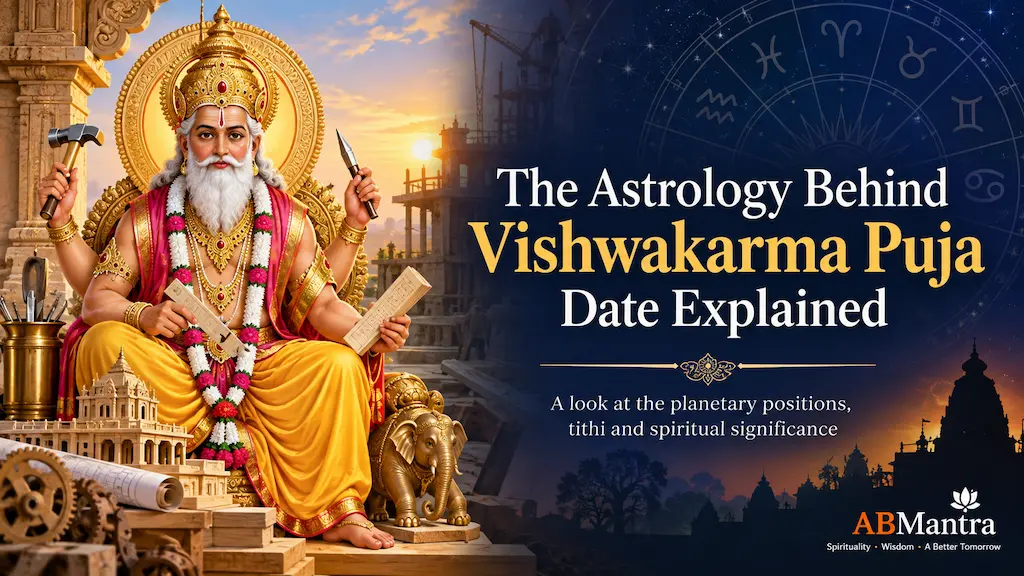

Most people who search for the astrology behind Vishwakarma Puja’s date are engineers, factory managers and skilled workers who have noticed something unusual: unlike every other Hindu festival they observe, this one never moves. Diwali is different every October or November. Navratri shifts. Janmashtami varies. But Vishwakarma Puja is always 17 September. Someone in the factory told them it was because of the Sun moving into Virgo, but nobody explained what that actually means in Jyotisha terms and why it is specifically relevant to a festival that worships a craftsman deity. This article answers that question completely.
What Kanya Sankranti Is and Why It Fixes the Date
The Hindu calendar system used across Bengal, Assam, Odisha, Bihar and much of the rest of India has two branches running simultaneously: a lunar calendar (which governs most festivals through tithi dates) and a solar calendar (which governs a smaller number of observances through the Sun’s movement between zodiac signs).
When the Sun moves from one Rashi (zodiac sign) to the next, the event is called a Sankranti. There are 12 Sankrantis per year – one for each zodiac sign the Sun passes through. The most famous of these is Makar Sankranti in January (Sun entering Capricorn), which governs the harvest festival observed across India. Kanya Sankranti is the Sun’s entry into Kanya Rashi (Virgo) – the sixth sign.
Solar events are fixed in astronomical time. The Sun enters Virgo on approximately 17 September every year in the Gregorian calendar – occasionally 16 September in a leap year adjustment, but otherwise consistent. This is why Vishwakarma Puja does not wander through the calendar the way lunar festivals do. It is anchored to an astronomical event, not to a lunar tithi calculation.
For 2026 specifically: The Kanya Sankranti moment is 8:02 AM IST on 17 September 2026 (confirmed from DrikPanchang and Haindavam.org calculations). The Punya Kaal – the meritorious window considered most auspicious for puja – begins at this moment and runs through the midday period. Puja performed within this window carries the full benefit of the Sankranti alignment.
The Jyotisha Behind the Alignment: Mercury, Kanya and Vishwakarma
This is where the astrology becomes genuinely interesting – and where every other article about the Vishwakarma Puja date stops short of the real explanation.
Kanya Rashi (Virgo) is governed by Budha – Mercury. In Jyotisha, Mercury is the planet of skilled intelligence: craft, precision, artisanship, engineering, calculation, communication, and the meticulous application of knowledge to practical problems. Mercury is the planet of the craftsman, the engineer, the architect, the analyst. The tradition describes Mercury as Saumya (gentle, refined, intelligent) – a planet whose quality is discriminating intelligence brought to bear on the material world.
Vishwakarma is the divine architect and craftsman – the Devashipi (divine artisan) who designed and built the celestial city, Lanka, Dwarka and the divine weapons. His function in the cosmos is precisely the Mercury function: the intelligent, precise application of skill to the creation of things. He is not the planet of brute force (Mars) or of spiritual transcendence (Ketu) or of wealth (Jupiter). He is the deity of skilled work done with intelligence and precision – Mercury’s domain.
When the Sun enters Mercury’s sign (Kanya) on Kanya Sankranti, the solar authority (Sun = vitality, purpose, recognition, leadership) moves into the domain of Mercury’s intelligence and skill. The result is the specific astrological alignment most appropriate for honouring a deity of skilled craftsmanship: solar energy expressing itself through the Mercury-governed qualities of precision, artisanship and applied intelligence.
This is the Jyotisha explanation that the date encodes. Vishwakarma Puja on Kanya Sankranti is not coincidence or convention. It is the annual alignment between the Sun’s energy and Mercury’s domain – the precise moment when solar vitality meets skilled intelligence. The tradition placed the festival here because the Rishis who designed the Hindu festival calendar understood this alignment.
The Sun in Kanya: What the Sixth Sign Governs
Understanding the sixth sign deepens the picture further. In the Jyotisha system, the six Rashis from Aries to Virgo represent the individual’s journey from pure self (Aries) to the individual in service to others (Virgo). The sixth sign is specifically the sign of Seva (service), of daily disciplined work, of the relationship between the individual and their craft.
The Brihat Parashara Hora Shastra (Chapter 4, Verse 17) identifies Kanya’s qualities as: Dwisvabhava (dual nature – earthy and intelligent simultaneously), the sign of the virgin with a lamp and grain, governing discrimination, service, detailed work and the crafts. These are exactly the qualities that Vishwakarma embodies and that the festival celebrates.
When the Sun transits Kanya, the year’s solar energy is focused specifically on these qualities: disciplined work, service, craftsmanship, precision, and the daily application of skill. The tradition recognises this transit as the correct moment to bless the tools and instruments through which skilled work is performed – not at a random point in the year but at the specific astronomical moment when the cosmic energy supports exactly this activity.
I have been asked about the Vishwakarma Puja date many times over 30 years, and the question almost always comes from clients who are professionals – engineers, factory owners, mechanics, software developers – who have been observing the puja for years without anyone explaining the underlying astrological logic to them. When I explain the Mercury-Kanya connection, most of them recognise it immediately. The qualities Mercury governs in Jyotisha – precision, the intelligent application of technical knowledge, skill expressed through disciplined daily work – are the qualities they already associate with their professional identity. Vishwakarma is their deity not by religious convention but by astrological correspondence.
The Punya Kaal timing matters practically. The Kanya Sankranti moment in 2026 is 8:02 AM IST. Beginning the puja at or shortly after this moment – typically between 8:00 AM and 11:30 AM – places the worship within the Punya Kaal window when the Sankranti energy is most concentrated. A puja performed at 9:00 AM on 17 September 2026 is astrologically well-placed. A puja performed at 6:00 AM before the Sankranti moment has not yet occurred is technically performed in the previous solar month (Simha), not Kanya.
For clients whose work is specifically Mercury-related – software engineers, data analysts, writers, teachers, accountants, all Mercury-governed professions – the Vishwakarma Puja on Kanya Sankranti has a specific additional Jyotisha significance. It is an annual opportunity to strengthen the Mercury principle in their own chart through devotion to the deity who most completely embodies Mercury’s creative-technical intelligence in divine form. I prescribe the Vishwakarma Gayatri (Om Vastoshpataye Vidmahe Chaturmukhaya Dhimahi Tanno Vishwakarma Prachodayat) specifically for these clients, chanted 108 times at the Punya Kaal.
The Two Dates: Kanya Sankranti vs Vishwakarma Jayanti
| Occasion | When | 2026 date | Which states | Astrological basis |
|---|---|---|---|---|
| Vishwakarma Puja (Kanya Sankranti) | When Sun enters Kanya Rashi (Virgo) | 17 September 2026, 8:02 AM IST | West Bengal, Odisha, Assam, Bihar, Jharkhand, most of North India | Solar calendar – Kanya Sankranti. Fixed annually around 17 September regardless of the lunar calendar. |
| Vishwakarma Jayanti | Trayodashi (13th day) of Kartik Shukla Paksha | November 2026 (exact date varies by lunar calculation) | Some traditions in South India and parts of North India | Lunar calendar – tithi-based. Moves through the Gregorian calendar like other lunar festivals. |
| Vishwakarma Puja after Diwali | Day after Diwali (Govardhan Puja day) | One day after Diwali 2026 | Some business communities in Gujarat and Maharashtra | Commercial calendar tradition – the day after Diwali is used to bless business tools and equipment for the new business year (which begins at Diwali in the Gujarati tradition). |
The Kanya Sankranti observance (17 September) and the Vishwakarma Jayanti (November) are genuinely distinct celebrations addressing different aspects of Vishwakarma’s identity. The September observance is the craftsman’s festival – for workers, factories and tools. The November Jayanti is the birth anniversary celebration – closer in character to how Ganesha Chaturthi celebrates Ganesha’s birth rather than his function.
What People Get Wrong About the Vishwakarma Puja Date
Error 1: “The date is fixed by religious authorities.”
The date is fixed by astronomy, not by religious authority. Kanya Sankranti is a planetary event that occurs on approximately 17 September every year because the Sun takes 365.25 days to complete its zodiac circuit. No religious body decides the date. The Sun’s position decides it.
Error 2: “It falls on 17 September because the government declared a holiday.”
This is backwards. The government holiday exists because the festival was already on 17 September. Eastern Indian states (West Bengal, Odisha, Assam, Bihar) observe 17 September as a government holiday specifically because Vishwakarma Puja, fixed on Kanya Sankranti, is a major festival for industrial workers. The holiday follows the festival; the festival does not follow the holiday.
Error 3: “Vishwakarma Puja is only for factory workers.”
The Kanya Sankranti connection means this festival is appropriate for anyone whose work is Mercury-governed: engineers, architects, software professionals, writers, teachers, accountants, doctors (Mercury governs discriminating diagnosis), designers. Any professional whose core skill is the intelligent application of technical knowledge to practical problems has a Jyotisha connection to the Kanya Sankranti celebration, whether they work in a factory or not.
Error 4: “Vishwakarma Puja and Vishwakarma Jayanti are the same festival.”
They are not. September 17 (Kanya Sankranti) and November (Trayodashi Kartik Shukla) are two distinct observances with different astrological bases and different character. Treating them as the same event and wondering why there are two dates creates unnecessary confusion – they have always been separate.
- Wikipedia – Vishvakarma Puja: Kanya Sankranti as the festival’s astronomical basis; the 16-18 September date range; the post-Diwali observance in some traditions
- Wikipedia – Kanya Sankranti: the Sun’s transit into Virgo/Kanya Rashi; its connection to Vishwakarma Puja; the solar calendar basis
- DrikPanchang – Vishwakarma Puja date and time: Kanya Sankranti moment calculations confirming 17 September as the standard date across centuries (DrikPanchang data extends to 2100 – the date remains 17 September)
- Haindavam.org – Kanya Sankranti 2026 calculations for multiple time zones confirming 8:02 AM IST as the Sankranti moment for India
- Brihat Parashara Hora Shastra, Chapter 4 (Rashi Descriptions) – Kanya Rashi’s qualities: Dwisvabhava, Mercury-governed, associated with crafts, discrimination, service and detailed work; the scriptural basis for the Mercury-Kanya-Vishwakarma Jyotisha connection
- Wikipedia – Vishvakarman: Vishwakarma’s identity as the divine architect; his Rigvedic origin (Rigveda 10.81 and 10.82); his role as the deity of all skilled creation
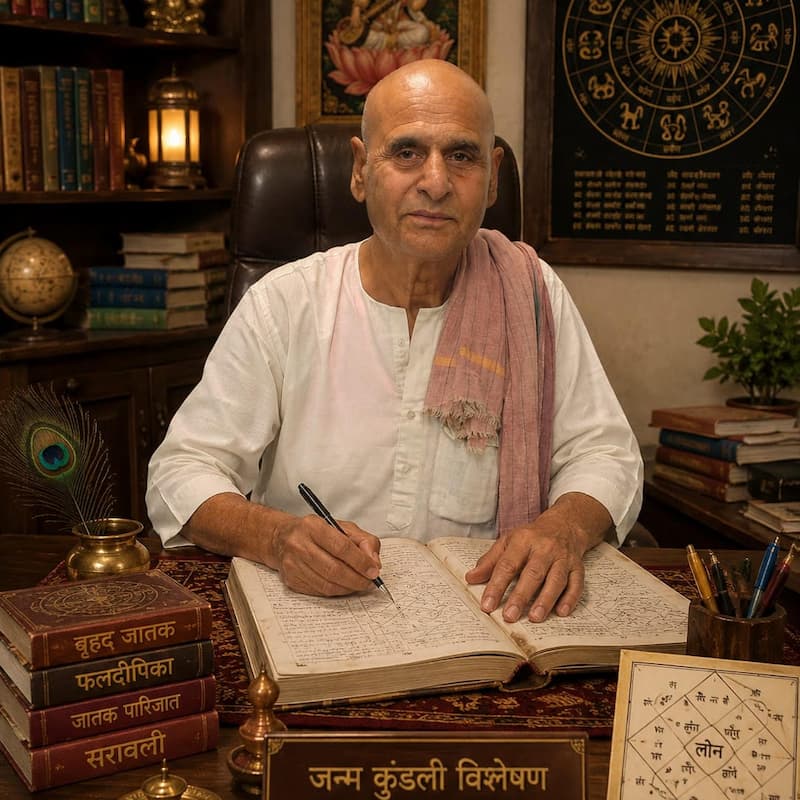
Narendra Kumar Chaubey is a Jyotisha Acharya with over 30 years of experience, based in Bihar and serving clients across India in Vedic astrology, mantra shastra, Vastu and ritual practice.
He completed his formal training at Kameshwar Singh Darbhanga Sanskrit University (KSDSU), one of India’s oldest and most respected institutions for Vedic and Sanskrit scholarship, where he studied Jyotisha shastra, mantra vidya and related classical sciences. KSDSU’s tradition of rigorous Sanskrit education tracing directly to the Mithila region’s centuries-old pandit lineage forms the foundation of his practice.
Over three decades, Narendra Kumar Chaubey has worked with thousands of individuals and families across Bihar and across India, offering guidance in:
- Kundli (birth chart) analysis: Identifying karmic patterns, planetary periods and life path guidance through classical Jyotisha
- Palmistry (Hasta Samudrika): Reading the hand according to the classical Samudrika Shastra tradition
- Vastu Shastra: Assessment and correction of living and working spaces according to directional and elemental principles
- Mantra and Pooja vidhi: Performing and guiding all categories of puja, havan, and mantra sadhana for personal, family and business situations
- Predictive Jyotisha: Transit analysis, muhurta (auspicious timing) selection and remedial guidance
He works across four languages Sanskrit, Hindi, English and Bhojpuri making classical knowledge accessible to practitioners across educational backgrounds and regions.
His writing for ABMantra brings the precision of classical Vedic training to practical mantra guidance: not general advice but specific prescriptions grounded in shastra, lineage and 30 years of direct practice with real situations.
For more info follow on: