
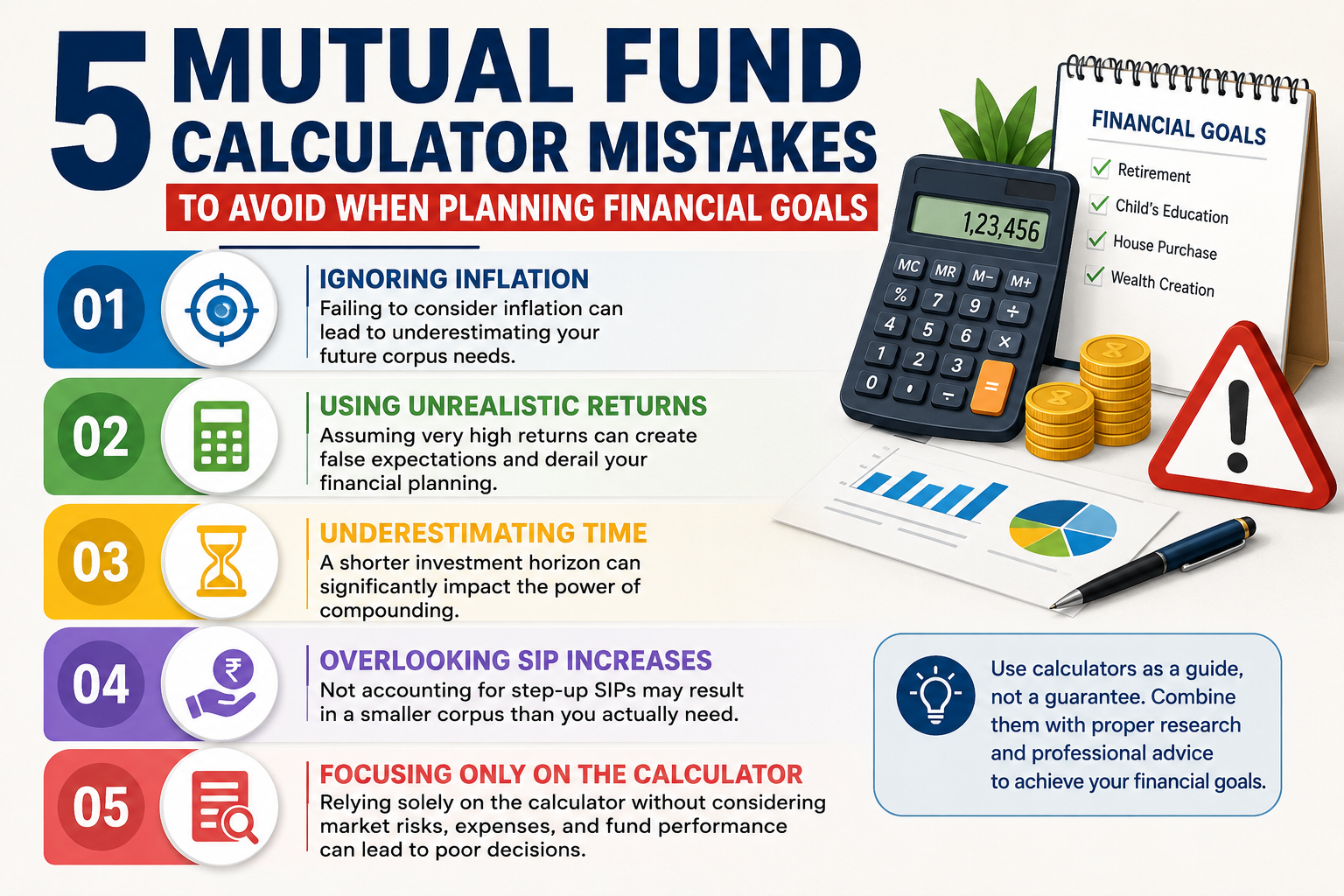

A mutual fund calculator can help investors estimate the potential value of their investments when planning for goals such as retirement, higher education or buying a home. By entering details like the investment amount, tenure and an assumed rate of return, users can get an indicative estimate to support financial planning. However, these projections depend on the assumptions entered and should be viewed as planning aids rather than predictions. Understanding common calculator mistakes may help investors set more realistic expectations.
1. Using Unrealistic Return Assumptions
One of the most common mistakes investors make is entering return assumptions that may not reflect realistic market conditions.
When using a calculator, it can be tempting to choose a higher expected return because it may show a larger potential corpus. However, calculator projections are highly sensitive to return assumptions. Even a small change in the expected rate of return may alter the projected value of an investment, particularly over longer periods.
For example, a projection based on one return assumption may look very different from a projection based on a slightly lower assumption. This difference can become more noticeable as the investment tenure increases.
Instead of relying on a single scenario, it may be useful to explore multiple assumptions and compare different potential outcomes. Looking at a range of possibilities can help create more balanced expectations and provide a broader perspective when planning for long-term goals.
2. Ignoring the Investment Time Horizon
Many investors focus heavily on the amount they plan to invest each month while paying less attention to the investment tenure.
However, time can play an important role in shaping the potential outcome of an investment. A longer investment horizon may increase the likelihood of benefiting from the potential effects of compounding, while a shorter tenure may result in very different projections.
For instance, increasing the investment period by a few years may sometimes have a noticeable impact on the projected corpus, even if the monthly contribution remains unchanged. On the other hand, reducing the tenure may lower the projected value despite maintaining the same investment amount.
When using a calculator, it can be helpful to experiment with different time horizons. This may provide a clearer understanding of how time can influence potential outcomes and help investors align their plans with their financial goals.
3. Treating Calculator Results as Predictions
A mutual fund calculator is designed to generate estimates based on the inputs provided by the user.
While these estimates can be useful for planning purposes, they should not be interpreted as predictions or guarantees. Actual investment performance may differ from projections due to a variety of factors, including market movements, economic conditions and changes in investor behaviour.
Sometimes investors may become overly attached to the projected corpus displayed by a calculator. However, it is important to remember that the output is based on assumptions rather than certainty.
Viewing calculator results as indicative estimates rather than future outcomes may help create more realistic expectations. This approach can also encourage investors to focus on planning and preparation rather than specific projected figures.
4. Forgetting to Review Calculations Regularly
Financial planning is an ongoing process rather than a one-time activity. As time passes, changes in income, expenses, financial responsibilities and personal goals may influence your investment needs and priorities. As a result, projections that seemed relevant earlier may require a fresh look. Revisiting your calculations periodically may help keep your investment plan aligned with your current circumstances and long-term financial objectives.
5. Focusing Only on the Final Corpus
Many investors immediately focus on the projected maturity value without paying enough attention to the assumptions behind it. However, the final corpus is only one part of the overall picture. Factors such as the investment amount, investment tenure and assumed rate of return can all influence the projected outcome. Understanding how these variables affect the calculation may help investors interpret projections more effectively and gain a clearer view of different potential scenarios.
How to Use a Calculator More Effectively
A few simple steps may help you use a calculator more effectively for financial planning:
- Try different investment amounts to see how they may influence potential outcomes.
- Compare different investment tenures to understand the impact of time on projections.
- Use multiple return assumptions to explore a range of possible scenarios.
- Review your calculations periodically as your financial goals and circumstances change.
- Focus on the assumptions behind the projections, not just the final corpus figure.
- Treat calculator outputs as indicative estimates rather than predictions of future performance.
- Remember that market-linked investments involve risk, and actual outcomes may differ from projections.
The calculator is an aid, not a prediction tool. It may provide only an indicative picture.
Conclusion
A mutual fund calculator can be a useful planning aid when used with realistic assumptions and a clear understanding of its limitations. By avoiding common mistakes such as relying on unrealistic projections, overlooking time horizons or treating estimates as predictions, investors may gain a broader understanding of different scenarios and use those insights when planning towards their long-term financial goals.
Mutual Fund investments are subject to market risks, read all scheme related documents carefully.
This document should not be treated as endorsement of the views/opinions or as investment advice. This document should not be construed as a research report or a recommendation to buy or sell any security. This document is for information purpose only and should not be construed as a promise on minimum returns or safeguard of capital. This document alone is not sufficient and should not be used for the development or implementation of an investment strategy. The recipient should note and understand that the information provided above may not contain all the material aspects relevant for making an investment decision. Investors are advised to consult their own investment advisor before making any investment decision in light of their risk appetite, investment goals and horizon. This information is subject to change without any prior notice.
The content herein has been prepared on the basis of publicly available information believed to be reliable. However, Bajaj Finserv Asset Management Limited does not guarantee the accuracy of such information, assure its completeness or warrant such information will not be changed. The tax information (if any) in this article is based on prevailing laws at the time of publishing the article and is subject to change. Please consult a tax professional or refer to the latest regulations for up-to-date information.

Rishabh Kumar is ABMantra’s writer for finance, technology and career content. He has over four years of experience translating complex financial and technical topics into plain language that everyday Indians can read, understand and act on.
Rishabh comes from a business family background in Delhi and developed an early interest in personal finance after watching relatives make avoidable financial mistakes due to a lack of accessible information. That experience shapes the way he writes — always starting from the reader’s confusion rather than the writer’s knowledge. He covers personal loans, investment basics, insurance, forex, income tax, and digital tools with a consistent focus on the Indian financial landscape, Indian regulations, and products that are actually available to Indian consumers.
At ABMantra, Rishabh also covers technology topics — apps, digital payments, online safety, and tech trends — always for an intelligent non-technical audience. He believes that most technology writing either talks down to readers or assumes too much prior knowledge, and tries to find the middle ground in everything he writes.
Areas of expertise: Personal Finance, Investments, Loans, Forex, Income Tax, Digital Tools, Career Guidance