
Quick Answer
The primary Mangal Dosh Nivaran Mantra:
Om Kraam Kreem Kraum Sah Bhaumaya Namah
ॐ क्रां क्रीं क्रौं सः भौमाय नमः
108 times every Tuesday on red coral or rudraksha mala, facing south, after sunset or early morning.
This guide covers everything in one place: what Mangal Dosh is, its symptoms, all 4 mantra forms including the Gorakhnath Shabar Mantra, the complete Tuesday puja vidhi, the full puja samagri list, when Kumbh Vivah is and is not needed, and every practical remedy the tradition prescribes.
Who This Article Is For
You have been told you have Mangal Dosha and want to know how to remove it | you want to know all the mantras in one place including the Shabar mantra | you need the complete step-by-step Tuesday puja method with the full list of materials | you want to know which remedies are genuinely necessary versus which are optional.
Main guide: Mangal Dosha Mantra: complete beej mantra text, meaning and Tuesday practice
Mangal Dosh : the Mars affliction in the birth chart : is one of the most feared and most misunderstood conditions in Vedic astrology. If you have been told you are Manglik, you have almost certainly felt the anxiety that comes with that label: will it cause problems in my marriage? Will my partner be harmed? What must I do to remove it? This guide gives you honest, complete answers from 30 years of Jyotisha practice : not to alarm you further, but to give you exactly what the tradition actually prescribes, based on what your chart actually shows.
The most important thing to say before anything else: approximately 40 to 50 percent of people told they are Manglik either do not have the dosha in its classical form, or have it with cancellation conditions that already neutralise it. Before following any remedy, have your full chart assessed by a qualified Jyotisha. The remedies below are for genuine Mangal Dosha cases : not for people who were briefly told “Mangal Dosh hai” without a proper chart analysis.
Mangal Dosh Kya Hai: What Mangal Dosha Actually Is
Mangal Dosha (also called Kuja Dosha or Manglik Dosha) occurs when Mars is placed in certain specific houses of the birth chart. Mars is the planet of energy, aggression, courage and drive. In the right placement, Mars is a powerful positive force: discipline, decisive action, physical vitality, leadership. In certain sensitive houses that govern marriage and relationships, Mars’s intense, fiery energy creates imbalance : and this imbalance is what the tradition calls Mangal Dosha.
The houses that create Mangal Dosha in the classical tradition:
- 1st house (Lagna): Mars’s energy directly affects the personality and body, making the person high-tempered and aggressive in relationships
- 4th house: Mars affects domestic peace and the home environment
- 7th house: The house of marriage : Mars here creates conflict between partners
- 8th house: The house of longevity of the spouse : the most sensitive placement in classical texts
Note: Some traditions also include the 2nd and 12th houses. The Brihat Parashara Hora Shastra : the primary classical source : specifies 1st, 4th, 7th and 8th as the primary Mangal Dosha houses. Always check which system your Jyotisha is using.
Mangal Dosh Ke Lakshan: Symptoms of Mangal Dosha
These are the signs that Mangal Dosha may be active in your chart and life:
- Repeated breakup of relationships and engagements : prospective alliances that consistently break without clear reason
- Unexplained delays in marriage : despite being a suitable candidate with appropriate family background, marriage simply does not happen
- Persistent conflict with spouse or partner : frequent ego clashes, arguments, and power struggles in the relationship
- Anger management difficulties : the native becomes excessively irritable, hot-tempered, or prone to explosive reactions
- Accidents and injuries : Mars governs blood and the physical body; unexplained accidents or surgeries can indicate an active Mars affliction
- Financial instability despite hard work : Mars’s disruption of the 2nd house (in some systems) can create financial obstacles despite genuine effort
- Legal troubles : Mars governs conflict and litigation; active Mars affliction can manifest as repeated legal difficulties
- Blood-related health issues : high blood pressure, skin problems, blood disorders, and fever-related conditions
- Career instability : particularly in jobs requiring teamwork, where the Manglik native’s aggression creates workplace friction
Important: These symptoms alone do not confirm Mangal Dosha. Many people experience these situations for reasons unrelated to Mars placement. A proper birth chart analysis is the only valid method of confirmation.
Mangal Dosh Nivaran Mantra: All Four Forms
The tradition prescribes four distinct mantras for Mangal Dosh Nivaran, each serving a different function. Most people know only the first one. Using all four together is the complete practice.
1. Mangal Beej Mantra (Primary : Use This for Daily Practice)
Mangal Beej Mantra
Sanskrit: Om Kraam Kreem Kraum Sah Bhaumaya Namah
Devanagari: ॐ क्रां क्रीं क्रौं सः भौमाय नमः
Meaning: Through the three seed sounds of Mars (Kraam Kreem Kraum), I bow to Bhaumaya : the son of the Earth (Bhoomi Putra), Mars.
Pronunciation guide: Kraam (the aa is long, like “arm”). Kreem (the ee is long, like “cream”). Kraum (the au is a diphthong, like “now”). Sah (short a, like “sun”). Bhaumaya (bhow-maa-ya).
When to chant: 108 times every Tuesday. Can also be chanted daily for sustained nivaran during active Mangal Mahadasha.
Mala: Red coral mala or rudraksha mala
Direction: South (Mars’s direction)
2. Mangal Vedic Mantra (Dhyana Shloka : Chant Once at Opening)
Mangal Vedic Dhyana Mantra
Sanskrit:
Dharanee Garbha Sambhootam Vidyut Kanti Samaprabham
Kumaram Shakti Hastam Tam Mangalam Pranamamy Aham
Devanagari:
धरणीगर्भसंभूतं विद्युत्कांतिसमप्रभम्
कुमारं शक्तिहस्तं तं मंगलं प्रणाम्यहम्
Meaning: I bow to Mangala : born of the womb of Earth (Dharanee Garbha Sambhootam), radiant as lightning (Vidyut Kanti Samaprabham), the eternal youth (Kumara) with Shakti spear in hand.
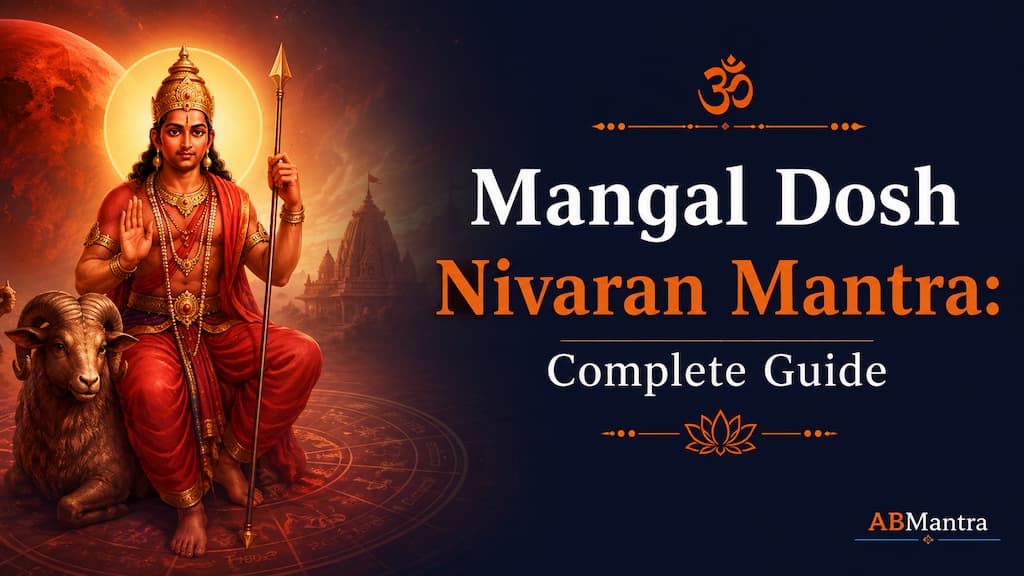
When to chant: Once at the beginning of Tuesday puja as the meditation shloka. Visualise Mars as a young warrior, red in colour, holding a spear, sitting on a ram.
3. Mangal Gayatri Mantra (For Daily Sustained Nivaran)
Mangal Gayatri Mantra
Sanskrit:
Om Angarakaya Vidmahe Bhoomipalaya Dhimahi
Tanno Bhaumah Prachodayat
Devanagari:
ॐ अंगारकाय विद्महे भूमिपालाय धीमहि
तन्नो भौमः प्रचोदयात्
Meaning: We know Angaraka (Mars, the red one). We meditate on Bhoomipalaya (the protector of Earth). May Bhouma (son of Earth, Mars) illuminate our path.
When to chant: 108 times daily : not only Tuesdays. This is the sustained daily nivaran practice, especially important during Mangal Mahadasha or Antardasha.
4. Gorakhnath Shabar Mantra for Mangal Dosh Nivaran
Manglik Dosh Nivaran Shabar Mantra (Gorakhnath Tradition)
Sanskrit:
ॐ सकल दोष बांधू मंगल बांधू उपद्रव बांधू
सातों द्वार नवकोट खीलूं
श्री गोरखनाथ शब्द सांचा पिण्ड काचा
फुरो मंत्र ईश्वरोवाचा।।
Transliteration:
Om Sakal Dosh Bandhu Mangal Bandhu Updrava Bandhu
Satoon Dwar Navkot Khiloon
Shree Gorakhnath Shabad Sancha Pind Kacha
Phuro Mantra Ishwarovacha
Meaning: In the name of Gorakhnath : bind all doshas, bind the Mangal affliction, bind all troubles. Lock all seven gateways and nine strongholds. The word of Gorakhnath is true, the body is a temporary vessel. May this mantra spoken by Ishwara take effect now.
Source: Nath Sampradaya Shabar tradition, attributed to Gorakhnath. This is the vernacular (Shabar) form of the Mangal Dosh remedy : more accessible and equally powerful in the Nath tradition.
Sadhana method: Start on Tuesday, ideally in a temple or before Lord Shiva. Wear red clothing. Sit on a red seat facing north. Light an oil lamp. Chant 5 rounds of mala (540 times) daily. Complete this for 4 consecutive Tuesdays. After completion, offer gifts (small red cloth or food) to young girls.
Mangalik Dosh Nivaran Puja Samagri: Complete Materials List
This is the complete list of items needed for the Tuesday Mangal Dosh Nivaran Puja. Keep all of these ready before beginning the practice.
| Item | Hindi name | Purpose | Quantity |
|---|---|---|---|
| Red flowers (hibiscus or rose) | लाल फूल (गुड़हल या गुलाब) | Primary offering to Mars | 21 or 108 flowers |
| Red cloth | लाल वस्त्र | Offered to Mars image or Hanuman; also worn by the practitioner | 1 piece (at least 1 meter) |
| Jaggery | गुड़ | Mars’s sweet : offered as Prasad and for Tuesday donation | 250 grams |
| Red lentils | मसूर दाल | Mars’s grain : donated on Tuesday to the needy | 250 grams |
| Copper pot or utensil | तांबे का बर्तन | Mars’s metal is copper : used as the offering vessel | 1 small copper pot |
| Ghee lamp | घी का दीपक | The primary flame for the puja | 1 diya with desi ghee |
| Red sandalwood paste | लाल चंदन | Applied as tilak on the Mars image or yantra | Small amount |
| Sesame seeds (black) | काले तिल | Offered to Mars : associated with Mars in the classical tradition | Handful |
| Sindoor | सिंदूर | Red vermilion : Mars’s colour, applied to the image | Small amount |
| Rudraksha or red coral mala | रुद्राक्ष या मूंगे की माला | For counting the 108 repetitions | 1 mala (108 beads) |
| Hanuman image or small idol | हनुमान जी की तस्वीर | Hanuman is the planetary deity who specifically governs and pacifies Mars | 1 image |
| Mangal Yantra (optional) | मंगल यंत्र | Geometric form of Mars energy : amplifies the mantra practice | 1 copper yantra if available |
Mangalik Dosh Nivaran Puja Vidhi: Complete Tuesday Worship Method
This is the complete step-by-step Tuesday Mangal Dosh Nivaran Puja method, combining the Vedic tradition’s prescriptions for Mars pacification.
Complete Tuesday Puja: Step by Step
Best time: Early morning (Brahma Muhurta: approximately 1 hour before sunrise) OR after sunset. Both are auspicious for Mars on Tuesdays. Morning is preferred for general practice; evening for Mangal Mahadasha and severe cases.
Step 1 : Preparation:
Bathe with clean water. Wear red clothing : red is Mars’s colour and wearing it on Tuesdays is itself a Mars remedy. Set up your puja space: spread a red cloth on the puja table. Place the Hanuman image or Mangal Yantra at the centre. Arrange the flowers, jaggery, copper pot and other samagri in front.
Step 2 : Ganesh Invocation (Sankalpa preparation):
Light the ghee lamp. Chant: Om Gam Ganapataye Namah : 11 times. This removes obstacles from the puja before it begins.
Step 3 : Sankalpa (Resolution):
Take water in your right palm. State your Sankalpa clearly: “I, [your name], son/daughter of [father’s name], of [gotra if known], performing this Mangal Dosh Nivaran Puja for the removal of Mars affliction from my birth chart and for the restoration of marital harmony and wellbeing in my life.” Release the water.
Step 4 : Hanuman Chalisa:
Recite the Hanuman Chalisa once. This is not optional : Hanuman is the planetary deity who specifically pacifies Mars. In the tradition’s understanding, Tuesday worship of Hanuman directly addresses Mangal Dosha because Hanuman represents the highest controlled expression of Mars energy. This single practice, done daily, is among the most powerful Mangal Dosh remedies available.
Step 5 : Dhyana Shloka (Mantra 1):
Chant the Vedic Dhyana Mantra once while visualising Mars: Dharanee Garbha Sambhootam Vidyut Kanti Samaprabham, Kumaram Shakti Hastam Tam Mangalam Pranamamy Aham. Offer red flowers.
Step 6 : Main Practice (Mantra 2):
Chant the Mangal Beej Mantra 108 times on the mala: Om Kraam Kreem Kraum Sah Bhaumaya Namah. Move one bead per complete mantra. Keep your eyes lightly closed and maintain focus on the mantra.
Step 7 : Mangal Gayatri (Mantra 3):
Chant the Mangal Gayatri Mantra 21 times: Om Angarakaya Vidmahe Bhoomipalaya Dhimahi Tanno Bhaumah Prachodayat.
Step 8 : Offerings:
Offer the red flowers one by one before the image. Offer jaggery as Prasad. Pour a small amount of water in the copper pot and offer it. Apply red sandalwood tilak to the image.
Step 9 : Closing prayer:
Sit in silence for 3 minutes. Then speak directly to Mars from your heart: what you are asking for and why. The tradition values sincere direct communication over formal recitation.
Step 10 : Tuesday Donation (Essential : do not skip):
Before the day ends: donate red lentils (masoor dal), red cloth, jaggery or copper coins to those in need, or leave at a temple. This charitable act on Tuesday is considered an essential dimension of the Mangal Dosh Nivaran : not an add-on. Mars’s karma is specifically discharged through this giving.
Manglik Dosh Ki Kaat: Alternative Practical Remedies
Beyond the mantra practice, the tradition prescribes several complementary remedies. These are the alternatives : choose those that fit your situation, faith and practical circumstances.
| Remedy | What it involves | How effective | Who it suits |
|---|---|---|---|
| Tuesday fast (Mangalvar Vrat) | Partial fast on Tuesdays : fruit only or one meal only. Break the fast in the evening after puja with red food (red lentils, tomatoes, jaggery). | Highly effective : voluntary austerity specifically appeals to Mars’s energy of discipline and controlled desire | Those who can sustain a weekly fast without health issues |
| Hanuman Chalisa daily | Recite the Hanuman Chalisa every morning without fail. On Tuesdays: recite twice. | The single most universally recommended Mangal Dosh remedy across all Jyotisha traditions. Hanuman controls Mars. | Everyone : no restrictions, no samagri needed, no specific timing required |
| Red coral gemstone (Moonga) | Wearing natural red coral in gold or copper setting on the ring finger of the right hand, on Tuesday morning after mantra chanting. | Powerful for WEAK Mars : strengthens Mars’s positive qualities. Not appropriate for everyone. | Only after qualified Jyotisha confirmation. Strengthening an already strong or malefic Mars can worsen the dosha. |
| 3 Mukhi Rudraksha | Wearing a 3 Mukhi Rudraksha (associated with fire/Agni and Mars pacification). Must be properly energised. | Good for reducing Mars’s aggressive expression and internal anger. Safer than red coral for uncertain cases. | Those who cannot get a Jyotisha assessment for gemstones : Rudraksha is generally safer |
| Kumbh Vivah | Symbolic marriage to a peepal tree, banana tree or Lord Vishnu idol before actual marriage. Performed by a qualified priest. | Specifically for severe cases: Mars in 8th house without cancellation conditions. Highly effective for this specific situation. | Only for severe Mangal Dosha before marriage, when a qualified Jyotisha has specifically recommended it |
| Mangalnath Mahadev, Ujjain | Visiting and worshipping at the Mangalnath Mahadev temple in Ujjain (the birthplace of Mars according to the Matsya Purana). Chanting the Beej Mantra 108 times at the temple. | The most powerful external remedy for Mangal Dosha. Even a single visit with sincere puja is considered highly effective. | For those who can make the trip. Vaitheeswaran Koil in Tamil Nadu is the equivalent for South Indian traditions. |
| Marrying another Manglik | The tradition holds that two Mangal Doshas in a marriage cancel each other out. | The single most effective Mangal Dosh remedy for the marriage dimension specifically : more effective than any mantra or gemstone for this purpose. | Only when the match is otherwise compatible : do not marry an unsuitable partner simply because they are Manglik |
| Mangal Shanti Homa | Formal fire offering performed by qualified priests with the Mangal Mantra chanted 10,000 times over multiple sessions. | Powerful intensive remedy : the professional equivalent of the home mantra practice compressed into a specific ritual event. | For severe cases or when home practice has not produced sufficient results after 6 months |
Cancellation Conditions: When Mangal Dosh Is Already Removed
The classical tradition describes specific conditions under which Mangal Dosha is automatically cancelled : the nivaran has already happened through the chart’s own configuration. Check these before following any remedy:
- Mars in Aries, Scorpio or Capricorn: Mars in its own signs (Aries, Scorpio) or exaltation (Capricorn) has its energy channelled constructively. The dosha is significantly weakened.
- Jupiter aspecting Mars: Jupiter’s aspect on Mars in the birth chart provides a wise, moderating influence that classical texts consider a genuine cancellation condition.
- Benefic planets (Jupiter or Venus) in the 7th house: Their presence counterbalances Mars’s malefic influence specifically in the house of marriage.
- Both partners are Manglik: The mutual Mars energy balances : the most universally recognised cancellation for the marriage dimension.
- Mars with Rahu or Ketu: In some traditions, the nodal axis conjunction with Mars neutralises the dosha.
- Born on Tuesday: A Manglik person born on Tuesday (Mars’s day) is said to have a stronger relationship with Mars energy, reducing the dosha’s negative impact.
Three Levels of Severity and Their Nivaran Timeline
| Severity | Mars placement | Primary remedy | Timeline for visible shift |
|---|---|---|---|
| Mild | 1st or 4th house, with some cancellation conditions present | Mantra practice + Hanuman Chalisa + Tuesday donation | 40 consecutive Tuesdays. First shift typically by Tuesday 21. |
| Moderate | 7th house : the marriage house. Active effects on relationship | Full puja vidhi + 40 Tuesdays + 108 days Mangal Gayatri daily + consider Kumbh Vivah if unmarried and marriage is repeatedly delayed | 40 Tuesdays for the puja practice. 108 days for the sustained daily Gayatri. |
| Severe | 8th house without cancellation conditions | Full puja vidhi + sustained mantra practice + Kumbh Vivah (if unmarried) OR Mangal Shanti Homa + Ujjain temple visit | Ongoing through the active Mars period in the dasha system. No fixed timeline : consistent practice is the prescription. |
From Our Practice
From Our Practice
In 30 years of Jyotisha practice, the Mangal Dosh consultation is among the most emotionally charged I handle. People come carrying years of anxiety about a label that was given to them sometimes carelessly, sometimes by astrologers who did not check for cancellation conditions, sometimes based on incomplete chart analysis.
The first thing I do in every Mangal Dosh consultation is check the cancellation conditions before prescribing any remedy. In my experience, approximately 40 to 50 percent of people who come to me having been told they have Mangal Dosha either do not have it in its classical form or have it with conditions that already neutralise it. For these people, the most important remedy I can offer is not a mantra but a correction: you do not have the problem you were told you have. The anxiety itself was the main issue.
For those who do have genuine Mangal Dosha, the combination I prescribe most consistently is: Hanuman Chalisa daily (the most powerful and universally accessible Mars remedy), the Beej Mantra 108 times every Tuesday, and the Tuesday charitable donation. These three together : maintained consistently over 40 Tuesdays : produce a genuine qualitative shift in the vast majority of mild to moderate cases.
The most important understanding I try to give every Manglik client is this: Mars is not your enemy. He is the planet of courage, decisive action, physical vitality and the protection of what is right. An afflicted Mars is not a curse : it is an invitation to develop the highest qualities of Mars deliberately rather than having their absence drive the problems the dosha creates. The mantra practice is not asking Mars to leave your chart. It is asking him to express his highest qualities through your life.
Frequently Asked Questions
❓ How do I know if I have Mangal Dosh : can I check it myself?
You need your complete birth chart (Janam Kundali) with the accurate birth time, date and place. Mars’s house position determines whether the dosha is present. The 1st, 4th, 7th and 8th houses create Mangal Dosha in the classical tradition. However, checking for cancellation conditions requires a more complete chart analysis : Mars’s sign, aspects from other planets, the 7th house’s complete picture. A free online kundali calculator can show you Mars’s house, but a qualified Jyotisha assessment is needed to properly determine severity and cancellation conditions. Do not begin major remedies like Kumbh Vivah based only on a free online check.
❓ I am already married. Does Mangal Dosh still apply and should I still do the mantra?
Yes, on both counts. For already-married people, Mangal Dosha continues to express itself through marital harmony, the spouse’s health, and the couple’s financial and domestic life. The Beej Mantra practice and Tuesday puja are not only pre-marriage remedies : they are ongoing practices that reduce the dosha’s active influence in married life. Kumbh Vivah, however, applies only before marriage. For already-married Mangliks, the complete Tuesday practice (Hanuman Chalisa + 108 Beej Mantra + donation) is the primary ongoing remedy.
❓ Which is the most powerful mantra for Mangal Dosh Nivaran?
The Mangal Beej Mantra (Om Kraam Kreem Kraum Sah Bhaumaya Namah) is the primary Vedic mantra for Mangal Dosh Nivaran and produces the most direct Mars pacification. The Gorakhnath Shabar Mantra (Om Sakal Dosh Bandhu Mangal Bandhu…) is the most powerful form in the Nath Sampradaya tradition : it specifically names the dosha and commands its binding. For complete nivaran, the Shabar Mantra sadhana (5 malas for 4 Tuesdays) combined with the daily Beej Mantra is the strongest available combination. But the single most universally effective Mars remedy : which the tradition consistently places above formal mantra for most practitioners : is the Hanuman Chalisa chanted daily.
❓ How long should I chant the Mangal Dosh Nivaran Mantra to see results?
For mild Mangal Dosha: the classical prescription is 40 consecutive Tuesdays of 108 repetitions of the Beej Mantra alongside Hanuman Chalisa and the Tuesday donation. Most practitioners report the first qualitative shift between Tuesday 21 and Tuesday 40 : typically an internal shift first (reduction in the specific anxiety or anger pattern the dosha was generating) followed by external shifts (obstacles in relationships beginning to reduce). For moderate to severe cases: the practice continues beyond 40 Tuesdays, ideally throughout the active Mangal period in the dasha system. Do not assess results after only 3 or 4 Tuesdays : Mars moves slowly and the nivaran process reflects this.
❓ Can unmarried women chant the Mangal Dosh Nivaran Mantra?
Yes, without restriction. The Mangal Dosh Nivaran Mantra has no gender restrictions. Women chant the Beej Mantra, perform the Tuesday puja and observe the Tuesday fast without restriction. The Hanuman Chalisa is also open to all. The Gorakhnath Shabar Mantra sadhana is equally available to women. Mars’s influence in the birth chart affects everyone : male and female : and the remedies are prescribed for all. For women specifically: the Katyayani Mantra alongside the Mangal Beej Mantra is an effective combination when Mangal Dosha is specifically creating marriage delays.
❓ Do I need a pandit or can I perform the Mangal Dosh Nivaran Puja myself at home?
The home puja described in this article : Hanuman Chalisa + Beej Mantra 108 times + donation : is completely self-administered and does not require a pandit. The Bhagavata Purana and other classical texts affirm that personal sincere practice is as effective as priest-mediated ritual. A pandit is specifically needed for the Mangal Shanti Homa (fire offering with 10,000 mantra repetitions) and for the Kumbh Vivah ceremony : both of which are more intensive formal rituals. For daily and weekly practice, the home puja is both sufficient and the primary method the tradition prescribes for householder practitioners.
Begin This Tuesday
The next Tuesday is your starting point. Assemble the samagri: red flowers, ghee lamp, jaggery, red cloth, a mala. Wear red. Set up before the Hanuman image. Light the lamp. Recite the Hanuman Chalisa. Chant the Dhyana shloka once. Then 108 times of Om Kraam Kreem Kraum Sah Bhaumaya Namah. Sit in silence for 3 minutes. Then the donation.
Return every Tuesday. Maintain the daily Hanuman Chalisa between Tuesdays. Give on every Tuesday without fail. These three : mantra, Hanuman, giving : are the complete Mangal Dosh Nivaran practice the tradition has prescribed for centuries. Maintained consistently over 40 Tuesdays, they produce genuine results in the vast majority of cases.
Mars is the planet of action. He responds to consistent disciplined action more than to intensity. Begin this Tuesday. Return next Tuesday. The nivaran is a process, not an event : and every Tuesday you maintain the practice, the process advances.
Sources
- Wikipedia : Kuja Dosha: classical Mangal Dosha definition, the 4/6 house traditions, Kumbh Vivah remedy and Manglik-Manglik cancellation
- Brihat Parashara Hora Shastra : the primary classical Jyotisha source for Mars’s house significations and the specific houses creating Mangal Dosha; cancellation conditions including Jupiter’s aspect
- Matsya Purana : origin of Mars (Mangala/Kuja) from Lord Shiva at Ujjain; Mangalnath Mahadev as the primary Mars deity and pilgrimage for Mars-related remedies
- Nath Sampradaya Shabar Mantra tradition : Gorakhnath Manglik Dosh Nivaran Shabar Mantra source, 4-Tuesday sadhana method and post-sadhana offering to young girls
Narendra Kumar Chaubey is a Jyotisha Acharya with over 30 years of experience, based in Bihar and serving clients across India in Vedic astrology, mantra shastra, Vastu and ritual practice.
He completed his formal training at Kameshwar Singh Darbhanga Sanskrit University (KSDSU), one of India’s oldest and most respected institutions for Vedic and Sanskrit scholarship, where he studied Jyotisha shastra, mantra vidya and related classical sciences. KSDSU’s tradition of rigorous Sanskrit education tracing directly to the Mithila region’s centuries-old pandit lineage forms the foundation of his practice.
Over three decades, Narendra Kumar Chaubey has worked with thousands of individuals and families across Bihar and across India, offering guidance in:
- Kundli (birth chart) analysis: Identifying karmic patterns, planetary periods and life path guidance through classical Jyotisha
- Palmistry (Hasta Samudrika): Reading the hand according to the classical Samudrika Shastra tradition
- Vastu Shastra: Assessment and correction of living and working spaces according to directional and elemental principles
- Mantra and Pooja vidhi: Performing and guiding all categories of puja, havan, and mantra sadhana for personal, family and business situations
- Predictive Jyotisha: Transit analysis, muhurta (auspicious timing) selection and remedial guidance
He works across four languages Sanskrit, Hindi, English and Bhojpuri making classical knowledge accessible to practitioners across educational backgrounds and regions.
His writing for ABMantra brings the precision of classical Vedic training to practical mantra guidance: not general advice but specific prescriptions grounded in shastra, lineage and 30 years of direct practice with real situations.
For more info follow on: