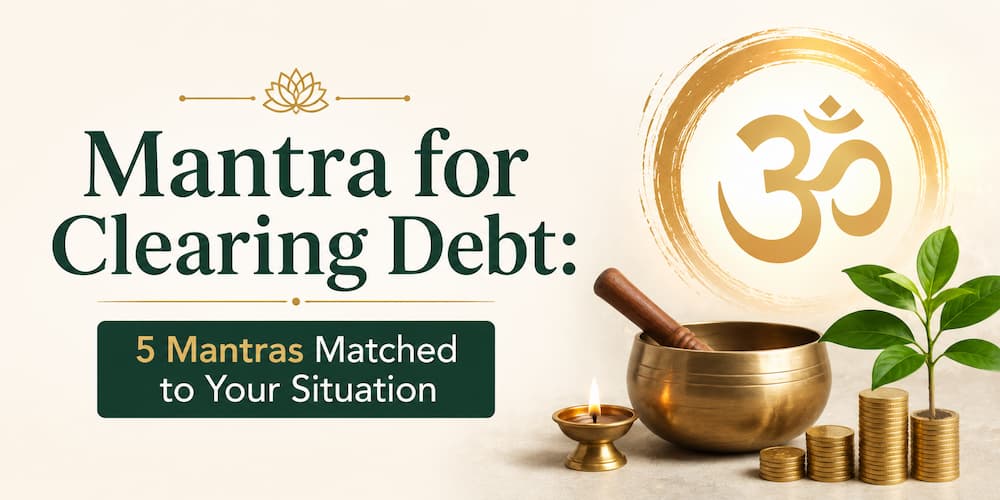

Quick Answer
The primary mantra specifically designed for debt removal is the Rin Mochan Mangal Stotra mantra (Rin = debt, Mochan = liberation):
Om Namo Bhagavate Narasimhaya Dhan Runa Vimochanaaya Namah
ॐ नमो भगवते नरसिंहाय धन ऋण विमोचनाय नमः
Meaning: Om. I bow to Lord Narasimha, the liberator from financial debts and hardships.
Chant 108 times daily. Begin on a Tuesday. Continue for 40 days minimum. For business debt: add the Kuber Mantra on Thursdays.
Who This Article Is For
This article is for you if: you have taken loans that you cannot repay and are under serious financial pressure | you want to know which mantra the classical tradition specifically prescribes for debt, not just for general wealth | you want the complete practice method and realistic timeline.
Important note: Mantra practice works alongside practical financial management : restructuring debt, managing expenses, seeking professional financial advice. The mantra removes energetic and karmic obstructions to repayment. It does not replace the practical steps.
Debt is different from poverty. Poverty is the absence of wealth. Debt is the presence of an obligation that exceeds current capacity. The Vedic tradition recognises this distinction and has specific mantras for debt relief that are different from the general wealth attraction mantras.
Here is what most debt mantra articles get wrong: they recommend the Lakshmi Mantra for debt. The Lakshmi Mantra is a wealth attraction mantra. Debt relief requires something different: the energy of liberation from obligation, of cutting the binding threads of financial pressure. The tradition uses Mars (Mangal), Ganesha, Narasimha and Hanuman for debt relief : not Lakshmi. Each one addresses a different dimension of debt.
Why the Tradition Uses Different Deities for Debt
Rin (ऋण) is the Sanskrit word for debt. It means both financial debt and karmic obligation. The tradition understands that financial debt and karmic debt are connected: a person who cannot repay financial obligations often has a pattern of karmic debt : obligations from past actions, past lives or ancestral patterns that manifest as persistent financial difficulty.
| Type of debt | Vedic understanding | Primary deity | Mantra |
|---|---|---|---|
| Sudden unexpected debt (medical, accident, emergency) | External event disrupted financial balance. Mars (Mangal) governs sudden events and their resolution. | Mars / Mangal | Rin Mochan Mangal Stotra |
| Business debt : loans for business that are not repaying | Jupiter (Guru) governs dharmic commerce and Kuber governs commercial wealth. Business debt involves both. | Kuber + Jupiter | Kuber Mantra + Jupiter Beej on Thursdays |
| Chronic debt : always in debt despite income | Karmic pattern. Ganesha as obstacle remover, Narasimha as destroyer of binding forces. | Ganesha + Narasimha | Ganesha Rin Hartaye Mantra + Narasimha debt mantra |
| Debt causing fear, paralysis and depression | Hanuman governs strength, courage and the removal of fear. When debt has created psychological paralysis, Hanuman mantra addresses the psychological dimension alongside the financial. | Hanuman | Rin Mochan Mangal Stotra on Tuesdays + Hanuman Chalisa daily |
| Ancestral debt pattern : debt in every generation of the family | Pitra Dosha (ancestral karmic debt). Requires Pitra Dosha remedy alongside the specific debt mantra. | Ancestors + Vishnu | Pitra Dosha mantra + Narasimha debt mantra |
Mantra 1: Narasimha Debt Liberation Mantra (Primary)
Lord Narasimha is the half-lion, half-man avatar of Vishnu who destroyed the demon Hiranyakashipu. The demon’s name literally means “golden mat” : he is the embodiment of attachment to gold and material wealth. Narasimha destroyed this attachment. In the debt context, the Narasimha mantra destroys the binding grip of financial obligation : the psychological and karmic threads that keep a person trapped in debt.
Narasimha Debt Liberation Mantra
Sanskrit: Om Namo Bhagavate Narasimhaya Dhan Runa Vimochanaaya Namah
Devanagari: ॐ नमो भगवते नरसिंहाय धन ऋण विमोचनाय नमः
Word-by-word meaning:
Om: primordial invocation
Namo Bhagavate: salutations to the divine Lord
Narasimhaya: to Narasimha (the man-lion avatar of Vishnu)
Dhan: wealth, financial
Runa: debt, obligation
Vimochanaaya: liberation from, release from (Vi = away from, Mocha = liberation)
Namah: I bow, I surrender
Count: 108 times daily
Day to begin: Thursday (Vishnu’s day)
Duration: 40 consecutive days
Mantra 2: Ganesha Rin Hartaye Mantra (For Chronic Debt Pattern)
Rin Hartaye means the one who takes away debt. Ganesha in his Rin Hartaye form is invoked specifically for breaking the cycle of chronic debt. This mantra is from the Brahmanda Purana tradition and is considered particularly effective when debt has become a repeating life pattern rather than a single crisis.
Ganesha Rin Hartaye Mantra
Sanskrit: Om Shreem Gam Runa Hartaye Gam Shreem Om Ganapataye Namah
Devanagari: ॐ श्रीं गं ऋण हर्तायै गं श्रीं ॐ गणपतये नमः
Meaning: Om. Through Shreem (Lakshmi’s abundance beej) and Gam (Ganesha’s beej), I invoke Ganesha in his form as the taker-away of debt. Salutations to Ganapati.
Structure: The mantra places Shreem (Lakshmi) on both sides of the Rin Hartaye invocation. Ganesha removes the obstacle of debt while Lakshmi fills the space left by the removal with abundance. This dual structure is what makes this mantra specifically effective for the chronic pattern rather than the single crisis.
Count: 108 times daily. Wednesday or Thursday.
Duration: 6 months for deeply established chronic debt patterns, per the Rinmochan Mahaganapati Stotra tradition from Brahmanda Purana.
Mantra 3: Rin Mochan Mangal Stotra (Tuesday Practice)
The Rin Mochan Mangal Stotra is a hymn to Mars (Mangal) as Rin Mochan, the debt-liberator. The tradition explains this through Mars’s nature: Mars governs energy, action, and the cutting of binding threads. Financial debt is understood as a binding : it constrains freedom of action in the world. Mars, as the planetary energy that cuts through obstruction, is the appropriate deity to invoke for debt liberation.
Rin Mochan Mangal Opening Verse
Sanskrit:
Mangalo Bhoomi Putrascha Runahartha Daana Pradha
Sthirasano Mahakaya Sarva Karma Virodhaka
Meaning: Mars, son of Earth, is the destroyer of debt and the giver of wealth. He has a stable seat, a great body, and he overcomes all obstacles to action.
The key phrase is Runahartha: Runa = debt, Hartha = destroyer. Mars as the destroyer of debt. This stotra is chanted on Tuesdays specifically because Tuesday is Mangalvar, Mars’s day.
Method: Chant the full Rin Mochan Mangal Stotra on Tuesdays. For the daily practice, use the Narasimha mantra (108 times daily) and reserve the full Mangal Stotra for Tuesday. The two practices work at different levels and complement each other.
The Complete 40-Day Debt Liberation Practice
Week-by-Week Structure
| Day | Practice | Count |
|---|---|---|
| Monday, Wednesday, Friday, Saturday, Sunday | Narasimha debt mantra: Om Namo Bhagavate Narasimhaya Dhan Runa Vimochanaaya Namah | 108 times |
| Tuesday | Rin Mochan Mangal Stotra (full text) + Narasimha mantra | Full Stotra once + 108 Narasimha mantra |
| Thursday | Kuber Mantra (Om Yakshaya Kuberaya… 108 times) + Narasimha mantra | 108 Kuber + 108 Narasimha |
Additional Practices During the 40 Days
- Do not borrow any new money during the 40-day period if at all possible. The practice is specifically about cutting the cycle of debt. Adding new debt during the practice works against it directly.
- On each Tuesday, give away a small amount : whatever you can, to someone in genuine need. This is not optional in the tradition: the Mars debt mantra tradition requires an act of giving on the day of chanting. You are creating the energetic opposite of debt.
- Keep a ghee lamp burning during every chanting session. Narasimha is associated with fire : the light that destroys darkness and attachment.
The Most Important Rule
Do not use this mantra practice as a reason to delay practical financial action. The mantra is not a substitute for contacting lenders, restructuring loans, cutting expenses, or seeking professional financial advice. It is a parallel practice that addresses the energetic and karmic dimension of debt alongside the practical financial dimension.
In the tradition, this is stated directly: the mantra removes what is unseen (the karmic and energetic binding). The practical action addresses what is seen (the financial situation). Both are needed. Neither alone is sufficient.
What to Realistically Expect
Most practitioners report the following sequence of changes during a 40-day debt liberation practice:
- Days 1 to 10: The internal state shifts first. Anxiety about debt, which often creates a paralysing fear that makes clear thinking impossible, begins to ease. This is not the debt resolving. It is the psychological grip of the debt loosening : which is what makes it possible to think clearly about practical solutions.
- Days 11 to 21: Unexpected opportunities to address the debt begin to appear. Not necessarily the debt disappearing but pathways emerging: a lender agreeing to restructure, an unexpected income source, a payment from someone who owed money arriving without prompting.
- Days 22 to 40: The direction is clearer. The debt has not necessarily resolved but the energetic suffocation of it has lifted enough to allow purposeful action.
- After Day 40: Continue the Tuesday Rin Mochan Mangal Stotra as a weekly maintenance practice until the debt is fully cleared.
From Our Practice
From Our Practice
A member of our Chinmaya Mission study group found himself with a business loan he could not service after his primary client cancelled a contract unexpectedly. The debt was real, significant and urgent. Banks would not restructure without security he did not have.
He began the 40-day practice: Narasimha debt mantra daily, Rin Mochan Mangal Stotra every Tuesday, Kuber Mantra every Thursday. He also, on each Tuesday, gave away whatever was in his wallet that day to someone at the roadside : even when it was very little.
On Day 23, a contact he had not spoken to in three years called about a project. The project did not fully solve the debt but it created enough cash flow to approach the bank with a credible restructuring proposal. The bank agreed on Day 35.
He said something that has stayed with me: “The mantra did not bring money. It gave me back the ability to think. And when I could think clearly, I could see what to do.” That description of clearing the energetic paralysis of debt : which is its most damaging dimension : is the most honest account of what this practice does.
Frequently Asked Questions
❓ I have a home loan I cannot repay and the bank is threatening action. Which mantra do I start with today?
Start with the Narasimha debt mantra today : Om Namo Bhagavate Narasimhaya Dhan Runa Vimochanaaya Namah, 108 times. You do not need to wait for Thursday to begin. Any day is valid for the Narasimha mantra. On the next Tuesday, add the Rin Mochan Mangal Stotra. Contact the bank simultaneously : the mantra practice is not an alternative to practical communication with lenders. The two must happen together.
❓ Should I chant the Lakshmi Mantra for debt or is that not the right mantra?
The Lakshmi Mantra (Om Shreem Mahalakshmiyei Namaha) is a wealth attraction mantra. It is excellent for general prosperity. For debt specifically, the Narasimha and Ganesha Rin Hartaye mantras are more directly targeted because they address liberation from obligation rather than attraction of abundance. Chant the debt-specific mantras as your primary practice and add the Lakshmi Mantra on Fridays as a secondary practice for attracting the income needed to service the debt.
❓ My whole family has always been in debt : my father, his father before him. Is there a mantra for this generational pattern?
The generational pattern suggests Pitra Dosha (ancestral karmic debt). Begin the Ganesha Rin Hartaye Mantra (Om Shreem Gam Runa Hartaye Gam Shreem Om Ganapataye Namah) as your primary daily practice : this is the mantra from the Brahmanda Purana specifically for breaking chronic karmic debt patterns. Combine it with Pitra Tarpan (water offering to ancestors) on the new moon. The generational pattern requires six months of consistent practice as prescribed in the Rinmochan Mahaganapati tradition : do not expect a 40-day result for a multi-generational pattern.
❓ I am not Hindu. Can I use these mantras for debt relief?
The mantras address the energetic dimension of debt : the karmic binding of financial obligation : through specific vibrational frequencies. The tradition does not claim these vibrations are restricted to Hindu practitioners. What is required is sincere intention, consistent practice, and practical parallel action on the financial dimension. These conditions do not depend on religious identity.
❓ How long until the debt actually clears?
The mantra does not specify a timeline because debt resolution depends on both the energetic work and the practical financial work. What the tradition documents is that the energetic grip of debt (the psychological paralysis and anxiety) typically eases within 11 to 21 days of sincere practice. The practical resolution : actual repayment or restructuring : follows when that paralysis is removed and clear action becomes possible. In most cases documented in the tradition, significant movement on debt resolution appears within 30 to 90 days of beginning the full 40-day practice combined with practical financial action.
❓ Should I do this practice in secret or can I tell others?
Do not disclose an active sadhana to others while it is in progress. This is standard guidance across the Vedic tradition for personal practice : disclosing an ongoing practice disperses its energy. After the 40 days are complete, there is no restriction on discussing the practice or its results. During the practice period, keep it private.
Begin Today
Sit down now. Close your eyes. Take three slow breaths.
Chant Om Namo Bhagavate Narasimhaya Dhan Runa Vimochanaaya Namah 21 times. Slowly. Hear the word Vimochanaaya : liberation from. Not accumulation of, but liberation from. That is the direction of this mantra. Not toward wealth but away from obligation.
Return tomorrow with 108 repetitions. And on Tuesday, add the Rin Mochan Mangal Stotra. And contact whoever you need to contact about the practical dimension of the debt.
Both. Always both. The mantra and the action. The energetic work and the practical work. Neither alone is the complete practice.
Sources
- Powerful Mantras to Clear Debts and Loans. Hindutone, July 2025. Narasimha debt mantra Sanskrit text and meaning; Lakshmi mantra as secondary practice
- Mantra Yantra and Remedies to Remove Debts. Prophet666, October 2023. Rin Mochan Mangal Stotra Tuesday practice; unexpected help in loan repayment
- Rin Mochan Maha Mangal Puja. Rudralife, June 2025. Rin and Mochan etymology; Hanuman connection; Tuesday ritual structure
- 7 Powerful Debt Removal Remedies. LifeGuru. Rinmochan Mahaganapati Stotra from Brahmanda Purana; 6-month timeline for chronic patterns
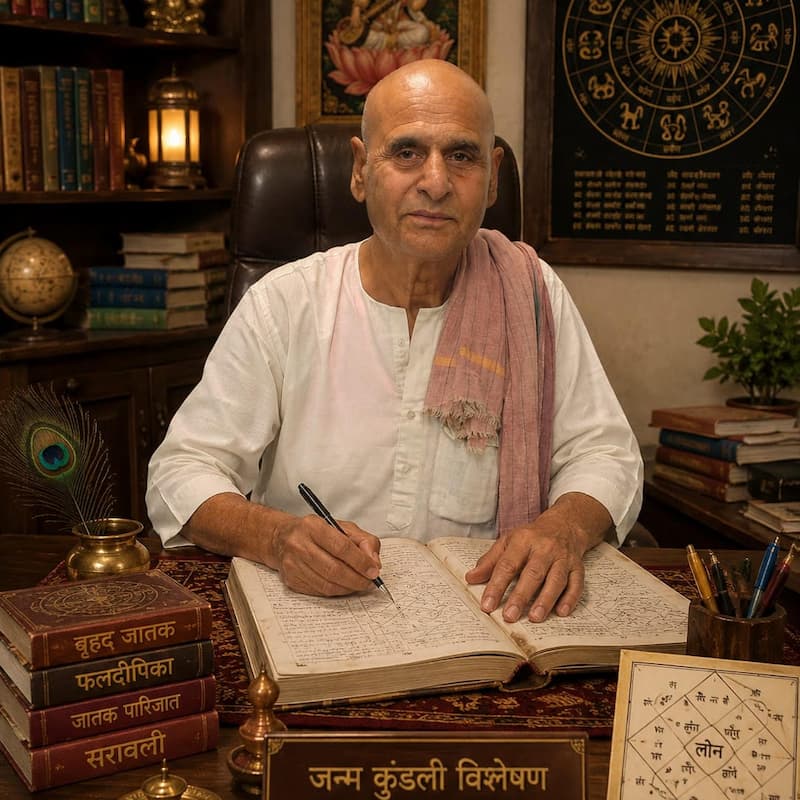
Narendra Kumar Chaubey is a Jyotisha Acharya with over 30 years of experience, based in Bihar and serving clients across India in Vedic astrology, mantra shastra, Vastu and ritual practice.
He completed his formal training at Kameshwar Singh Darbhanga Sanskrit University (KSDSU), one of India’s oldest and most respected institutions for Vedic and Sanskrit scholarship, where he studied Jyotisha shastra, mantra vidya and related classical sciences. KSDSU’s tradition of rigorous Sanskrit education tracing directly to the Mithila region’s centuries-old pandit lineage forms the foundation of his practice.
Over three decades, Narendra Kumar Chaubey has worked with thousands of individuals and families across Bihar and across India, offering guidance in:
- Kundli (birth chart) analysis: Identifying karmic patterns, planetary periods and life path guidance through classical Jyotisha
- Palmistry (Hasta Samudrika): Reading the hand according to the classical Samudrika Shastra tradition
- Vastu Shastra: Assessment and correction of living and working spaces according to directional and elemental principles
- Mantra and Pooja vidhi: Performing and guiding all categories of puja, havan, and mantra sadhana for personal, family and business situations
- Predictive Jyotisha: Transit analysis, muhurta (auspicious timing) selection and remedial guidance
He works across four languages Sanskrit, Hindi, English and Bhojpuri making classical knowledge accessible to practitioners across educational backgrounds and regions.
His writing for ABMantra brings the precision of classical Vedic training to practical mantra guidance: not general advice but specific prescriptions grounded in shastra, lineage and 30 years of direct practice with real situations.
For more info follow on: