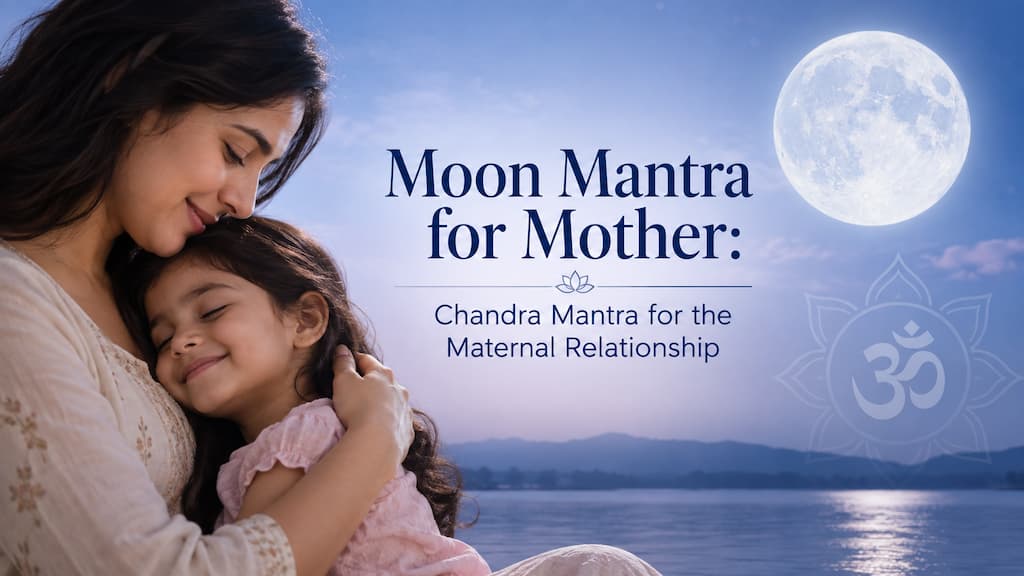

People searching for the moon mantra for mother are rarely doing so from a place of ease. The relationship with one’s mother is working well, no one goes looking for a mantra. What brings someone to this search is usually one of three things: a relationship with their mother that carries old pain or present distance; a mother whose health is declining and they feel helpless; or a mother who has died, and the grief of that is ongoing. The Chandra mantra addresses all three. But it does so differently for each, and most articles about this topic treat them as the same situation.
The moon mantra for the mother is the prescription I give most carefully. Not because it is dangerous – it is not – but because the people who need it are often in real pain, and I want to be precise about what it can and cannot do.
What it can do: it builds the practitioner’s own capacity to receive nourishment. It softens the emotional guardedness that a difficult maternal history creates. Over 40 to 60 days of consistent practice, most practitioners notice that they are slightly more able to receive care from people who genuinely offer it – friends, partners, their own children. This is the Moon’s nourishing quality building from within. It is not dramatic. But it is real and it compounds over time.
What it cannot do: it cannot change a mother who is genuinely harmful or permanently unavailable. It cannot give you the childhood you did not have. It cannot resolve grief on a schedule. The clients who expect those outcomes are disappointed. The clients who practice it as a process of inner nourishment – not a petition for the external situation to change – tend to report meaningful shifts within 60 to 90 days.
For practitioners whose mothers have died: I recommend the Amavasya practice specifically, not because I can prove it does what the tradition claims it does, but because it gives grief a container. Something you do on a regular schedule that says: I still have a relationship with you, even now. Grief benefits from ritual. The Amavasya water offering with the mother’s name spoken aloud is a small, private, regular act of maintaining the relationship – and that, I have found, is what grief most needs.
Why the Moon Is Specifically the Planet of the Mother
In Vedic astrology, every significant relationship and life theme has a Karaka – a planetary significator that governs it. The Moon is the Matrukaraka, the significator of the mother. This is not a loose association. It is specific.
The Moon governs the mother because it governs nourishment, receptivity, emotional care and the quality of being held and sustained. These are what a mother provides to a child – or fails to provide when the relationship is difficult. The Moon also governs the quality of the practitioner’s inner life: the capacity to receive nourishment from others, to feel emotionally safe, to trust that care is available. A person whose Moon is weak or afflicted in the chart often has a complicated relationship with their own mother – not always because the mother is a difficult person, but because the Moon’s weakness creates a barrier to receiving the nourishment that may actually be on offer.
The 4th house is the second astrological indicator of the mother. Where the Moon is the Karaka (the planetary significator), the 4th house is the Bhava (the house) – the part of the chart where the mother’s specific presence in the practitioner’s life shows up. When both the Moon and the 4th house are afflicted – the Moon weak and the 4th house lord under malefic influence – the maternal wound tends to run deeper and the mantra practice needs more time and more consistency.
Moon as Matrukaraka and 4th house as the house of mother together describe two dimensions of the same relationship: the planetary quality (how you receive nourishment) and the house quality (how the actual mother shows up in your life).
The Three Situations – and What Each Needs
Situation 1: The relationship with a living mother is difficult or distant
This is the most common reason people search for this mantra. The relationship is complicated – old wounds, long silences, the specific pain of loving someone you also find difficult, or the sadness of a connection that never quite became what you hoped it would be.
What the Chandra mantra does here is not what most people expect. It does not directly change the mother. It changes the practitioner’s inner relationship with the maternal energy – which, over time, creates the conditions in which the outer relationship can shift. Specifically: a weak or afflicted Moon produces a quality of emotional guardedness in the practitioner, a difficulty in being genuinely received or in genuinely receiving others. The mantra, practiced consistently, softens this quality. The practitioner becomes more able to receive what is actually available in the relationship, however imperfect. And sometimes the mother, feeling less resistance or more warmth in the practitioner, responds differently. Neither outcome is guaranteed. But the inner shift is consistent.
The mantra most appropriate for Situation 1: Om Som Somaya Namah – the nourishing Soma form. Chanted before sleep (21 times), with the specific intention of opening the practitioner’s own capacity to receive maternal care, imperfect as it may be. Not as a petition to change the mother, but as a practice of softening the practitioner’s own emotional guardedness.
Situation 2: The mother’s health is declining or in crisis
The tradition has a clear position on this: you can chant the Chandra Beej Mantra for another person’s benefit. When chanting for a mother’s health specifically, the standard protocol is the same as chanting for any ill person – hold the mother clearly in mind throughout the practice, include her name in the Sankalpa, and direct the mantra’s nourishing quality toward her.
The Moon’s governance of the body is specific: bodily fluids, the lymphatic system, the hormonal system, the immune system’s nourishing functions, and the overall vital fluid quality of the body. Moon-related health issues include water retention, hormonal imbalance, conditions that fluctuate with the lunar cycle, and the general depletion of vital fluids that comes with aging. The Chandra mantra for a mother’s health specifically addresses these Moon-governed dimensions of physical wellbeing.
The mantra most appropriate for Situation 2: Chandra Beej Mantra – Om Shraam Shreem Shraum Sah Chandramase Namah – chanted 108 times with the mother held in mind. For an acute health situation: 1,008 times daily if possible.
Situation 3: The mother has passed – grief and the ongoing relationship
This is the situation no competitor article addresses. The Moon governs the mother in Jyotisha – and this governance does not end at death. The Vedic tradition holds that the relationship with departed parents continues through the Pitru dimension: the ancestor realm that the Moon, as the gateway to and from this world, specifically presides over.
The Chandra mantra for a deceased mother serves two functions that are worth distinguishing. First: it is a grief practice for the practitioner. The Moon governs grief specifically – the tides of loss that come and go, the way grief peaks at certain times (often at the full Moon, when all emotional experience is amplified), the emotional processing that has no clear endpoint. Chanting the Chandra mantra during grief is not asking for the grief to stop. It is asking for the Moon’s nourishing quality to sustain you through it.
Second: it is an offering to the mother’s departed soul. The Pitru Tarpana practice – offering water to ancestors while naming them – is specifically a Moon ritual: performed on Amavasya (new Moon), facing south (the direction of Pitrus), near water. For a practitioner whose mother has recently died, adding the Chandra mantra to the Amavasya Tarpana creates a complete practice: the water offering addresses the ancestral dimension, and the mantra addresses both the practitioner’s grief and the ongoing energetic connection with the maternal spirit.
The Primary Mantras for Each Situation
For Situation 1 (relationship difficulty):
21 times before sleep with the specific sankalpa: “May I become more able to receive what is genuinely available in this relationship.” Not: “May my mother become different.” The distinction matters. The mantra works on the practitioner’s receptivity, not on the mother’s behaviour.
Monday morning: 108 times, white flowers offered to a Chandra image or to the Moon itself if visible at dawn.
For Situation 2 (mother’s health):
108 times daily. Hold the mother clearly in mind throughout. State the Sankalpa: “I chant this mantra for the health and wellbeing of [mother’s name]. May Chandra’s nourishing quality sustain her body and ease her suffering.”
For acute health situations: 1,008 times daily. On Mondays: offer milk and white flowers before chanting. The Arghya (milk offering to the Moon on Purnima) can be performed on the mother’s behalf: the practitioner holds the mother in mind while offering the milk, explicitly stating that the offering is made for her benefit.
For Situation 3 (deceased mother, grief):
The Amavasya practice: On Amavasya (new Moon) – the monthly day for ancestor remembrance – perform Pitru Tarpana if you know the procedure (offering water while naming the mother, facing south, near water). Then: Om Som Somaya Namah 108 times, with the mother’s name held in the Sankalpa.
The Pitrapaksha practice: The 15-day period of Pitrapaksha (Shradh) in Bhadrapada-Ashvin (September-October) is the annual period most concentrated for ancestor connection. During this period, the Chandra mantra for a deceased mother is chanted daily. 108 times minimum. Milk offering on the Amavasya that falls within Pitrapaksha is the most concentrated single practice of the year for this intention.
The grief practice at any time: When grief peaks – at the anniversary of the death, on the mother’s birthday, at unexpected moments of loss – Om Som Somaya Namah chanted slowly, without counting, simply until the acute wave of grief passes. The Moon is the planet of grief. His mantra does not stop it. It carries you through it.
Matru Shakti: The Internal Mother
This is the dimension of the Moon-mother relationship that no competitor article touches, and it may be the most important one for practitioners who come from difficult maternal backgrounds.
In Vedic understanding, the Moon governs not only the external mother but the internal maternal principle – Matru Shakti, the capacity within every person to nourish themselves, to provide their own emotional sustenance, to be a caring presence for themselves. A person who did not receive adequate maternal nourishment in childhood typically has a corresponding weakness in this internal capacity. They find it difficult to rest, to ask for help, to allow themselves to receive care, to practise basic self-nourishment. They may work constantly, neglect sleep, dismiss their own emotional needs, and be far more capable of giving care than receiving it.
This is a Moon pattern. And the Chandra mantra addresses it.
Practitioners who come from difficult maternal backgrounds often notice that the first changes from consistent Chandra mantra practice are in their relationship with themselves: they begin, slowly and sometimes reluctantly, to allow themselves more rest. They find it slightly easier to ask for help. The quality of self-criticism softens a little. These are not dramatic events. But they are the Moon’s nourishing quality working from the inside out – building the internal Matru Shakti that a nourishing external mother would have built from the outside in.
The clearest indication that Matru Shakti is the actual issue – rather than simply the external relationship – is this: the difficulty persists even when the mother is no longer in the picture. When she has died, or when contact has been severed, the pattern remains. The person still cannot rest. They still over-function and under-receive. They still find it easier to give care than to accept it. This is because the external mother was not the source of the wound; she was the occasion for it. The wound lives in the Manas – in the Moon itself. And the Moon is inside you, not outside.
Practitioners who come from genuinely harmful maternal backgrounds – not merely difficult ones, but genuinely harmful – sometimes resist the idea that the mantra can help them. Their argument is reasonable: the damage was real, it was external, and no mantra changes what happened. That is correct. The mantra does not change what happened. What it changes is the Moon’s current capacity to give what it genuinely has – which, even in a person with a deeply wounded maternal history, is real and available. The Soma quality (nourishment, warmth, the capacity to receive care) was not destroyed by the difficult childhood. It was suppressed and made unavailable. The mantra’s job is to make it available again. One small increment at a time, over months of consistent practice.
The Moon cannot give you the childhood you did not have. But it can build, gradually, the internal mother that adult life requires. That is what the mantra is doing when the external maternal relationship is genuinely beyond repair.
Frequently Asked Questions
The Chart Indicators for Maternal Relationship Difficulty
| Chart indicator | What it typically produces | Mantra emphasis |
|---|---|---|
| Moon in Scorpio (debilitation) |
The practitioner’s relationship with the mother tends toward emotional intensity – either very close and almost suffocating, or distant and guarded. The Scorpio Moon’s characteristic emotional secretiveness often creates difficulty in the maternal relationship because genuine vulnerability is hard in both directions. | Om Som Somaya Namah before sleep. Builds the capacity for emotional openness that Scorpio Moon finds difficult. Also: Om Rohinikantaya Namah on Mondays – Rohini’s open, nourishing quality is the antidote to Scorpio’s guardedness. |
| Moon-Saturn (Visha Yoga) | The maternal relationship often carries a quality of emotional coldness – not necessarily hostility, but absence of warmth. The mother may have been physically present but emotionally unavailable. The practitioner often carries an inner sense of having been a burden rather than a delight. | Chandra Beej Mantra daily + Maha Mrityunjaya on Saturdays. The Moon mantra builds nourishing warmth; the Mrityunjaya specifically addresses Saturn’s cold contracting quality. |
| Moon-Rahu (Shakata Yoga) | The maternal relationship is often chaotic, unpredictable or boundary-dissolving. The mother may have been emotionally overwhelming in some periods and absent in others. The practitioner often has difficulty trusting that care is stable and reliable. | Chandra Beej Mantra daily + Rahu mantra on Saturdays. The Moon mantra builds stable nourishment; the Rahu mantra addresses the boundary-dissolving, unstable quality of Rahu’s maternal influence. |
| 4th house lord afflicted | The mother as a specific person (the 4th house) rather than as a principle (the Moon) has been a source of difficulty. This can manifest as the mother being genuinely harmful, absent, or compromised in ways that go beyond the Moon’s emotional quality. | Both the Moon mantra (for the emotional-nourishment dimension) and the mantra of the 4th house lord’s planet (for the specific house dimension). A qualified Jyotisha reading is needed to identify the 4th house lord in a specific chart. |
| Moon in 6th, 8th or 12th house | The maternal relationship sits in a house of difficulty, hidden matters, or dissolution. The 6th house Moon often produces a relationship with the mother that involves service and obligation rather than easy connection; the 8th house Moon often involves significant emotional intensity and transformation; the 12th house Moon often involves emotional distance or a mother who was somehow unavailable. | Om Som Somaya Namah for the nourishment dimension + Chandra Beej Mantra for the astrological strengthening. The specific house provides context for the type of difficulty but the mantra prescription is consistent. |
The Amavasya and Pitrapaksha Practices
For practitioners whose mother has died, these two regular practices provide the structure for an ongoing relationship with the maternal energy through the Pitru dimension.
Monthly – Amavasya (new Moon): The monthly new Moon day is specifically the Pitru Tithi in Hindu tradition – the day for ancestor remembrance. On every Amavasya: face south, near water (a river, a well, a large vessel of water, or the sea). Offer water while naming your mother: “This offering I make for [mother’s name], who has passed from this world. May she receive it. May she be at peace.” Then: Om Som Somaya Namah 108 times. This monthly practice maintains the energetic connection across the Pitru dimension that the tradition holds is real and accessible.
Annual – Pitrapaksha (Shradh): The 15-day period of Pitrapaksha in Bhadrapada-Ashvin is the annual concentrated period for ancestor connection. During these 15 days, the Chandra mantra for a deceased mother is chanted daily. The Amavasya at the end of Pitrapaksha – called Sarvapitru Amavasya, the day for all departed ancestors – carries the most concentrated Pitru energy of the year. The practice on this day: full Tarpana if possible, or a simpler water offering with the mother named, followed by Om Som Somaya Namah 108 times, offered specifically for her peace and continued journey.
- Brihat Parashara Hora Shastra – Moon as Matrukaraka (significator of the mother); the 4th house as the Bhava of mother; Moon in the 6th, 8th and 12th houses and their effects on the maternal relationship; Visha Yoga and Shakata Yoga effects on maternal connection; Pitru dimension and the Moon’s role as gateway to the ancestor realm
- Wikipedia – Chandra: the Moon’s governance of nourishment, bodily fluids, the emotional mind (Manas), and the maternal principle in Vedic tradition
- Wikipedia – Pitru Paksha: the 15-day Shradh period in Bhadrapada-Ashvin for ancestor remembrance; Tarpana (water offering to ancestors); Sarvapitru Amavasya; the Pitru dimension and its relationship to the Moon
- Wikipedia – Amavasya: the new Moon day as Pitru Tithi in Hindu tradition; ancestor offerings performed on Amavasya; the south-facing direction for Pitru practices
Moon Mantra Benefits: complete Chandra Mantra guide for mind, emotions and healing
Chandra Beej Mantra: Om Shraam Shreem Shraum complete meaning and practice
Moon Mantra for Mental Peace: the 3am mind and anxiety guide
Maha Mrityunjaya Mantra: for the mother’s long life and protection
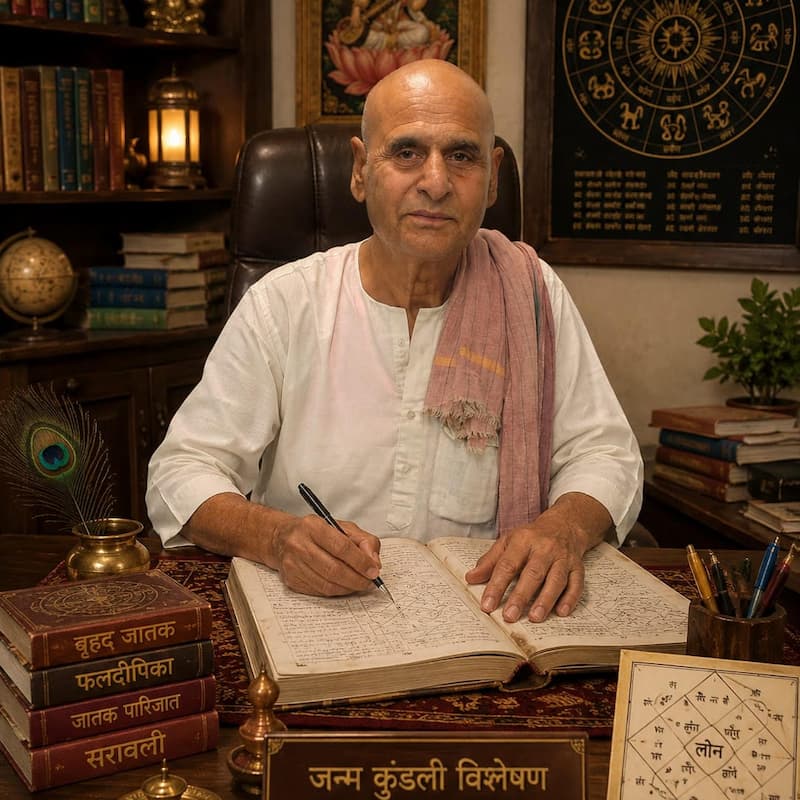
Narendra Kumar Chaubey is a Jyotisha Acharya with over 30 years of experience, based in Bihar and serving clients across India in Vedic astrology, mantra shastra, Vastu and ritual practice.
He completed his formal training at Kameshwar Singh Darbhanga Sanskrit University (KSDSU), one of India’s oldest and most respected institutions for Vedic and Sanskrit scholarship, where he studied Jyotisha shastra, mantra vidya and related classical sciences. KSDSU’s tradition of rigorous Sanskrit education tracing directly to the Mithila region’s centuries-old pandit lineage forms the foundation of his practice.
Over three decades, Narendra Kumar Chaubey has worked with thousands of individuals and families across Bihar and across India, offering guidance in:
- Kundli (birth chart) analysis: Identifying karmic patterns, planetary periods and life path guidance through classical Jyotisha
- Palmistry (Hasta Samudrika): Reading the hand according to the classical Samudrika Shastra tradition
- Vastu Shastra: Assessment and correction of living and working spaces according to directional and elemental principles
- Mantra and Pooja vidhi: Performing and guiding all categories of puja, havan, and mantra sadhana for personal, family and business situations
- Predictive Jyotisha: Transit analysis, muhurta (auspicious timing) selection and remedial guidance
He works across four languages Sanskrit, Hindi, English and Bhojpuri making classical knowledge accessible to practitioners across educational backgrounds and regions.
His writing for ABMantra brings the precision of classical Vedic training to practical mantra guidance: not general advice but specific prescriptions grounded in shastra, lineage and 30 years of direct practice with real situations.
For more info follow on: