
Quick Answer
Om Namah Shivaya (ॐ नमः शिवाय) means: I bow to Shiva or I surrender to Shiva.
But this translation captures only the surface. The mantra contains a complete cosmological map in five syllables:
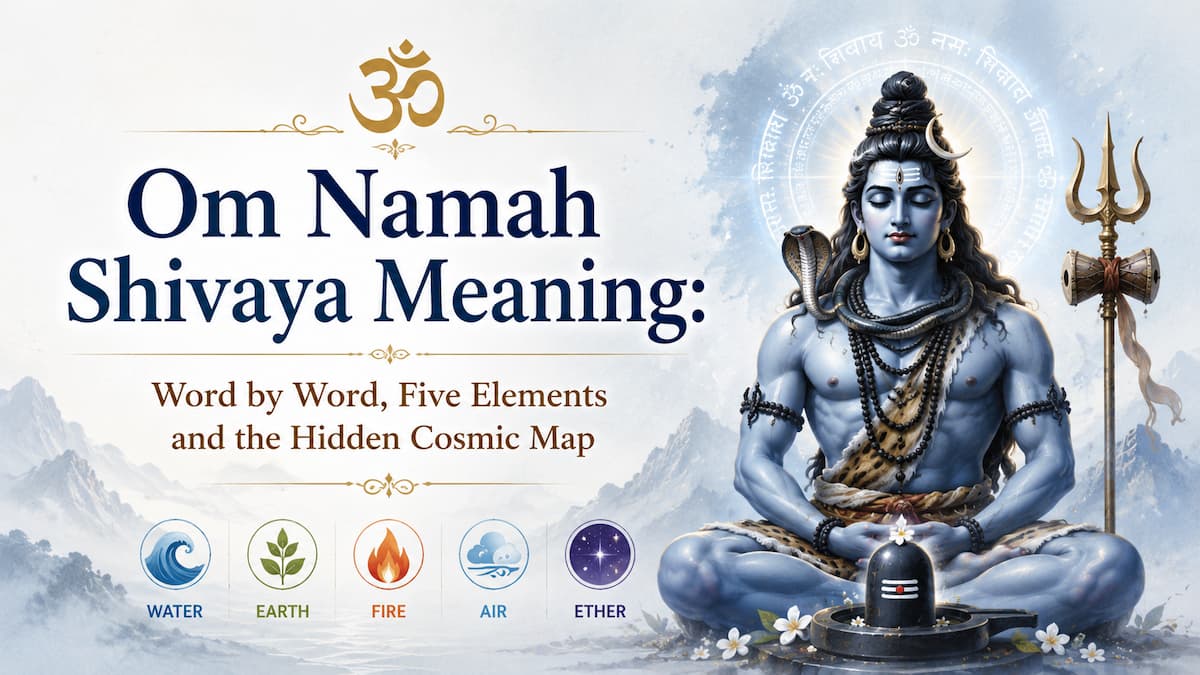
Na = Earth element | Ma = Water element | Shi = Fire element | Va = Air element | Ya = Space/Ether element
When you chant these five syllables in sequence, you are moving through all five elements that constitute the physical universe and all five elements that constitute your body simultaneously. The mantra is not addressed to Shiva as an external deity. It is addressed to the Shiva consciousness that is the ground of your own awareness.
Who This Article Is For
This article is for you if: you chant Om Namah Shivaya daily but want to understand what each syllable actually means | you want to know why this is called the Panchakshara Mantra and what Panchakshara means | you want the deeper philosophical meaning that most articles do not cover.
Also see: Om Namo Narayanaya: the Vishnu mantra compared and Maha Mrityunjaya Mantra: complete guide
Om Namah Shivaya is one of the most widely chanted mantras on earth. Millions of people chant it daily without knowing what each syllable means. This article gives you both the word-by-word meaning and the deeper meaning that transforms the chant from a devotional repetition into a conscious cosmological meditation.
Here is what most Om Namah Shivaya articles miss entirely: every article covers the five elements meaning (Na = earth, Ma = water, and so on). Almost none cover the Pancha Kriya meaning : the five cosmic functions of Shiva that each syllable simultaneously invokes. These two layers of meaning are not alternatives. They operate simultaneously. Understanding both changes the quality of the practice completely.
The Source: Where Om Namah Shivaya Comes From
Om Namah Shivaya is one of the oldest continuously chanted mantras in the world. Its earliest written appearance is in the Shri Rudram (also called Rudra Namakam), a hymn found in the Taittiriya Samhita of the Krishna Yajurveda (TS 4.5.8.1). The specific line is:
Original source : Shri Rudram, Taittiriya Samhita 4.5.8.1
Namah Shivaya ca Shivataraya ca
नमः शिवाय च शिवतराय च
Salutations to Shiva and to the one who is even more auspicious than Shiva.
This line praises Rudra (the Vedic predecessor of Shiva) in his auspicious aspect. The Yajurveda is conservatively dated to 1000 BCE. The mantra has been in continuous use for at least 3,000 years. It later became central to the Shiva Purana and the Shaiva Agamas, where it is described as the Panchakshara Mantra and the Maha Mantra of the Shaiva tradition.
Om Namah Shivaya: Word by Word Meaning
| Word | Sanskrit root | Literal meaning | Deeper significance |
|---|---|---|---|
| Om (ॐ) | A + U + M | The primordial sound of the universe | When prefixed to Namah Shivaya, Om becomes the Pranava : the cosmic sound that opens and consecrates the five-syllable mantra. This makes Om Namah Shivaya a six-syllable mantra (Shadakshara), while Namah Shivaya alone is the five-syllable Panchakshara. |
| Namah (नमः) | Nam = to bow, to surrender | Salutation, I bow, I surrender | Namah is not a casual greeting. In the Shaiva tradition it represents Sharanagati : complete surrender of the ego. The tradition holds that genuine Namah is itself a liberating act: the moment the ego bows without reservation, Shiva is already present. |
| Shivaya (शिवाय) | Shiva + ya (dative suffix) | To Shiva (dative case: offered to, directed toward) | Shiva means the auspicious one (from the root Shi = auspicious, Va = one who bestows). The dative suffix ya means this is offered to Shiva, addressed toward Shiva. The salutation is directed. |
The Panchakshara: Five Syllables, Five Elements
Panchakshara means five syllables (Pancha = five, Akshara = syllable, also meaning imperishable or indestructible). The five syllables are Na, Ma, Shi, Va, Ya : the five core sounds of the mantra excluding Om.
Each syllable corresponds to one of the Pancha Mahabhuta, the five great elements that constitute all physical existence:
| Syllable | Element | Sanskrit | Chakra | What it purifies |
|---|---|---|---|---|
| Na (न) | Earth (Prithvi) | पृथ्वी | Muladhara (Root) | The physical body, bones, muscles, organs. The densest layer of existence. Chanting Na grounds and stabilises the physical system. |
| Ma (म) | Water (Jala) | जल | Svadhisthana (Sacral) | Fluids, emotions, attachment, the unconscious. Chanting Ma brings fluidity and releases emotional congestion. |
| Shi (शि) | Fire (Agni) | अग्नि | Manipura (Solar Plexus) | Digestion, transformation, the burning of karma and ignorance. Chanting Shi activates the transformative fire within. |
| Va (व) | Air (Vayu) | वायु | Anahata (Heart) | Breath, prana, movement, love. Chanting Va purifies the prana and opens the heart to universal compassion. |
| Ya (य) | Space / Ether (Akasha) | आकाश | Vishuddha (Throat) | Space, sound, infinite consciousness. Chanting Ya connects the individual soul to Shiva’s boundless awareness. |
The order of the syllables is significant. Na (earth, the densest) to Ya (space, the most subtle) follows the sequence from the grossest to the most refined dimension of existence. Chanting the mantra in order is a movement from the physical body toward pure consciousness : from the most contracted expression of existence to the most expanded. The mantra is a map of the journey, not just a prayer.
The Deeper Layer: Five Cosmic Functions of Shiva (Pancha Kriya)
This is the layer of meaning almost no article covers. Beyond the five elements, each syllable simultaneously invokes one of the five cosmic functions (Pancha Kriya) of Shiva : the five actions through which he governs the entire universe.
The Five Cosmic Functions: What Most Articles Miss
The Shaiva Siddhanta tradition, one of the major Shaiva philosophical schools, describes Shiva as performing five eternal cosmic actions simultaneously. Every syllable of the Panchakshara invokes one of these actions. This is why the mantra is considered complete in itself : it encompasses the entirety of Shiva’s cosmic activity.
| Syllable | Cosmic function | Sanskrit | What it means |
|---|---|---|---|
| Na | Srishti (Creation) | सृष्टि | Shiva’s capacity to project the universe from within himself. Every moment of existence is an act of Shiva’s creation. Na invokes the creative function. |
| Ma | Sthiti (Preservation) | स्थिति | Shiva’s capacity to sustain the created universe in existence. The continuity of the cosmos is Shiva’s sustaining function. Ma invokes the preserving function. |
| Shi | Samhara (Dissolution) | संहार | Shiva’s capacity to absorb creation back into himself at the end of each cycle. Not destruction for its own sake but dissolution for renewal. Shi invokes the dissolving function. |
| Va | Tirobhava (Concealment) | तिरोभाव | Shiva’s capacity to hide his own nature through Maya, creating the apparent individuality of souls. The veil through which the universe appears separate from its source. Va invokes the concealing function. |
| Ya | Anugraha (Grace) | अनुग्रह | Shiva’s capacity to remove the concealment of Maya and reveal himself to the soul that sincerely seeks him. Grace is the reversal of concealment : the lifting of the veil. Ya invokes the grace function. |
When you hold both layers simultaneously : five elements and five cosmic functions : the mantra becomes a meditation on the complete nature of existence. Na is earth AND creation. Ma is water AND preservation. Shi is fire AND dissolution. Va is air AND the concealment that makes the world appear separate from God. Ya is space AND the grace that removes that concealment and returns the soul to its source.
The final syllable Ya is the most important of all five. You are not just invoking the space element. You are invoking Shiva’s grace: the specific divine action that removes the concealment (Va) and restores the direct perception of reality. The mantra ends with grace by design.
Panchakshara vs Shadakshara: Five or Six Syllables
This distinction confuses many practitioners.
| Form | Syllables | Text | Tradition |
|---|---|---|---|
| Panchakshara (Five syllable) |
Na : Ma : Shi : Va : Ya | Namah Shivaya (without Om) | The original Vedic form from Shri Rudram. The five syllables without the Pranava prefix. Used in formal Vedic recitation. |
| Shadakshara (Six syllable) |
Om : Na : Ma : Shi : Va : Ya | Om Namah Shivaya (with Om) | The Tantric and Puranic form. Om is added as the Pranava that consecrates and amplifies the five syllables. This is the form most commonly chanted in daily practice today. |
For daily personal practice, Om Namah Shivaya (with Om) is correct and complete. The Om prefix is not an addition that changes the mantra. It is the opening of the energetic channel through which the five syllables operate most powerfully.
The Shiva Panchakshara Stotra: Adi Shankaracharya’s Commentary in Verse
Adi Shankaracharya, the 8th-century Advaita philosopher, composed the Shiva Panchakshara Stotra: a five-verse poem in which each verse meditates on one syllable of the mantra. This stotra is the most celebrated commentary on the Panchakshara and is chanted in Shiva temples across India after the main Om Namah Shivaya recitation.
The opening verse, on the syllable Na:
Shiva Panchakshara Stotra : Verse 1 (Na)
Nagendra Haraya Trilochanaya
Bhasmanga Ragaya Maheshwaraya
Nityaya Shudhaya Digambaraya
Tasmai Nakara Namah Shivaya
नागेन्द्रहाराय त्रिलोचनाय
भस्माङ्गरागाय महेश्वराय।
नित्याय शुद्धाय दिगम्बराय
तस्मै न-काराय नमः शिवाय॥
Salutations to Shiva, who wears the king of serpents as a garland, who is three-eyed, whose body is smeared with ash, who is the great lord, who is eternal, who is pure, who wears the sky as his garment : to that Na syllable, I bow to Shiva.
Each of the five verses follows the same structure: a description of Shiva’s qualities associated with that syllable, ending with the syllable named explicitly as the object of salutation. Shankaracharya is teaching that the syllable and Shiva are identical: bowing to Na is bowing to Shiva in his earth form and his creative function simultaneously.
How Understanding the Meaning Changes the Practice
Most practitioners chant Om Namah Shivaya as a sound. Understanding the meaning converts it into a meditation.
| Without knowing the meaning | With knowing the meaning |
|---|---|
| Chanting Na as the first of five sounds | Chanting Na as the earth element within your body and Shiva’s act of creation : both simultaneously |
| Chanting Ma as the second syllable | Chanting Ma as the water element and Shiva’s act of preservation : feeling the sustaining quality in the sound |
| Chanting Shi as the third syllable | Chanting Shi as fire and dissolution : the transformative burning of what no longer serves |
| Chanting Va as the fourth syllable | Chanting Va as air and the concealing grace of Maya : acknowledging the veil that makes the world appear separate from its source |
| Chanting Ya as the fifth syllable | Chanting Ya as space and as Shiva’s grace : the specific divine action that removes the concealment and returns you to your source |
From Our Practice
From Our Practice
I chanted Om Namah Shivaya for three years before I understood the Pancha Kriya layer : the five cosmic functions. The five elements I knew. Na equals earth, Ma equals water: this much is in every article about the mantra.
The Pancha Kriya meaning changed the practice for me in a specific way. When I reach Va : the concealment function : I now pause internally. Va is Shiva hiding himself from himself, which is what the ego is. The world appearing separate from its source. Chanting Va with that understanding is not asking for anything. It is acknowledging what is happening: the concealment is Shiva’s own act, and it serves the creation of individual experience.
And then Ya: grace. The reversal of Va. The removal of the concealment. The mantra ends with that. Every time you complete one repetition of Om Namah Shivaya, you have passed through creation, preservation, dissolution, concealment and grace. You have traversed the complete cycle of existence in six syllables.
That is what the tradition means when it says this mantra is complete in itself.
Frequently Asked Questions
❓ What does Om Namah Shivaya mean in simple words?
In simple words: I bow to Shiva. The word Namah means salutation or surrender. Shivaya is the dative form of Shiva, meaning offered to Shiva or directed toward Shiva. The literal meaning is I offer my salutation to Shiva. The deeper meaning, which the mantra’s five syllables contain, is: I acknowledge the five elements within me and the five cosmic functions of Shiva, and I surrender the ego that separates me from their source.
❓ I have been told Om Namah Shivaya should not be chanted by women. Is that true?
No. This claim has no scriptural basis. The Shri Rudram in the Yajurveda, the original source of the mantra, makes no gender restriction. The Shiva Purana does not restrict it. Numerous female saints and devotees across history : including Akka Mahadevi, the 12th-century Kannada saint who composed devotional poetry to Shiva : chanted this mantra throughout their lives. Women and girls chant Om Namah Shivaya freely in temples across India. The restriction has no classical source.
❓ How many times should I chant Om Namah Shivaya daily?
108 times is the standard daily practice using a Rudraksha mala. For a complete Shiva sadhana (purashcharan), the classical count is 125,000 repetitions : typically performed over 40 days at approximately 3,125 repetitions per day. For daily maintenance practice, 108 times in the morning is sufficient. The Shiva Purana also documents 11 times as the minimum for those with very limited time. The consistency of daily practice matters more than the count.
❓ What is the difference between Om Namah Shivaya and Om Namah Shivaya Namah?
Om Namah Shivaya is the standard form. Om Namah Shivaya Namah adds a second Namah at the end, creating a symmetrical frame: Namah at the beginning and Namah at the end, with the five syllables in the centre. This is used in some specific ritual contexts and is considered a more complete devotional form in certain Shaiva lineages. For daily personal practice, the standard Om Namah Shivaya is complete and correct.
❓ Can I chant Om Namah Shivaya at night or before sleeping?
Yes. Om Namah Shivaya has no time restriction. It is described in the Vaishnava Chintamani tradition as universally accessible at any time, and the Shaiva tradition makes the same statement. Chanting it before sleep is a valid and documented practice. Unlike some other mantras that activate energy and can disturb sleep, Om Namah Shivaya carries a quality of dissolution and return to stillness (Shi = dissolution, Ya = grace) that makes it suitable for evening practice. Many practitioners report it as their most effective pre-sleep mantra.
❓ Is Om Namah Shivaya the same as the Maha Mrityunjaya Mantra?
No. They are different mantras from different traditions that both address Shiva. Om Namah Shivaya is the Panchakshara Mantra of the Shaiva devotional tradition, focused on surrender to Shiva as the ground of all existence. The Maha Mrityunjaya Mantra (Om Tryambakam Yajamahe) is from Rigveda 7.59.12, attributed to sage Vasishtha, and is specifically a healing and death-protection mantra addressed to Rudra-Shiva as Tryambaka (the three-eyed one). Both are powerful. Om Namah Shivaya is the devotional mantra for daily relationship with Shiva. The Maha Mrityunjaya is the specific mantra for crisis, illness and protection from death.
Begin With One Complete Cycle
The next time you sit to chant Om Namah Shivaya, chant the first repetition very slowly. Hold each syllable for one full breath if you can.
Om: the opening of the channel.
Na: earth. Creation. The densest layer of your body and Shiva’s act of bringing the universe into being.
Ma: water. Preservation. The flow of life and Shiva’s sustaining of everything that exists.
Shi: fire. Dissolution. The burning of what no longer serves, in you and in the cosmos.
Va: air. Concealment. The veil that makes you feel separate from your source.
Ya: space. Grace. The reversal of the veil. The direct perception of what has always been true.
Then repeat 107 more times at your normal pace. But carry that first repetition with you through all the ones that follow.
The tradition says the mantra is complete in itself. Now you know what complete means.
Sources:
- Om Namah Shivaya: Meaning, Origins and Yogic Power. Inlet Yoga, October 2025. Shri Rudram Taittiriya Samhita 4.5.8.1 source; five elements and reverse order from manifestation to source
- Om Namah Shivaya Meaning: Complete Guide. BhaktiBharat.org. Five cosmic functions (Pancha Kriya): Srishti, Sthiti, Samhara, Tirobhava, Anugraha : each syllable mapped to one function
- Shiva Panchakshara Stotra. Wikipedia. Adi Shankaracharya authorship; syllable-to-element correspondence from classical texts
- Om Namah Shivay Mantra: Complete Guide. Hindu Mirror, January 2026. Panchakshara vs Shadakshara distinction; Om Namah Shivaya vs Om Shivaya Namah comparison
Narendra Kumar Chaubey is a Jyotisha Acharya with over 30 years of experience, based in Bihar and serving clients across India in Vedic astrology, mantra shastra, Vastu and ritual practice.
He completed his formal training at Kameshwar Singh Darbhanga Sanskrit University (KSDSU), one of India’s oldest and most respected institutions for Vedic and Sanskrit scholarship, where he studied Jyotisha shastra, mantra vidya and related classical sciences. KSDSU’s tradition of rigorous Sanskrit education tracing directly to the Mithila region’s centuries-old pandit lineage forms the foundation of his practice.
Over three decades, Narendra Kumar Chaubey has worked with thousands of individuals and families across Bihar and across India, offering guidance in:
- Kundli (birth chart) analysis: Identifying karmic patterns, planetary periods and life path guidance through classical Jyotisha
- Palmistry (Hasta Samudrika): Reading the hand according to the classical Samudrika Shastra tradition
- Vastu Shastra: Assessment and correction of living and working spaces according to directional and elemental principles
- Mantra and Pooja vidhi: Performing and guiding all categories of puja, havan, and mantra sadhana for personal, family and business situations
- Predictive Jyotisha: Transit analysis, muhurta (auspicious timing) selection and remedial guidance
He works across four languages Sanskrit, Hindi, English and Bhojpuri making classical knowledge accessible to practitioners across educational backgrounds and regions.
His writing for ABMantra brings the precision of classical Vedic training to practical mantra guidance: not general advice but specific prescriptions grounded in shastra, lineage and 30 years of direct practice with real situations.
For more info follow on: