
The Panchadasi Mantra benefits begin with understanding what this mantra actually is. The Panchadasi is the 15-syllable heart mantra of Goddess Tripura Sundari – the most revered mantra in the entire Sri Vidya tradition and one of the most powerful Shakti mantras in the Vedic canon. Panchadasi means fifteen: Pancha (five) and Dasha (ten), though the syllables are grouped as 5 + 6 + 4 across three sacred segments called Kutas. Understanding what the Panchadasi Mantra benefits are requires understanding its three-part structure – because each Kuta governs a distinct dimension of the practitioner’s life and consciousness, and the benefits of each are specific and different.
The Panchadasi Mantra: Complete Text
The three Kutas (segments):
Vagbhava Kuta: Ka E I La Hreem (5 syllables) – governs speech, knowledge and creation
Kamaraja Kuta: Ha Sa Ka Ha La Hreem (6 syllables) – governs desire, attraction and manifestation
Shakti Kuta: Sa Ka La Hreem (4 syllables) – governs power, liberation and dissolution
Goddess: Tripura Sundari (Lalita Maha Tripura Sundari, Shodashi, Rajarajeshwari)
Tradition: Sri Vidya – the Shakta Tantric tradition of the Divine Mother
Source: Vamakeshvara Tantra, Parashurama Kalpa Sutra, Tripura Rahasya
Purashcharan count: 1 lakh (100,000) repetitions for complete Sadhana
Accessible daily count: 108 times, after sunrise or at Sandhya (twilight)
Who Is Tripura Sundari: The Goddess Behind the Mantra
Tripura Sundari – whose name means “the beautiful one of the three worlds” – is the third of the ten Mahavidyas and is considered by the Sri Vidya tradition to be the supreme form of the Divine Mother encompassing all other forms. She is also called:
- Shodashi – the sixteen-year-old (eternally youthful divine consciousness)
- Lalita – the playful one, the one who sports with creation
- Rajarajeshwari – the queen of all queens, the supreme sovereign
- Kameshwari – the goddess of all desire and its fulfilment
- Maha Shodashi – the great sixteen, referring to the Shodashi mantra (Panchadasi + one additional syllable)
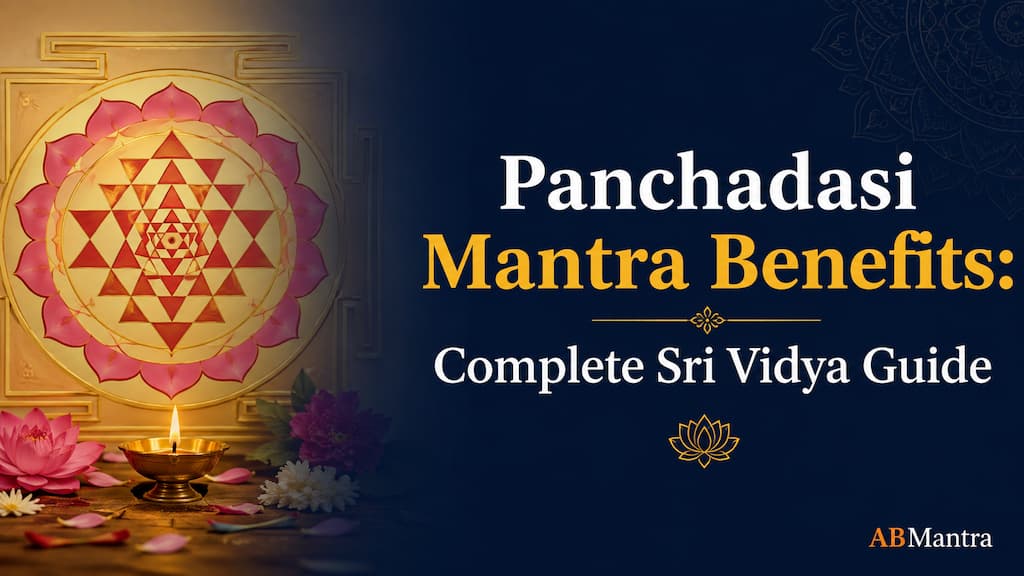
She is seated on a throne of the five Brahmas (Brahma, Vishnu, Rudra, Ishwara and Sadashiva in their reclined form as her throne) and holds a noose (Pasha), a goad (Ankusha), a bow of sugarcane (Ikshu Dhanush) and arrows of five flowers. Her Sri Yantra – the geometric form of her energy – is the most complex and most revered Yantra in the tradition.
The Panchadasi Mantra is specifically her sonic form – the fifteen syllables that together constitute her complete vibrational body. Each syllable is one of her fifteen aspects, corresponding to the fifteen lunar phases (tithis) that form the complete lunar cycle. This is why the mantra is considered complete in itself: it contains the full cycle of cosmic manifestation and return.
The Three Kutas: What Each Segment Does
This is what no competing article explains. The Panchadasi’s benefits are not uniform – each of the three Kutas governs a specific dimension of existence, and the mantra works on all three simultaneously.
| Kuta | Syllables | Sanskrit | Goddess aspect | Shakti (power) | Domain governed |
|---|---|---|---|---|---|
| Vagbhava Kuta (first segment) |
Ka E I La Hreem | क ए ई ल ह्रीं | Saraswati – the goddess of speech, learning and all Vidya | Ichha Shakti – the power of will and intention | Speech, language, knowledge, learning, creative expression, the power of Vak (the word). Vagbhava literally means “born of Vak” – this Kuta is the source of the mantra’s power over all communication and knowledge. |
| Kamaraja Kuta (middle segment) |
Ha Sa Ka Ha La Hreem | ह स क ह ल ह्रीं | Lakshmi – the goddess of abundance, prosperity and magnetic grace | Jnana Shakti – the power of knowledge and discrimination | Desire in its divine form (Kama), attraction, prosperity, abundance, relationships, beauty, the fulfilment of all legitimate worldly wishes. Kamaraja means “the king of desire” – this Kuta governs the world of manifestation and abundance. |
| Shakti Kuta (final segment) |
Sa Ka La Hreem | स क ल ह्रीं | Kali/Parvati – the transforming, dissolving, liberating power | Kriya Shakti – the power of action and transformation | Spiritual power, liberation, transformation, the dissolution of ego, the clearing of karmic bonds, the direct experience of the divine. This Kuta is specifically the liberation segment – it carries the practitioner beyond all three worlds toward Moksha. |
The 15 Syllables: What Each One Encodes
The Panchadasi syllables are Bija (seed) syllables – not ordinary Sanskrit words but primordial sonic seeds that carry the energy of specific cosmic principles. The tradition holds that these syllables cannot be fully “translated” because their meaning is vibrational, not linguistic. However, the classical texts do assign each syllable a specific cosmic correspondence:
| # | Syllable | Devanagari | Kuta | Classical correspondence |
|---|---|---|---|---|
| 1 | Ka | क | Vagbhava | Kameshwara – Shiva as the Lord of all desire and love. The primordial masculine principle. |
| 2 | E | ए | Vagbhava | Para Shakti / Kameshwari – the supreme energy, the primordial feminine. The union of Ka and E represents the inseparable Shiva-Shakti. |
| 3 | I | ई | Vagbhava | Ananda Bhairavi – the bliss consciousness, the sustained joy that underlies all experience. |
| 4 | La | ल | Vagbhava | Indra / Earth element – the grounding principle, the power that sustains material existence. |
| 5 | Hreem | ह्रीं | Vagbhava | Bhuvaneshwari Bija – the creative space of all manifestation. The Hreem that appears in each Kuta seals and completes that segment’s energy. |
| 6 | Ha | ह | Kamaraja | Shiva as Akasha (space element) – the infinite open awareness that contains all phenomena. |
| 7 | Sa | स | Kamaraja | Saraswati / Maya – the creative intelligence that weaves the appearance of the world. |
| 8 | Ka | क | Kamaraja | Kameshwara again – the desire principle appearing in the middle segment as the engine of manifestation. |
| 9 | Ha | ह | Kamaraja | Shiva again – the witnessing consciousness present within all manifestation. |
| 10 | La | ल | Kamaraja | Indra again – the governing principle of the material world, now working in the domain of desire and abundance. |
| 11 | Hreem | ह्रीं | Kamaraja | Bhuvaneshwari – completing and sealing the Kamaraja Kuta’s energy. |
| 12 | Sa | स | Shakti | Saraswati / pure consciousness – the knowledge principle in its most refined form. |
| 13 | Ka | क | Shakti | Kameshwara – Shiva’s presence even in the liberation segment, confirming that Moksha is not the absence of Shiva but his full presence. |
| 14 | La | ल | Shakti | Earth/Indra – the grounding of liberation in embodied experience. Liberation is not escape from the world but transformation within it. |
| 15 | Hreem | ह्रीं | Shakti | Bhuvaneshwari – the final seal. The creative space that both generates and receives all of creation. The mantra ends where it began – in the infinite creative ground. |
Panchadasi Mantra Benefits: Complete Analysis
The benefits of the Panchadasi Mantra arise from its three-Kuta structure addressing all four Purusharthas (the four aims of human life) simultaneously – something no single-purpose mantra achieves.
Benefits from the Vagbhava Kuta (Ka E I La Hreem)
- Mastery of speech and communication: Vag means speech. The Vagbhava Kuta is specifically the speech segment – consistent practice produces a noticeable improvement in the quality, clarity and authority of the practitioner’s verbal expression.
- Acceleration of learning and knowledge acquisition: The Saraswati energy of this Kuta directly governs all Vidya (branches of knowledge). Students, scholars and all those engaged in intellectual work experience improvement in retention, understanding and the ability to communicate complex ideas clearly.
- Creative power and artistic expression: The Ichha Shakti of this Kuta – the power of will and intention – when activated, produces a quality of creative flow that artists, writers and musicians consistently report as the primary experiential benefit of Sri Vidya practice.
- Removal of mental confusion: The Bhuvaneshwari Bija (Hreem) in this Kuta specifically creates inner space – the quality of mental clarity and spaciousness that dissolves the fog of indecision and confusion.
Benefits from the Kamaraja Kuta (Ha Sa Ka Ha La Hreem)
- Prosperity, abundance and material wellbeing: The Lakshmi energy of the Kamaraja Kuta governs abundance in all its forms. The practice specifically draws wealth, prosperity, good fortune and the material conditions that support a flourishing life.
- Attraction and magnetic personal presence: Kama in its highest form is the divine magnetic quality – the capacity to draw what is meant for you. Consistent Kamaraja Kuta energy produces an increase in the practitioner’s natural personal magnetism and attractiveness.
- Fulfilment of sincere desires: The Jnana Shakti of this Kuta – the power of discriminating knowledge – enables the practitioner to desire wisely (knowing what is truly needed) and then draw that desire into manifestation with Tripura Sundari’s grace.
- Success in all worldly endeavours: Business, career, relationships, family – all fall within the Kamaraja Kuta’s domain of manifestation. This is why the Sri Vidya tradition is specifically recommended for householder practitioners who want spiritual development alongside worldly success.
Benefits from the Shakti Kuta (Sa Ka La Hreem)
- Spiritual liberation (Moksha): The Shakti Kuta is the liberation segment. Its consistent activation through the mantra gradually loosens the ego’s identification with the limited self and creates the conditions for the direct recognition of one’s identity with the divine.
- Dissolution of deep karmic patterns: The transforming Kriya Shakti of this Kuta works at the level of deep karmic impressions (Samskaras) – not just surface behaviour but the root patterns that drive repetitive suffering across lifetimes.
- Kundalini awakening: The tradition holds that the three Kutas of the Panchadasi correspond to the three knots (Granthis) that block Kundalini’s ascent – Brahma Granthi (root), Vishnu Granthi (heart) and Rudra Granthi (throat). Consistent practice gradually works on all three.
- Fearlessness and inner stability: As the Shakti Kuta’s liberation energy activates, the existential fear that arises from identifying with the temporary ego reduces. This is not emotional suppression but a genuine shift in the practitioner’s relationship with their own mortality and limitations.
Benefits of the Complete 15-Syllable Mantra
When all three Kutas are chanted together as the complete Panchadasi, the integrated effect is more than the sum of the three parts:
- All four Purusharthas simultaneously: Dharma (righteous living – Vagbhava Kuta), Artha (material prosperity – Kamaraja Kuta), Kama (fulfilment of desires – Kamaraja Kuta) and Moksha (liberation – Shakti Kuta) are all addressed in one mantra. No other mantra in the tradition achieves this.
- Activation of all 15 lunar phases (Kalas): The 15 syllables correspond to the 15 Moon phases. Chanting the complete mantra activates all 15 Chandra Kalas within the practitioner’s subtle body, producing a quality of wholeness and completion in the energy field.
- Union of Shiva and Shakti within the practitioner: The Ka syllables (Shiva) and the Hreem syllables (Shakti/Bhuvaneshwari) appear throughout all three Kutas. Their repeated pairing in the mantra creates the vibrational experience of the Shiva-Shakti union – the tradition’s highest state – within the practitioner’s own consciousness.
Accessible Practice vs Full Sri Vidya Sadhana
| Level | Practice | Initiation needed? | For whom |
|---|---|---|---|
| Level 1 – Devotional | Reading about Tripura Sundari, understanding the three Kutas, meditating on the mantra’s meaning, attending Sri Vidya pujas or temples. Not chanting the mantra itself but building relationship with the deity and tradition. | No | Anyone drawn to the Sri Vidya tradition |
| Level 2 – Simple Japa | Chanting the mantra 108 times daily with genuine devotion and understanding of its three-Kuta structure and the deity it invokes. No formal ritual protocol – just sincere, informed chanting. | Ideally receive from a practitioner, but accessible from classical sources. The tradition has different views – some lineages permit simple japa without formal initiation; others require it. Follow your tradition or teacher’s guidance. | Sincere devotees of the Divine Mother with genuine understanding of what they are chanting |
| Level 3 – Complete Sri Vidya Sadhana | Full Panchadasi Sadhana with Sri Chakra worship, complete Nyasa (ritual installation of the mantra in the body), Dhyana (visualisation of the goddess), specific Tithi observations, Homa (fire offering) and the complete 1 lakh Purashcharan protocol. | Yes – formal Guru Deeksha is mandatory and universally held to be required across all Sri Vidya lineages. The Parashurama Kalpa Sutra is explicit: the mantra given without proper initiation does not bear fruit. | Those who have found a qualified Sri Vidya Guru and received formal initiation |
Complete Accessible Practice Guide
Best time: Dawn (Brahma Muhurta) or Sandhya (twilight – both sunrise and sunset). The Sri Vidya tradition specifically prescribes Sandhya – the liminal transition between states – as the most potent time for Tripura Sundari practice.
Mala: Sphatik (crystal quartz) mala – specifically associated with Tripura Sundari and the Sri Vidya tradition. Red coral mala is also used in some lineages.
Offerings: Red flowers (especially red hibiscus or red roses – Tripura Sundari’s specific flower), kumkum (red vermilion), fragrant incense, ghee lamp. The Sri Yantra image or yantra – even a simple printed image – as the focal point.
Practice:
- Sit facing east at dawn or facing west at dusk. Light the ghee lamp. Offer red flowers.
- Begin with three slow breaths – one breath for each Kuta. With the first breath: hold the Vagbhava Kuta in awareness (knowledge, speech, creative power). With the second: hold the Kamaraja Kuta (abundance, desire, manifestation). With the third: hold the Shakti Kuta (liberation, transformation, the divine itself).
- Chant the complete mantra 108 times on the mala: Ka E I La Hreem – Ha Sa Ka Ha La Hreem – Sa Ka La Hreem. Move one bead per complete 15-syllable repetition.
- After completing the count: sit in silence for 5 minutes. Do not speak immediately. Let the three Kutas integrate.
The 31-matra timing (for those who want precision): The Vedanta Students tradition notes that the complete Panchadasi is chanted in 31 matras (units of time) when pauses are maintained between Kutas, and 29 matras when chanted continuously. For accessible practice, chant at a natural, reverent pace without concern for precise timing.
From Our Practice
In 30 years of Jyotisha practice, I encounter the Panchadasi Mantra most frequently in two specific client situations. The first is the person who has been on a spiritual path for years – meditating, chanting, following a sattvic lifestyle – but feels that something is missing, that a ceiling has been reached in their practice. For these practitioners, the Sri Vidya tradition and the Panchadasi specifically represent the next dimension: a practice that addresses not just one aspect of the self (the emotional, or the intellectual, or the karmic) but all dimensions simultaneously through the three-Kuta structure.
The second situation is the person who genuinely wants both – worldly success and spiritual depth – and has been told by various teachers that they must choose one or abandon the other. The Sri Vidya tradition’s answer to this false choice is the Panchadasi: the mantra that addresses all four Purusharthas simultaneously. The Kamaraja Kuta is not a concession to the material – it is a full and dignified acknowledgment that prosperity, desire and abundance are not obstacles to the divine but expressions of it.
The most significant benefit I have observed consistently in practitioners who maintain serious Panchadasi japa – even at Level 2 without formal initiation – is a quality I would describe as increasing alignment. Things begin to happen at the right time. The right teacher appears. The right opportunity arrives. This is not magic in the common sense. It is the natural result of a consciousness that is increasingly resonant with Tripura Sundari’s frequency – which is, in the tradition’s understanding, the frequency of the universe’s own deepest intelligence.
Frequently Asked Questions
- Wikipedia – Tripura Sundari: the third Mahavidya, Shodashi iconography, Sri Vidya tradition, the Panchadasi as her 15-syllable mantra
- Wikipedia – Sri Vidya: the Shakta Tantric tradition of Tripura Sundari, the Panchadasi and Shodashi mantras, the Sri Chakra, the lineage tradition
- Parashurama Kalpa Sutra – the primary classical source on the Panchadasi Mantra, its three-Kuta structure, the requirement for Guru initiation, and the Purashcharan protocol of 1 lakh repetitions
- Vamakeshvara Tantra and Tripura Rahasya – the correspondence of the 15 syllables to the 15 lunar phases (Chandra Kalas), the syllable-by-syllable cosmic correspondences
- Wikipedia – Sri Yantra: the geometric body of Tripura Sundari, its nine interlocking triangles, the relationship between the Sri Chakra and the Panchadasi Mantra
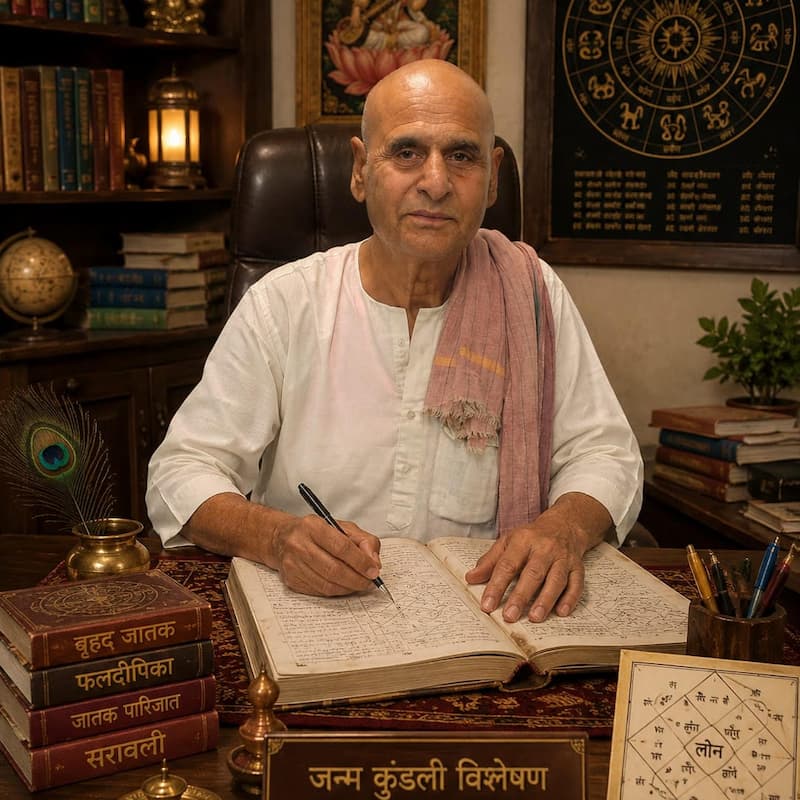
Narendra Kumar Chaubey is a Jyotisha Acharya with over 30 years of experience, based in Bihar and serving clients across India in Vedic astrology, mantra shastra, Vastu and ritual practice.
He completed his formal training at Kameshwar Singh Darbhanga Sanskrit University (KSDSU), one of India’s oldest and most respected institutions for Vedic and Sanskrit scholarship, where he studied Jyotisha shastra, mantra vidya and related classical sciences. KSDSU’s tradition of rigorous Sanskrit education tracing directly to the Mithila region’s centuries-old pandit lineage forms the foundation of his practice.
Over three decades, Narendra Kumar Chaubey has worked with thousands of individuals and families across Bihar and across India, offering guidance in:
- Kundli (birth chart) analysis: Identifying karmic patterns, planetary periods and life path guidance through classical Jyotisha
- Palmistry (Hasta Samudrika): Reading the hand according to the classical Samudrika Shastra tradition
- Vastu Shastra: Assessment and correction of living and working spaces according to directional and elemental principles
- Mantra and Pooja vidhi: Performing and guiding all categories of puja, havan, and mantra sadhana for personal, family and business situations
- Predictive Jyotisha: Transit analysis, muhurta (auspicious timing) selection and remedial guidance
He works across four languages Sanskrit, Hindi, English and Bhojpuri making classical knowledge accessible to practitioners across educational backgrounds and regions.
His writing for ABMantra brings the precision of classical Vedic training to practical mantra guidance: not general advice but specific prescriptions grounded in shastra, lineage and 30 years of direct practice with real situations.
For more info follow on: