

If you have ever stood facing the rising sun with your palms joined and felt an inexplicable surge of calm and clarity, you have already experienced what generations of Vedic seers understood centuries ago the Sun is not merely a star. It is a living, conscious force that sustains all life. The Surya Mantra is a sacred Vedic hymn dedicated to Lord Surya, the Sun God, that channels this cosmic energy directly into the practitioner’s body, mind and circumstances.
In simple terms, a Surya Mantra is any Sanskrit hymn, chant or seed syllable recited in devotion to Lord Surya with the intention of drawing blessings related to health, vitality, success, clarity of mind and spiritual growth. From the Rigveda to the Ramayana, Surya has been revered as Pratyakshadaivam, the only deity you can see with your own eyes. This directness makes the Surya Mantra one of the most accessible and immediately effective practices in the entire Vedic tradition.
This article covers every important aspect of Surya Mantra practice: the complete lyrics with English transliteration, the meaning and significance of each major mantra, scientifically and spiritually documented benefits and a step-by-step guide to the correct chanting method followed by seasoned practitioners across India.
Who is Lord Surya? Significance in Vedic Tradition
Among the Navagrahas, the nine celestial forces that influence human destiny in Vedic astrology, Surya holds the position of supreme importance. He is the soul of the solar system, the light that makes all other lights visible. In classical Sanskrit texts, Surya is described as riding a golden chariot pulled by seven horses, each representing one of the seven colours of visible light and one of the seven days of the week. He holds a lotus in two of his four hands, symbolising purity and spiritual awakening, while the other two hands bestow blessings and offer protection.
What distinguishes Surya from most deities in the Hindu pantheon is precisely the quality that makes him Pratyakshadaivam; you do not need faith to know that the Sun exists. You feel it every morning. This intimate, daily, unavoidable relationship between human beings and the Sun is why Vedic rishis encoded so much wisdom into the Surya Mantra tradition. Chanting these mantras at sunrise was not merely ritual, it was a scientifically precise method of synchronising human consciousness with the most powerful energy source in our solar system.
Surya is also the guru of Hanuman and is closely associated with the Makara Sankranti festival, Chhath Puja and Ratha Saptami, all occasions on which millions of Indians still wake before dawn to offer water to the rising sun. This living tradition, maintained across thousands of years, is the cultural and spiritual foundation from which every Surya Mantra draws its power.
Surya Mantra Lyrics Sanskrit, Transliteration and English Meaning
The Surya Mantra tradition is not a single hymn but a rich family of mantras, each with its own specific purpose, syllable structure and depth of meaning. Below are the major Surya Mantras with their Sanskrit text, Romanised transliteration and English meaning.
1. Surya Beej Mantra Om Hraam Hreem Hraum Sah Suryaya Namah
| Sanskrit | Romanised Transliteration | English Meaning |
| ॐ ह्रां ह्रीं ह्रौं सः सूर्याय नमः | Om Hraam Hreem Hraum Sah Suryaya Namah | I bow to the Sun God, invoking his seed energy through the three sacred syllables |
The Beej (seed) Mantra is the most potent of all Surya Mantras. Om is the universal sound of creation. Hraam, Hreem and Hraum are the three seed syllables of Surya, representing the Sun in his three aspects the morning (Arka), noon (Mitra) and evening (Bhaskar) forms. Sah is the life-force syllable. Together, they form a complete sonic invocation of solar energy. Chanting this mantra 108 times daily at sunrise is considered the most direct way to awaken solar vitality within the body.
2. Om Shri Surya Mantra Lyrics and Meaning
The Om Shri Surya Mantra is a devotional salutation that acknowledges the thousand-rayed nature of the Sun a Vedic metaphor for Surya’s omnipresence and life-giving abundance.
| Sanskrit | Romanised Transliteration | English Meaning |
| ॐ नमो भास्कराय विद्महे महाद्युतिकराय धीमहि तन्नो आदित्यः प्रचोदयात् | Om Namo Bhaskaraya Vidmahe Maha Dyuthi Karaya Dhimahi Tanno Adityah Prachodayat | We meditate on Lord Bhaskar, the brilliantly radiant one; may that Aditya inspire and illuminate our intellect |
| ॐ श्री सूर्याय सहस्रकिरणाय नमः | Om Shri Suryaya Sahasra Kiranaya Namah | Salutations to Lord Surya, who radiates a thousand rays of light |
This mantra is particularly recommended for those seeking success in creative fields, gaining public recognition or overcoming chronic fatigue and lack of motivation. The phrase Sahasra Kiranaya thousand-rayed reflects the Vedic understanding that the Sun’s energy operates on multiple frequencies simultaneously, nourishing the body, awakening the intellect and purifying the spirit all at once.
3. Aditya Hridayam Origin, Lyrics and Meaning
Of all the Surya Mantras, the Aditya Hridayam is the most dramatically powerful. Its origin lies in the Yuddha Kanda of Valmiki’s Ramayana. Before the decisive battle with Ravana, when Rama stood exhausted on the battlefield, the sage Agastya descended from the heavens and taught him this ancient solar hymn. The very name means ‘Heart of Aditya’ it is not merely a mantra but a complete meditation on the solar deity.
| Key Verse (Sanskrit) | Transliteration | Meaning |
| आदित्यहृदयं पुण्यं सर्वशत्रुविनाशनम् | Aditya Hridayam Punyam Sarva Shatru Vinashanam | This blessed heart of Aditya destroys all enemies and obstacles |
| जयावहं जपेन्नित्यं अक्षय्यं परमं शिवम् | Jayavaham Japennityam Akshayam Paramam Shivam | Reciting it daily brings eternal victory, inexhaustible blessings and supreme auspiciousness |
Sage Agastya instructed Rama to recite the Aditya Hridayam three times and Rama subsequently defeated Ravana. The practical lesson encoded in this story is that this mantra is meant precisely for moments when you feel overwhelmed, outmatched or spiritually depleted. It is one of the most powerful Surya Mantras for removing deep-seated obstacles, overcoming adversaries and restoring courage and energy.
Meaning and Significance of the Surya Mantra
To truly understand a Surya Mantra is to understand something fundamental about how the ancient Vedic tradition viewed reality. In the Rigveda the oldest of the four Vedas the Sun is addressed in hundreds of hymns, not as an astronomical object but as a conscious being whose light is consciousness itself. The Gayatri Mantra, addressed to Savitri (a solar deity), is perhaps the most chanted mantra in the world today, precisely because it asks the Sun’s intelligence to illuminate the practitioner’s mind.
This is the core meaning of chanting any Surya Mantra: you are not just making a sound. You are aligning your personal vibration with the solar frequency, the same frequency that drives photosynthesis, regulates the body’s circadian rhythms and has powered every civilization in human history. The seven syllables in key Surya Mantras correspond to the seven chakras (energy centres) in the subtle body and the seven horses of Surya’s chariot correspond to the seven visible wavelengths of sunlight. This is not coincidence; it is a sophisticated system of symbolic correspondence built by rishis who had spent lifetimes studying the relationship between sound, light and consciousness.
From an astrological perspective, the Sun represents Atman the soul. A weakly placed Sun in one’s birth chart (horoscope) manifests as low confidence, poor health, authority issues or a lack of clear life direction. Chanting a powerful Surya Mantra regularly is the primary Vedic remedy prescribed to strengthen a weak Sun in the natal chart.
Benefits of Chanting the Surya Mantra
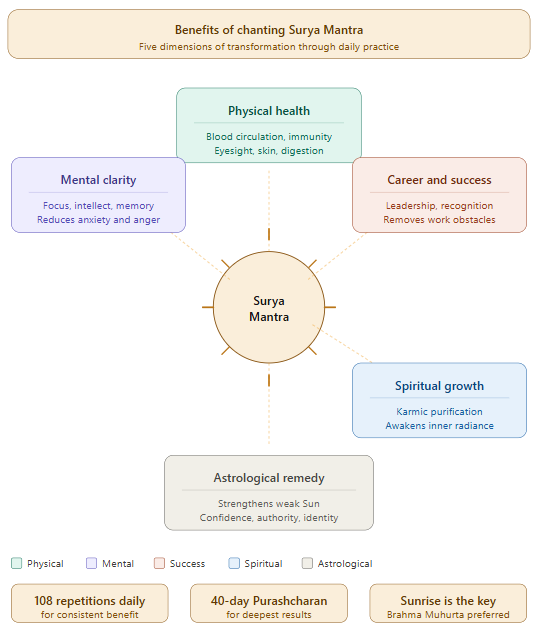
The benefits documented by practitioners and referenced across Vedic texts range from the deeply personal to the broadly cosmic. These are not superstitious claims; many align directly with what modern science understands about circadian biology, sound vibration therapy and the psychoneuroimmunological effects of daily ritual.
Surya Mantra for Success Career, Business and Students
The relationship between the Sun and success is one of the oldest ideas in Indian culture. Surya represents clarity, authority, leadership and the power of self-expression all essential ingredients for success in any field. For professionals seeking career growth, the Bhaskara Gayatri Mantra (Om Bhaskaraya Vidmahe Maha Dyuthi Karaya Dhimahi) chanted 108 times every Sunday morning has been cited by practitioners as a tool for opening doors that seemed permanently closed.
For business owners, the Surya Mantra for success is especially potent when combined with Sunday rituals offering red flowers, jaggery and water to the rising sun while reciting the mantra. Students preparing for competitive examinations in India have long been advised by Vedic astrologers to begin their study routine with at least 12 recitations of the Surya Namaskar Mantra to sharpen concentration and improve retention. The Sun governs the intellect and discrimination two faculties no student can succeed without.
| PRACTITIONER TIP For fast results, chant the Surya Beej Mantra Om Hraam Hreem Hraum Sah Suryaya Namah 12,000 times over 40 consecutive days starting on a Sunday. This is known as Purashcharan and is considered the most complete form of Surya Mantra sadhana. |
Health and Physical Wellbeing Healing Through Solar Vibration
Ancient Ayurvedic and Vedic texts consistently link Surya worship to physical vitality. Modern research into heliotherapy and circadian biology supports the intuition behind morning sun rituals: exposure to sunrise light resets the body’s master clock, regulates melatonin and cortisol levels, boosts vitamin D synthesis and strengthens immune function. The practice of facing east and chanting a Surya Mantra at sunrise combines this physiological benefit with the neurological effects of rhythmic sound repetition.
Specific health benefits attributed to regular Surya Mantra practice include improved blood circulation, stronger eyesight (the Sun governs vision in Vedic physiology), healthier skin, better digestion (the digestive fire or Agni is a solar principle) and relief from chronic fatigue. The Aditya Hridayam, in particular, is prescribed for those recovering from long illness, as its 31 verses form a complete system of solar invocation that is said to rebuild prana (life force) from its very foundations.
Mental Clarity and Emotional Equilibrium
The Sun represents Atman the unchanging self at the centre of consciousness. Regular Surya Mantra practice, especially the Gayatri Mantra addressed to Savitri, is associated with dramatic improvements in mental clarity, decision-making ability and emotional stability. Practitioners report a reduction in anxiety and reactive anger and an increased sense of purpose and direction. This aligns with what we know about the effects of morning routines, mindfulness practices and rhythmic breathing on the parasympathetic nervous system.
Spiritual Growth and Karmic Purification
At the deepest level, the Surya Mantra is a tool for what Vedic texts call karma-phala-bhog, the process of living out the consequences of past actions with grace and equanimity. The Sun burns everything equally; it withholds its light from no one. In this sense, consistent Surya Mantra practice is said to purify the karmic record, burn accumulated negative tendencies (called samskaras) and gradually elevate the practitioner toward a state of inner radiance that mirrors the outer radiance of the Sun itself.
Correct Chanting Method Step-by-Step Vidhi
The effectiveness of any Surya Mantra depends enormously on how it is chanted. The ancient texts are very specific about the conditions, timing, posture and mental state required for optimal results. Here is the complete, correct method followed by experienced practitioners across India:
- Choose the right time Brahma Muhurta or sunrise. The Brahma Muhurta begins approximately 96 minutes before sunrise and is considered the most potent time for any mantra practice. If this is not possible, chanting at the exact moment of sunrise while facing east is equally effective. Avoid chanting the Surya Mantra after midday.
- Prepare your physical space and body. Bathe before chanting this is not merely symbolic hygiene but a preparation of the body’s energy field (the aura) to receive solar vibrations. Wear clean clothes, preferably white, yellow or orange, which are Surya’s colours.
- Gather the traditional offerings. Fill a copper vessel (tambe ka lota) with fresh water. Add red flowers (preferably red hibiscus), a few grains of rice and a small amount of jaggery or red sandalwood powder to the water. Copper is considered the metal of Surya in Vedic tradition.
- Stand or sit facing east. If standing, hold the copper vessel with both hands at chest height. If sitting, use the Sukhasana or Padmasana position and place the offerings before you. Keep your spine straight this aligns the Sushumna Nadi (central energy channel) with the solar rays.
- Pour the water offering (Arghya). While reciting the mantra, slowly pour the water from the vessel in a thin stream toward the sun, allowing the light to refract through the stream. In Vedic cosmology, this creates a direct energetic bridge between the practitioner and the solar deity.
- Chant with complete focus. Begin with Om and maintain a steady, rhythmic pace. The ideal repetition count is 108 times for daily practice, using a Spatika (crystal quartz) mala or a red coral mala. For shorter practice, 7 or 12 repetitions are acceptable minimums. The mantra should be chanted aloud initially (Vachika Japa) until you have memorised it completely, then progressed to whispered chanting (Upamshu Japa) and finally to mental repetition (Manasika Japa), which is the most powerful form.
- Maintain the correct mental state throughout. The Vedic texts are unambiguous on this point chanting while harbouring anger, jealousy or dishonesty significantly reduces the mantra’s power. Approach the practice with a sense of gratitude, as if greeting a beloved and revered elder. After completing the chanting, sit quietly for a few minutes and meditate on the golden light of the sun entering your body through the Ajna chakra (the space between your eyebrows).
| IMPORTANT NOTE ON THE STARTING DAY Begin your Surya Mantra practice on a Sunday during Shukla Paksha (the waxing phase of the moon). Sunday is the day of Surya (Ravivar in Hindi) and the waxing moon amplifies the energy of new beginnings. The most auspicious periods in the Indian calendar for beginning this practice are Ratha Saptami (Magha Saptami), Makara Sankranti and the period from April 12 to April 23 when the Sun transits its sign of exaltation, Aries. |
The 12 Names of the Sun God in Surya Namaskar Mantra
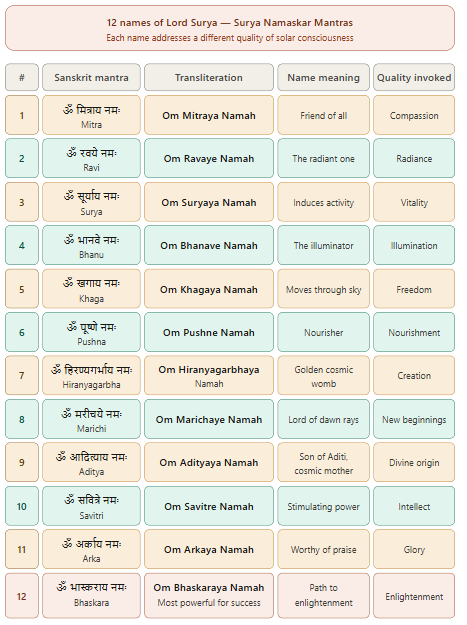
The 12 Surya Namaskar Mantras are among the most widely used Surya Mantra forms in both yoga practice and daily Vedic worship. Each of the 12 names of Lord Surya corresponds to one of the twelve Surya Namaskar yoga poses and addresses a different quality or aspect of solar energy. Together, they form a complete invocation of Surya in all his dimensions.
| # | Sanskrit Mantra | Transliteration | Meaning of the Name |
| 1 | ॐ मित्राय नमः | Om Mitraya Namah | Salutations to the friend of all |
| 2 | ॐ रवये नमः | Om Ravaye Namah | Salutations to the radiant one who shines |
| 3 | ॐ सूर्याय नमः | Om Suryaya Namah | Salutations to the one who induces activity |
| 4 | ॐ भानवे नमः | Om Bhanave Namah | Salutations to the one who illuminates |
| 5 | ॐ खगाय नमः | Om Khagaya Namah | Salutations to the one who moves through the sky |
| 6 | ॐ पूष्णे नमः | Om Pushne Namah | Salutations to the nourisher and giver of strength |
| 7 | ॐ हिरण्यगर्भाय नमः | Om Hiranyagarbhaya Namah | Salutations to the golden cosmic womb of creation |
| 8 | ॐ मरीचये नमः | Om Marichaye Namah | Salutations to the effulgent lord of the dawn rays |
| 9 | ॐ आदित्याय नमः | Om Adityaya Namah | Salutations to the son of Aditi, the cosmic mother |
| 10 | ॐ सवित्रे नमः | Om Savitre Namah | Salutations to the stimulating power of the sun |
| 11 | ॐ अर्काय नमः | Om Arkaya Namah | Salutations to the one worthy of praise and glory |
| 12 | ॐ भास्कराय नमः | Om Bhaskaraya Namah | Salutations to the one who leads to enlightenment |
In the traditional Surya Namaskar practice, each mantra is chanted as you move into the corresponding yoga posture. Even without the physical practice, chanting all 12 names in sequence is considered a complete daily salutation to Lord Surya and takes less than two minutes.
Surya Mantra in English A Pronunciation Guide for Beginners
One of the most common barriers people face when beginning Surya Mantra practice is the unfamiliarity of Sanskrit pronunciation. The good news is that Sanskrit is a phonetically consistent language once you learn the basic rules, every word is pronounced exactly as it is written. Here are the essential rules for chanting the Surya Mantra in English (Romanised form) accurately.
- The ‘a’ at the end of words like ‘Namah’ or ‘Suryaya’ is a short, open vowel like the ‘a’ in ‘sum’. Do not pronounce it like the ‘a’ in ‘day’.
- ‘Hraam’, ‘Hreem’ and ‘Hraum’ in the Beej Mantra are retroflex sounds. The ‘Hr’ is produced with the tongue slightly curled upward. Practice these slowly before attempting a full recitation.
- The double vowels ‘aa’, ‘ee’ and ‘oo’ are held for twice the duration of their single counterparts. ‘Hraam’ is held slightly longer than a short syllable.
- ‘Sah’ in the Beej Mantra is an aspirated sound breathe out slightly as you pronounce it, as if you are sighing the ‘s’.
- ‘Om’ should be chanted as a long, resonant three-part sound ‘A-U-M’ allowing the vibration to move from the back of the throat (A) to the lips (U) to the closed-lip hum (M).
- Never rush. The effectiveness of a Surya Mantra in English pronunciation is directly proportional to the care given to each syllable. One correctly pronounced recitation is worth ten hurried ones.
For absolute beginners, a practical approach is to listen to a recorded recitation of your chosen Surya Mantra by an experienced practitioner for at least one week before attempting to chant independently. This builds the correct sonic template in your auditory memory and makes pronunciation natural and effortless.
Auspicious Times, Days and Periods to Chant Surya Mantra
While the Surya Mantra can be chanted at any time with benefit, there are specific times and periods when the solar energy is at its most accessible and the mantra’s effects are therefore most powerful.
- Daily: Brahma Muhurta (96 minutes before sunrise) is the most potent daily window. Sunrise itself is the second most powerful time. Both windows involve the specific quality of solar light low-angle, rich in infrared and specific visible spectrum wavelengths that the Vedic rishis identified as most aligned with the mantra vibrations.
- Weekly: Sundays (Ravivar) are dedicated to Surya in the Hindu weekly calendar. Beginning or intensifying a Surya Mantra practice on a Sunday sets up a weekly rhythm that compounds over time.
- Monthly: The Saptami (seventh day) of both Shukla Paksha (waxing moon) and Krishna Paksha (waning moon) is auspicious for Surya worship. The most important is Ratha Saptami, which falls on the seventh day of the bright fortnight of Magha month.
- Annually: Makara Sankranti (mid-January), Ratha Saptami (January-February) and the period from April 12 to April 23 (when the Sun is in Aries, its sign of exaltation) are the most powerful windows in the annual cycle. Solar eclipses (Surya Grahan) are considered especially potent for chanting; many practitioners chant the Surya Mantra continuously throughout an eclipse.
- Forty-day sadhana: The most structured form of Surya Mantra practice involves 40 consecutive days of uninterrupted chanting. Starting on a Sunday during Shukla Paksha and chanting 108 times each morning without missing a single day is considered the minimum complete practice for any serious result.
Conclusion Begin Your Surya Mantra Practice Today
The Surya Mantra tradition is one of the most complete, accessible and empirically rich spiritual practices available in the Vedic heritage. Whether you are drawn to it for health reasons, career success, spiritual growth or astrological remedy, there is a Surya Mantra specifically suited to your purpose and your level of practice.
The simplest possible beginning is this: tomorrow morning, stand by your window or step outside, face the east and as the sun rises, close your eyes, take a deep breath and say Om Suryaya Namah even just once, with complete sincerity. That single moment of conscious recognition of you acknowledging the Sun and the Sun, as it were, acknowledging you is the seed of everything this tradition promises.
From that seed, a dedicated Surya Mantra practice can grow into one of the most transformative daily habits you will ever cultivate. The texts promise health, clarity, success and spiritual luminosity. The practitioners across thousands of years of unbroken tradition confirm it. The invitation is open and it renews itself every single morning at sunrise.
FAQs about Surya Mantra
The Surya Mantra is a Sanskrit hymn dedicated to Lord Surya, the Vedic Sun God. In its most essential form Om Hraam Hreem Hraum Sah Suryaya Namah it translates as: ‘I bow to Lord Surya, invoking his three-fold solar energy.’ The mantra is a complete sonic invocation of solar vitality, designed to align the practitioner’s consciousness with the consciousness of the Sun.
Regular daily practice is associated with five main categories of benefit: (1) Physical improved vitality, better circulation, stronger immunity and relief from chronic fatigue. (2) Mental sharper intellect, improved concentration and emotional stability. (3) Career and success greater clarity of purpose, leadership presence and removal of professional obstacles. (4) Spiritual purification of karmic tendencies and a gradual awakening of inner radiance. (5) Astrological strengthening of a weak Sun in the birth chart, which addresses issues related to confidence, authority and self-identity.
The standard practice is 108 repetitions per session, using a Spatika (crystal quartz) mala or red coral mala. For those with limited time, 12 repetitions (one for each of Surya’s names) is considered the minimum effective dose. For intensive sadhana aimed at specific results, the traditional prescription is 12,000 recitations over 40 consecutive days approximately 300 per day.
Brahma Muhurta approximately 96 minutes before sunrise is considered the optimal time. Chanting at the exact moment of sunrise while facing east is equally powerful. The practical rule is: the earlier in the day, the better. Chanting after midday is generally not recommended for the primary Surya Mantra practice.
The Om Shri Surya Mantra Om Shri Suryaya Sahasra Kiranaya Namah is a devotional salutation acknowledging the Sun’s thousand rays. It is particularly effective for those seeking success, public recognition or creative inspiration. It can be chanted as a simple morning salutation even without the full vidhi (ritual method), making it ideal for beginners or those with limited time.
For career and worldly success, the Bhaskara Gayatri Mantra (Om Bhaskaraya Vidmahe Maha Dyuthi Karaya Dhimahi Tanno Adityah Prachodayat) is considered the most powerful by most Vedic astrologers. For overcoming adversaries and removing deep-seated obstacles, the Aditya Hridayam is unparalleled. For overall vitality and solar energy, the Beej Mantra (Om Hraam Hreem Hraum Sah Suryaya Namah) is the most concentrated form.
Yes, absolutely. There is no gender restriction on Surya Mantra practice in the mainstream Vedic tradition. Surya is available to all beings equally after all, the Sun shines on everyone without discrimination. Some traditional schools advise pausing formal Japa practice during menstruation, but there is no prohibition on silent mental repetition (Manasika Japa) at any time.
The 12 names are: Mitra (friend of all), Ravi (radiant one), Surya (inducer of activity), Bhanu (illuminator), Khaga (sky-traveller), Pushna (nourisher), Hiranyagarbha (golden womb), Marichi (ray of light), Aditya (son of Aditi), Savitri (stimulating power), Arka (worthy of praise) and Bhaskara (path to enlightenment). Each name represents a different quality of solar energy and consciousness.
Use the Romanised transliteration for example, ‘Om Hraam Hreem Hraum Sah Suryaya Namah’ for the Beej Mantra. Listen to recordings by trained Sanskrit practitioners for at least a week before chanting independently, to establish correct pronunciation. Focus particularly on the vowel lengths (short vs long) and the aspirated sounds. Even imperfect pronunciation with sincere devotion is considered far more effective than perfect pronunciation without feeling.
The Beej (seed) Mantra Om Hraam Hreem Hraum Sah Suryaya Namah is the most concentrated form of Surya invocation. Unlike longer devotional hymns, it works at the level of pure vibrational resonance rather than narrative meaning. The syllables Hraam, Hreem and Hraum are the bija (seed) sounds of Surya in his three temporal aspects (morning, noon and evening). Because it is a pure energy transmission encoded in sound, the Beej Mantra is generally considered the fastest-acting of all Surya Mantras.
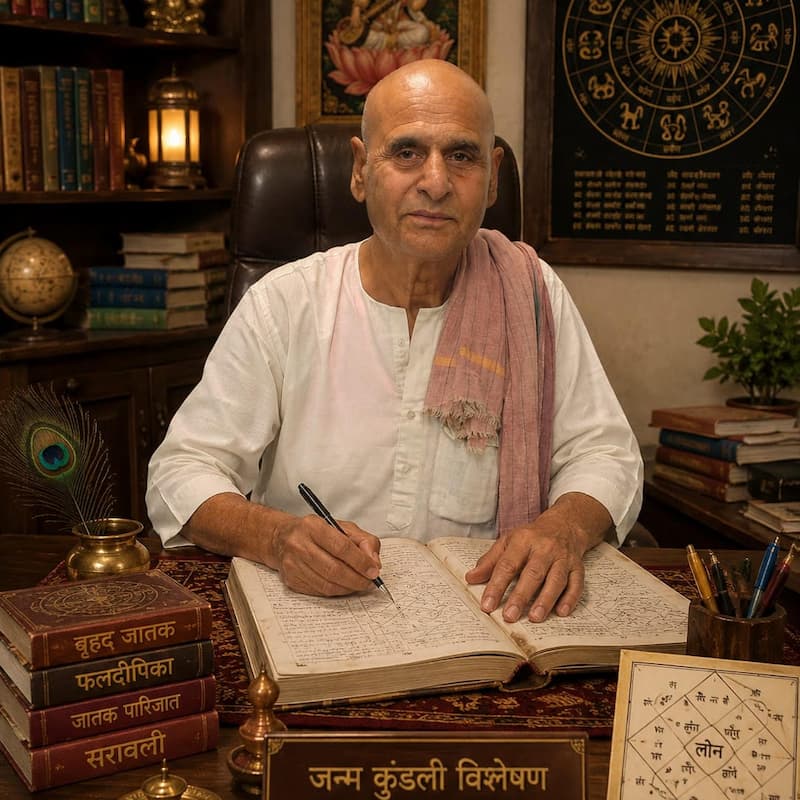
Narendra Kumar Chaubey is a Jyotisha Acharya with over 30 years of experience, based in Bihar and serving clients across India in Vedic astrology, mantra shastra, Vastu and ritual practice.
He completed his formal training at Kameshwar Singh Darbhanga Sanskrit University (KSDSU), one of India’s oldest and most respected institutions for Vedic and Sanskrit scholarship, where he studied Jyotisha shastra, mantra vidya and related classical sciences. KSDSU’s tradition of rigorous Sanskrit education tracing directly to the Mithila region’s centuries-old pandit lineage forms the foundation of his practice.
Over three decades, Narendra Kumar Chaubey has worked with thousands of individuals and families across Bihar and across India, offering guidance in:
- Kundli (birth chart) analysis: Identifying karmic patterns, planetary periods and life path guidance through classical Jyotisha
- Palmistry (Hasta Samudrika): Reading the hand according to the classical Samudrika Shastra tradition
- Vastu Shastra: Assessment and correction of living and working spaces according to directional and elemental principles
- Mantra and Pooja vidhi: Performing and guiding all categories of puja, havan, and mantra sadhana for personal, family and business situations
- Predictive Jyotisha: Transit analysis, muhurta (auspicious timing) selection and remedial guidance
He works across four languages Sanskrit, Hindi, English and Bhojpuri making classical knowledge accessible to practitioners across educational backgrounds and regions.
His writing for ABMantra brings the precision of classical Vedic training to practical mantra guidance: not general advice but specific prescriptions grounded in shastra, lineage and 30 years of direct practice with real situations.
For more info follow on: