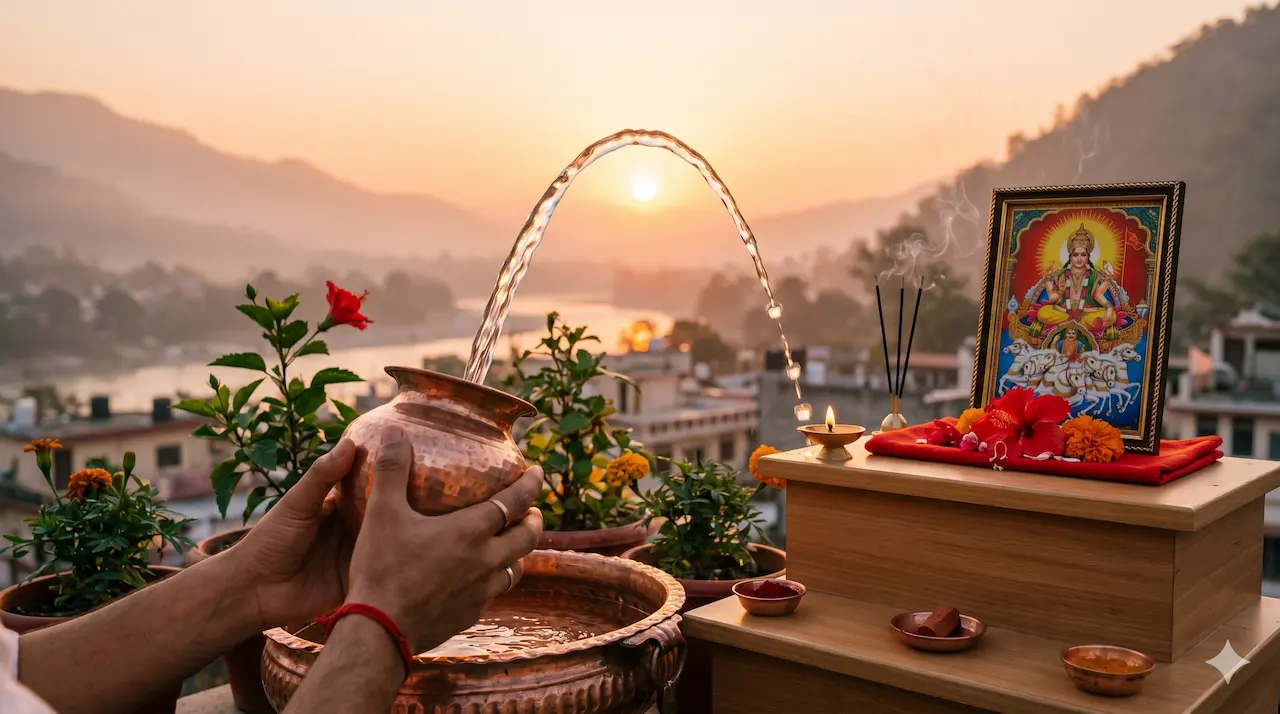

The core of Surya Puja is the Arghya, offering water to the Sun at sunrise while chanting a mantra. Everything else in the puja, the flowers, the lamp, the incense, the idol, adds depth and beauty to that one central act. But the Arghya alone, done every morning with attention, is already a complete practice.
This guide walks you through the full Surya Puja Vidhi step by step. It covers what you need, how to set up your space, how to offer Arghya correctly, which mantras to chant and when, what to do on Sundays, and the most common mistakes beginners make and how to avoid them.
For the complete guide to Surya Mantras including the Beej Mantra, Aditya Hridayam and pronunciation guide, see our main article: Surya Mantra: Meaning, Benefits and Correct Chanting Method.
What You Need: Surya Puja Samagri List
Here is everything you need for a proper Surya Puja at home. Items marked with a star are truly essential. The rest add to the puja but are not required, especially when you are just starting out.
| Item | Quantity | Why It Is Used |
| Copper Kalash (lota) | 1 | Used to hold the Arghya water. Copper is the metal of Surya in Vedic tradition. It enhances the solar quality of the water offering. A brass lota also works. |
| Clean water | As needed | The base of the Arghya offering. Use fresh, clean water from the tap. If you have Ganga jal, add a small amount to the kalash. |
| Red flowers | A small handful | Surya’s colour is red. Hibiscus, marigold or any red flower works. Add a few petals to the Arghya water and place the rest on the altar. |
| Sesame seeds (til) | One teaspoon | One of the oldest offerings to Surya mentioned in the Vedas. Add a small pinch to the Arghya water. The rest can be offered separately or donated. |
| Jaggery (gud) | A small piece | Offered as prasad after puja. Jaggery is preferred over sugar in all Surya rituals as it is more sattvic and directly associated with solar energy in Ayurveda. |
| Red sandalwood (lal chandan) | A small quantity | Applied as tilak on your forehead before puja and used to mark the Surya image or photo. Red sandalwood carries a warm, solar quality. |
| Kumkum (vermilion) | A pinch | Used as tilak on the forehead and applied to the Surya idol or photo. Red is the colour of Surya and Mangala (Mars) in Jyotish. |
| Ghee diya | 1 | A small earthen lamp lit with pure ghee. The lamp is placed facing east during puja. Never use a synthetic oil lamp for Surya puja. |
| Agarbatti (incense sticks) | 2 to 3 | Tagar (white lotus) incense is traditionally preferred for Surya. Any clean, natural incense is acceptable. Avoid synthetic or strongly perfumed incense. |
| Surya photo or idol | 1 | A printed photo or small idol of Lord Surya is the focal point of the indoor puja. If you are doing the puja outdoors facing the actual sun, you do not need this. |
| Red cloth | One small piece | Placed on the altar as the base on which the Surya photo or idol stands. Red represents energy and devotion. |
| Fresh fruit | One or two pieces | Offered as Naivedya (food offering) to Surya at the end of the main puja. Coconut, banana or orange are commonly used. |
If you are just starting and do not have all these items, begin with just a copper or steel vessel of water and Om Suryaya Namah. You can add items over time as you settle into the practice.
Source: Traditional samagri lists based on Surya Puja Vidhi described in the Garuda Purana and classical Jyotish texts on Surya worship (Navagraha Pooja Paddhati).
How to Set Up Your Puja Space
You can do Surya Puja in two ways: outdoors facing the actual Sun, or indoors at a home altar. Both are fully acceptable. Outdoors is more powerful because you have a direct line of sight to the Sun.
Outdoor Setup (Terrace, Garden or Open Window)
1. Choose a spot where you can see the rising Sun clearly. A terrace, garden or balcony facing east is ideal.
2. Lay a clean mat or cloth on the ground to stand on. Go barefoot if possible.
3. Fill the copper kalash with clean water. Add a few red flower petals and a pinch of sesame seeds.
4. Keep your ghee diya nearby, already lit if you are including it.
5. Stand facing east and wait for the Sun to rise above the horizon before offering Arghya.
Indoor Setup (Home Altar)
6. Place a clean red cloth on your puja shelf or table facing east.
7. Put the Surya photo or idol on the red cloth. It should ideally face east or west.
8. Arrange the other items: diya on the left, agarbatti on the right, flowers in front, kalash of water nearby.
9. Apply tilak (kumkum or red chandan) on the Surya image.
10. Light the diya and agarbatti to begin.
For the Arghya, you will still need to stand near a window or balcony facing east so you can pour the water in the direction of the Sun. If this is not possible, pour the water in an east-facing direction from inside the room.
Surya Puja Vidhi: Step-by-Step
Follow these steps in order. The whole puja, including Arghya and mantra chanting, takes about 20 to 30 minutes for the daily version.
Step 1: Prepare Yourself
11. Wake up before sunrise. The ideal time is 30 to 45 minutes before the Sun rises.
12. Bathe or at least wash your hands, feet and face. Do not eat or drink anything before the puja.
13. Wear clean clothes. Yellow, white or saffron (orange) are the traditional colours for Surya puja. Avoid black.
14. Apply a small red tilak on your forehead using kumkum or red chandan. This marks the beginning of the sacred time.
Step 2: Offer Arghya to the Sun
This is the most important part of the puja. Arghya means offering water to the Sun.
15. Fill the copper kalash with clean water. Add a few red flower petals, a pinch of sesame seeds and, if you have it, a small amount of raw milk or Ganga jal.
16. Stand facing east, barefoot if possible. Hold the kalash in both hands, raising it to the level of your forehead.
17. Tilt the kalash so the water pours in a gentle arc toward the Sun. Do not pour it so it falls on your feet. Step back if needed so the water falls on the ground in front of you.
18. Watch the Sun through the arc of water as it pours. This is how you safely view the Sun during Arghya.
19. Chant Om Suryaya Namah as you pour. Offer Arghya three times.
20. On the second and third offerings, you can chant the Surya Gayatri or the Aadidev mantra (see Mantras section below).
From our practice: When we first started the daily Arghya, we felt uncertain about whether we were doing it correctly. The one thing that resolved that uncertainty was this: the moment the water arc catches the morning light and you see the Sun through it, the ritual explains itself. No amount of reading about the Arghya prepares you for how natural it feels to stand there and pour water toward the rising Sun. Start with plain water and Om Suryaya Namah. Everything else can come later.
Step 3: Chant the Surya Mantra
After the Arghya, sit or stand quietly and chant your chosen Surya Mantra.
21. For beginners: Chant Om Suryaya Namah 11 or 27 times. Simply count on your fingers.
22. For regular practice: Chant the Surya Beej Mantra (Om Hraam Hreem Hraum Sah Suryaya Namah) 108 times using a mala.
23. Chant slowly and clearly. There is no benefit in rushing. One sincere mantra counts more than ten distracted ones.
24. Keep your eyes softly closed or gently fixed on the area where the Sun is.
Step 4: Main Puja at the Altar (Indoor Practice)
If you have an indoor altar, perform these steps after the Arghya and mantra:
25. Light the ghee diya and agarbatti if not already lit.
26. Offer red flowers by gently placing them before the Surya image.
27. Apply fresh tilak of red chandan on the Surya photo or idol.
28. Place the jaggery or fruit on a clean leaf or small plate as Naivedya (food offering).
29. Sit in front of the altar for 2 to 3 minutes in silence. This quiet time after the active ritual is important. Let the practice settle.
Step 5: Surya Namaskar (Optional but Recommended)
After the puja, if time and health permit, perform 7 or 12 rounds of Surya Namaskar while still facing east. Chant Om Suryaya Namah with each of the 12 poses. This combines the physical practice with the mantra and completes the morning Surya sadhana.
For the complete 12-name Surya Namaskar Mantra with the corresponding yoga poses and chanting method, see our article: Surya Namaskar Mantra: 12 Names of the Sun God with Meaning and Steps.
Step 6: Prasad and Close
30. Break the fast with the jaggery or fruit that was offered as Naivedya. This is the prasad.
31. Touch a drop of the Arghya water to your forehead and eyes. This is a traditional practice mentioned in the Sivapurana and is said to carry the purifying quality of the Sun’s energy.
32. Bow once toward the east as a final salutation.
Surya Puja Mantras: Which to Chant and When
You do not need to chant all of these. Pick one or two that you can say clearly and chant them consistently. Below is a reference for each mantra and the right moment to use it.
| Mantra | When to Chant | Who It Suits |
| Om Suryaya Namah | During Arghya — chant once per pour, for all three offerings | The easiest and most widely used. Anyone can chant this, including children and beginners. |
| Om Aadidev Namastubhyam Praseed Mama Bhaskara, Divakar Namastubhyam Prabhakar Namostute | During Arghya — chant all three lines while pouring the water | A full salutation mantra. Chant this for the first of the three Arghya offerings. |
| Om Adityaya Vidmahe Sahasra Kiranaya Dhimahi, Tanno Surya Prachodayat | Second and third Arghya offerings | The Surya Gayatri. Invokes Surya as the thousand-rayed one who illuminates the intellect. |
| Om Hraam Hreem Hraum Sah Suryaya Namah | During main puja — 108 times on mala | The Surya Beej Mantra. The most powerful Surya mantra. Chant this after the Arghya while seated. |
| Om Grunih Suryah Adityah | Can be chanted any time during puja or after | Short and easy to remember. Good for children and elderly family members to join in. |
For the complete meaning of each syllable in the Surya Beej Mantra and a 4-week beginner learning schedule, see our article: Surya Beej Mantra: Meaning, Benefits and How to Chant Om Hraam Hreem Hraum.
Sunday Surya Puja: The Special Weekly Practice
Sunday is Ravivar, the day of Ravi (the Sun). The daily puja is a good habit. The Sunday puja is where you go deeper. Traditional practitioners reserve Sunday for an extended practice that builds accumulated solar energy over weeks and months.
| Additional Practice | How to Do It |
| Extended mantra practice | Chant the Surya Beej Mantra 3 rounds of 108 (324 total) instead of the usual single round. This is the recommended Sunday practice for those working on a Jyotish remedy or a 40-day sadhana. |
| Aditya Hridayam recitation | Recite the complete Aditya Hridayam (31 verses) on Sunday mornings after the Arghya and regular mantra practice. If the full text is too long at first, begin with the first three verses and add more each week. |
| Donation (Dana) | Give wheat, jaggery, sesame seeds or red cloth to someone in need. Donations on Sunday are specifically associated with Surya in Jyotish. Even a small, sincere donation carries merit. |
| Fasting (optional) | Observing a partial or full fast on Sundays is a traditional Surya practice. A partial fast means eating only one meal after sunset, without salt, and avoiding non-vegetarian food throughout the day. |
| Cow seva | Feeding a cow with green grass or fodder on Sunday is mentioned in classical texts as highly meritorious for strengthening the Sun. If this is not possible, donating to a gaushala (cow shelter) serves the same purpose. |
Source: Traditional Sunday Surya Vrat practice described in Brihat Parashara Hora Shastra (Surya chapter) and the Surya Purana. Donation items and fasting rules compiled from classical Navagraha Puja texts.
7 Common Mistakes in Surya Puja and How to Fix Them
These are the most common errors beginners make. Each one has a simple fix.
| Mistake | How to Fix It |
| Pouring Arghya water on your feet | Pour the water toward the Sun so it falls on the ground, not directly onto your feet. In traditional practice, water that touches your feet after being offered to Surya is considered inauspicious. Step back slightly if needed so the water falls clear. |
| Looking directly at the Sun | View the Sun through the stream of water as you pour. The arc of water filters the light and lets you see the Sun safely. Never stare at the Sun directly, especially not with open eyes before 8 AM in winter or after full sunrise in summer. |
| Wearing leather footwear during puja | Remove all footwear before the puja. In Vedic practice, leather items are avoided during all worship rituals. Go barefoot on grass or stand on a clean mat. |
| Using a plastic or steel vessel | Use a copper or brass vessel for the Arghya. Copper is the metal of Surya and genuinely enhances the quality of the offering. Plastic and steel have no traditional role in Surya puja. |
| Doing puja after eating | Perform the Arghya and main puja before eating anything. Even a glass of water is best avoided until the puja is complete. This keeps the body in a pure and receptive state during the ritual. |
| Skipping the tilak | Apply a small red tilak on your forehead before beginning puja. This is a simple but important step that marks the beginning of the sacred time. Kumkum or red chandan both work. |
| Rushing through mantras | Chant slowly and clearly. One mantra chanted with full attention is worth more than ten chanted while the mind wanders. If time is short, reduce the number of repetitions but keep the pace slow and sincere. |
Daily Puja vs Sunday Puja: What Is the Difference?
| Element | Daily Puja | Sunday Puja |
| Time needed | 15 to 25 minutes | 45 minutes to 1.5 hours |
| Arghya | 3 offerings | 3 offerings (same as daily) |
| Mantra count | 108 Beej Mantra once | 3 rounds of 108 (324 total) |
| Aditya Hridayam | Optional | Recommended (at least 3 verses) |
| Fasting | Not required | Optional partial fast (one meal after sunset) |
| Donation (Dana) | Not required | Wheat, jaggery, sesame, red cloth |
| Cow seva | Not required | Recommended (feed green grass to a cow) |
| Best for | Maintaining connection and daily solar alignment | Jyotish remedies, 40-day sadhana, deeper practice |
Conclusion
Surya Puja is one of the oldest, simplest and most rewarding practices in the Vedic tradition. It asks very little of you: wake up early, face east, pour water toward the Sun, say a mantra. In return, it gives you a daily anchor, a moment of stillness before the day begins, and a connection to a force that has been sustaining life on this planet since long before any of us arrived.
Start tomorrow morning. You do not need all twelve items on the samagri list. You do not need to know all five mantras. Start with a vessel of clean water and Om Suryaya Namah. Let the practice grow from there.
The Sun will be there every morning. The only question is whether you will meet it.
FAQs About Surya Puja Vidhi
What is Surya Puja Vidhi?
Surya Puja Vidhi is the step-by-step method of worshipping Lord Surya, the Sun God, at home. It includes taking a bath before sunrise, setting up a simple altar, offering water to the Sun (Arghya), chanting Surya Mantras, lighting a lamp and incense, making food offerings (Naivedya) and distributing prasad. The puja is ideally done at sunrise every day, with a more elaborate version on Sundays.
Can I do Surya Puja without a pandit?
Yes. Surya Puja at home does not require a priest. It is one of the most accessible Vedic rituals precisely because the Sun is Pratyakshadaivam, the directly visible God. You need no intermediary. Follow the steps in this guide, chant the mantras with sincere attention, and offer water to the rising Sun. That is the complete puja.
What is the best time to do Surya Puja?
Sunrise is the ideal time. Specifically, the window starting 30 minutes before sunrise (Brahma Muhurta) through 30 minutes after the sun clears the horizon is considered the most powerful time for all Surya worship. The Arghya should be offered as the sun appears above the horizon, while you can still look at it safely through the arc of water.
Which direction should I face during Surya Puja?
Always face east during Surya Puja. East is the direction of the rising Sun and the direction from which solar energy is most directly received. If your home or terrace does not allow an east-facing position, face the direction closest to east from your location.
What can I offer if I do not have all the samagri items?
Plain water in any clean vessel is a complete and fully accepted offering to Surya. The tradition says ‘bhola bhaav deva paav’: sincere devotion is what God accepts, and a humble offering of plain water with genuine intention is honoured. Do not skip the puja because you lack a copper kalash or red flowers. A steel glass and any flower from your garden will do for a sincere daily practice.
Can women do Surya Puja every day?
Yes. There are no gender restrictions on daily Surya Puja. Women can and should offer Arghya and chant Surya Mantras every morning. The traditional guidance is to pause the full puja during menstruation and resume after the fourth day. During that time, quiet mantra chanting or simply acknowledging the Sun at sunrise is considered appropriate.
Narendra Kumar Chaubey is a Jyotisha Acharya with over 30 years of experience, based in Bihar and serving clients across India in Vedic astrology, mantra shastra, Vastu and ritual practice.
He completed his formal training at Kameshwar Singh Darbhanga Sanskrit University (KSDSU), one of India’s oldest and most respected institutions for Vedic and Sanskrit scholarship, where he studied Jyotisha shastra, mantra vidya and related classical sciences. KSDSU’s tradition of rigorous Sanskrit education tracing directly to the Mithila region’s centuries-old pandit lineage forms the foundation of his practice.
Over three decades, Narendra Kumar Chaubey has worked with thousands of individuals and families across Bihar and across India, offering guidance in:
- Kundli (birth chart) analysis: Identifying karmic patterns, planetary periods and life path guidance through classical Jyotisha
- Palmistry (Hasta Samudrika): Reading the hand according to the classical Samudrika Shastra tradition
- Vastu Shastra: Assessment and correction of living and working spaces according to directional and elemental principles
- Mantra and Pooja vidhi: Performing and guiding all categories of puja, havan, and mantra sadhana for personal, family and business situations
- Predictive Jyotisha: Transit analysis, muhurta (auspicious timing) selection and remedial guidance
He works across four languages Sanskrit, Hindi, English and Bhojpuri making classical knowledge accessible to practitioners across educational backgrounds and regions.
His writing for ABMantra brings the precision of classical Vedic training to practical mantra guidance: not general advice but specific prescriptions grounded in shastra, lineage and 30 years of direct practice with real situations.
For more info follow on: