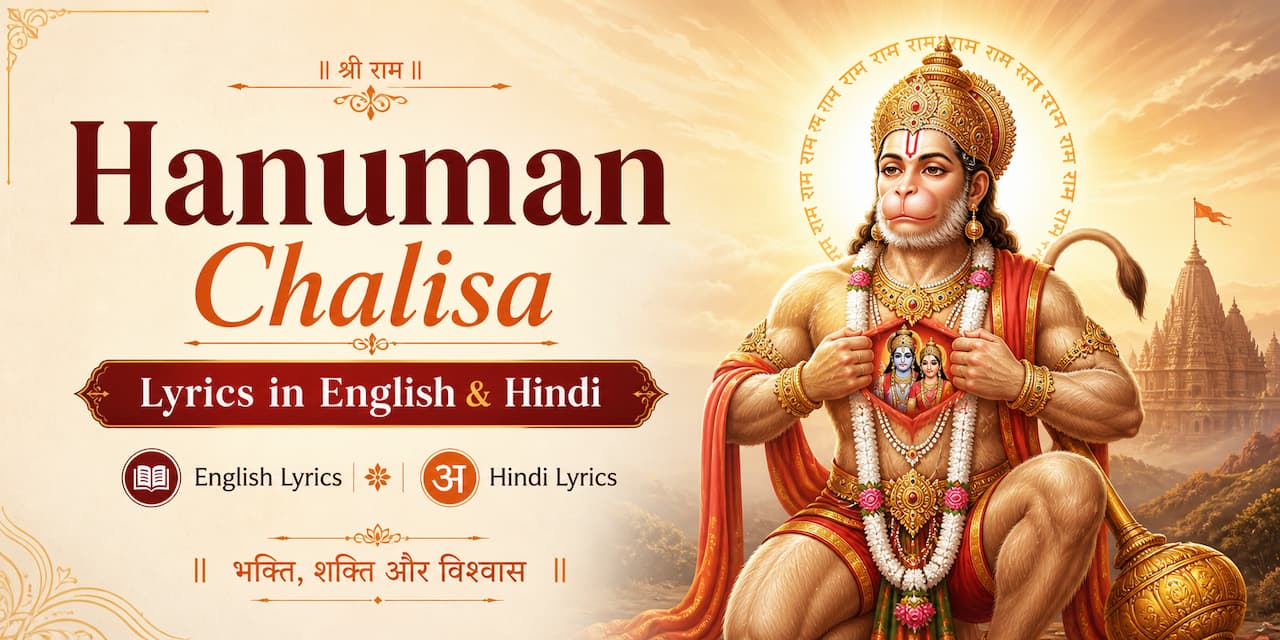
The Hanuman Chalisa is chanted by an estimated 50 million people every day, making it one of the most recited prayers in human history. It is chanted in homes and temples, in offices before difficult meetings, in buses and trains during the morning commute, at hospital bedsides and in army camps. It is chanted by children who have memorised it by age eight and by elders who have been chanting it daily for sixty years.
What makes the Hanuman Chalisa so trusted is not just its antiquity or its rhythmic beauty. It is the precision of its 40 verses — each one addressing a specific aspect of Hanuman’s nature or making a specific promise to the devotee. Verse 24 directly addresses ghosts and negative energies. Verse 25 addresses disease and pain. Verse 28 addresses the fulfilment of any wish. Verse 38 seals the entire Hanuman Chalisa with Lord Shiva’s personal witness. Understanding what each verse means transforms the practice from a recitation into a conversation with one of the most powerful beings in the Hindu tradition.
This complete Hanuman Chalisa guide covers both opening dohas, all 40 chaupais and the closing doha — with the original Hindi lyrics, Roman transliteration, and the meaning of each verse explained in simple English. It also covers the correct way to read the Hanuman Chalisa, how many times to chant, the best day and time, the benefits of regular practice and everything a first-time reader needs to begin.
What Is Hanuman Chalisa: Origin and History
The Hanuman Chalisa was composed by Goswami Tulsidas (1532 to 1623 CE), one of the greatest poet-saints in Indian history. Tulsidas is best known for the Ramcharitmanas, the Hindi retelling of the Ramayana that transformed spiritual devotion across North India. But it was the Hanuman Chalisa, a far shorter work, that reached the widest audience and the deepest hearts. The Hanuman Chalisa in Hindi became the most memorised text in North Indian devotional culture within a generation of its composition, and has remained so for over 450 years.
The Hanuman Chalisa was composed in Awadhi, a dialect of Hindi spoken in the Ayodhya region of Uttar Pradesh. It was written in the bhakti metre of chaupai (four-line verses), making the Hanuman Chalisa easy to memorise and sing. Tulsidas also founded the Sankat Mochan Hanuman Temple in Varanasi, which is said to be the place where he first saw Lord Hanuman directly. The Hanuman Chalisa emerged from that direct experience, not from scholarship.
Source: Goswami Tulsidas, Vinaya Patrika and Ramcharitmanas (16th century CE). The Hanuman Chalisa is generally placed in the Vinaya Patrika collection, composed around 1574 to 1600 CE during Tulsidas’s years in Varanasi.
The traditional story of the Hanuman Chalisa’s composition describes Tulsidas being imprisoned by Mughal Emperor Akbar after refusing to perform a miracle in the royal court. While in his cell in Fatehpur Sikri, he composed the Hanuman Chalisa in Hindi, chanting it with complete focus on Lord Hanuman’s protection. The story says that as he completed the verses, an army of monkeys descended on the city, causing such chaos that Akbar ordered Tulsidas released. The complete Hanuman Chalisa lyrics we know today come from this experience.
Each of the 40 Hanuman Chalisa chaupais is said to represent one of the 40 days Tulsidas spent in prison. The number 40 also mirrors the 40-day sadhana tradition in which any sustained spiritual practice produces its deepest results. The Hanuman Chalisa is therefore both a historical document and a living template for practice.
Hanuman Chalisa Structure: How the 40 Verses Are Organised
Understanding the Hanuman Chalisa structure helps you chant with greater awareness and deeper meaning. The Hanuman Chalisa is not a random collection of praises — it follows a deliberate philosophical progression that mirrors the devotee’s own inner journey from ignorance to surrender.
| Section |
Verses |
What It Covers |
| Opening Dohas (2) |
Doha 1 and 2 |
Purification of the mind. Tulsidas bows to his Guru and acknowledges his own limitations before approaching Hanuman. |
| Verses 1 to 10 |
Chaupai 1-10 |
Hanuman’s divine qualities, physical appearance, names and attributes. Establishes who he is through direct meditation on his form. |
| Verses 11 to 20 |
Chaupai 11-20 |
His deeds in the Ramayana: reviving Lakshmana, burning Lanka, crossing the ocean, the Sanjeevani episode. Establishes what he has done. |
| Verses 21 to 30 |
Chaupai 21-30 |
His powers and blessings for devotees: protection from fear, disease removal, wish fulfilment, Saturn remedy. What he can do for you. |
| Verses 31 to 40 |
Chaupai 31-40 |
Promises, witness and surrender. Shiva’s witness in verse 38. Tulsidas’s personal prayer in verse 39. The closing doha as the ultimate request. |
| Closing Doha |
Final Doha |
The complete Hanuman prayer condensed into one verse: Son of Wind, remover of troubles, dwell in my heart with Rama, Lakshmana and Sita forever. |
Hanuman Chalisa: The Two Opening Dohas
The Hanuman Chalisa begins not with verse 1 but with two dohas — couplets that set the spiritual foundation before the main hymn begins. Many practitioners who chant the Hanuman Chalisa daily without knowing the meanings are surprised to discover how much is packed into just these two opening couplets.
Opening Doha 1
श्रीगुरु चरन सरोज रज, निज मनु मुकुरु सुधारि। बरनउँ रघुबर बिमल जसु, जो दायकु फल चारि॥
Shri Guru Charan Saroj Raj, Nij Manu Mukuru Sudhari. Barnau Raghuvar Bimal Jasu, Jo Dayaku Phal Chari.
Meaning: With the dust of the Guru’s lotus feet, I cleanse the mirror of my mind. I sing the pure glory of Rama, the best of Raghus, which grants all four fruits of life.
Significance: Tulsidas begins not with Hanuman but with his own Guru. This teaches that the path to any deity begins with humility and inner purification. The four fruits (Phal Chari) are Dharma, Artha, Kama and Moksha — everything a human being needs across all dimensions of life.
Opening Doha 2
बुद्धिहीन तनु जानिके, सुमिरौं पवन-कुमार। बल बुद्धि विद्या देहु मोहिं, हरहु कलेश विकार॥
Buddhiheen Tanu Jaanike, Sumirou Pavan-Kumar. Bal Buddhi Vidya Dehu Mohi, Harahu Kalesh Vikar.
Meaning: Knowing myself to be ignorant and without wisdom, I remember you, O son of the Wind. Grant me strength, wisdom and knowledge, and remove my afflictions and sorrows.
Significance: The second doha sets the devotee’s attitude for the entire Chalisa: complete acknowledgment of one’s own limitations before asking for divine grace. Pride blocks the mantra. Humility opens it.
Hanuman Chalisa Verses 1 to 10: Hanuman’s Qualities and Divine Form
The first ten chaupais of the Hanuman Chalisa establish who Hanuman is through direct meditation on his qualities, names and divine appearance. These are the Hanuman Chalisa lyrics most people first memorise because they set the tone for the entire hymn. Read them slowly and visualise the form they describe.
Chaupai 1-10: Hanuman’s Qualities
Chaupai 1
जय हनुमान ज्ञान गुन सागर। जय कपीस तिहुँ लोक उजागर॥
Jai Hanuman Gyan Gun Sagar, Jai Kapis Tihu Lok Ujagar.
Meaning: Victory to Hanuman, ocean of wisdom and virtue. Victory to the lord of monkeys who illuminates the three worlds.
Significance: The Chalisa opens with two victories — one for Hanuman’s inner qualities (wisdom and virtue) and one for his cosmic reach (the three worlds). This establishes him as both a personal protector and a universal force.
Chaupai 2
राम दूत अतुलित बल धामा। अंजनि-पुत्र पवनसुत नामा॥
Ram Doot Atulit Bal Dhama, Anjani-Putra Pavanasut Nama.
Meaning: You are the messenger of Lord Rama, abode of incomparable strength, son of Mother Anjani and the Wind God.
Significance: Three identities in one verse: Rama’s messenger (his purpose), son of Anjani (his human lineage), son of Vayu (his divine lineage). These three together explain why Hanuman is both accessible and infinitely powerful.
Chaupai 3
महाबीर बिक्रम बजरंगी। कुमति निवार सुमति के संगी॥
Mahaveer Vikram Bajrangi, Kumati Niwar Sumati Ke Sangi.
Meaning: O great hero, courageous one with a body strong as a thunderbolt, you remove evil thinking and are the companion of good wisdom.
Significance: Bajrangi means body of vajra (thunderbolt). The deeper meaning is psychological: Hanuman removes kumati (harmful, destructive thought patterns) and replaces them with sumati (clear, wise thinking). This verse is specifically relevant for those struggling with anxiety, negative thoughts or poor decision-making.
Chaupai 4
कंचन बरन बिराज सुबेसा। कानन कुंडल कुंचित केसा॥
Kanchan Baran Biraj Subesa, Kanan Kundal Kunchit Kesa.
Meaning: Golden in complexion, beautifully dressed, you wear forest-flower earrings and have curly hair.
Significance: Tulsidas describes Hanuman’s physical form for meditation. Visualising Hanuman in this golden form while chanting deepens the practice significantly. This verse establishes the dhyana (visualisation) aspect of the Chalisa.
Chaupai 5
हाथ बज्र औ ध्वजा बिराजै। काँधे मूँज जनेऊ साजै॥
Hath Bajra Au Dhwaja Birajei, Kandhe Munj Janeu Sajei.
Meaning: In your hands shine the thunderbolt and the banner, and across your shoulder rests the sacred thread of munja grass.
Significance: The thunderbolt represents destructive power over negativity. The banner represents victory. The sacred thread represents Brahmanical knowledge. Hanuman holds both warrior power and scholarly wisdom.
Chaupai 6
शंकर सुवन केसरी नंदन। तेज प्रताप महा जग वंदन॥
Shankar Suvan Kesari Nandan, Tej Pratap Maha Jag Vandan.
Meaning: Son of Lord Shiva, son of Kesari — your radiance and glory are worshipped by the whole world.
Significance: This verse confirms the dual parentage: Kesari (the vanara king) as earthly father, and Shankar (Shiva) as the divine origin. The whole world worships him — an accurate description of Hanuman’s reach across the globe today.
Chaupai 7
विद्यावान गुनी अति चातुर। राम काज करिबे को आतुर॥
Vidyavan Guni Ati Chatur, Ram Kaj Karibe Ko Aatur.
Meaning: You are supremely learned, virtuous and very clever, always eager to do the work of Lord Rama.
Significance: Aatur means eager, even restless. Hanuman does not serve Rama dutifully — he serves with enthusiastic eagerness. This quality of joyful, eager service is what the Chalisa asks the devotee to cultivate in themselves.
Chaupai 8
प्रभु चरित्र सुनिबे को रसिया। राम लखन सीता मन बसिया॥
Prabhu Charitra Sunibe Ko Rasiya, Ram Lakhan Sita Man Basiya.
Meaning: You take great delight in hearing the stories of the Lord. In your mind dwell Rama, Lakshmana and Sita.
Significance: Rasia means one who savours, who takes deep pleasure in. Hanuman does not merely remember Rama — he relishes the remembrance. The mind where Rama, Lakshmana and Sita all reside together is a mind that is complete and protected from all sides.
Chaupai 9
सूक्ष्म रूप धरि सियहिं दिखावा। बिकट रूप धरि लंक जरावा॥
Sukshma Roop Dhari Siyahi Dikhawa, Bikat Roop Dhari Lanka Jarava.
Meaning: Taking a tiny form you appeared before Sita; taking a fearsome form you burned Lanka.
Significance: The same Hanuman who could be gentle enough to approach a grieving Sita without frightening her could also be fearsome enough to destroy an entire city. Perfect calibration of power to situation — true strength knows when to be small and when to be vast.
Chaupai 10
भीम रूप धरि असुर संहारे। रामचंद्र के काज सँवारे॥
Bhim Roop Dhari Asur Sanhare, Ramchandra Ke Kaj Sanware.
Meaning: Taking a mighty form you destroyed demons and accomplished all the works of Lord Rama.
Significance: Every form Hanuman took was in the service of a specific task. This is the essence of sakama (purposeful) action: calibrating every act to what the moment truly requires.
Hanuman Chalisa Verses 11 to 20: His Great Deeds in the Ramayana
The middle section of the Hanuman Chalisa recounts Hanuman’s specific acts in the Ramayana. These Hanuman Chalisa verses establish his power through evidence — not theory but demonstrated action across impossible circumstances. Understanding what each verse describes transforms the Hanuman Chalisa from a chant into a living record of what Hanuman is capable of doing.
Chaupai 11-20: His Deeds
Chaupai 11
लाय सजीवन लखन जियाये। श्रीरघुबीर हरषि उर लाये॥
Laay Sajeevan Lakhan Jiyaye, Shri Raghubar Harashi Ur Laye.
Meaning: Bringing the Sanjeevani herb, you revived Lakshmana. Lord Rama embraced you joyfully.
Significance: The Sanjeevani episode is the most beloved of all Hanuman stories. When Lakshmana lay dying and no one else could help, Hanuman flew to the Himalayas and returned with the life-giving herb. This is why Hanuman is called Sankatmochan — the one who resolves what seems impossible.
Chaupai 12
रघुपति कीन्ही बहुत बड़ाई। तुम मम प्रिय भरतहि सम भाई॥
Raghupati Kinhi Bahut Badai, Tum Mam Priya Bharatahi Sam Bhai.
Meaning: Lord Rama praised you greatly, saying: You are as dear to me as my own brother Bharata.
Significance: This is the greatest honour Rama ever bestowed on anyone. Bharata was considered the embodiment of dharma and selfless love. Equating Hanuman with Bharata is Rama saying: your devotion has made you my equal. This verse is the heart of the Chalisa’s theology.
Chaupai 13
सहस बदन तुम्हरो जस गावैं। अस कहि श्रीपति कंठ लगावैं॥
Sahas Badan Tumharo Jas Gavein, As Kahi Shripati Kanth Lagavein.
Meaning: Thousands of mouths sing your glory — saying this, Lord Rama embraced you.
Significance: Sahas Badan is Adi Shesha, the cosmic serpent with a thousand heads who sings the Lord’s praises eternally. When Rama says even Shesha sings Hanuman’s glory, he is elevating Hanuman to a cosmic level that transcends ordinary devotion.
Chaupai 14
सनकादिक ब्रह्मादि मुनीसा। नारद सारद सहित अहीसा॥
Sanakadik Brahmadi Munisa, Narad Sarad Sahit Ahisa.
Meaning: Sages like Sanaka, gods like Brahma, Narada, Saraswati and the serpent king — all sing your praises.
Significance: The list of those who praise Hanuman is comprehensive: sages, creator gods, celestial musicians, the goddess of wisdom herself. When the best beings in creation all acknowledge one being, that acknowledgment carries enormous weight.
Chaupai 15
जम कुबेर दिगपाल जहाँ ते। कवि कोविद कहि सकें कहाँ ते॥
Jam Kuber Digpal Jahan Te, Kavi Kovid Kahi Sake Kahan Te.
Meaning: Yama, Kubera, the guardians of all directions — what poet or scholar can fully describe your glory?
Significance: Tulsidas ends his enumeration with humility: even he, one of India’s greatest poets, cannot fully describe Hanuman. This admission is itself part of the Chalisa’s teaching — there are dimensions of the divine that language cannot reach.
Chaupai 16
तुम उपकार सुग्रीवहिं कीन्हा। राम मिलाय राज पद दीन्हा॥
Tum Upkar Sugriwahi Tinha, Ram Milay Raj Pad Tinha.
Meaning: You helped Sugriva, connected him with Rama, and thereby restored his kingdom and throne.
Significance: Hanuman’s role was not only on the battlefield. He was a diplomat, a counsellor and a connector. It was Hanuman who first brought Rama and Sugriva together, creating the alliance without which Lanka could never have been defeated.
Chaupai 17
तुम्हरो मंत्र विभीषण माना। लंकेश्वर भए सब जग जाना॥
Tumharo Mantra Vibhishan Mana, Lankeshwar Bhaye Sab Jag Jana.
Meaning: Vibhishana accepted your counsel and became the ruler of Lanka — this is known throughout the world.
Significance: Hanuman’s advice to Vibhishana was the counsel that saved a kingdom. When Vibhishana was unsure whether to leave Ravana and join Rama, it was Hanuman’s words that gave him the clarity and courage to choose righteousness.
Chaupai 18
जुग सहस्र जोजन पर भानू। लील्यो ताहि मधुर फल जानू॥
Yug Sahastr Yojan Par Bhanu, Lilyo Tahi Madhur Phal Janu.
Meaning: The Sun, thousands of yojanas away, you swallowed as a sweet fruit in your childhood play.
Significance: This famous verse contains a hidden astronomical measurement. Yug (12,000) multiplied by Sahastra (1,000) multiplied by Yojan (approximately 8 miles) gives approximately 96 million miles — remarkably close to the actual Earth-Sun distance of 93 million miles. Tulsidas encoded cosmic truth in a devotional verse.
Chaupai 19
प्रभु मुद्रिका मेलि मुख माहीं। जलधि लाँघि गये अचरज नाहीं॥
Prabhu Mudrika Meli Mukh Mahin, Jaladhi Langhi Gaye Acharaj Nahin.
Meaning: Holding Lord Rama’s ring in your mouth, you leapt across the ocean — this is no surprise for you.
Significance: The ring Rama gave Hanuman was not just an identification token for Sita. It was Rama’s trust given physically into Hanuman’s hands. Carrying that trust, the ocean was no obstacle. This verse teaches that when we carry divine trust, all impossible crossings become possible.
Chaupai 20
दुर्गम काज जगत के जेते। सुगम अनुग्रह तुम्हरे तेते॥
Durgam Kaj Jagat Ke Jete, Sugam Anugrah Tumhare Tete.
Meaning: All the difficult tasks of this world become easy through your grace.
Significance: This is the promise at the heart of the Hanuman Chalisa. Not just some tasks — all difficult tasks. Not just sometimes — through your grace. The Chalisa is a direct request for this grace, made through understanding and love rather than transaction.
Hanuman Chalisa Verses 21 to 30: His Powers and Blessings for Devotees
The third section of the Hanuman Chalisa turns from history to the present. What can the Hanuman Chalisa do for you, here and now? These ten verses answer that question directly with some of the most powerful promises in all of devotional literature. Verse 24, verse 25 and verse 28 together make the Hanuman Chalisa the go-to prayer for protection, healing and wish fulfilment across the entire Hindu tradition.
Chaupai 21-30: His Powers
Chaupai 21
राम दुआरे तुम रखवारे। होत न आज्ञा बिनु पैसारे॥
Ram Duware Tum Rakhware, Hot Na Aagya Binu Paisare.
Meaning: You are the guardian of Rama’s gate. Nothing enters without your permission.
Significance: Hanuman is the gatekeeper of Rama’s presence. Cultivate Hanuman’s grace and you cultivate access to the highest. This is why approaching Rama through Hanuman is the traditional path in North Indian devotion.
Chaupai 22
सब सुख लहै तुम्हारी सरना। तुम रक्षक काहू को डरना॥
Sab Sukh Lahe Tumhari Sarna, Tum Rakshak Kahu Ko Darna.
Meaning: All happiness is gained in your refuge. With you as protector, there is nothing to fear.
Significance: Sarna means complete refuge, not partial shelter. Total, unconditional protection. The verse makes a sweeping promise: all happiness, all protection, nothing to fear. This is the declaration that millions of devotees rest their lives on.
Chaupai 23
आपन तेज सम्हारो आपै। तीनों लोक हाँक ते काँपै॥
Aapan Tej Samharo Aapai, Tinon Lok Hank Te Kanpai.
Meaning: Only you can contain your own radiance. At your roar, all three worlds tremble.
Significance: A being so powerful that only he himself can contain his own energy — and yet he chooses to be gentle with devotees. Infinite power held in perfect restraint, deployed only in service.
Chaupai 24
भूत पिशाच निकट नहिं आवै। महाबीर जब नाम सुनावै॥
Bhoot Pisach Nikat Nahin Avai, Mahaveer Jab Nam Sunave.
Meaning: Ghosts and evil spirits do not come near when the name of the great Hanuman is proclaimed.
Significance: Fear — whether from actual negative energies or from anxiety and psychological disturbance — dissolves in the presence of Hanuman’s name. The protection described is both spiritual and psychological.
Chaupai 25
नासै रोग हरै सब पीरा। जपत निरंतर हनुमत बीरा॥
Nasei Rog Harei Sab Pira, Japat Nirantar Hanumat Bira.
Meaning: All diseases are cured and all pain is removed for one who chants Hanuman’s name continuously.
Significance: Nirantar means continuously, without gap. The verse does not promise a quick fix but a sustained practice. All diseases (rog) and all pain (pira) — physical, mental and spiritual.
Chaupai 26
संकट तें हनुमान छुड़ावै। मन क्रम बचन ध्यान जो लावै॥
Sankat Ten Hanuman Chudavai, Man Karm Bachan Dhyan Jo Lavai.
Meaning: Hanuman rescues from all troubles the one who meditates on him through thought, deed and word.
Significance: Man (mind), Karm (action) and Bachan (speech) — all three must align. Hanuman rescues those who think of him, act in accordance with his qualities and speak his name. This verse teaches integrated devotion, not just ritual repetition.
Chaupai 27
सब पर राम तपस्वी राजा। तिन के काज सकल तुम साजा॥
Sab Par Ram Tapasvi Raja, Tin Ke Kaj Sakal Tum Saja.
Meaning: Rama is the greatest among ascetic kings. You accomplished all his works.
Significance: The implication is powerful: if you can have Hanuman’s grace, you have access to the one who can do everything for the highest.
Chaupai 28
और मनोरथ जो कोई लावै। सोई अमित जीवन फल पावै॥
Aur Manorath Jo Koi Lavai, Soi Amrit Jeevan Phal Pavai.
Meaning: Whoever brings any wish to Hanuman receives abundant fruit of immortal life.
Significance: Any wish (koi manorath — any desire). The promise is not selective. Whatever a sincere devotee brings to Hanuman — worldly or spiritual, large or small — is heard and responded to.
Chaupai 29
चारों जुग परताप तुम्हारा। है परसिद्ध जगत उजियारा॥
Charo Yug Partap Tumhara, Hai Parsidh Jagat Ujiyara.
Meaning: Your glory shines in all four ages. You are renowned as the light of the world.
Significance: Hanuman’s glory is not era-specific. He is equally revered across the Satya, Treta, Dvapara and Kali yugas. In Kalyug — the present age — his accessibility is specifically emphasised.
Chaupai 30
साधु-संत के तुम रखवारे। असुर निकंदन राम दुलारे॥
Sadhu Sant Ke Tum Rakhware, Asur Nikandan Ram Dulare.
Meaning: You are the protector of saints and sages, the destroyer of demons, and the beloved of Lord Rama.
Significance: Three roles in one verse: protector of the good, destroyer of evil, beloved of the highest. Hanuman holds all three simultaneously.
Hanuman Chalisa Verses 31 to 40: Promises, Witness and Final Surrender
The final section of the Hanuman Chalisa moves toward completion and surrender. The Hanuman Chalisa promises become explicit here, Lord Shiva appears as witness in verse 38, and Tulsidas makes his personal, intimate closing prayer. Reading these last ten verses of the Hanuman Chalisa is the moment the hymn delivers everything it has been building toward.
Chaupai 31-40: Promises and Surrender
Chaupai 31
राम दुआरे तुम रखवारे। होत न आज्ञा बिनु पैसारे॥
Ram Duware Tum Rakhware, Hot Na Aagya Binu Paisare.
Meaning: You are the guardian of Rama’s gate. Nothing passes without your command.
Significance: This verse is repeated as a refrain, reinforcing the gatekeeper role. Repetition in the Chalisa is intentional — it creates the impression of the verse on the mind through rhythm, just as water shapes stone through consistent flow.
Chaupai 32
सब सुख लहै तुम्हारी सरना। तुम रक्षक काहू को डरना॥
Sab Sukh Lahe Tumhari Sarna, Tum Rakshak Kahu Ko Darna.
Meaning: All happiness flows in your refuge. With you as protector, what is there to fear?
Significance: The second repetition, now as a question. By verse 32, the devotee who has been chanting for 30 verses has already received the answer through the accumulated power of those verses.
Chaupai 33
तुम्हारी भक्ति मार्ग सहज। राम तुम पर है विश्वास।
Tumhari Bhakti Marg Sahaj, Ram Tum Par Hai Vishwas.
Meaning: Your path of devotion is natural and simple. Lord Rama himself places his trust in you.
Significance: Sahaj means natural, effortless, arising from one’s own nature. Hanuman’s path of devotion is not forced or artificial — it is the most natural expression of a human soul aligned with its highest purpose.
Chaupai 34
सूक्ष्म रूप धरि सियहिं दिखावा। बिकट रूप धरि लंक जरावा॥
Sukshma Roop Dhari Siyahi Dikhawa, Bikat Roop Dhari Lanka Jarava.
Meaning: In tiny form you appeared to Sita; in fearsome form you burned Lanka.
Significance: The range of Hanuman’s forms reflects the range of divine response to human need. This verse invites trust that whatever form of help is needed, Hanuman has it available.
Chaupai 35
भीम रूप धरि असुर संहारे। रामचंद्र के काज सँवारे॥
Bhim Roop Dhari Asur Sanhare, Ramchandra Ke Kaj Sanware.
Meaning: In a mighty form you destroyed demons and accomplished Rama’s every purpose.
Significance: The mission is always the same: accomplish what the Lord requires. The form changes. The dedication does not. This is the model of karma yoga.
Chaupai 36
जै जै जै हनुमान गोसाईं। कृपा करहु गुरुदेव की नाईं॥
Jai Jai Jai Hanuman Gosain, Kripa Karahu Gurudev Ki Nain.
Meaning: Victory, victory, victory to you, O master Hanuman. Shower grace upon me as a Guru showers upon a disciple.
Significance: The triple Jai (victory) is the most intense form of salutation in the Chalisa. And then the extraordinary request: not just devotee grace but Guru grace — the deepest possible relationship in the Vedic tradition.
Chaupai 37
जो शत बार पाठ कर कोई। छूटहि बंदि महा सुख होई॥
Jo Shat Bar Path Kar Koi, Chhutehi Bandi Maha Sukh Hoi.
Meaning: Whoever reads the Chalisa one hundred times is freed from all bondage and attains great happiness.
Significance: Shat (hundred) repetitions. This verse is the scriptural basis for the practice of chanting the Chalisa 100 times continuously, which many devotees undertake during crisis or vow.
Chaupai 38
जो यह पड़ै हनुमान चालीसा। होय सिद्धि साखी गौरीसा॥
Jo Yah Padhai Hanuman Chalisa, Hoye Siddhi Sakhi Gaurisa.
Meaning: Whoever reads this Hanuman Chalisa attains success. Lord Shiva himself is the witness.
Significance: The ultimate guarantee. Shiva — the destroyer of all illusion, the one who sees through all pretense — is named as the witness. When Shiva witnesses a promise in the Chalisa, the promise is absolute. This verse is why the Chalisa is trusted so completely across generations.
Chaupai 39
तुलसीदास सदा हरि चेरा। कीजै नाथ हृदय महँ डेरा॥
Tulasidas Sada Hari Chera, Keejai Nath Hridaya Mahan Dera.
Meaning: Tulsidas is always a servant of the Lord. O Hanuman, make your home in my heart.
Significance: The Chalisa ends where it should — not with a request for wealth or victory but for Hanuman’s permanent presence in the heart. All other benefits follow from this one. A heart where Hanuman dwells permanently has protection, courage, wisdom and grace as natural conditions.
Chaupai 40 (Closing Doha)
पवन तनय संकट हरन, मंगल मूरति रूप। राम लखन सीता सहित, हृदय बसहु सुर भूप॥
Pawan Tanay Sankat Haran, Mangal Murti Roop. Ram Lakhan Sita Sahit, Hriday Basahu Sur Bhoop.
Meaning: O son of the Wind, destroyer of all troubles, embodiment of auspiciousness — dwell in my heart with Rama, Lakshmana and Sita forever.
Significance: The closing doha. Sankat Haran (remover of all troubles), Mangal Murti (auspicious form). The final request is for an entire divine family to reside in the heart: Hanuman, Rama, Lakshmana and Sita together. A heart holding all four is a heart that is complete, protected and at peace.
How to Read Hanuman Chalisa: Complete Step-by-Step Method
Reading the Hanuman Chalisa correctly is simple. The Hanuman Chalisa does not require a special posture, a specific location or expensive items. What it requires is attention and sincerity. Whether you are reading the Hanuman Chalisa for the first time or returning to it after years away, the method is the same.
What You Need
- A clean, quiet space — even a small corner of a room works
- A ghee diya and agarbatti lit before you begin (optional but recommended)
- A photo or small idol of Hanuman (optional but helpful for focus)
- Red flowers and a small offering of jaggery or laddoo for the weekly practice
Step-by-Step Reading Method
- Bathe and wear clean clothes before the practice. Beginning the Hanuman Chalisa with a clean body signals to the mind that the time ahead is sacred. Red or saffron are traditional for Hanuman worship.
- Light the diya and agarbatti. Face east or north.
- Begin with the Hanuman Dhyana Shloka: Manojavam Marutatulyavegam… recited three times. This centres the mind.
- Chant the two opening dohas. Read slowly, understanding each word.
- Read all 40 chaupais at a steady pace — not too fast, not too slow.
- Close with the final doha: Pawan Tanay Sankat Haran…
- Sit in silence for two to three minutes after completion. Let the vibration settle.
- Offer a laddoo or jaggery as prasad. Distribute to family members.
From our practice: The shift in the Hanuman Chalisa happens around verse 22 to 24. If you are reading it for the first time, you may not notice. But after a few weeks of daily reading, something changes in those verses. Sab Sukh Lahe Tumhari Sarna (all happiness in your refuge) stops being a sentence you are reading and becomes a statement you believe. This is not something that happens through intellectual understanding. It happens through repetition over time. The Chalisa is a practice, not a text. Read it daily for one month and you will understand this from the inside.
How Many Times to Read
| Times |
When and Why |
| 1 time |
Standard daily practice. Takes 10 to 15 minutes. Complete and meaningful for maintaining regular connection with Hanuman. |
| 3 times |
Dedicated daily practice for those building a consistent sadhana. Tuesday and Saturday mornings. |
| 7 times |
Chanted when seeking relief from a specific difficulty. Seven is a sacred count in Hanuman practice. |
| 11 times |
The traditional Tuesday and Saturday extended practice. Takes about two hours. The most common dedicated count. |
| 100 times |
Referenced directly in verse 37. Frees from all bondage. Done as a specific 3 to 4 hour devotional practice or group akhand path. |
Hanuman Chalisa Benefits: What Regular Reading Does
The Hanuman Chalisa benefits described here are drawn from the Hanuman Chalisa text itself, from classical commentaries on the Ramcharitmanas and from the accumulated experience of millions of practitioners across centuries.
| Benefit |
How It Works |
Source |
| Protection from fear and negative energies |
Verses 24 and 25 directly address fear removal and disease cure. Chanting creates an energetic boundary that classical texts describe as impenetrable to negative forces. |
Chapters of the Ramcharitmanas on Hanuman’s qualities. |
| Removal of obstacles and fulfilment of goals |
Verse 20 promises that all difficult tasks of the world become easy through Hanuman’s grace. Verse 28 promises that any wish brought to Hanuman receives abundant fruit. |
Valmiki Ramayana references to Hanuman as Sankatmochan. |
| Saturn remedy (Sade Sati) |
Chanting the Hanuman Chalisa on Saturdays is the most widely prescribed classical Jyotish remedy for Sade Sati and Saturn mahadasha. |
Brihat Parashara Hora Shastra, Saturn remedy chapter. |
| Disease and health |
Verse 25 is explicit: all diseases are cured and all pain removed for one who chants Hanuman’s name continuously. This refers to sustained practice rather than occasional chanting. |
Ramcharitmanas Sundarkand, on Hanuman’s healing energy. |
| Mental clarity and wisdom |
Verse 7 describes Hanuman as supremely learned. Verse 3 says he removes evil thinking and companions good wisdom. Regular Chalisa chanting specifically targets the quality of thinking. |
Art of Living Foundation on Chalisa and mental clarity. |
| Success in studies and competitive exams |
Verse 1 invokes the ocean of wisdom (Gyan Gun Sagar). Verse 2 names Hanuman as Atulit Bal Dhama — the source of incomparable strength including intellectual strength. |
Traditional teaching lineages recommending Tuesday Chalisa practice for students. |
Frequently Asked Questions About Hanuman Chalisa
What is Hanuman Chalisa and why is it chanted?
Hanuman Chalisa is a 40-verse devotional hymn composed by the poet-saint Goswami Tulsidas in the 16th century, written in Awadhi language. The word Chalisa means forty in Hindi. It is chanted to invoke Lord Hanuman’s grace, protection, strength and blessings. It is the most widely recited prayer in Hinduism, chanted daily by an estimated 50 million people worldwide. The Chalisa contains specific promises — backed by Lord Shiva as witness in verse 38 — that sincere recitation leads to success, protection and fulfilment.
How many times should Hanuman Chalisa be read?
The most common counts are 1 time (daily practice), 3 times (dedicated daily practice), 7 times (for specific intentions), 11 times (the standard Tuesday and Saturday practice) and 100 times (during crisis or specific vows, as mentioned in verse 37). For beginners, once daily is a complete and meaningful practice.
What is the best time to read Hanuman Chalisa?
Sunrise (Brahma Muhurta, 4:35 AM to 5:23 AM) is the most auspicious time. Sunrise itself is the second-best time, and sunset the third. Tuesday and Saturday morning practices carry the most potency. The Chalisa can be chanted at any time with a pure heart — including before sleep for those with anxiety or nightmares.
Can we read Hanuman Chalisa at night?
Yes. The Chalisa can be chanted at any hour. For those experiencing fear, anxiety or nightmares at night, chanting the Chalisa before sleep is specifically recommended. Verse 24 (Bhoot Pisach Nikat Nahin Avai) is the key verse for night-time protection. Many devotees chant it silently while lying down as a way to settle the mind and establish Hanuman’s protective presence.
Can women read Hanuman Chalisa?
Yes, fully and without restriction. Women can chant the Hanuman Chalisa at all times, in all conditions. There are no gender restrictions on the Chalisa. Many women maintain a daily Chalisa practice as their primary spiritual anchor.
How long does it take to memorise Hanuman Chalisa?
Most adults can memorise the full 40 verses within 3 to 6 weeks of daily reading. The most effective method is to learn 2 to 3 verses per day, reciting the cumulative verses from verse 1 each time. The rhyme and rhythm of Awadhi make memorisation much easier than it appears.
What is the scientific verse in Hanuman Chalisa?
Verse 18 is the famous astronomical verse: Yug Sahastr Yojan Par Bhanu, Lilyo Tahi Madhur Phal Janu. Using ancient Vedic measurements (Yug = 12,000, Sahastr = 1,000, Yojan = approximately 8 miles), the calculation gives approximately 96 million miles — remarkably close to the actual Earth-Sun distance of 93 million miles. Tulsidas, writing in the 16th century, encoded an accurate cosmic measurement in a devotional verse describing the child Hanuman’s leap toward the Sun.
Is Hanuman Chalisa a mantra or a stotra?
It is a stotra — a devotional hymn — not a mantra in the technical sense. A mantra is a short sacred phrase designed for japa (repetitive counting chanting). The Chalisa is a longer composition of 40 verses meant to be recited as a complete devotional act. However, individual verses from the Chalisa function as mantras when extracted and repeated. Verses 24, 25 and 38 are the three most commonly used as standalone mantra-like repetitions.
Conclusion: Begin Reading the Hanuman Chalisa Today
The Hanuman Chalisa is one of the most complete spiritual practices ever composed in a single short text. All 40 Hanuman Chalisa verses cover Hanuman’s identity, his deeds, his powers, his specific gifts to devotees, the promises of the Hanuman Chalisa and the correct attitude of the devotee. Nothing is left out.
Reading the Hanuman Chalisa once today is enough to begin. You do not need to understand every word. You do not need to have memorised the Hanuman Chalisa. You do not need a pandit or a special occasion. Read the Hanuman Chalisa once, slowly, with this guide open beside you. Let the words do what they have been doing for 450 years.
The Hanuman Chalisa has been protecting, strengthening and guiding its practitioners for over 450 years. It will do the same for you.
Jai Bajrang Bali.
Disclaimer: Chanting the Hanuman Chalisa is a spiritual practice that supports mental and emotional wellbeing. It does not replace medical or professional care.