
Lord Hanuman is the most widely worshipped deity in India today. More temples are dedicated to him than to any other form of the divine. More people chant his name daily than any other mantra. More households in North India have a Hanuman image at the entrance than any other deity. This near-universal devotion is not the product of organised religion or institutional promotion it has grown organically, century after century, because the experience of Hanuman’s presence and protection is something that ordinary people across India have reported in their own lives for over a thousand years.
Lord Hanuman’s significance in Hinduism rests on a combination of qualities that are rare in any single being and unknown anywhere else in the tradition. He has infinite physical strength yet no ego. He has the highest wisdom yet complete humility. He serves with absolute dedication yet asks nothing in return. He is accessible to everyone yet is described as the foremost being in all three worlds. Understanding who Lord Hanuman is, where he came from, what he did in the Ramayana and what he symbolises in the Vedic tradition is the foundation of all meaningful Hanuman mantra practice.
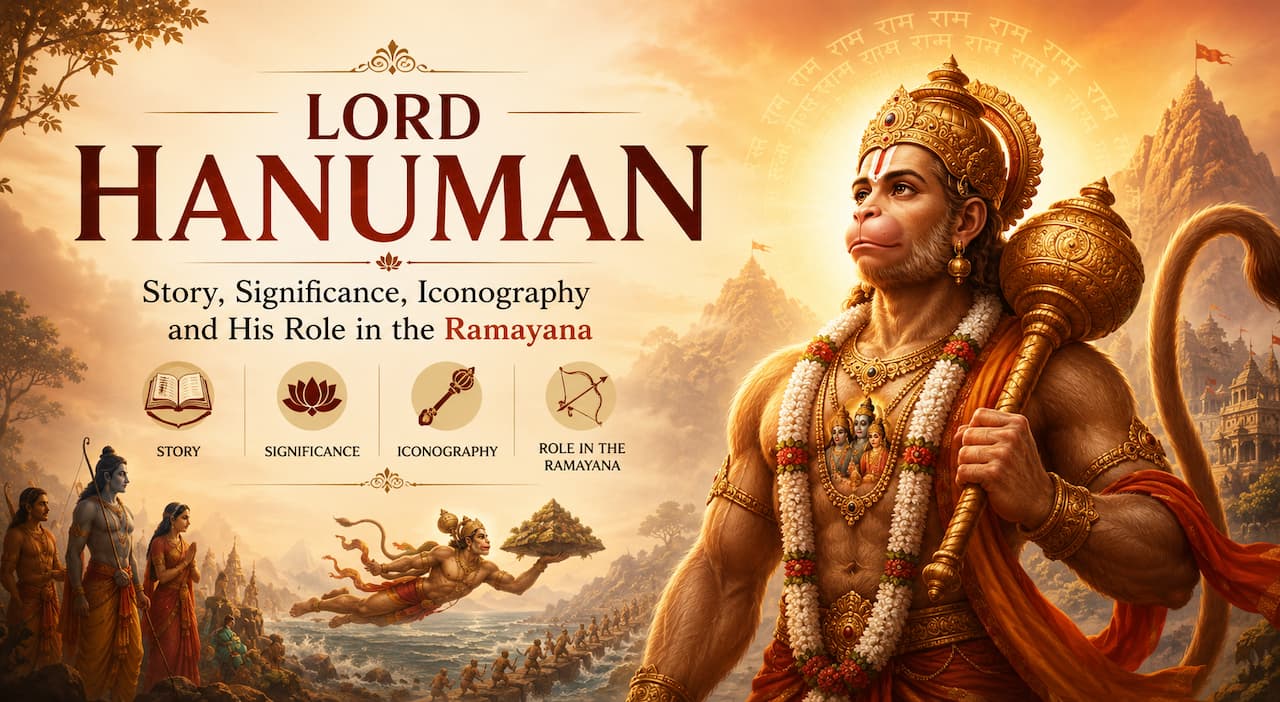
This complete guide to the Lord Hanuman story covers his birth, his 10 principal names and their meanings, his iconography and what each element symbolises, his six key missions in the Ramayana, and his significance for the present age.
For the complete Hanuman Mantra guide including all mantras, meanings and chanting methods, see: Hanuman Mantra Meaning, Types, Benefits and How to Chant.
Lord Hanuman Birth Story: How He Came Into the World
Lord Hanuman’s birth story is told across multiple classical texts the Valmiki Ramayana, the Shiva Purana and various Puranic traditions and each version adds a different dimension to the meaning of his arrival. The core account comes from the Valmiki Ramayana’s Kishkindha Kanda and Uttara Kanda.
The Parents: Anjana, Kesari and Vayu
Hanuman was born to Anjana, an apsara (celestial being) who had been born on earth as a vanara due to a sage’s curse. The curse specified that she would be released when she gave birth to an incarnation of divine power. His social father was Kesari, a brave and noble vanara king of the region near Trimbakeshwar in what is now Maharashtra.
His divine parentage came through Vayu, the god of wind. The tradition describes how, at the time of Dasharatha’s Putrakameshti Yajna (the sacrifice performed to obtain divine children), a divine bird carried a portion of the sacred Payasa (the divine food) through the air. Vayu, the wind god, directed this Payasa toward the outstretched hands of Anjana, who was performing austerities on a hilltop. Anjana received and consumed the Payasa, and from this divine interaction Hanuman was born. This is why he is simultaneously Anjani Putra (son of Anjana), Kesari Nandan (son of Kesari) and Pavan Putra (son of the wind).
Source: Valmiki Ramayana, Kishkindha Kanda, Chapter 66. The dual parentage account social father Kesari and divine father Vayu appears in both the Kishkindha Kanda and the Uttara Kanda.
The Shiva Purana Account: Hanuman as Shiva’s Avatar
The Shiva Purana adds a parallel account: that Lord Shiva himself took birth as Hanuman in order to serve Lord Vishnu’s avatar Rama. In this tradition, Anjana had performed intense tapas (austerities) specifically requesting Shiva as her son. Shiva, pleased with her devotion, agreed to be born through her. This is the basis for Hanuman’s title Ekadasha Rudra he is one of the eleven Rudra manifestations of Shiva.
Both accounts are simultaneously true within the tradition’s framework of understanding. Hanuman is the son of Vayu through Anjana on the earthly plane, and the incarnation of Shiva’s divine energy on the cosmic plane. These are two different levels of the same reality, not contradictions.
Source: Shiva Purana, Rudra Samhita. Hanuman as Ekadasha Rudra is also referenced in Tulsidas’s Hanuman Chalisa (verse 6: Shankar Suvan Kesari Nandan).
The Divine Boons at Birth
When the infant Hanuman leapt toward the Sun (mistaking it for a fruit) and Indra struck him down with the Vajra, Vayu withdrew all air from the universe in grief. The suffering of all living beings brought the gods to appease Vayu and in doing so they blessed the child Hanuman with extraordinary gifts. Each blessing came from a different deity:
- Brahma: Protection from his own Brahma’s curse making Hanuman immune to the irrevocable curse
- Indra: His Vajra (thunderbolt) would no longer be effective against Hanuman, and Hanuman would be stronger than Vajra
- Yama (death): Hanuman would be free from Yama’s jurisdiction he would not die unless he chose to
- Varuna (water): Protection from water Varuna’s weapons would not affect him
- Agni (fire): Immunity from fire particularly significant given the Lanka burning episode
- Surya (the Sun): Radiance, wisdom and the capacity to learn directly from Surya as a disciple
- Vishwakarma (divine architect): Safety from all objects of his own creation
These boons together explain all of Hanuman’s extraordinary feats in the Ramayana: the ocean crossing (Vayu’s son can travel through air), the burning of Lanka (immune to fire), the revival of Lakshmana before dawn (speed beyond limit), the defeat of all weapons directed at him (Vajra immunity). Lord Hanuman’s powers were not arbitrary they were divinely structured for the specific missions he was destined to accomplish.
Lord Hanuman and Lord Surya: The Guru-Disciple Story
One of the most important stories in the Lord Hanuman tradition and one that directly connects the Surya Mantra and Hanuman Mantra practices is the story of Hanuman becoming Lord Surya’s disciple.
After recovering from the Sun incident and receiving the divine boons, the young Hanuman approached Lord Surya and requested to become his student. Surya refused initially on practical grounds: as the Sun, he was always moving across the sky and could not have a student who needed him to stop and face them.
Hanuman solved this problem with characteristic ingenuity. He grew to enormous size and walked backwards across the sky, keeping his face always toward Surya as the Sun moved. In this way walking backward across the heavens he received Surya’s complete teaching while the Sun never needed to halt his journey. Surya, moved by this extraordinary demonstration of determination and devotion, taught Hanuman the entire nine systems of knowledge: the four Vedas, the six Vedangas, nine systems of grammar, logic, philosophy and the complete shastras.
This story is the reason why Tulsidas’s description of Hanuman in the Hanuman Chalisa begins with his wisdom: Gyan Gun Sagar (ocean of wisdom and virtue) before his strength. Hanuman’s intellect came from a direct education by the source of all light and knowledge. It also explains why the Hanuman tradition describes Surya as Hanuman’s guru and why strengthening one’s relationship with the Surya Mantra strengthens the Hanuman practice simultaneously.
For the complete guide to Surya Mantra the mantras of Lord Hanuman’s own guru see: Surya Mantra Meaning, Benefits and Correct Chanting Method.
Source: This story appears in the Uttara Kanda tradition and in various Puranic accounts. The Hanuman Chalisa’s description of Hanuman as Vidyavan Guni Ati Chatur (supremely learned, virtuous and very clever) directly references this education from Surya.
Lord Hanuman Significance: 10 Principal Names and Their Meanings
Lord Hanuman is known by many names across different traditions and regions of India. Each name illuminates a different aspect of his nature or role. Together, the names form a complete picture of who he is. The ten most important names, their meanings and their textual sources are given below.
| Name | Meaning | Source |
| Hanuman | One with a prominent or broken jaw from the Sanskrit Hanu (jaw) and Man (prominent). Named after the incident when Indra’s thunderbolt struck his jaw. | Valmiki Ramayana, Uttara Kanda |
| Anjaneya | Son of Anjana his mother’s name. The most commonly used name in South India. | Valmiki Ramayana, Kishkindha Kanda |
| Pavan Putra | Son of the Wind (Pavan = wind). Reflects his divine parentage through Vayu, the wind god. | Valmiki Ramayana |
| Vayuputra | Same as Pavan Putra son of Vayu. Used interchangeably. | Valmiki Ramayana |
| Bajrangbali | One whose body (anga) is strong as a thunderbolt (vajra, rendered as bajra in Hindi). Bajrang = diamond-body, Bali = strong. | Hindi devotional tradition |
| Mahavira | The great hero. Describes his warrior quality courage that goes beyond ordinary strength. | Hanuman Chalisa, Tulsidas |
| Sankat Mochan | The remover of all troubles (Sankat = trouble, Mochan = one who removes). His most beloved functional name. | Devotional tradition |
| Ramaduta | Messenger of Rama. His primary role identity the one entrusted by Rama with impossible missions. | Valmiki Ramayana, Sundarakanda |
| Chiranjeevi | The ever-living, the immortal. One of the seven Chiranjeevis immortal beings who remain in the world across all ages. | Puranic tradition |
| Kalyug Devata | The deity of the current age (Kalyug). Most accessible and most directly responsive in the present era. | Ramcharitmanas, Tulsidas |
Lord Hanuman Iconography: What Every Element of His Form Means
Every element of Lord Hanuman’s traditional iconographic form carries specific theological meaning. Understanding the iconography transforms looking at a Hanuman image from a passive visual experience into an active reading of what the tradition says about the nature of the ideal devotee.
| Vanara form: Hanuman is depicted as a vanara a being that is part human, part monkey. The vanara form represents the integration of animal vitality and power with human intelligence and devotion. He is not a monkey who becomes devotional but a complete being whose outer form reflects inner qualities of agility, strength and fearless courage. |
| Vermilion (sindoor) complexion: Hanuman is often depicted coated in sindoor (red vermilion). This comes from the story where Sita applied sindoor to her forehead for Rama’s long life. Hanuman, learning this, applied sindoor all over his body for Rama’s benefit. Red is the colour of Mars (Mangal) and of Hanuman’s warrior energy. |
| The Gada (mace)Represents strength, authority and the power to break through obstruction. Hanuman wields the gada in his warrior aspect the same weapon associated with Vishnu and Yama (the god of justice). It is the weapon of righteous force. |
| The mountain in his hand: The most recognisable Hanuman image: Hanuman holding an entire mountain (the Dron Parvat, from which he retrieved the Sanjeevani herb). This image represents the principle that when you cannot find what you need, bring the entire source. It is the symbol of absolute thoroughness in service. |
| The tail: Hanuman’s tail is always raised never between the legs. The raised tail is the symbol of fearlessness and the absence of defeat. In the Lanka episode, Ravana tried to humiliate Hanuman by setting his tail on fire. Hanuman used the burning tail to set Lanka alight. What was meant to humiliate became the instrument of his mission’s completion. |
| Open chest (Hridaya darshan): The most devotionally powerful image of Hanuman: him tearing open his chest to reveal Rama and Sita seated within his heart. This image is the visual representation of the teaching: the devotee whose heart is completely occupied by the Lord has no room for fear, desire or ego. |
| Brahmacharya (celibate form): Hanuman is Param Brahmachari one who has mastered the life force through complete celibacy. This mastery is the source of his extraordinary physical and mental powers. The tradition describes celibacy not as repression but as conservation and redirection of creative energy toward spiritual strength. |
Lord Hanuman in the Ramayana: Six Key Missions
The Lord Hanuman significance in the Ramayana cannot be overstated without Hanuman, the Ramayana’s central events could not have occurred. He is not a supporting character who helps the hero. He is the operative intelligence who makes the hero’s mission possible. Each of his six key missions in the Ramayana established a different dimension of his character.
1. Meeting Rama and Sugriva (Kishkindha Kanda)
Hanuman was the first to approach Rama and Lakshmana when they arrived in the forest near Rishyamukha Mountain. He approached in the form of a Brahmin student and engaged them in sophisticated conversation. Rama, recognising his quality, said to Lakshmana: ‘This being has studied the Vedas, grammar and all the shastras not one word was mispronounced, not one phrase was disconnected.’ Hanuman then facilitated the alliance between Rama and Sugriva the political act without which Lanka could never have been reached.
2. Crossing the Ocean and Finding Sita (Sundara Kanda)
The Sundara Kanda is entirely the story of Hanuman. When all other vanaras despaired at the edge of the ocean and no one dared attempt the crossing, it was Jambavan who reminded Hanuman of his forgotten powers. Hanuman leapt 800 yojanas across the ocean, defeated multiple obstacles including Surasa and Simhika, entered Lanka in the form of a cat, searched the entire city, found Sita in the Ashoka grove, presented Rama’s ring, reassured her, destroyed the Ashoka garden, allowed himself to be captured, refused to acknowledge Ravana as his master in Ravana’s own court, and returned with the intelligence that changed the entire direction of the war.
3. Burning Lanka (Sundara Kanda)
When Ravana ordered Hanuman’s tail to be set on fire as punishment, Hanuman allowed it then expanded to cosmic size, broke his bonds, and used the burning tail to set fire to Lanka’s buildings and mansions. This act, described across 15 sargas of the Sundara Kanda, served a double purpose: it demonstrated to Ravana that Rama had forces capable of destroying Lanka, and it proved to the monkey army that the ocean crossing and Lanka entry were possible. Hanuman then extinguished his tail in the ocean and returned to Rama.
4. Reviving Lakshmana with the Sanjeevani (Yuddha Kanda)
When Indrajit’s Shakti weapon struck Lakshmana and left him at the edge of death, Vaidya Sushen declared that only the Sanjeevani herb from the Dron Mountain in the Himalayas could revive him before sunrise. Hanuman flew to the Himalayas, could not identify the specific herb, and brought the entire Dron Mountain to Lanka. Lakshmana was revived with seconds to spare. Rama embraced Hanuman and said: ‘You are as dear to me as Bharata.’ This is considered one of the greatest declarations of love in all of Indian literature.
5. Entering Patala for Rama and Lakshmana (Post-Yuddha Kanda tradition)
When Ahiravana (the ruler of Patala, the underworld) abducted the sleeping Rama and Lakshmana using maya (illusion), Hanuman entered Patala the realm of death alone to rescue them. He defeated Ahiravana by simultaneously extinguishing five lamps in five different directions, fulfilling the condition of Ahiravana’s invulnerability. This episode is not in the Valmiki Ramayana but appears in later regional texts including the Kamba Ramayanam and various Puranic traditions.
6. Carrying the Message to Ayodhya (Yuddha Kanda / Uttara Kanda)
After the war, Rama sent Hanuman ahead to Ayodhya to inform Bharata of his return before the 14-year exile ended. Hanuman first went to Sringiverapura to inform Nishada king Guha, then to Nandigram where Bharata was waiting for Rama’s return. This mission of bringing news of returning the light of joy to those who had waited in darkness is considered one of Hanuman’s most emotionally significant acts in the tradition.
Primary source: Valmiki Ramayana Kishkindha Kanda (meeting Rama), Sundara Kanda (Lanka mission and burning), Yuddha Kanda (Sanjeevani, Ahiravana). The Patala/Ahiravana episode appears in post-Valmiki regional traditions including the Kamba Ramayanam.
Lord Hanuman Significance: Why He Is the Most Worshipped Deity in India
The Lord Hanuman significance that generates such universal devotion is not primarily about miraculous powers. It is about the quality of relationship he offers. Every other deity in the Hindu tradition requires either elaborate ritual, specific caste qualification, formal initiation, or at minimum a clear sense of one’s own worthiness to approach. Hanuman requires none of these.
The tradition consistently describes Hanuman as the deity of the ordinary person in an ordinary crisis. The merchant whose business is failing, the student before an examination, the person in a hospital corridor waiting for news all of them call on Hanuman without ceremony or preparation. The tradition says he responds to all of them, not in proportion to the elaborateness of their worship but in proportion to the sincerity of their call.
Hanuman as Kalyug Devata
The Ramcharitmanas specifically identifies the current age (Kalyug) as the age when Hanuman is most actively present and most directly accessible. The Ramcharitmanas verse states: Kalyug Keval Nam Adhara in Kalyug, the name alone is the support. And the name most readily available, most immediately effective, most universally chanted across all castes and communities in India is Jai Hanuman.
This accessibility in Kalyug is not accidental. The tradition teaches that Kalyug makes disciplined sadhana difficult to sustain lives are shorter, distractions are more powerful, spiritual energy is harder to accumulate. Hanuman’s response to this is the simplest possible: call my name with a sincere heart and I will come. No other deity makes this promise with Hanuman’s consistency.
Shakti and Bhakti Together
The most precise description of Lord Hanuman’s significance comes from the academic and devotional consensus: he is the perfect embodiment of Shakti (power) and Bhakti (devotion) simultaneously. Infinite power held in perfect devotion. Complete strength guided entirely by love. This is the combination that the Vedic tradition identifies as the highest human possibility and it is what Hanuman demonstrates in every episode of the Ramayana.
Most spiritual traditions create a tension between worldly effectiveness and spiritual purity the stronger you become, the more the ego grows; the more devoted you become, the more withdrawn from action you become. Hanuman dissolves this tension completely. His Bhakti is the source of his Shakti. His devotion is what makes him more capable, not less. This is the teaching that millions of devotees across India have absorbed not through philosophy but through the simple daily act of chanting his name.
From our practice: The quality of Lord Hanuman that strikes you most directly in sustained practice is not his power but his presence. The Sankat Mochan Hanuman temple in Varanasi founded by Tulsidas himself carries an atmosphere that is unlike any other temple we have visited. It is simultaneously very alert and very still. Practitioners who spend time there regularly describe the same quality: the feeling of being seen and known by a presence that is both vast and immediately personal. This quality enormous presence without distance is what devotees are pointing to when they say Hanuman is the deity of Kalyug. He is not far away requiring intermediaries. He is present, available and responsive. That is his most important quality and his most significant gift.
Conclusion: Lord Hanuman in Your Daily Life
Understanding Lord Hanuman’s story, significance and iconography transforms how you approach every aspect of the Hanuman mantra tradition. The Hanuman Chalisa is no longer just 40 verses it is a meditation on a being whose qualities are described specifically and whose promises are backed by a tradition of direct experience stretching across a thousand years. The Sankat Mochan Mantra is not just a sound it is an invocation of the being who entered the underworld for his devotees and who, the tradition says, is still doing so today.
Lord Hanuman’s significance in Hinduism ultimately rests on this: he is proof that strength and devotion are not opposites. That serving completely is the highest form of freedom. That the fastest path to the divine is through one-pointed love for its greatest devotee. The Ramayana shows this through action. The mantra tradition makes it available to every ordinary practitioner, in every ordinary situation, today.
Jai Bajrang Bali. Jai Sankat Mochan. Jai Pavan Putra.
Frequently Asked Questions About Lord Hanuman
Who is Lord Hanuman?
Lord Hanuman is a divine being from the Hindu tradition a vanara (a being that is part human, part monkey) who served as the most devoted follower and most capable aide of Lord Rama in the epic Ramayana. He is the son of Anjana and Kesari, with divine parentage through Vayu, the wind god. In the Hindu theological framework, he is described simultaneously as the son of Vayu (wind), a manifestation of Lord Shiva (the Ekadasha Rudra tradition), and as the ideal devotee of Lord Rama. He is one of the seven Chiranjeevis immortal beings who remain present in the world across all ages and is specifically described as the deity most directly accessible and responsive to sincere prayer in the current age (Kalyug).
What is Lord Hanuman’s significance in Hinduism?
Lord Hanuman’s significance in Hinduism rests on three qualities that he embodies simultaneously and completely: infinite strength without ego, the highest wisdom without pride, and absolute devotion without personal desire. These three together represent the highest ideal of human potential in the Vedic tradition. He is worshipped as the protector who removes all troubles (Sankatmochan), as the embodiment of celibate strength (Param Brahmachari), as the ideal devotee (Bhakta Shiromani), and as the ever-present guardian of Kalyug. His accessibility requiring no initiation, no elaborate ritual, only sincere devotion makes him the most universally worshipped deity in India today.
Why is Hanuman called Pavan Putra?
Hanuman is called Pavan Putra (son of the wind) because of his divine parentage through Vayu, the wind god. In the Valmiki Ramayana’s account, Anjana was performing austerities on a mountain when Vayu carried the sacred food offering (the Payasa that had been brought for Dasharatha’s wives) to her through divine agency. From this divine encounter, Hanuman was born. His Pavan Putra quality explains several of his characteristics: his speed (wind-fast), his ability to travel any distance in any form, his power of pranayama (breath control) which is the basis of all his physical strength, and his quality as the force that sustains all life just as Vayu (air) sustains all living beings.
What is the story of Lord Hanuman swallowing the Sun?
This story appears in the Puranas rather than the original Valmiki Ramayana. As a child, the young Hanuman saw the rising sun and mistook it for a ripe fruit. Using his inherited powers from Vayu, he leapt into the sky and seized the Sun. On the same day, Rahu (the shadow planet) was scheduled to eclipse the Sun. Seeing Hanuman holding the Sun, Rahu fled and complained to Indra. Indra hurled his thunderbolt (Vajra) at Hanuman, striking his jaw and causing him to fall to earth. Vayu, grief-stricken, withdrew all air from the universe. The suffering of all living beings persuaded the gods to come to Vayu and bless the child Hanuman with divine gifts: Brahma gave him immortality from his curses, Indra gave him invulnerability to his own Vajra, Yama gave him freedom from death, Varuna gave him protection from water, and Surya gave him radiance and the capacity to learn directly from him as a disciple.
Why is Hanuman covered in sindoor?
The story comes from a scene after Rama’s return to Ayodhya. Hanuman saw Mother Sita applying sindoor (vermilion) to her forehead. When he asked what it was for, she said it was for Rama’s long life and wellbeing. Hanuman immediately applied sindoor all over his entire body, reasoning: if a small mark on the forehead keeps Rama well, then sindoor applied to every part of the body will protect him even more completely. Rama, moved by this act of absolute devotion, embraced Hanuman. Since then, offering sindoor to Hanuman has been one of the most important acts of devotion, and Hanuman’s images are often depicted in sindoor-red colour.
Is Lord Hanuman immortal?
Yes. Lord Hanuman is one of the seven Chiranjeevis immortal beings described in Puranic tradition who remain alive and present in the world across all four yugas (cosmic ages). The Valmiki Ramayana itself does not directly state his immortality, but both accounts of his birth suggest an extraordinary lifespan: Jambavan reports that Indra granted him the boon of choosing the moment of his own death, and Brahma granted him immunity from Brahmashap (the irrevocable curse). Tulsidas, in the Ramcharitmanas and the Hanuman Chalisa, describes Hanuman as the Kalyug Jagrut Devata the most actively present deity in the current age which presupposes his continued living presence.
Who was Hanuman’s guru?
Lord Surya, the Sun god, was Hanuman’s Guru. This is the story that creates the connection between the Surya Mantra and Hanuman Mantra traditions in abmantra.com’s content. When the young Hanuman had recovered from the Sun-swallowing incident and received his divine boons, he approached Lord Surya and asked to become his student. Surya initially refused because, as the Sun, he was always moving across the sky. Hanuman solved this by growing to cosmic size and walking backwards across the sky facing Surya thus receiving his complete education without Surya needing to stop. Surya taught him the nine systems of knowledge including the four Vedas, the six Vedangas, logic and grammar. This is why the mantra Hanuman Dhyana Shloka calls him Buddhimatam Varishtham the foremost among the wise.
Why is Hanuman the most important deity for Kalyug?
Hanuman is described as Kalyug Jagrut Devata the most awake and most directly responsive deity of the current cosmic age for several specific reasons. First, he is a Chiranjeevi and is actually present in the world during Kalyug, unlike many deities who are accessible only through mediated worship. Second, the Ramcharitmanas states that in Kalyug, disciplined sadhana is harder to maintain and Hanuman’s approach requires only sincere devotion, not elaborate ritual or long preparation. Third, his speed and accessibility: the tradition describes Hanuman as arriving in response to his name being spoken sincerely there is no queue, no intermediary, no prerequisite. This directness is what Kalyug most needs and what Hanuman most provides.
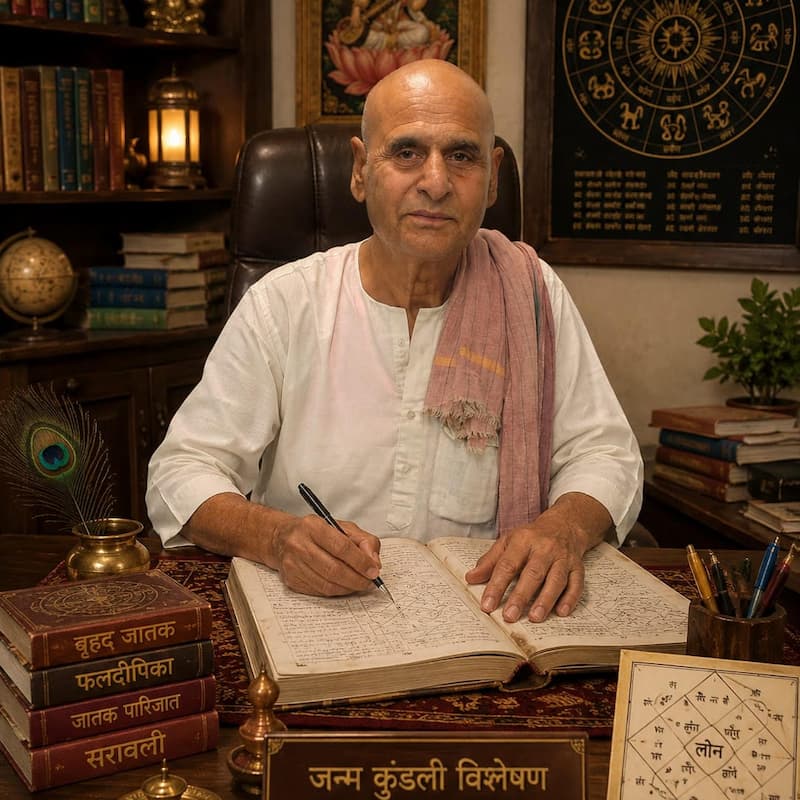
Narendra Kumar Chaubey is a Jyotisha Acharya with over 30 years of experience, based in Bihar and serving clients across India in Vedic astrology, mantra shastra, Vastu and ritual practice.
He completed his formal training at Kameshwar Singh Darbhanga Sanskrit University (KSDSU), one of India’s oldest and most respected institutions for Vedic and Sanskrit scholarship, where he studied Jyotisha shastra, mantra vidya and related classical sciences. KSDSU’s tradition of rigorous Sanskrit education tracing directly to the Mithila region’s centuries-old pandit lineage forms the foundation of his practice.
Over three decades, Narendra Kumar Chaubey has worked with thousands of individuals and families across Bihar and across India, offering guidance in:
- Kundli (birth chart) analysis: Identifying karmic patterns, planetary periods and life path guidance through classical Jyotisha
- Palmistry (Hasta Samudrika): Reading the hand according to the classical Samudrika Shastra tradition
- Vastu Shastra: Assessment and correction of living and working spaces according to directional and elemental principles
- Mantra and Pooja vidhi: Performing and guiding all categories of puja, havan, and mantra sadhana for personal, family and business situations
- Predictive Jyotisha: Transit analysis, muhurta (auspicious timing) selection and remedial guidance
He works across four languages Sanskrit, Hindi, English and Bhojpuri making classical knowledge accessible to practitioners across educational backgrounds and regions.
His writing for ABMantra brings the precision of classical Vedic training to practical mantra guidance: not general advice but specific prescriptions grounded in shastra, lineage and 30 years of direct practice with real situations.
For more info follow on: