
|
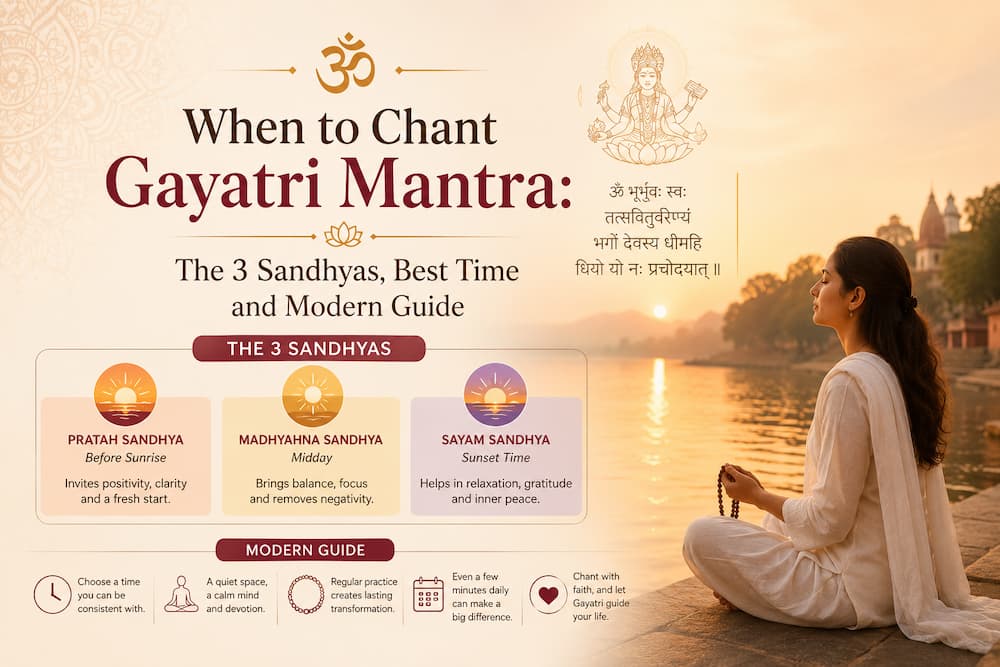
Quick Answer The Gayatri Mantra is traditionally chanted three times a day at the three Sandhyas: 1. Pratha Sandhya : Dawn, during Brahma Muhurta (4:24 AM to 5:12 AM, roughly 1.5 hours before sunrise). Facing East. 2. Madhyahnika : Midday, between 11:45 AM and 12:15 PM. Facing North. 3. Sayam Sandhya : Dusk, at sunset. Facing West. If you can only chant once, Brahma Muhurta is the single most powerful time. If three times is not possible, once at dawn is the correct priority. |
|
Who This Article Is For This article is for you if: you chant the Gayatri Mantra daily and want to know whether you are doing it at the right time | you work shifts or have a schedule that makes 4 AM impossible | you have heard different answers about the best time and want the classical source, not an opinion. |
If you have been wondering whether you are chanting the Gayatri Mantra at the right time, this article gives you the complete answer. The 7 AM post-bath chant is a good time. But it is not the best time. The classical texts are specific: the Gayatri Mantra has three optimal windows each day, and Brahma Muhurta : before the sun rises : is the most powerful of all three. This article tells you exactly when, which direction to face, how many times, and what to do if your schedule does not allow the traditional timing.
The Three Sandhyas: Why the Gayatri Mantra Has Three Chanting Windows |
The word Sandhya means junction or transition. The three Sandhyas are the three natural transition points of the day: the junction between night and day (dawn), the peak of the day (noon), and the junction between day and night (dusk). These transitions are not arbitrary. They are the three moments when the relationship between solar energy and the human nervous system changes most significantly.
The Gayatri Mantra is a solar mantra. It invokes Savitar : the divine light of the sun : and asks it to illuminate the mind (dhiyo yo nah prachodayat: may that divine light guide our intellect). Chanting it at the three transitions aligns the practitioner’s energy with the sun’s movement through the day. This is the original logic of Sandhyavandanam: salutation at the junctions.
|
What the Classical Source Says The Chandogya Upanishad (2.24.1) describes the three Sandhyas as the three forms of the cosmic day. The Dharmasindhu, a comprehensive 18th-century manual of Vedic practice, specifies the exact time windows for each Sandhya and their chanting counts. Sri Chandrasekharendra Saraswati (Kanchi Paramacharya), writing in Hindu Dharma, states: “Even in times of misfortune the Gayatri must be muttered at least ten times at dawn, midday and dusk. These are hours of tranquility.” |
When to Chant Gayatri Mantra: The Complete Time Guide |
The table below gives the exact timing, direction, count and classical reason for each chanting window.
|
Why the counts differ : 108, 32 and 64 The counts 108, 32 and 64 are specified in the Dharmasindhu and correspond to the three Vedic deities who preside over each Sandhya. Morning (Vishnu) = 108 (the full mala count, most complete). Noon (Brahma) = 32 (Brahma’s sacred number in some traditions). Evening (Shiva) = 64 (half of 108, reflecting Shiva’s role in dissolution rather than creation). In practice, most modern teachers and lineages simplify this to 108 repetitions at whichever Sandhya you can perform. The classical count differences are for those following a strict formal Sandhyavandanam : the daily ritual vow. |
Brahma Muhurta: Why 4 AM Is the Most Powerful Time |
Brahma Muhurta translates as the hour of Brahma : the creator. It begins 1 hour and 36 minutes before local sunrise and lasts 48 minutes. In most parts of India this falls between 4:00 AM and 5:30 AM depending on the season and location.
Here is what most articles on this topic miss: Brahma Muhurta is not primarily about tradition. It is about the human nervous system. Cortisol (the alertness hormone) begins its natural pre-waking rise approximately 90 minutes before your habitual wake time. At 4 AM this creates alert but calm wakefulness : the ideal mental state for mantra concentration. The classical texts arrived at this conclusion without fMRI machines. The modern research confirms it.
Three specific qualities make Brahma Muhurta the most powerful time for Gayatri chanting:
Practical reality: For most working Indians, 4 AM is not achievable every day. The classical texts acknowledge this. Sri Chandrasekharendra Saraswati writes: “Even in times of misfortune the Gayatri must be muttered at least ten times at dawn.” Ten times. At dawn. That is the minimum the tradition asks of someone whose life does not permit the full practice.
What If You Cannot Chant at 4 AM? The Practical Modern Guide |
This is the real question for most people reading this. Here is the honest, tradition-based answer for each common life situation.
|
The Minimum the Tradition Asks Sri Chandrasekharendra Saraswati (Kanchi Paramacharya) in Hindu Dharma: “Even in times of misfortune the Gayatri must be muttered at least ten times at dawn, midday and dusk.” Ten times. Not 108. Not 32. Ten. If your life allows only that, you are still within the tradition’s minimum. The tradition was written for people with real lives, not only for monks. |
Direction to Face While Chanting: Why It Matters |
Facing east in the morning and west in the evening is not superstition. The Gayatri Mantra is addressed to the sun (Savitar). Facing the direction of the sun while chanting creates a direct alignment between the practitioner and the source of the mantra’s invoked energy.
For personal practice (not formal Sandhyavandanam), facing east is always acceptable at any time of day.
Can You Chant the Gayatri Mantra at Night? |
This question is addressed separately in many classical texts. The answer depends on what you mean by night.
After sunset but before 10 PM: This is the Sayam Sandhya window. Fully valid. Facing west, 64 repetitions or 108.
After 10 PM: The classical texts do not prescribe formal Gayatri chanting after 10 PM. This is not a prohibition : it is the absence of a prescription. If you miss the evening Sandhya and chant at 11 PM, the mantra is not harmful. It is simply not in its prescribed window.
At midnight: Midnight belongs to Kali’s energy in the Shakta tradition and to Shiva’s Ardha Ratri in the Shaiva tradition. The Gayatri is a solar mantra. Chanting it at midnight does not damage the practitioner : but it is outside the mantra’s natural domain.
|
The Honest Answer If you forgot to chant all day and it is now midnight, chant 11 times with sincere intention and go to sleep. The tradition’s crisis minimum applies here. Do not skip an entire day because you missed the ideal window. |
From Our Practice |
|
From Our Practice I began a strict Brahma Muhurta practice for 40 consecutive days in January. The first week was genuinely difficult : waking at 4:15 AM in Delhi winter is not comfortable. By Day 12 something changed. The 4 AM hour stopped feeling like a sacrifice and started feeling like the only quiet moment in the day that belonged entirely to the practice. The city had not started yet. The birds had not started yet. The mind had not started constructing the day’s problems yet. I have since found that even one hour of the 4 AM quality is worth more for the mantra’s effect than two hours at any other time. The classical texts are correct. The difference is not superstition : it is something you can directly verify in about two weeks. |
Frequently Asked Questions |
Begin Tomorrow Morning |
The next Brahma Muhurta in your city begins approximately 1 hour and 36 minutes before local sunrise tomorrow. For Delhi: approximately 4:24 AM in summer, 5:10 AM in winter. Check the sunrise time for your location and count back 96 minutes.
Set one alarm. Place your mala by your bed tonight. Tomorrow morning, when the alarm sounds, sit up, do not check your phone, and begin the first of 108 repetitions.
Do this for 14 consecutive days. By Day 14 you will not need the alarm to understand why the classical texts are specific about this window. The quality of the practice at 4:30 AM is something the texts describe but only the practitioner can verify.
|
Sources and Citations
|
Narendra Kumar Chaubey is a Jyotisha Acharya with over 30 years of experience, based in Bihar and serving clients across India in Vedic astrology, mantra shastra, Vastu and ritual practice.
He completed his formal training at Kameshwar Singh Darbhanga Sanskrit University (KSDSU), one of India’s oldest and most respected institutions for Vedic and Sanskrit scholarship, where he studied Jyotisha shastra, mantra vidya and related classical sciences. KSDSU’s tradition of rigorous Sanskrit education tracing directly to the Mithila region’s centuries-old pandit lineage forms the foundation of his practice.
Over three decades, Narendra Kumar Chaubey has worked with thousands of individuals and families across Bihar and across India, offering guidance in:
- Kundli (birth chart) analysis: Identifying karmic patterns, planetary periods and life path guidance through classical Jyotisha
- Palmistry (Hasta Samudrika): Reading the hand according to the classical Samudrika Shastra tradition
- Vastu Shastra: Assessment and correction of living and working spaces according to directional and elemental principles
- Mantra and Pooja vidhi: Performing and guiding all categories of puja, havan, and mantra sadhana for personal, family and business situations
- Predictive Jyotisha: Transit analysis, muhurta (auspicious timing) selection and remedial guidance
He works across four languages Sanskrit, Hindi, English and Bhojpuri making classical knowledge accessible to practitioners across educational backgrounds and regions.
His writing for ABMantra brings the precision of classical Vedic training to practical mantra guidance: not general advice but specific prescriptions grounded in shastra, lineage and 30 years of direct practice with real situations.
For more info follow on: