
|
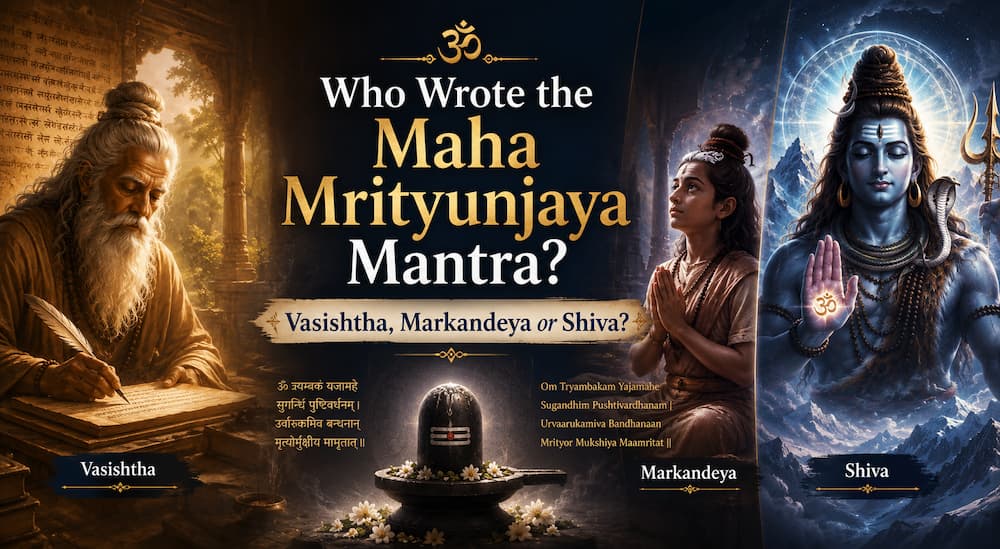
Quick Answer The Maha Mrityunjaya Mantra appears in two traditions with two different attributions: Textual attribution: Sage Vasishtha (Vasishtha Maitravarunihi) : the mantra is found in Rigveda, Mandala 7, Hymn 59, Verse 12 (RV 7.59.12), and Mandala 7 of the Rigveda is attributed to the Vasishtha family of sages. Traditional attribution: Sage Markandeya : the Puranas record that Lord Shiva revealed this mantra to Markandeya when he was facing premature death at age 12, and Markandeya transmitted it to humanity. Both are correct. Vasishtha is the textual seer (Mantra Drashta) who recorded the mantra in the Rigveda. Markandeya is the devotional figure whose story explains why and how the mantra is used for protection against death. |
|
Who This Article Is For This article is for you if: you have seen conflicting answers about who wrote this mantra and want to understand why different sources give different names | you want the actual Rigveda reference to cite | you want to understand the Markandeya story and why it matters for the practice. Also see: Maha Mrityunjaya Mantra: meaning, benefits and how to chant correctly |
If you have searched who wrote the Maha Mrityunjaya Mantra and found two different names on different sites, you were not looking at wrong information. You were looking at two different but equally valid answers from two different traditions. This article explains both, gives you the actual Rigveda reference, and tells you why the confusion exists.
The Textual Answer: Vasishtha and Rigveda 7.59.12 |
In academic and textual terms, the Maha Mrityunjaya Mantra is attributed to Vasishtha Maitravarunihi, one of the Saptarishis (seven great sages) of the Vedic tradition. The mantra appears in:
Mandala 7 of the Rigveda is one of the eight family books : the oldest core section of the text, composed between 1500 and 1000 BCE. The Vasishtha family of sages is credited with composing most of Mandala 7. Vasishtha himself is considered its principal author.
The specific hymn (RV 7.59) is a composite hymn addressed to Rudra, the Vedic deity who later merged with Shiva. The last four verses of the hymn, including verse 12 which contains the Maha Mrityunjaya Mantra, are considered late additions to the hymn. They relate to the Sakamedha ritual, the final ritual in the four-monthly cycle of Vedic sacrifices.
The Traditional Answer: Markandeya and the Story of Conquering Death |
The Puranas give a different and equally important attribution. In the Pauranic (Puranic) tradition, the Maha Mrityunjaya Mantra is inseparably connected with Sage Markandeya : and for a reason that makes the mantra’s purpose immediately clear.
The story, recorded in the Shiva Purana and referenced in the Markandeya Purana:
|
The Story of Markandeya The sage Mrikandu and his wife Marudmati performed intense penance hoping for a child. Lord Shiva appeared and gave them a choice: an intelligent son with a lifespan of only 12 years, or a son of limited intelligence with a long life. Mrikandu chose the intelligent son. Markandeya was born, exceptionally gifted, but fated to die at 12. When Markandeya reached his 12th year and understood his fate, he did not accept it. He sat in complete surrender before a Shiva Linga, arms wrapped around it, chanting continuously. When Yama, the god of death, came to take him, Markandeya refused to release the Shiva Linga. Lord Shiva himself emerged to protect his devotee. He defeated Yama and granted Markandeya immortality : declaring that whoever was so deeply absorbed in his worship could not be touched by death. The mantra Markandeya chanted during those final hours is the Maha Mrityunjaya Mantra. Lord Shiva had revealed it to him specifically as a means of transcending premature death. Markandeya then transmitted it to humanity. |
This is why the mantra is chanted at times of illness, at the deathbed, during surgery, and in any situation involving fear of death. The story is not mythology separate from the practice. It is the explanation of the practice.
Why Both Attributions Are Correct: The Key Distinction |
Here is what most articles miss entirely: Vasishtha and Markandeya are not competing answers. They address two completely different questions.
|
The Counterintuitive Point About This Mantra Unlike most Vedic mantras where the textual attribution is the primary one, the Maha Mrityunjaya Mantra is unusual: the Pauranic attribution to Markandeya is arguably more important to the practice than the textual attribution to Vasishtha. This is because the mantra is not used primarily as a Vedic ritual recitation. It is used as a protection against death. And that use is explained entirely by Markandeya’s story, not by Vasishtha’s role as the recorder of Mandala 7. When you chant this mantra at a hospital bedside or during a crisis, you are doing exactly what Markandeya did. The story and the practice are inseparable. |
The Mantra Text: Word by Word |
From Our Practice |
|
From Our Practice I first chanted the Maha Mrityunjaya Mantra continuously during a period when someone close to me was in the ICU. I did not know the story of Markandeya at that time. I only knew the instruction: chant 108 times and do not stop. When I later read the story of Markandeya sitting with his arms around the Shiva Linga refusing to move, refusing to accept what was coming, I recognised that quality. It is not a passive prayer. It is a refusal. A declaration that what appears inevitable does not have to be accepted. Understanding that changed how I chant it. Not as a request. As a refusal to be separated from what is permanent. |
Frequently Asked Questions |
Begin With Markandeya’s Refusal |
The next time you sit to chant the Maha Mrityunjaya Mantra, recall Markandeya for one moment before you begin. A 12-year-old boy who knew his time was up and refused to accept it. Who wrapped his arms around what was permanent and would not let go.
That quality of refusal : not panic, not bargaining, not resignation : is the inner posture the mantra is designed to produce. Markandeya did not beg Shiva to save him. He simply made himself unreachable to death by being completely present in what cannot die.
Chant 108 times. Do not rush. The cucumber does not tear itself from the vine. It releases when it is ready. The mantra works the same way.
|
Sources and Citations
|
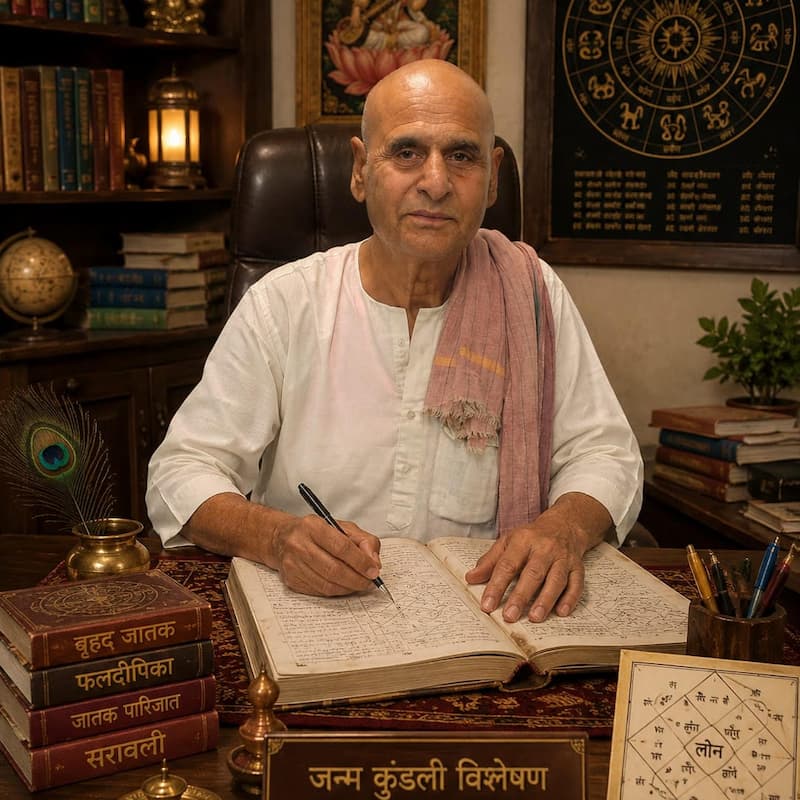
Narendra Kumar Chaubey is a Jyotisha Acharya with over 30 years of experience, based in Bihar and serving clients across India in Vedic astrology, mantra shastra, Vastu and ritual practice.
He completed his formal training at Kameshwar Singh Darbhanga Sanskrit University (KSDSU), one of India’s oldest and most respected institutions for Vedic and Sanskrit scholarship, where he studied Jyotisha shastra, mantra vidya and related classical sciences. KSDSU’s tradition of rigorous Sanskrit education tracing directly to the Mithila region’s centuries-old pandit lineage forms the foundation of his practice.
Over three decades, Narendra Kumar Chaubey has worked with thousands of individuals and families across Bihar and across India, offering guidance in:
- Kundli (birth chart) analysis: Identifying karmic patterns, planetary periods and life path guidance through classical Jyotisha
- Palmistry (Hasta Samudrika): Reading the hand according to the classical Samudrika Shastra tradition
- Vastu Shastra: Assessment and correction of living and working spaces according to directional and elemental principles
- Mantra and Pooja vidhi: Performing and guiding all categories of puja, havan, and mantra sadhana for personal, family and business situations
- Predictive Jyotisha: Transit analysis, muhurta (auspicious timing) selection and remedial guidance
He works across four languages Sanskrit, Hindi, English and Bhojpuri making classical knowledge accessible to practitioners across educational backgrounds and regions.
His writing for ABMantra brings the precision of classical Vedic training to practical mantra guidance: not general advice but specific prescriptions grounded in shastra, lineage and 30 years of direct practice with real situations.
For more info follow on: