


Quick Answer
If you are in Sade Sati right now, begin with this mantra on the next Saturday:
Om Sham Shanicharaya Namah
ॐ शं शनिश्चराय नमः
Chant 108 times every Saturday minimum. Daily chanting of 108 times produces faster results. Use a black Rudraksha mala or iron mala. Face west. Morning is ideal, Saturday evening is also valid.
For deeper Sade Sati relief, add the Shani Beej Mantra: Om Praam Preem Praum Sah Shanaishcharaya Namah : chanted 19,000 times over the complete practice period.
Who This Article Is For
This article is for you if: your astrologer has told you that you are in Sade Sati and you want to know which mantra to chant | you have been experiencing 2 to 3 years of continuous setbacks and suspect Saturn’s influence | you want an honest answer about what the Shani mantra actually does and how long it takes.
Note: Sade Sati is a 7.5-year period of Saturn’s transit through three consecutive zodiac signs relative to your natal Moon sign. To confirm whether you are in Sade Sati, check with a qualified Jyotish astrologer or use a reliable birth chart calculator.
If your astrologer has told you that you are in Sade Sati, you are probably not looking for a philosophical explanation of Saturn’s karmic role. You are looking for something practical to do. This article gives you the specific mantra, the correct method, and the honest answer about what Sade Sati actually is and what the mantra practice realistically achieves.
Here is what most Sade Sati mantra articles get wrong: they present the Shani mantra as a way to remove or escape Saturn’s influence. That is not how the tradition understands it. Shani is the planet of karma. His Sade Sati cannot be escaped. It can be navigated with discipline, surrender and correct practice. The mantra does not remove the test. It gives you the qualities to pass it.
What Is Sade Sati: The Complete Explanation
Sade Sati (meaning seven and a half in Sanskrit: Saade = half, Saat = seven) is the 7.5-year period during which Saturn transits through three consecutive zodiac signs: the sign before your natal Moon sign, your natal Moon sign itself, and the sign after it. Since Saturn spends approximately 2.5 years in each sign, the total transit is 7.5 years.
Every person experiences Sade Sati approximately three times in a lifetime: roughly at ages 25 to 32, 55 to 62, and 85 to 92, depending on their natal Moon sign and Saturn’s position at birth.
| Phase of Sade Sati | Saturn’s position | What typically happens | Duration |
|---|---|---|---|
| Rising phase | Sign before natal Moon sign | Gradual increase in pressure. Financial concerns begin. Health of family members may be affected. Sense of increasing burden. | 2.5 years |
| Peak phase | Natal Moon sign itself | The most intense phase. Direct Saturn pressure on the mind (Moon governs mind). Major life changes, losses or restructuring. The karmic lessons are clearest here. | 2.5 years |
| Setting phase | Sign after natal Moon sign | Gradual easing. Saturn’s lessons are integrating. New stability begins to emerge. What was restructured starts to show its value. | 2.5 years |
The counterintuitive truth about Sade Sati: it is not a punishment. In Vedic astrology, Saturn is the planet of dharma, karma, discipline and justice. His Sade Sati removes what is not built on a solid foundation and forces the native to build their life on more honest, sustainable ground. Every major spiritual teacher in India who has spoken about Sade Sati has said the same thing: the people who navigate it well emerge from it stronger, clearer and more aligned than they entered.
The Three Shani Mantras for Sade Sati: Which One to Use
Mantra 1: Shani Moola Mantra (Most Widely Used)
Shani Moola Mantra
Sanskrit: Om Sham Shanicharaya Namah
Devanagari: ॐ शं शनिश्चराय नमः
Word-by-word meaning:
Om: primordial sound, universal invocation
Sham (शं): beej (seed) mantra of Saturn, encodes Saturn’s vibration directly
Shanicharaya: to Shani, the slow mover (Shanaih = slow, Charaya = moving, referring to Saturn’s 29.5-year orbit)
Namah: I bow, I surrender, I acknowledge your sovereignty
Count: 108 times daily or 23,000 times for a complete Shani sadhana
Best day: Saturday (Shanivar)
Best time: Morning or Saturday evening
Direction: West
Mantra 2: Shani Beej Mantra (For Deeper Relief)
Shani Beej Mantra
Sanskrit: Om Praam Preem Praum Sah Shanaishcharaya Namah
Devanagari: ॐ प्राँ प्रीं प्रौं सः शनैश्चराय नमः
Meaning: Om. Through the three beej sounds of Saturn (Praam, Preem, Praum) I invoke Shanaishchara (Saturn, the slow-moving one) and offer my salutation.
Praam, Preem, Praum are the three Saturn beej mantras corresponding to Saturn’s three-phase energy: rising (Praam), peak (Preem) and setting (Praum). Chanting all three in sequence addresses all phases of the Sade Sati simultaneously.
Count: 19,000 times for a complete purashcharan (one for each year of Saturn’s orbit). In daily practice: 108 times daily on Saturdays.
Mantra 3: Shani Stotram (The Descriptive Prayer)
Shani Stotram: Opening Verse
Om Nilanjana Samabhasam Raviputram Yamagrajam
Chhaya Martanda Sambhootam Tam Namami Shanaishcharam
ॐ नीलाञ्जनसमाभासं रविपुत्रं यमाग्रजम्।
छायामार्तण्डसम्भूतं तं नमामि शनैश्चरम्॥
Meaning: I bow to Shanaishchara (Saturn) who is dark blue like a storm cloud, who is the son of the Sun (Ravi), the elder brother of Yama (god of death), born of Chhaya (shadow) and Martanda (the sun).
This stotram is the classical descriptive prayer of Shani Dev. It is used to establish the relationship with Saturn before beginning the mantra practice. Recite it once before your main mantra count.
Which Shani Mantra for Which Situation
| Your situation | Best mantra | Count | Duration |
|---|---|---|---|
| Just entering Sade Sati, building a practice | Om Sham Shanicharaya Namah | 108 times every Saturday | Every Saturday throughout Sade Sati |
| In the peak phase (Saturn on natal Moon) | Shani Beej Mantra + Moola Mantra | 108 times daily, both mantras | Full 2.5 years of peak phase minimum |
| Severe financial loss or career collapse | Shani Beej Mantra primary | 108 times daily, 7 Saturdays minimum | 40-day continuous sadhana recommended |
| Health problems during Sade Sati | Maha Mrityunjaya Mantra + Shani Moola | Maha Mrityunjaya 108 times daily, Shani Moola 108 times Saturday | Until recovery |
| Relationship difficulties, family conflict | Om Sham Shanicharaya Namah | 108 times every Saturday, donate to the poor that day | 11 Saturdays minimum |
| General Sade Sati maintenance practice | Hanuman Chalisa + Shani Moola Mantra | Hanuman Chalisa on Tuesdays, Shani Moola on Saturdays | Throughout all 7.5 years |
The Complete Saturday Practice: Step by Step
Saturday is Saturn’s sacred day. The practice below is the traditional Shani upasana (worship) for Sade Sati. Even if you chant daily, Saturday practice carries additional weight.
What You Need
- Black Rudraksha mala (first choice) or iron mala: both are specifically associated with Saturn
- Sesame oil (til ka tel): Shani Dev’s most important offering. A lamp burning sesame oil on Saturday is the single most effective Shani remedy in the classical texts.
- Black sesame seeds (kale til): offered to Shani Dev or placed at the base of a Peepal tree
- Blue or black cloth for the altar
- Image of Shani Dev or a Shani Yantra
Saturday Practice Sequence
- Wake early on Saturday. Bathe before the practice.
- Light a sesame oil lamp. This is not optional for Saturday Shani practice : the sesame oil lamp is the primary offering to Saturn in the classical tradition.
- Offer black sesame seeds to the image of Shani Dev.
- Recite the Shani Stotram (Nilanjana Samabhasam) once to establish the relationship.
- Chant Om Sham Shanicharaya Namah 108 times. Face west. Move one bead per repetition. Keep your breath slow and your posture steady.
- If doing the Shani Beej Mantra, add 108 repetitions of Om Praam Preem Praum Sah Shanaishcharaya Namah immediately after.
- Sit in silence for 5 minutes. Do not rush to stand.
- On that Saturday, donate: mustard oil, black sesame seeds, iron, black urad dal, or food to someone in genuine need. Shani Dev is most pleased by service to the poor and disabled. The donation is as important as the mantra.
The Donation Rule: Why It Matters More Than You Think
In the classical Jyotish tradition, Saturn governs the poor, the elderly, the disabled and the oppressed. The single most effective Saturn remedy in the Brihat Parasara Hora Shastra is not a mantra : it is seva (service) to those who are suffering.
Every Saturday, alongside your mantra practice: donate something to someone in genuine need. It does not need to be large. One meal, one coin, one act of help to someone who cannot help themselves. This is the offering Saturn actually values.
What to Realistically Expect: The Honest Answer
Most Sade Sati articles either catastrophise Saturn’s influence or promise that a mantra will make everything fine. Both are dishonest.
Here is the accurate traditional understanding:
| What the mantra does | What the mantra does not do |
|---|---|
| Builds your inner capacity to face Saturn’s lessons with less resistance and more clarity | Remove the karmic debt that Saturn is collecting. That debt must be paid. The mantra helps you pay it with dignity. |
| Gradually reduces the intensity of Saturn’s most acute effects: the sudden shocks, the sense of being opposed by fate | Prevent all difficulty during Sade Sati. Some difficulty is the point. It is how the lessons are delivered. |
| Builds the qualities Saturn values most: patience, discipline, honesty, systematic effort, compassion for those who suffer | Work without those same qualities being actively practised in daily life. The mantra amplifies what you bring to it. |
| Creates a consistent structure of practice that gives the mind an anchor during the instability Saturn creates | Protect you from the consequences of actions that contradict Saturn’s dharmic principles: dishonesty, laziness, exploitation |
The timeline for noticeable relief varies. Most practitioners report a qualitative shift in how they experience challenges, not a disappearance of challenges, within 11 to 21 Saturdays of consistent practice. The external situation may not change in that period. The internal relationship to the situation does.
From Our Practice
From Our Practice
A student I worked with entered Sade Sati’s peak phase in 2021 with a business collapse, a health diagnosis and a marriage under severe strain. All three arrived within four months of each other.
She began the Saturday Shani practice: sesame oil lamp, Om Sham Shanicharaya Namah 108 times, black sesame offered to a Peepal tree near her home, one meal donated to someone on the street. Every Saturday for 18 months without exception.
By month 8, the health diagnosis had resolved. By month 14, the business had restructured into something smaller but stable. The marriage, after a period of honest reckoning, also survived.
What she said at the end of the 18 months has stayed with me: “I did not escape what Saturn was asking for. I paid it. The mantra was how I paid it with my eyes open instead of with my eyes shut.”
That is the most accurate description of what a Shani mantra practice during Sade Sati actually produces that I have encountered.
Frequently Asked Questions
❓ My astrologer says I am in the peak phase of Sade Sati and everything is falling apart. Where do I start?
Start this Saturday. Light a sesame oil lamp, offer black sesame seeds and chant Om Sham Shanicharaya Namah 108 times facing west. That is your starting point. Add the Shani Beej Mantra (Om Praam Preem Praum Sah Shanaishcharaya Namah) 108 times immediately after. On that same Saturday, donate one meal or mustard oil to someone in genuine need. Repeat every Saturday. The peak phase is the hardest but it is also when consistent practice produces the most significant internal shift.
❓ I have been in Sade Sati for 4 years and nothing seems to be working despite chanting. What am I doing wrong?
Check two things. First: are you donating on Saturdays? The mantra without seva is incomplete in the Shani tradition. Saturn governs justice and service. The donation is as structurally important as the chanting. Second: are you expecting the mantra to remove the Sade Sati experience rather than to help you navigate it? If yes, that expectation itself creates resistance. Saturn’s lessons cannot be bypassed. They can be met with more capacity and less suffering.
❓ Can women chant Shani mantra? My family says it is only for men.
Yes. Women chant Shani mantras widely and there is no classical scriptural basis for restricting Shani worship to men. Sade Sati affects men and women equally : Saturn does not distinguish by gender. The classical Shani temples in India, including Shingnapur and Shani Shingnapur, are visited by women devotees without restriction.
❓ Should I chant Shani mantra every day or only on Saturdays?
Saturday is the prescribed day and carries the most weight. Daily chanting is permitted and produces faster results during the acute phases of Sade Sati. If daily chanting is not feasible, 11 consecutive Saturdays of consistent practice is the minimum complete cycle in the traditional Shani upasana. Every Saturday without exception matters more than occasional daily chanting.
❓ My Sade Sati ends in 8 months. Should I still start the practice now?
Yes. The setting phase of Sade Sati (the last 2.5 years) still carries Saturn’s influence even as it eases. Beginning a mantra practice now helps integrate the lessons of the full 7.5 years and establishes a foundation for the post-Sade Sati period. The classical guidance is that Shani worship begun during Sade Sati should continue for at least 11 Saturdays after the period officially ends.
❓ Is Hanuman Chalisa more effective than Shani mantra for Sade Sati?
The Hanuman Chalisa is recommended for Sade Sati in the popular tradition because Hanuman (a devotee of Ram, an avatar of Vishnu) is believed to mediate Saturn’s harshest effects. It is not a replacement for Shani mantra but a complementary practice. The traditional recommendation is Hanuman Chalisa on Tuesdays and Shani mantra on Saturdays, both maintained throughout the Sade Sati period. One does not negate the need for the other.
Begin This Saturday
Find a quiet corner of your home. Place a small image of Shani Dev or simply a lamp burning sesame oil. That lamp is your altar for the next 7.5 years.
Chant Om Sham Shanicharaya Namah 108 times. Move one bead per repetition. Keep your breathing slow. After the 108th repetition, sit quietly for 5 minutes. Then go and donate something, however small, to someone who needs it.
Return next Saturday. And the Saturday after that.
Shani Dev does not ask for perfection. He asks for consistency, honesty and service. Those are the exact three qualities the Sade Sati is here to develop in you. The mantra practice is not a shortcut around that development. It is the path through it.
Sources:
- Om Shanaye Namah Saturn Mantra: Meaning, Method, Benefits. AstroSight, 2 weeks ago. Shanaishcharaya etymology, Sade Sati definition and Saturn mantra tradition
- Main Mantra of Shani Dev: Significance, Benefits and Recitation. Shani Temple, March 2026. Beej mantra syllable breakdown and Sade Sati application
- How to Meditate with Shani Dev Mantra for Shani Sade Sati. NKB Meditation. Three Shani mantras and their specific purposes during Sade Sati
- Benefits of Lord Shani (Saturn) Mantra. AskGanesha. Nilanjana Samabhasam stotram and classical Shani descriptions
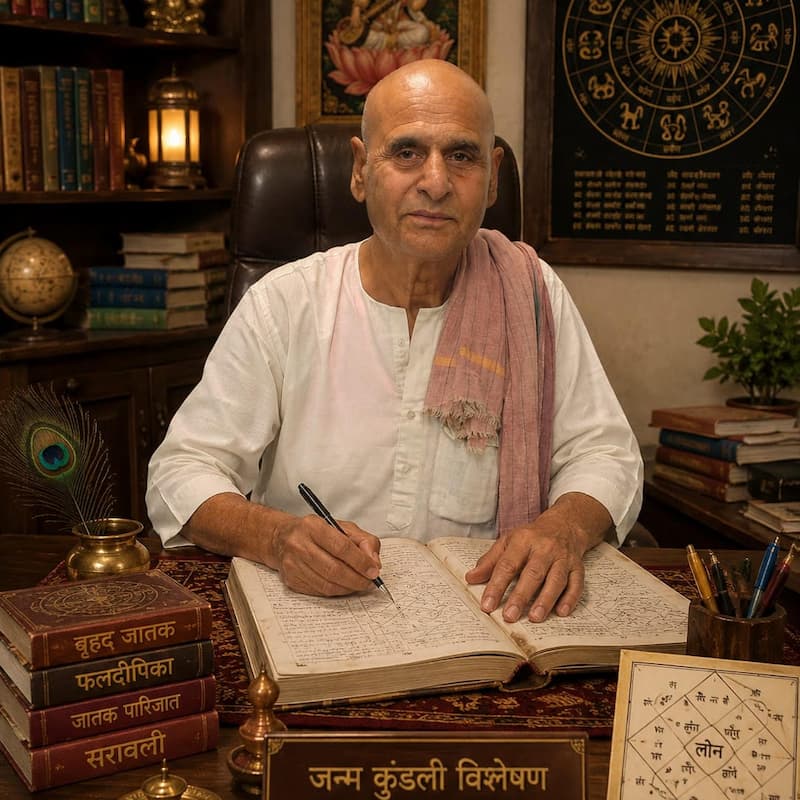
Narendra Kumar Chaubey is a Jyotisha Acharya with over 30 years of experience, based in Bihar and serving clients across India in Vedic astrology, mantra shastra, Vastu and ritual practice.
He completed his formal training at Kameshwar Singh Darbhanga Sanskrit University (KSDSU), one of India’s oldest and most respected institutions for Vedic and Sanskrit scholarship, where he studied Jyotisha shastra, mantra vidya and related classical sciences. KSDSU’s tradition of rigorous Sanskrit education tracing directly to the Mithila region’s centuries-old pandit lineage forms the foundation of his practice.
Over three decades, Narendra Kumar Chaubey has worked with thousands of individuals and families across Bihar and across India, offering guidance in:
- Kundli (birth chart) analysis: Identifying karmic patterns, planetary periods and life path guidance through classical Jyotisha
- Palmistry (Hasta Samudrika): Reading the hand according to the classical Samudrika Shastra tradition
- Vastu Shastra: Assessment and correction of living and working spaces according to directional and elemental principles
- Mantra and Pooja vidhi: Performing and guiding all categories of puja, havan, and mantra sadhana for personal, family and business situations
- Predictive Jyotisha: Transit analysis, muhurta (auspicious timing) selection and remedial guidance
He works across four languages Sanskrit, Hindi, English and Bhojpuri making classical knowledge accessible to practitioners across educational backgrounds and regions.
His writing for ABMantra brings the precision of classical Vedic training to practical mantra guidance: not general advice but specific prescriptions grounded in shastra, lineage and 30 years of direct practice with real situations.
For more info follow on: