
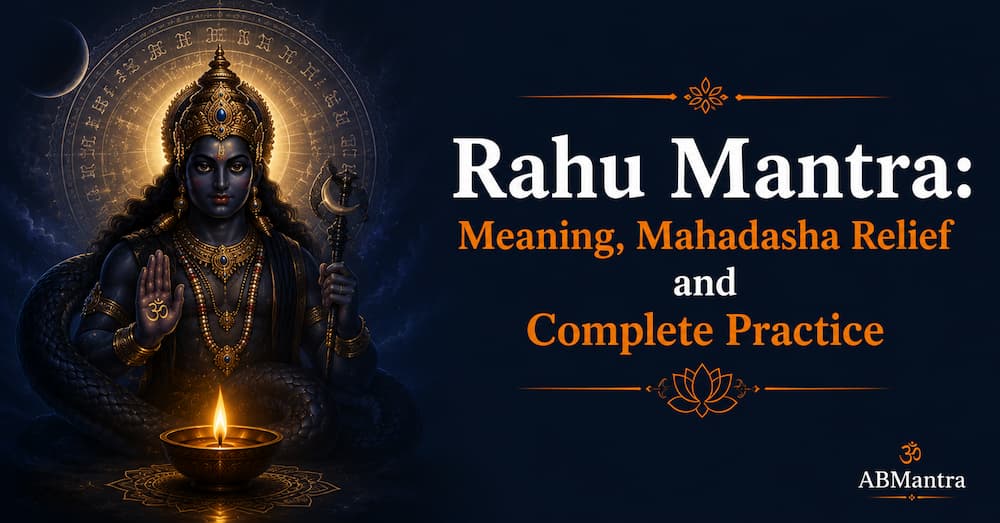

Quick Answer
The three primary Rahu mantras and when to use each:
Rahu Beej Mantra (most powerful : for Rahu Mahadasha):
Om Bhram Bhreem Bhraum Sah Rahave Namah
ॐ भ्रां भ्रीं भ्रौं सः राहवे नमः
108 times daily during Rahu Mahadasha or Antardasha
Rahu Vedic Mantra (for general pacification):
Om Dhum Ram Rahave Namah
ॐ धूं रां राहवे नमः
108 times on Saturdays and Wednesdays
Rahu Puranic Mantra (for deeper karmic work):
Ardakayam Mahaviryam Chandraditya Vimardanam Singhika Garbha Sambhootam Tam Rahum Pranamamyaham
Chant once in the morning during significant Rahu periods
Who This Article Is For
This article is for you if: your Jyotisha practitioner has told you that Rahu Mahadasha is currently active in your chart and you want to know which mantra to chant | you experience the classic Rahu symptoms (confusion, obsessive ambition, illusion, sudden reversals) and want a mantra remedy | you have Kaal Sarp Dosha or Rahu in a sensitive house (1st, 7th or 10th) and want the correct pacification mantra.
Also see: Navagraha Mantra: all 9 planet mantras with complete guide
Rahu is the most misunderstood of the nine Navagrahas. He is not a physical planet but the north node of the Moon : the point where the Moon’s orbit intersects the ecliptic. In Vedic astrology, Rahu governs obsessive ambition, material desire, illusion, sudden change and the karmic lessons that come from unfulfilled desires carried from previous lifetimes. He amplifies whatever he touches, makes the native crave what they do not have, and creates the restless drive for achievement that can produce either great success or great destruction depending on how the native works with his energy.
Here is what most Rahu mantra articles miss: Rahu is not simply a malefic planet to be pacified and suppressed. He is the planet of material ambition and worldly achievement. In many charts, Rahu is a great benefic : he drives the native toward extraordinary achievement that Saturn’s caution would never permit. The mantra tradition for Rahu is not about destroying his influence. It is about channelling his enormous energy from compulsion toward conscious direction. The Beej Mantra does not silence Rahu. It aligns the native with Rahu’s transformative power rather than being driven by it blindly.
Understanding Rahu Before Chanting the Mantra
| Rahu quality | Expressed destructively | Expressed constructively |
|---|---|---|
| Obsessive ambition | Relentless craving, never satisfied, burnout from constant striving | Extraordinary drive that produces breakthrough achievement in a chosen field |
| Illusion and deception | Self-deception, being deceived by others, seeing what one wants to see | Creative imagination, the capacity to envision what does not yet exist |
| Sudden change | Chaotic reversals, instability, inability to maintain anything | Breakthrough moments, unexpected opportunities, rapid transformation |
| Foreign and unconventional | Cultural alienation, feeling outside all groups, rootlessness | Cross-cultural success, innovation, breaking boundaries others respect |
| Material desire | Compulsive accumulation, desire without satisfaction | The drive that produces material success when directed consciously |
The Rahu mantra practice is specifically about moving from the left column to the right column : from compulsive Rahu to conscious Rahu. The Beej Mantra, chanted with awareness of this intention, is the classical tool for this transformation.
The Three Rahu Mantras
Mantra 1: Rahu Beej Mantra : The Primary Practice
Rahu Beej Mantra
Sanskrit: Om Bhram Bhreem Bhraum Sah Rahave Namah
Devanagari: ॐ भ्रां भ्रीं भ्रौं सः राहवे नमः
Word by word:
Om: primordial invocation
Bhram Bhreem Bhraum: the three Rahu beej sounds : the three vibrational states of Rahu’s energy (shadow, illusion, transformation)
Sah: so it is : the affirmative seal
Rahave: to Rahu (dative case : directed toward Rahu)
Namah: I bow, I surrender
The significance of Bhram Bhreem Bhraum: These three sounds follow the same three-state structure as all planetary beej mantras. Each represents Rahu at a different level of manifestation. Together they invoke his complete energy and create the alignment through which his power can be consciously directed rather than suffered.
When to chant: Daily, 108 times, during active Rahu Mahadasha or Antardasha periods.
Direction: South-west (Rahu’s direction)
Day: Saturday (Rahu shares Saturn’s day in some traditions) or Wednesday
Mala: Blue sapphire mala or sandalwood mala
Duration for Mahadasha: Continue for the entire Mahadasha period. Rahu Mahadasha lasts 18 years : the mantra is the daily practice for that entire period, not a 40-day sadhana.
Mantra 2: Rahu Vedic Mantra : For General Pacification
Rahu Vedic Mantra
Sanskrit: Om Dhum Ram Rahave Namah
Devanagari: ॐ धूं रां राहवे नमः
Meaning: Om. Dhum (the sound of purification and dissolving negativity). Ram (Rahu’s stabilising sound). To Rahu I bow.
Dhum is the specific beej of purification : the sound that dissolves the confusion and illusion that Rahu generates. Chanting it in the Rahu mantra is both an invocation of Rahu and a simultaneous request for the dissolution of his negative qualities.
When to use: For those not in Rahu Mahadasha but who have Rahu in a sensitive house (1st, 7th or 10th). Also for general Rahu pacification without the intensity of the full Beej Mantra practice. 108 times on Saturdays and Wednesdays.
Mantra 3: Rahu Puranic Mantra : The Invocation of Rahu’s Story
Rahu Puranic Mantra
Sanskrit:
Ardakayam Mahaviryam Chandraditya Vimardanam
Singhika Garbha Sambhootam Tam Rahum Pranamamyaham
Devanagari:
अर्धकायं महावीर्यं चंद्रादित्य विमर्दनम्।
सिंहिका गर्भ संभूतं तं राहुं प्रणमाम्यहम्॥
Meaning: I bow to Rahu, who is half-bodied (the north node, without a lower body), of great power (Mahaviryam), who afflicts the Sun and Moon (Chandraditya Vimardanam), born from the womb of Singhika (his demon mother).
The significance of Ardakayam: Rahu’s mythological form is half a body : the demon Swarbhanu who drank the nectar of immortality was cut in half by Vishnu’s Sudarshana Chakra. The upper half became Rahu (north node), the lower half became Ketu (south node). Chanting Ardakayam acknowledges this cosmological reality: Rahu is literally an incomplete being, eternally seeking the completion he was denied. This understanding changes how the practitioner relates to Rahu’s energy : as an incomplete force seeking wholeness, not as an enemy to be defeated.
When to use: Once in the morning during significant Rahu periods. Not a repetitive practice but a daily invocation that establishes the correct relationship with Rahu’s energy before the day begins.
Rahu in Different Houses: Which Mantra Is Most Important
| Rahu placement | Primary effect | Recommended mantra |
|---|---|---|
| Rahu in 1st house | Unusual personality, difficulty with self-image, unconventional path | Vedic Mantra daily + Beej Mantra during Mahadasha |
| Rahu in 7th house | Unusual marriage, unconventional partner, delay or difficulty in marriage | Beej Mantra daily + Katyayani Mantra for marriage specifically |
| Rahu in 10th house | Highly ambitious career, unconventional profession, sudden career changes | Vedic Mantra on Wednesdays for channelling professional Rahu constructively |
| Kaal Sarp Dosha (Rahu-Ketu axis enclosing all planets) | Life feels like it moves in a serpentine pattern : progress then reversal, breakthrough then setback | Beej Mantra daily + Maha Mrityunjaya Mantra for protection + Kaal Sarp Shanti Puja |
| Rahu Mahadasha (18-year period) | Period of intense ambition, material drive, possible confusion about direction | Beej Mantra daily for entire Mahadasha + Puranic Mantra once morning |
The Wednesday and Saturday Practice
Weekly Rahu Practice
Wednesday (Mercury’s day): Rahu shares qualities with Mercury in some traditions : both govern communication, intelligence and the mind’s restlessness. Chanting the Rahu Vedic Mantra on Wednesdays alongside any Mercury mantra creates a complementary practice that addresses both the obsessive quality (Rahu) and the clarity of direction (Mercury).
Saturday (Saturn’s day): Rahu and Saturn are considered allies in Vedic astrology : both are separating, limiting, karmic forces that challenge the native’s attachment to what they want. Chanting the Rahu Beej Mantra on Saturdays alongside the Shani mantra creates a powerful combination for deep karmic processing during difficult planetary periods.
Offering: Blue flowers or black sesame seeds. Coconut. The coconut is specifically associated with Rahu in the tradition : offering a coconut at a Rahu or Durga temple on Saturdays is a classical Rahu remedy that complements the mantra practice.
From Our Practice
From Our Practice
In my Jyotisha practice I work with many clients in active Rahu Mahadasha. The first thing I tell them is: Rahu Mahadasha is not a period to fear. It is the period where your most ambitious desires are activated and tested. Whether they produce success or chaos depends entirely on how consciously you work with the energy.
A client came to me at the beginning of his Rahu Mahadasha, which had just started at age 34. He was already showing classic Rahu beginning-of-Mahadasha symptoms: a sudden intense desire to completely change his career, a fascination with foreign countries, a restlessness that prevented him from sleeping well, and three different business ideas pursuing him simultaneously.
I prescribed the Rahu Beej Mantra 108 times daily and the Puranic Mantra once in the morning. I also prescribed a specific practice: after chanting the Beej Mantra, to sit for 5 minutes and ask himself one question: “Which of the things I am chasing right now is Rahu’s illusion and which is Rahu’s genuine opportunity?”
That question, asked daily from the grounded state produced by the mantra, is the functional purpose of the Rahu practice. Rahu will always generate multiple attractive possibilities. The mantra does not reduce the number of possibilities. It develops the native’s capacity to discriminate between the illusory ones and the genuine ones. After 6 months of consistent practice, this client had dropped two of the three business ideas and committed fully to the third. By the end of year 2 of his Mahadasha, that third business had grown significantly. The other two ideas he had abandoned had both been attempted by others in his network and failed.
Frequently Asked Questions
❓ My Rahu Mahadasha just began. Should I be worried?
No. Rahu Mahadasha is a 18-year period of intense material engagement. For most people it is the period of their most significant material achievement. The key is whether Rahu in your chart is well-placed or poorly placed. A well-placed Rahu (in Gemini, Virgo, Capricorn or Aquarius, or in the 3rd, 6th, 10th or 11th house) produces extraordinary achievement during Mahadasha. A poorly placed Rahu produces the darker qualities : confusion, compulsion, reversal. Begin the Beej Mantra immediately regardless of placement. The mantra does not suppress Rahu’s energy but channels it constructively.
❓ I have Kaal Sarp Dosha. Is Rahu mantra enough to address it?
The Rahu Beej Mantra is the mantra component of the Kaal Sarp Dosha remedy but it is not sufficient alone. The classical remedy for Kaal Sarp Dosha is: Rahu Beej Mantra daily, Ketu Beej Mantra daily (Om Sram Sreem Sraum Sah Ketave Namah), Maha Mrityunjaya Mantra for protection, and a Kaal Sarp Shanti Puja performed at a qualified temple (Trimbakeshwar in Nashik is the most traditionally prescribed location). The puja is the ritual completion that the mantra alone cannot replace.
❓ How many times should I chant the Rahu mantra daily?
108 times daily is the standard prescription for active Rahu Mahadasha or Antardasha. For general Rahu pacification (not in Mahadasha but Rahu in a sensitive house), 108 times on Saturdays and Wednesdays is sufficient. The complete traditional Rahu sadhana is 18,000 repetitions : at 108 per day this takes approximately 167 days. This is the prescription for serious Rahu affliction. For most practitioners, the daily 108 throughout the Mahadasha period is the practical and effective equivalent.
❓ Can I chant Rahu mantra at night?
Yes. Unlike solar mantras (Gayatri, Surya) which are specifically morning practices, Rahu mantras have no time restriction. Rahu governs the night, the shadow and the hidden : chanting at night is fully appropriate for his mantra. Some practitioners find the Rahu Beej Mantra particularly effective as a late-evening practice before sleep, as Rahu’s restless energy is often most prominent at night. If you experience insomnia during Rahu Mahadasha, chanting the Beej Mantra 27 times before sleep is the specific traditional remedy for Rahu-caused sleep disturbance.
❓ What is the difference between Rahu and Saturn in Vedic astrology and their mantras?
Both Rahu and Saturn are separating, challenging forces in Vedic astrology, but they operate differently. Saturn is the planet of karma, discipline, limitation and the slow grinding of effort over time. His challenges are earned through previous actions and resolved through sustained effort and patience. Rahu is the planet of desire, illusion and the soul’s obsessions from previous lifetimes. His challenges are experienced as confusion, compulsion and the relentless pull of what the native craves. Saturn’s mantra pacifies through submission to duty. Rahu’s mantra works through conscious alignment with desire energy and discriminating between illusion and genuine opportunity.
❓ Should I chant both Rahu and Ketu mantras together?
Yes, and this is strongly recommended. Rahu and Ketu are always exactly opposite each other in the chart : the north node and south node of the Moon. They create a karmic axis. Chanting Rahu’s mantra without Ketu’s mantra addresses only half the axis. The complete practice: Rahu Beej Mantra 108 times followed by Ketu Beej Mantra (Om Sram Sreem Sraum Sah Ketave Namah) 108 times. This dual practice addresses the complete nodal axis and produces a more balanced integration of the karmic lesson that both nodes together represent.
Begin This Wednesday or Saturday
If you are in Rahu Mahadasha: begin the Beej Mantra today. Any day. 108 times. Do not wait for Wednesday or Saturday : those are the optimal days, not the required days. Begin now and maintain the Wednesday and Saturday as the most intensive sessions.
If you are not in Rahu Mahadasha but have Rahu in a sensitive house: begin the Vedic Mantra (Om Dhum Ram Rahave Namah) on Wednesdays and Saturdays. 108 times. Offer blue flowers or coconut.
Rahu is not your enemy. He is the part of your karma that involves desire, ambition and the soul’s unfinished business from previous lifetimes. The mantra does not remove that karma. It makes you conscious of it : and consciousness of Rahu’s energy is exactly what transforms it from compulsion into direction.
Sources
- Rahu Beej Mantra: Meaning and Practice. The Vedic Crystals, April 2026. Bhram Bhreem Bhraum beej meaning; Rahave word by word; Rahu as karmic desire planet
- Rahu Mantra: Meaning, Mahadasha Benefits. AstroBhava, September 2025. Om Dhum Ram Rahave Namah meaning; Dhum as purification; three Rahu mantra forms
- Rahu Mantra: Meaning, Benefits and Significance. AnyTimeAstro. Puranic Mantra Sanskrit text; Ardakayam meaning; Rahu Shanti Mantra for peace
- Rahu Mantra: Meaning, Benefits and When to Chant. Vedanshika, March 2026. Bhraam Bhreem Bhroum vibrational significance; mantra as act of surrender; Rahu Mahadasha guidance
Narendra Kumar Chaubey is a Jyotisha Acharya with over 30 years of experience, based in Bihar and serving clients across India in Vedic astrology, mantra shastra, Vastu and ritual practice.
He completed his formal training at Kameshwar Singh Darbhanga Sanskrit University (KSDSU), one of India’s oldest and most respected institutions for Vedic and Sanskrit scholarship, where he studied Jyotisha shastra, mantra vidya and related classical sciences. KSDSU’s tradition of rigorous Sanskrit education tracing directly to the Mithila region’s centuries-old pandit lineage forms the foundation of his practice.
Over three decades, Narendra Kumar Chaubey has worked with thousands of individuals and families across Bihar and across India, offering guidance in:
- Kundli (birth chart) analysis: Identifying karmic patterns, planetary periods and life path guidance through classical Jyotisha
- Palmistry (Hasta Samudrika): Reading the hand according to the classical Samudrika Shastra tradition
- Vastu Shastra: Assessment and correction of living and working spaces according to directional and elemental principles
- Mantra and Pooja vidhi: Performing and guiding all categories of puja, havan, and mantra sadhana for personal, family and business situations
- Predictive Jyotisha: Transit analysis, muhurta (auspicious timing) selection and remedial guidance
He works across four languages Sanskrit, Hindi, English and Bhojpuri making classical knowledge accessible to practitioners across educational backgrounds and regions.
His writing for ABMantra brings the precision of classical Vedic training to practical mantra guidance: not general advice but specific prescriptions grounded in shastra, lineage and 30 years of direct practice with real situations.
For more info follow on: