
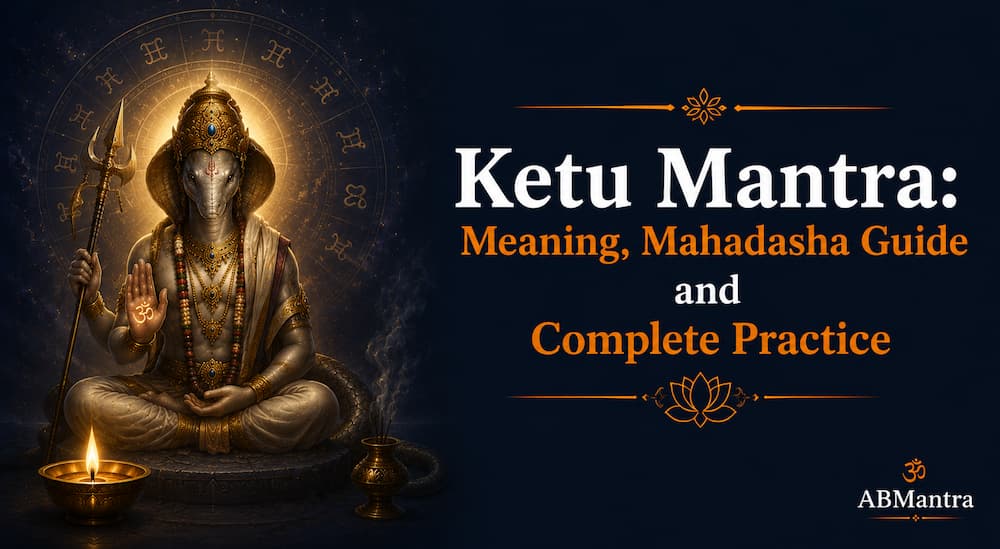

Quick Answer
The primary Ketu mantra is the Ketu Beej Mantra:
Om Sram Sreem Sraum Sah Ketave Namah
ॐ स्रां स्रीं स्रौं सः केतवे नमः
Also chant: Om Ketave Namah daily for general Ketu pacification. 108 times daily during Ketu Mahadasha (7 years). Tuesday and Saturday are Ketu’s most auspicious days.
Who This Article Is For
This article is for you if you are in Ketu Mahadasha and want to know what to chant | you want to understand what Ketu actually represents beyond the generic south node description | you have Ketu in the 1st, 7th or 12th house and experience its specific effects.
Also see: Rahu Mantra: the north node complete practice guide and Navagraha Mantra: all 9 planet mantras explained
Ketu and Rahu are opposite nodes of the Moon’s orbit, but they are energetically opposite in every other way. Where Rahu is the planet of intense desire, material ambition and craving for what the native does not have, Ketu is the planet of detachment, renunciation and the dissolution of what the native thought they wanted. Where Rahu says “more,” Ketu says “enough.” Where Rahu looks outward at the world, Ketu looks inward at the self.
Here is what most Ketu mantra articles miss: they treat Ketu as simply another malefic to be pacified, like a gentler version of Rahu. But Ketu’s function is fundamentally different and more spiritually significant. Ketu represents the accumulated spiritual wisdom from past lifetimes. Ketu Mahadasha is not a period of loss. It is a period of liberation from what was never truly necessary. The mantra practice for Ketu is not about removing Ketu’s influence. It is about consciously working with the liberation process Ketu brings so it happens with grace rather than through forced renunciation.
What Ketu Actually Is
| Ketu quality | Experienced unconsciously | Experienced consciously |
|---|---|---|
| Detachment | Felt as loss: things dissolving without understanding why | Liberation from what was consuming energy without serving growth |
| Dissolution of ego | Confusion about identity, feeling purposeless | Deepening spiritual awareness, freedom from defensive ego structures |
| Past life mastery | Overcomplicated in that area, strange indifference | Effortless skill and deep intuitive understanding |
| Isolation | Loneliness, inability to connect | Capacity for deep meditation, inner resources others lack |
| Mysticism | Strange experiences, feeling unreal, vivid dreams | Genuine spiritual development, intuitive perception |
The Ketu Beej Mantra: Word by Word
Ketu Beej Mantra Analysis
Sanskrit: Om Sram Sreem Sraum Sah Ketave Namah
Devanagari: ॐ स्रां स्रीं स्रौं सः केतवे नमः
Word by word:
Om: primordial invocation
Sram Sreem Sraum: the three Ketu beej sounds corresponding to Ketu’s three-fold energy of dissolution, inward turning and liberation
Sah: so it is, the affirmative seal
Ketave: to Ketu (dative case)
Namah: I bow, I surrender
The significance of surrender in Ketu mantra: Ketu’s entire function is the dissolution of the ego’s control. The act of genuinely surrendering in the mantra is itself the practice that Ketu requires. Chanting with the quality of genuine release rather than the ego’s attempt to manage Ketu’s influence is the specific intention the tradition prescribes.
Ketu Puranic Mantra
Ketu Puranic Mantra
Sanskrit:
Palasha Pushpa Sankaasham Taraka Graha Mastakam
Raudram Raudraatmakam Ghoram Tam Ketum Pranamaamyaham
Devanagari:
पलाश पुष्प संकाशं तारका ग्रह मस्तकम्।
रौद्रं रौद्रात्मकं घोरं तं केतुं प्रणमाम्यहम्॥
Meaning: I bow to Ketu, who appears like the Palash flower (orange-red), who presides over stars and planets, who is fierce (Raudra) and of fierce nature, who is terrible to behold (Ghora).
Raudra and Ghora: Ketu is described as fierce because the dissolution he brings is uncomfortable. The ego does not release its structures willingly. Ketu’s terribleness is the terribleness of genuine transformation: the death of what was held onto most tightly in order for what is genuinely necessary to emerge.
Ketu in Different Houses
| Ketu placement | Past life mastery | This life’s challenge | Mantra focus |
|---|---|---|---|
| 1st house | Self-identity and individual will | Confusion about identity, need to dissolve fixed self-concept | Beej Mantra with quality of surrender |
| 4th house | Home and emotional security | Difficulty feeling settled, complex relationship with family | Beej Mantra + Maha Mrityunjaya for grounding |
| 7th house | Partnership and relationship | Unusual marriage, partner who triggers spiritual awakening | Beej Mantra + Katyayani for relationship |
| 10th house | Career and public role | Disinterest in conventional career despite talent | Beej Mantra accepting non-conventional purpose |
| 12th house | Liberation and transcendence | Natural spiritual gifts, possible dissociation from material world | Beej Mantra for grounding this spiritual energy |
The Ketu Mahadasha: Three Phases
Ketu Mahadasha lasts 7 years, the shortest of all Mahadasha periods. The tradition holds this briefness as intentional: Ketu’s liberation process is intense but swift.
Three Phases of Ketu Mahadasha
Phase 1 (years 1 to 2): Dissolution
The most uncomfortable phase. Things that seemed permanent begin to dissolve. Practice: Beej Mantra 108 times daily with the intention of releasing attachment to what is dissolving. Do not fight the dissolution.
Phase 2 (years 3 to 5): Redirection
A new direction begins to emerge, almost always unexpected and spiritually oriented. Practice: Beej Mantra daily + Gayatri Mantra for clarity of discernment.
Phase 3 (years 5 to 7): Integration
The deepest spiritual development of the Mahadasha occurs here. Practice: Beej Mantra daily + the specific mantra of the deity toward whom Ketu has oriented you.
From Our Practice
From Our Practice
Of all the planetary Mahadasha periods I work with in my Jyotisha practice, Ketu Mahadasha produces the most profound transformations and the most confusion at its beginning. Clients arrive describing their problems in terms of loss. The career ended. The relationship dissolved. The sense of purpose disappeared. They want to know how to get these things back.
The difficult truth is that Ketu did not take these things. Ketu revealed that the soul had already outgrown them. The practice during Ketu Mahadasha is not recovery. It is recognition: what has dissolved was already complete.
A client came to me at the beginning of her Ketu Mahadasha. She was a successful corporate lawyer who had just received her second major promotion. Within six months of the Mahadasha beginning, she found herself unable to care about her work. The driving ambition that had sustained her career for 15 years had simply vanished.
I prescribed the Ketu Beej Mantra daily and the Puranic Mantra each morning. By year 3, she had begun studying environmental law in her evenings. By year 5, she had shifted to environmental litigation : work she described as the first thing in 20 years that felt completely real. The corporate career Ketu dissolved was not a failure. It was a completed chapter. The mantra helped her release it consciously enough to see what was coming next.
Frequently Asked Questions
❓ My Ketu Mahadasha started and I feel lost, purposeless and disconnected. Is this normal?
Yes. This is the most common experience at the beginning of Ketu Mahadasha. The purposelessness is Ketu dissolving the ego’s attachment to its constructed purposes, not permanently. Begin the Beej Mantra 108 times daily immediately. The practice creates a quality of presence in which a new direction can be perceived without the ego’s interference.
❓ Should I chant both Rahu and Ketu mantras?
Yes, strongly recommended. Rahu Beej Mantra 108 times followed immediately by Ketu Beej Mantra 108 times creates a complete nodal axis practice. This is particularly important for Kaal Sarp Dosha where all planets fall between the Rahu-Ketu axis.
❓ What is the best time to chant the Ketu mantra?
Twilight (dawn or dusk) is most resonant for Ketu practice as Ketu governs transitions. Evening before sleep is also effective. Consistency matters more than timing for Ketu mantra.
❓ I feel spiritually detached with no interest in material life. Is this Ketu or depression?
Ketu-type detachment has the quality of spaciousness. Clinical depression has heaviness and inability to function in daily life. If you cannot maintain basic routines, please consult a mental health professional alongside any spiritual practice. Both astrological and clinical perspectives may be simultaneously valid and necessary.
❓ Ketu Mahadasha is 7 years. Do I chant the mantra for all 7 years?
Yes. 108 repetitions of the Beej Mantra daily for the 7-year period is the complete practice, amounting to approximately 275,000 total repetitions. For those who cannot maintain this, Tuesday and Saturday practice of 108 repetitions each week is the minimum effective practice.
❓ Ketu is in my 7th house. Will I never have a good marriage?
Not at all. Ketu in the 7th means the soul has already mastered the lessons of partnership in previous lifetimes. Marriage is likely but unconventional, and the partner is often very different from what was expected. Chant the Beej Mantra daily and the Katyayani Mantra on Fridays specifically for the relationship dimension.
Begin This Evening
Ketu’s practice is unlike every other planetary mantra. Every other planetary mantra is chanted with intention toward something. The Ketu Beej Mantra is chanted with intention away from something: away from attachment, away from the ego’s control, away from what has already been completed.
This evening, sit quietly. Chant Om Sram Sreem Sraum Sah Ketave Namah 108 times. With each repetition, release something: any fixed idea about who you are, any anxious grip on a specific outcome, any resistance to the direction life has been moving without your permission.
Ketu’s gift is not what he brings. It is what he frees you from. And what he frees you from was never truly yours anyway.
Sources
- Wikipedia : Ketu (mythology): Ketu as south lunar node, Vedic cosmological significance, Swarbhanu myth and the Ardakayam half-body origin
- Ketu Beej Mantra meaning and practice. The Vedic Crystals, April 2026. Om Sram Sreem Sraum Sah Ketave Namah beej analysis; surrender quality in Ketu mantra; 108 times daily during Mahadasha
- Ketu Graha: Mahadasha effects and remedies. AnyTimeAstro. Palasha Pushpa Sankasham Puranic mantra text; Ketu in 7 houses with effects; 7-year Mahadasha phases
- Navagraha Ketu: planetary significance. Vedanshika, March 2026. Ketu as south node of Moon; Ketu Mahadasha as liberation period; Ketu versus Rahu energetic polarity in the natal chart
Narendra Kumar Chaubey is a Jyotisha Acharya with over 30 years of experience, based in Bihar and serving clients across India in Vedic astrology, mantra shastra, Vastu and ritual practice.
He completed his formal training at Kameshwar Singh Darbhanga Sanskrit University (KSDSU), one of India’s oldest and most respected institutions for Vedic and Sanskrit scholarship, where he studied Jyotisha shastra, mantra vidya and related classical sciences. KSDSU’s tradition of rigorous Sanskrit education tracing directly to the Mithila region’s centuries-old pandit lineage forms the foundation of his practice.
Over three decades, Narendra Kumar Chaubey has worked with thousands of individuals and families across Bihar and across India, offering guidance in:
- Kundli (birth chart) analysis: Identifying karmic patterns, planetary periods and life path guidance through classical Jyotisha
- Palmistry (Hasta Samudrika): Reading the hand according to the classical Samudrika Shastra tradition
- Vastu Shastra: Assessment and correction of living and working spaces according to directional and elemental principles
- Mantra and Pooja vidhi: Performing and guiding all categories of puja, havan, and mantra sadhana for personal, family and business situations
- Predictive Jyotisha: Transit analysis, muhurta (auspicious timing) selection and remedial guidance
He works across four languages Sanskrit, Hindi, English and Bhojpuri making classical knowledge accessible to practitioners across educational backgrounds and regions.
His writing for ABMantra brings the precision of classical Vedic training to practical mantra guidance: not general advice but specific prescriptions grounded in shastra, lineage and 30 years of direct practice with real situations.
For more info follow on: