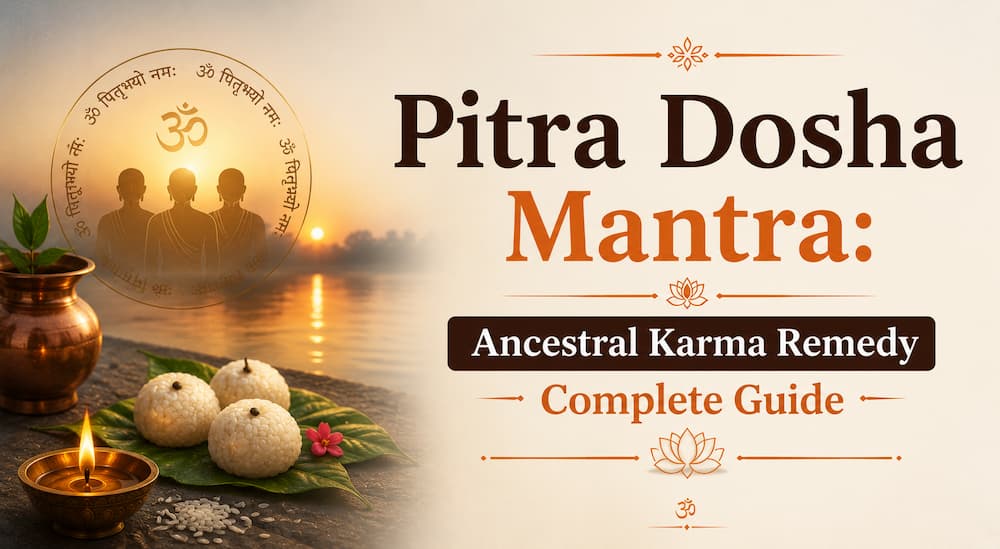

Quick Answer
The primary mantras for Pitra Dosha are:
Pitru Shanti Mantra (daily practice):
Om Sarva Pitrudevatabhyo Namah
ॐ सर्व पितृदेवताभ्यो नमः
Meaning: I offer my obeisance to all ancestral deities. Chant 108 times daily for 21 days minimum, ideally during Pitru Paksha or on Amavasya (new moon).
Narayan Mantra for ancestors:
Om Namo Bhagavate Vasudevaya Pitru Devayai Namah
Meaning: Salutations to Lord Vasudeva (Vishnu) and to the ancestral deities.
Maha Mrityunjaya Mantra: Chant for the departed ancestors’ liberation alongside the Pitru Shanti Mantra daily.
Who This Article Is For
This article is for you if your Jyotisha practitioner has identified Pitra Dosha in your birth chart | you experience chronic unexplained obstacles across multiple areas of life (career, marriage, health, progeny) | you want to understand what Pitra Dosha actually means astrologically and perform the correct remedy | you want to know the difference between the mantra practice and the ritual practices (Shraddha, Tarpan, Pind Daan).
Pitra Dosha is among the most misunderstood concepts in Vedic astrology. The name suggests a curse from ancestors, which creates unnecessary fear. The classical understanding is different: Pitra Dosha is an ancestral karmic debt : an unresolved obligation between the native and their departed ancestors. The ancestors are not cursing the native. They are waiting to be honored so that they can bless.
Here is what most Pitra Dosha articles miss: the mantra is only one part of the three-part remedy the tradition prescribes. The complete remedy is: mantra (internal acknowledgement and invocation), Tarpan or Shraddha (ritual water and food offering to ancestors), and charitable giving (feeding crows, dogs and cows : the animals through whom ancestors are believed to receive offerings). Most articles give you only the mantra and omit the other two. All three are needed for the complete remedy.
What Pitra Dosha Actually Is
Pitra Dosha (also spelled Pitru Dosha or Pitri Dosha) is an astrological affliction arising from unresolved ancestral karma. It is not a curse but a karmic debt transmitted across generations when:
- Ancestors died without proper last rites being performed
- A family member died an unnatural or violent death without the required Pinda Daan and Shraddha
- Ancestors have unresolved desires, injustices or obligations that were carried into death
- The native or their family have neglected ancestral duties across generations
Astrologically, Pitra Dosha is primarily indicated by the affliction of the Sun (significator of father and ancestors) by Rahu or Saturn in the birth chart. The 9th house (house of father, fortune and ancestors) and its lord also play a significant role. The severity depends on how many of these indicators are simultaneously present.
| Pitra Dosha indicator | Primary effect | Severity |
|---|---|---|
| Sun + Rahu conjunction in 9th house | Strongest Pitra Dosha : ancestral karma affecting all life areas simultaneously | Most severe |
| Sun afflicted by Saturn in 9th house | Career and authority obstacles, difficult relationship with father or father figures | Severe |
| 9th house lord debilitated or in dusthana (6th, 8th, 12th) | Fortune blocked, obstacles in receiving ancestral blessings | Moderate |
| Rahu in 9th house without strong mitigating benefics | Confusion around ancestral lineage, unconventional family patterns | Moderate |
| Multiple family members with similar life obstacles across generations | Generational pattern suggesting ancestral karma : not necessarily visible in one chart alone | Assessed through family pattern |
The Complete Three-Part Pitra Dosha Remedy
Part 1: The Mantra Practice
Pitru Shanti Mantra
Sanskrit: Om Sarva Pitrudevatabhyo Namah
Devanagari: ॐ सर्व पितृदेवताभ्यो नमः
Meaning: I bow to all ancestral deities without exception. The word Sarva (all) is deliberate : it invokes not just known ancestors but all ancestors across all lineages that have contributed to the native’s existence.
Practice: 108 times daily. Sunrise is the most auspicious time. Face east.
Best days: Amavasya (new moon) every month. Pitru Paksha (the 16-day ancestral period, typically September to October) : chant every day of this period.
Duration: 21 days for acute Pitra Dosha. Daily practice indefinitely for maintenance and ancestral blessing.
Narayan Mantra for Ancestral Liberation
Sanskrit: Om Namo Bhagavate Vasudevaya Pitru Devayai Namah
Meaning: Salutations to Lord Vasudeva (Vishnu as the pervader of all) and to the ancestral deities.
Why Vishnu for Pitra Dosha: In the Vedic tradition, Vishnu governs the sustaining and preserving function of cosmic order. Ancestors who have not attained liberation (Mukti) remain in the intermediate realm (Pitru Loka) awaiting the completion of their karmic journey. Vishnu’s energy specifically governs the passage between the earthly realm and the higher realms. Chanting his mantra on behalf of ancestors supports their journey and their liberation.
Combined practice: Pitru Shanti Mantra 108 times, then Narayan Mantra 21 times, then Maha Mrityunjaya Mantra 11 times. This sequence covers all three dimensions: honoring ancestors (Pitru Shanti), supporting their liberation (Narayan), and protecting the native from the residual effects of their unresolved karma (Maha Mrityunjaya).
Part 2: Tarpan and Shraddha
The ritual complement to the mantra practice is Tarpan (water offering to ancestors) and Shraddha (food offering and prayer ceremony). These are performed on Amavasya each month and daily during Pitru Paksha.
Simple Tarpan Practice for Home Use
What you need: Clean water in a copper vessel, sesame seeds (til), kusha grass.
Method: Face south (the direction of the ancestors in the Vedic tradition). Hold the copper vessel with both hands. Add sesame seeds. Pour a small stream of water three times while chanting: Om Pitru Devabhyo Namah. Speak the names of your parents and grandparents if known. Offer each of them a stream of water.
When: Every Amavasya (new moon day) and every day of Pitru Paksha. This simple 5-minute practice, done consistently, is the single most powerful Pitra Dosha remedy in the tradition.
Part 3: Charitable Giving
The third part of the Pitra Dosha remedy is charitable giving specifically linked to ancestral appeasement. The tradition prescribes feeding particular beings through whom ancestors are believed to receive the offering:
- Crows (Kaka): Considered the direct messengers of the ancestors. Offering rice balls or cooked rice to crows is the most classical Pitra Dosha charitable remedy. Do this on Amavasya and during Pitru Paksha.
- Cows (Go): Feed with grass, jaggery or chapati. The cow is considered sacred in the Vedic tradition and giving to her satisfies multiple karmic debts simultaneously.
- Dogs: Feed with chapati or rice on Amavasya. Dogs are associated with Bhairava and with the transition between the worlds of the living and the dead.
- Brahmins: Invite Brahmins to a meal and offer them dakshina during Pitru Paksha. This is the formal Shraddha practice.
The Most Important Pitra Dosha Practice: Pitru Paksha
Pitru Paksha is the 16-day period (the dark fortnight of Bhadrapada month, typically September to October) specifically designated for ancestral ceremony in the Hindu calendar. The tradition holds that during this period the gates between the earthly realm and Pitru Loka (the ancestral realm) are open, making ancestral ceremonies dramatically more effective.
Pitru Paksha Practice : The Most Powerful Annual Remedy
Each day of Pitru Paksha:
Morning: Pitru Shanti Mantra 108 times + Narayan Mantra 21 times
Morning: Simple Tarpan with water and sesame seeds facing south
Morning: Feed crows before eating yourself
On the Mahalaya Amavasya (final day of Pitru Paksha):
This is the most sacred day of the entire year for ancestral ceremony. If you perform only one Pitra Dosha remedy in the entire year, perform it on Mahalaya Amavasya. At minimum: Tarpan, Pitru Shanti Mantra 108 times, feeding crows and Brahmins.
From Our Practice
From Our Practice
I have seen Pitra Dosha produce remarkably consistent patterns across families when the astrological indicators are strong. The most characteristic pattern is multi-generational: the father had difficulty with his career, the grandfather experienced significant loss, and the native finds themselves facing similar categories of obstacle despite different circumstances.
A client consulted me whose chart showed a powerful Sun-Rahu conjunction in the 9th house. His father had died young under difficult circumstances, and his grandfather had left the ancestral village under circumstances that had never been fully resolved in the family’s memory. The client himself had experienced persistent blockage in his career despite exceptional ability, and two business partnerships that had both ended badly.
The pattern was clear: unresolved ancestral karma across three generations, with my client now carrying the accumulated weight. I prescribed the complete three-part remedy: Pitru Shanti Mantra daily, Tarpan on every Amavasya and daily during the next Pitru Paksha, and the feeding practice (crows every Amavasya, Brahmins during Pitru Paksha).
Within six months of consistent practice, the business partnership situation had resolved with terms significantly better than expected. Within a year, a new career opportunity had opened that was connected to the ancestral village his grandfather had left : an almost impossible coincidence from the perspective of ordinary causation.
What I tell clients is this: Pitra Dosha is not about debt and punishment. It is about completion. The ancestors need something to be completed or acknowledged. When that completion happens through consistent practice, the blocked energy releases : not just for the native but for the entire lineage.
Frequently Asked Questions
❓ I cannot have children despite medical investigations showing no problem. Can Pitra Dosha cause this?
Yes. Difficulty in conceiving without medical cause is one of the most classically documented effects of Pitra Dosha. The ancestral karmic debt can manifest specifically as difficulty in producing the next generation when the ancestral lineage has unresolved karma. The complete three-part remedy (mantra, Tarpan, charitable giving) combined with the specific Santana Gopal Mantra (Om Shrim Hreem Klim Glaum Devakisut Govind Vasudev Jagadpate Dehi Me Tanayam Krishna Tvaamaham Sharanam Gatah) is the classical combined prescription.
❓ How do I know if my problems are from Pitra Dosha or just ordinary life difficulties?
Three indicators suggest Pitra Dosha rather than ordinary difficulty. First, multiple life areas are simultaneously and persistently affected (career, marriage, health, progeny) rather than one specific area. Second, the same patterns appear across multiple generations of your family. Third, the problems began without obvious external cause and have not responded to ordinary practical remedies. If all three indicators are present, have your birth chart assessed by a qualified Jyotisha for the specific astrological indicators (Sun-Rahu conjunction, 9th house afflictions).
❓ I do not know the names of my ancestors. Can I still perform Tarpan?
Yes. The Tarpan practice does not require specific names. The mantra Om Sarva Pitrudevatabhyo Namah includes all ancestors : Sarva means all. The offering is directed to all ancestors of all lineages, known and unknown, for however many generations they extend back. The tradition holds that the offering reaches all ancestors regardless of whether their names are spoken. If you know some names but not all, speak those you know and conclude with Sarva (all) for those you do not.
❓ I am a woman. Can I perform Shraddha and Tarpan myself?
The traditional prescription is that Shraddha is performed by male family members, typically the eldest son. However, when no male family member is available or willing to perform the ritual, women performing Shraddha and Tarpan on behalf of their ancestors is accepted in most regional traditions and is significantly better than the ritual not being performed at all. The mantra practice (Pitru Shanti Mantra daily) has no gender restriction whatsoever. Women chant the Pitru Shanti Mantra equally and it is fully effective.
❓ Where should I perform Pind Daan for maximum effect?
Gaya (Bihar) is the most powerful location for Pind Daan in the tradition, specifically the Vishnupad Temple on the banks of the Falgu River. The Garuda Purana specifically prescribes Gaya as the supreme location for ancestral liberation. Trimbakeshwar (Nashik), Prayagraj (Sangam) and Haridwar are also powerful locations for Pinda Daan and Shraddha ceremonies. Performing Pind Daan at Gaya once in the lifetime is considered the complete resolution of most Pitra Dosha conditions alongside the ongoing mantra and Tarpan practice.
❓ How long does Pitra Dosha remedy take to show results?
The MantraVidya tradition documents that positive results typically begin after 21 days of consistent daily chanting. The complete resolution of a strong Pitra Dosha : particularly the multi-generational Sun-Rahu type : typically takes one to three full Pitru Paksha cycles (one to three years) of consistent practice. Pitra Dosha is a generational karma, not a temporary planetary period. Its resolution is measured in years of consistent honoring, not in days of intensive practice.
Begin on the Next Amavasya
Find the date of the next Amavasya (new moon). That is your starting day.
On that morning, wake before sunrise. Face south. Pour water three times while chanting Om Pitru Devabhyo Namah. Speak the names of your parents and grandparents. Then chant Om Sarva Pitrudevatabhyo Namah 108 times. Then feed the crows before you eat.
Return on the following Amavasya. And every day during Pitru Paksha. One Pitru Paksha of complete practice produces a shift in the ancestral karma that no one-time ritual can match.
The ancestors are not your enemies. They are your lineage, your inheritance, and the accumulated karma of all the lives that made yours possible. Honoring them is not a religious obligation. It is the acknowledgement of what is true: that you did not arrive here alone, and that the unresolved things they carried do not have to be carried by you forever.
Sources
- Pitra Dosha Nivaran: Complete Guide. AstroSight, April 2026. Pitra Dosha as karmic debt not curse; Sun-Rahu affliction as primary indicator; Shraddha and Pind Daan as core remedies
- Pitru Shanti Mantra. MantraVidya, September 2024. Om Sarva Pitrudevatabhyo Namah text and meaning; 21-day results; Amavasya practice timing
- Pitra Dosh Remedies and Pooja Guide. IIAG. Om Namo Bhagavate Vasudevaya and Maha Mrityunjaya as combined remedy; charitable giving through crows and cows
- Daily Practices and Remedies for Pitra Dosh Nivaran. Trimbakeshwar, April 2025. Surya Arghya morning practice; crow feeding; Pitru Paksha as most powerful period
Narendra Kumar Chaubey is a Jyotisha Acharya with over 30 years of experience, based in Bihar and serving clients across India in Vedic astrology, mantra shastra, Vastu and ritual practice.
He completed his formal training at Kameshwar Singh Darbhanga Sanskrit University (KSDSU), one of India’s oldest and most respected institutions for Vedic and Sanskrit scholarship, where he studied Jyotisha shastra, mantra vidya and related classical sciences. KSDSU’s tradition of rigorous Sanskrit education tracing directly to the Mithila region’s centuries-old pandit lineage forms the foundation of his practice.
Over three decades, Narendra Kumar Chaubey has worked with thousands of individuals and families across Bihar and across India, offering guidance in:
- Kundli (birth chart) analysis: Identifying karmic patterns, planetary periods and life path guidance through classical Jyotisha
- Palmistry (Hasta Samudrika): Reading the hand according to the classical Samudrika Shastra tradition
- Vastu Shastra: Assessment and correction of living and working spaces according to directional and elemental principles
- Mantra and Pooja vidhi: Performing and guiding all categories of puja, havan, and mantra sadhana for personal, family and business situations
- Predictive Jyotisha: Transit analysis, muhurta (auspicious timing) selection and remedial guidance
He works across four languages Sanskrit, Hindi, English and Bhojpuri making classical knowledge accessible to practitioners across educational backgrounds and regions.
His writing for ABMantra brings the precision of classical Vedic training to practical mantra guidance: not general advice but specific prescriptions grounded in shastra, lineage and 30 years of direct practice with real situations.
For more info follow on: