
Quick Answer
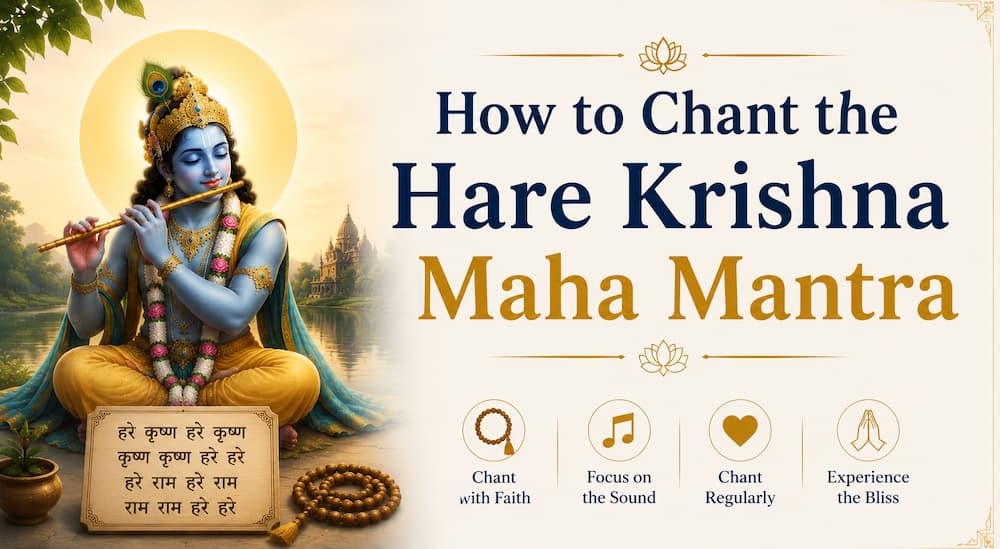
The Hare Krishna Maha Mantra:
Hare Krishna Hare Krishna Krishna Krishna Hare Hare
Hare Rama Hare Rama Rama Rama Hare Hare
हरे कृष्ण हरे कृष्ण कृष्ण कृष्ण हरे हरे।
हरे राम हरे राम राम राम हरे हरे॥
How to chant: One Maha Mantra per bead on a 108-bead tulasi mala = one round. Minimum: 1 round (108 repetitions) daily. Traditional ISKCON prescription: 16 rounds (1,728 repetitions) daily. Begin with 1 to 4 rounds and build gradually.
Source: Kali Santarana Upanishad : described as the only remedy for the evils of Kali Yuga and the supreme liberation mantra for this age.
Who This Article Is For
This article is for you if you have heard the Hare Krishna Maha Mantra and want to understand what it means and why it is chanted | you want the complete method for Japa (bead chanting) and Kirtan (group chanting) | you want to know how many rounds to chant, what the Pancha Tattva mantra is, and how to avoid the most common mistakes.
Also see: Krishna Mantra: the primary Vaishnava mantras and complete guide and How to use a mala: complete japa practice guide
The Hare Krishna Maha Mantra is the best-known Sanskrit mantra outside India, chanted on the streets of New York, London, Tokyo and every major city on earth since Srila Prabhupada introduced it to the West in 1966. But most people who know the tune do not know what the words mean, where the mantra comes from, or how the tradition says it should be chanted to produce its full spiritual effect.
Here is what most Hare Krishna Maha Mantra articles miss: the mantra should be chanted with attention given to each name individually, not as a blur of familiar sound. The Kali Santarana Upanishad’s prescription is that the 16 names of the Maha Mantra destroy the 16-layered illusory covering of the living entity. Each name corresponds to one layer of illusion. Chanting mechanically : letting the tongue rush ahead of the mind : is the most common mistake and the most significant obstacle to the mantra producing its described effects. The method matters as much as the mantra.
The Source and Authority of the Maha Mantra
The Hare Krishna Maha Mantra appears in the Kali Santarana Upanishad, one of the 108 principal Upanishads. In the text, Narada asks Brahma: “What is the remedy for the evils of Kali Yuga?” Brahma answers with the Maha Mantra and states: “These 16 names destroy all the evil effects of Kali Yuga. No better means exists in all the Vedas.”
The mantra was popularized publicly by Sri Chaitanya Mahaprabhu (1486 CE), who introduced the practice of Nama Sankirtan : public group chanting of the divine names : across India. Before Chaitanya, Sanskrit mantra practice was largely a private, indoor affair. Chaitanya brought it into the streets, the marketplaces and the homes of ordinary people. The tradition holds that this was intentional: the Maha Mantra was designed specifically for Kali Yuga, where people have neither the time, focus nor discipline for the more elaborate practices of previous ages.
The Meaning of Each Word
| Name | Meaning | What it invokes |
|---|---|---|
| Hare | The divine energy of the Lord : specifically Radha’s energy as the divine feminine complement to Krishna. Also interpreted as: O Hari (the remover), addressing the energy that removes the ego’s illusions. | The divine feminine energy; Radha; the energy that draws the soul toward God |
| Krishna | The all-attractive one. From Karshati : he who attracts all. The divine in its most personal, joyful, love-filled form. | The Supreme Personality, the all-attractive divine |
| Rama | He who gives eternal joy (Ramayati = he who causes delight). Also Lord Rama. Also Balarama : Krishna’s brother. All three meanings are simultaneously present. | The joy of the divine; Lord Rama; Balarama; eternal bliss |
The full Maha Mantra is a prayer: “O divine energy, O all-attractive Lord, O source of eternal joy : please engage me in your service.” This is the Gaudiya Vaishnava understanding. The soul is calling for the divine’s attention, asking to be engaged with the divine rather than with the material world’s distractions.
The Two Methods of Chanting
Method 1: Japa : Individual Bead Chanting
Complete Japa Practice
What you need: A 108-bead tulasi mala (tulasi wood is traditional for Vaishnava practice). Keep it in a bead bag to protect it from the floor and from public view.
Method:
1. Before beginning each round: chant the Pancha Tattva mantra once: Jaya Shri Krishna Chaitanya Prabhu Nityananda Shri Advaita Gadadhara Shrivasadi Gaura Bhakta Vrinda. This opening prayer invokes Chaitanya Mahaprabhu’s protection before the Maha Mantra begins.
2. Hold the mala in the right hand. Begin with the bead next to the Meru bead (the head bead). Never cross over the Meru bead : when you reach it, reverse direction for the next round.
3. Roll each bead between the thumb and middle finger. Use one bead per complete Maha Mantra: Hare Krishna Hare Krishna Krishna Krishna Hare Hare Hare Rama Hare Rama Rama Rama Hare Hare.
4. Chant each name distinctly, with attention on the sound and meaning of each name.
5. 108 beads = 1 round.
Count of rounds:
Beginners: 1 to 4 rounds daily. Build gradually.
Initiated Vaishnavas (ISKCON): 16 rounds daily minimum. This takes 1.5 to 2 hours.
Sri Chaitanya Mahaprabhu himself chanted 192 rounds daily.
Method 2: Kirtan : Group Call and Response
Kirtan Practice
Kirtan is the communal, melodic form of the Maha Mantra : a lead singer calls out the mantra and the group responds in chorus. Accompanied by mridanga (drum) and kartals (cymbals).
The tradition holds: Kirtan is specifically more powerful than Japa for Kali Yuga because it involves multiple voices, creates a shared energetic field, and is impossible to perform absent-mindedly. The social dimension of Kirtan : the call and response between devotees : is itself the practice. Unlike Japa which is internal, Kirtan is relational.
For those who cannot access group Kirtan: chanting the Maha Mantra aloud while doing household work, cooking, or walking is a valid informal Kirtan practice. The tradition distinguishes between formal meditative Japa (requiring full attention) and this informal continuous chanting, both of which are prescribed.
Most Common Mistakes and How to Avoid Them
| Mistake | What happens | Correction |
|---|---|---|
| Chanting mechanically while mind wanders | The tongue moves but no spiritual contact is made | Hear each name as you say it. The practice is hearing, not just speaking. |
| Rushing to complete rounds quickly | Speed defeats the purpose | Quality of attention over quantity of rounds. Fewer rounds with full attention is better than many rounds mechanically. |
| Crossing the Meru bead | Traditional protocol violated | Reverse direction at the Meru bead, never cross it |
| Skipping days and making up rounds later | Breaks the consistency that builds the practice’s effect | Daily consistency is everything. One sincere round daily beats seven rushed rounds on one day |
| Chanting after non-vegetarian food | Vaishnava tradition recommends a vegetarian diet alongside the practice | The Maha Mantra’s power builds with sustained sattvic lifestyle |
From Our Practice
From Our Practice
The Hare Krishna Maha Mantra occupies a specific place in the Vedic tradition’s understanding of this age that no other mantra does. The Kali Santarana Upanishad’s statement : no better means exists in all the Vedas : is not a casual claim. It reflects the tradition’s assessment of what Kali Yuga requires: a practice that is universally accessible (no initiation, no caste qualification, no gender restriction), portable (chantable anywhere, any time), communally practiced (Kirtan requires only two people), and powerful enough to work despite the practitioner’s inevitable distraction and imperfection.
In my own practice and in the guidance I offer to clients, the Maha Mantra is what I recommend to people who feel overwhelmed by the complexity of Sanskrit mantra practice. There is no pronunciation difficulty : Hare Krishna is one of the easiest Sanskrit phrases for any language speaker. There is no restriction on time or place. The only requirement is sincerity: give the names your actual attention, however briefly.
The tradition also says something important about imperfect chanting: even chanting done carelessly or with divided attention produces some benefit because the names themselves carry power regardless of the chanter’s qualification. This is the Maha Mantra’s specific grace: it works even when you are not perfectly focused. It rewards you for trying, and over time, the trying becomes easier and the focus deeper.
Frequently Asked Questions
❓ I am not a Hindu. Can I chant the Hare Krishna Maha Mantra?
Yes, with complete sanction of the tradition. The Kali Santarana Upanishad explicitly states there are no prerequisites. ISKCON has introduced this mantra to millions of people worldwide from every religious and cultural background. Sri Chaitanya Mahaprabhu himself gave the mantra to Muslims and Christians without requiring conversion. The divine names are the property of all living beings, not of any particular religion.
❓ How many rounds should I chant as a beginner?
Begin with 1 round (108 repetitions) daily. One round takes approximately 7 to 10 minutes for a beginner. Maintain this for 21 days. If the practice feels natural and you want to deepen it, add a second round. The 16-round daily practice of initiated Vaishnavas is the formal commitment of a dedicated practitioner, not the expectation for a beginner. Quality of attention in one sincere round is far more valuable than 16 mechanical rounds.
❓ Does the Hare Krishna Maha Mantra have to be chanted on beads or can I just say it?
Both are valid. The bead practice (Japa) is the formal meditative practice that keeps count and builds the habit of specific rounds. The informal continuous chanting : saying the Maha Mantra while cooking, walking, commuting, or doing any repetitive activity : is also fully valid and recommended in the tradition as a way of maintaining constant divine remembrance between formal Japa sessions. The beads develop depth. The informal chanting develops consistency. Both are needed.
❓ What is the Pancha Tattva mantra and do I need to chant it before the Maha Mantra?
The Pancha Tattva mantra is: Jaya Shri Krishna Chaitanya Prabhu Nityananda Shri Advaita Gadadhara Shrivasadi Gaura Bhakta Vrinda. It is a salutation to Sri Chaitanya Mahaprabhu and his four principal associates. The Gaudiya Vaishnava tradition prescribes chanting it once before each round of the Maha Mantra as a protective invocation. It is not mandatory for all practitioners but is strongly recommended in ISKCON and Gaudiya lineages. For practitioners outside this specific tradition, beginning with Om Namo Bhagavate Vasudevaya three times before the Maha Mantra serves the same opening function.
❓ Is there a difference between Hare Krishna Hare Krishna… and Hare Rama Hare Rama…? Some versions start with Hare Rama.
The Kali Santarana Upanishad version begins with Hare Krishna. The alternative version (beginning Hare Rama) appears in some editions published by the Ramanandi tradition who give precedence to Rama’s name. Both are the same mantra with the same 16 names. Sri Chaitanya Mahaprabhu’s tradition, all Gaudiya Vaishnava lineages and ISKCON use the Hare Krishna-first version. Either version is fully valid. The names are the same; the sequence varies by tradition.
❓ Can I chant the Hare Krishna Maha Mantra during periods?
Yes. The Vaishnava tradition places no menstruation restriction on the Hare Krishna Maha Mantra. The Kali Santarana Upanishad’s statement that there are no prerequisites applies universally. Sri Chaitanya Mahaprabhu’s public Kirtan included women participants without restriction. The Maha Mantra is specifically described as the most accessible practice of Kali Yuga : any restriction on who can chant it would contradict its fundamental nature.
Begin Tonight
You do not need beads to begin. Tonight, sit quietly for 5 minutes. Say the Maha Mantra aloud 16 times. Hear each name as you say it: Hare : the divine energy calling to you; Krishna : the all-attractive; Hare : again; Krishna : again. Krishna Krishna. Hare Hare. Then Hare Rama. Hare Rama. Rama Rama. Hare Hare.
That is the practice. 16 repetitions, 5 minutes, no equipment required.
Tomorrow, add a mala if you have one. Count 108 repetitions. One round. Do it again the day after. And the day after that. In 21 days you will have direct experience of what this mantra does. The tradition’s promise and your own experience will be the only teaching you need.
Sources
- Hare Krishna Hare Rama: Mantra Lyrics and Meaning. Mahakatha, March 2026. 108 per round, 16 rounds for serious practitioners; Bhagavad Gita on sincere devotion; Japa and Kirtan methods
- Hare Krishna Maha Mantra: Meaning, Benefits and How to Chant. HinduTone. Kali Santarana Upanishad quote; Chaitanya 192 rounds daily; common mistakes; Meru bead rule
- How to Chant Hare Krishna Mahamantra (ISKCON). ISKCON Reading. Pancha Tattva mantra before each round; bead bag method; Chaitanya Mahaprabhu’s instruction
- Hare Krishna Mahamantra: Meaning and Significance. Mantra Tips, January 2024. Kali Santarana Upanishad dialogue between Brahma and Narada; 16 names destroy 16 layers of illusion; universal accessibility confirmed
Narendra Kumar Chaubey is a Jyotisha Acharya with over 30 years of experience, based in Bihar and serving clients across India in Vedic astrology, mantra shastra, Vastu and ritual practice.
He completed his formal training at Kameshwar Singh Darbhanga Sanskrit University (KSDSU), one of India’s oldest and most respected institutions for Vedic and Sanskrit scholarship, where he studied Jyotisha shastra, mantra vidya and related classical sciences. KSDSU’s tradition of rigorous Sanskrit education tracing directly to the Mithila region’s centuries-old pandit lineage forms the foundation of his practice.
Over three decades, Narendra Kumar Chaubey has worked with thousands of individuals and families across Bihar and across India, offering guidance in:
- Kundli (birth chart) analysis: Identifying karmic patterns, planetary periods and life path guidance through classical Jyotisha
- Palmistry (Hasta Samudrika): Reading the hand according to the classical Samudrika Shastra tradition
- Vastu Shastra: Assessment and correction of living and working spaces according to directional and elemental principles
- Mantra and Pooja vidhi: Performing and guiding all categories of puja, havan, and mantra sadhana for personal, family and business situations
- Predictive Jyotisha: Transit analysis, muhurta (auspicious timing) selection and remedial guidance
He works across four languages Sanskrit, Hindi, English and Bhojpuri making classical knowledge accessible to practitioners across educational backgrounds and regions.
His writing for ABMantra brings the precision of classical Vedic training to practical mantra guidance: not general advice but specific prescriptions grounded in shastra, lineage and 30 years of direct practice with real situations.
For more info follow on: