
Quick Answer
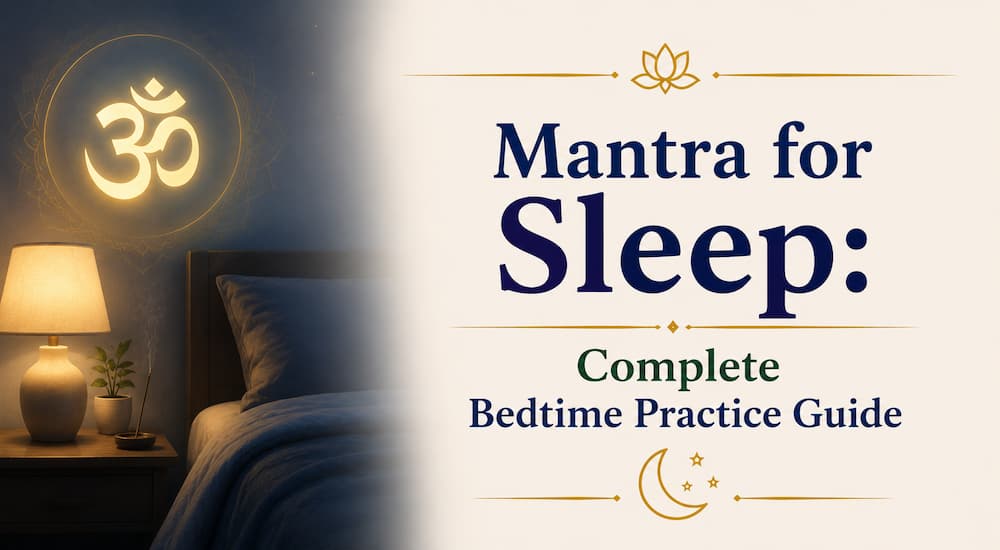
Three mantras to help you sleep:
For falling asleep: Om Namah Shivaya : 108 times chanted slowly in bed, one full breath between each repetition
For sleep with anxiety: Maha Mrityunjaya Mantra 21 times before sleep : addresses the fear underneath insomnia
The classical sleep invocation (Nidra Mantra):
Tvam Swapno Nidra Devi Sukhada Varada
Devata Suprasanna Bhav
(Prayer to Nidra Devi, the goddess of sleep : chant 3 times before lying down)
Method: Chant in bed, lying down or seated. Eyes closed. No mala needed. Pace slowly. If you fall asleep before finishing the count, the practice has worked.
Who This Article Is For
This article is for you if you have difficulty falling asleep, staying asleep, or wake at 2 to 3 AM and cannot return to sleep | you want to know which mantra the tradition specifically prescribes for sleep | you want a complete pre-sleep ritual that uses mantra alongside other Vedic sleep practices.
Important note: Persistent insomnia (more than 3 nights per week for more than one month) warrants evaluation by a qualified doctor. Mantra practice supports healthy sleep alongside appropriate medical care. If your sleep problems are affecting your health or functioning significantly, please consult a doctor.
Also see: Mantra for anxiety: the mantras that calm the restless mind and Which mantra is good for health: complete situation-based guide
The Vedic tradition has a specific understanding of sleep (Nidra) that modern sleep science confirms. Sleep is the state of consciousness in which the Jiva (individual soul) returns temporarily to the deep causal body : the layer of consciousness closest to the divine source. Healthy sleep is not the absence of consciousness but a specific quality of consciousness: the deep, dreamless Sushupti state in which the ego relaxes its control and the natural intelligence of the body can restore itself.
Here is what most mantra for sleep articles miss: they give you mantras to chant but do not explain why chanting helps sleep. Insomnia is almost always a Vata imbalance problem in Ayurvedic terms : an excess of the air and movement quality that keeps the mind restless after the body is tired. Mantra chanting specifically addresses Vata by doing the opposite of what Vata is: instead of scattered movement (the racing mind of insomnia), mantra chanting is focused, rhythmic, repetitive and slow. These qualities directly counter the Vata qualities that produce sleeplessness.
Why Mantra Works for Sleep
The physiological mechanism is specific. Slow, rhythmic chanting at the pace of one mantra per complete breath (approximately 4 to 6 seconds per repetition) naturally regulates breathing to approximately 10 to 12 breaths per minute. This is precisely the respiratory rate associated with parasympathetic nervous system dominance : the “rest and digest” state that is the prerequisite for healthy sleep. Counting the repetitions (even on fingers in bed) gives the restless mind a simple repetitive task that prevents it from generating the anxious thought chains that keep most insomnia sufferers awake.
The Three Sleep Mantras
Om Namah Shivaya: The Primary Sleep Mantra
Sanskrit: Om Namah Shivaya
Devanagari: ॐ नमः शिवाय
Why Shiva for sleep: Shiva is the deity of dissolution, of the return of all forms to formlessness. Sleep is a miniature version of the dissolution Shiva governs : the temporary return of the individual ego to the formless ground of consciousness. The Panchakshara (Na Ma Shi Va Ya) in the sleep context is specifically an invitation to this dissolution: I bow to the one before whom all individual effort, anxiety and control dissolve.
Method in bed: Lie in Shavasana (corpse pose : on your back, arms slightly away from the body, legs uncrossed). Eyes closed. Begin chanting Om Namah Shivaya silently, slowly, one repetition per full breath cycle. Count on your fingers or simply count mentally. If you reach 108, you are still awake and the practice continues. If you fall asleep at 47, excellent : the mantra has done its job.
Maha Mrityunjaya: For Fear-Based Insomnia
For whom: People who cannot sleep because of worry about illness, death of self or loved ones, health anxiety, existential fear. This is specifically death-fear and Maha Mrityunjaya : the great victory over death : is precisely designed for this.
Method: Seated on the bed, not yet lying down. Chant the Maha Mrityunjaya Mantra 21 times : Om Tryambakam Yajamahe Sugandhim Pushtivardhanam Urvarukamiva Bandhanan Mrityor Mukshiya Maamritat. After the 21st repetition, lie down and begin Om Namah Shivaya silently. The combination : Maha Mrityunjaya releasing the fear dimension and Om Namah Shivaya dissolving the ego’s residual agitation : addresses both the root (fear) and the symptom (restlessness) of this specific form of insomnia.
Nidra Devi Invocation: The Classical Sleep Prayer
Sanskrit:
Tvam Swapno Nidra Devi Sukhada Varada
Devata Suprasanna Bhav
Meaning: You are the dream and sleep, O Nidra Devi, the giver of happiness, the giver of boons. O goddess, be pleased with me.
Nidra Devi is the goddess of sleep in the Devi Bhagavata Purana : a specific aspect of Mahadevi who governs the state of deep sleep. She is described as the divine mother who “folds all beings into herself” each night. Invoking her by name before sleep is the tradition’s specific acknowledgement that sleep is not the absence of consciousness but a return to the divine mother’s embrace.
Method: Chant 3 times while seated before lying down. This is a short prayer, not a long practice : its function is to open the transition into sleep as a conscious, intentional act rather than an accidental collapse into unconsciousness.
The Complete Pre-Sleep Practice
| Time before sleep | Practice | Duration |
|---|---|---|
| 30 minutes before | No screens. Dim lights. Warm water or warm milk. Read something calm. The mantra practice works best when the nervous system is already beginning to quiet. | 30 minutes |
| 10 minutes before lying down | Seated on bed: Maha Mrityunjaya 21 times (if fear-based insomnia) or Nidra Devi invocation 3 times | 5 minutes |
| In bed | Om Namah Shivaya silently, slowly, one per breath, counting to 108 or until sleep comes | Until sleep |
The 2 AM Waking Problem
Many people fall asleep normally but wake between 2 and 4 AM and cannot return to sleep. In Ayurveda, this window is Vata time : the hours governed by the Vata dosha’s air and movement quality, which naturally activates the mind. In Jyotisha, persistent 2 AM waking often correlates with a difficult Saturn or Rahu influence in the chart.
The mantra prescription for 2 AM waking: keep a mala beside the bed. When you wake, do not reach for your phone. Instead, reach for the mala and begin Om Namah Shivaya silently. The counting gives the Vata-activated mind its task. The mantra’s specific quality counters the Vata quality. Most practitioners who use this protocol report returning to sleep within 15 to 20 minutes of beginning the count.
From Our Practice
From Our Practice
My father had severe insomnia from his late fifties onward. He had tried various approaches without consistent success. I suggested the Om Namah Shivaya practice in bed : 108 repetitions, lying down, one per breath. He was skeptical. He was also desperate enough to try.
He reported to me three weeks later that he had not reached 108 once in those three weeks. He fell asleep consistently between 40 and 70 repetitions. In 30 years of Jyotisha practice, the Om Namah Shivaya sleep practice is the single recommendation I have seen produce the most consistent positive response across the widest variety of people. It works for young adults with exam anxiety, for middle-aged professionals with work stress insomnia, and for older people with the lighter sleep of age. The mechanism is simple and reliable: a repetitive, rhythmic, meaningful task that the mind can hold without effort gradually draws the mind away from its own agitation into the peaceful state that precedes sleep.
Frequently Asked Questions
❓ I try to chant but my mind keeps wandering. Does it still work?
Yes. This is the most common experience in the first weeks and it does not diminish the practice’s effectiveness. When you notice the mind has wandered : whatever thought you have been following, however long you have been following it : simply return to the mantra count. Do not judge the wandering. Returning to the mantra from the wandering is itself the practice. The brain’s capacity for focused attention strengthens through this return, not through the absence of wandering. Most practitioners find that by Day 14 of the nightly practice, the mind wanders less and sleep comes more readily.
❓ Should I use a mala in bed for the sleep practice?
A mala is optional for the sleep practice. Many people find it helpful because the physical sensation of moving the beads gives the mind an additional gentle anchor. Others find the mala uncomfortable to hold while lying down. If you use a mala in bed, hold it loosely in whichever hand is most comfortable. If you prefer not to use a mala, count on the fingers of one hand or count mentally. The count matters because it gives the restless mind a task; the mala is the tool, not the practice.
❓ Can I use recorded mantra to help me sleep instead of chanting myself?
Listening to recorded mantra as a sleep aid is valid and many people use it effectively. However, it is not as effective as personal chanting for the sleep purpose because the physiological mechanism depends specifically on your own regulated breath. When you chant, the breath regulation happens naturally because chanting requires breath. When you listen, the breath is not specifically engaged. For sleep, personal silent chanting (manasik japa) is the most effective form. Recordings are better than nothing but less effective than self-practice.
❓ My partner sleeps next to me and I do not want to wake them. Can I chant silently?
Yes. Silent mantra (manasik japa) is fully valid for the sleep practice and is in fact considered the most appropriate form for this context. The Panchakshara chanted silently in the mind while lying still produces the same parasympathetic nervous system activation as audible chanting. Your partner will not be disturbed. Many practitioners who share a bed find that their partner also sleeps better on nights when they maintain their silent mantra practice : the quality of stillness generated extends into the shared sleeping environment.
❓ I use sleep medication. Can I combine the mantra practice with medication?
Yes. There is no conflict between mantra practice and sleep medication. The mantra practice addresses the psychological and energetic dimensions of sleeplessness; medication addresses the physiological dimension. They work on different systems and complement each other. Do not stop sleep medication without consulting your doctor. The mantra practice may gradually reduce your dependence on medication over weeks or months as your natural sleep capacity is restored : but this transition should happen naturally and with your doctor’s guidance, not through abruptly stopping medication.
❓ Which Ayurvedic practices complement the sleep mantra?
Three Ayurvedic practices specifically address Vata-based insomnia alongside mantra: warm sesame oil foot massage before bed (Pada Abhyanga) : 5 minutes each foot : which grounds the Vata energy and is one of the most consistently effective Ayurvedic sleep practices; warm milk with a pinch of nutmeg and turmeric before bed; and consistent sleep and wake times, as Vata’s restlessness is significantly worsened by irregular schedules. These three practices with the Om Namah Shivaya sleep mantra form a complete approach to insomnia from the Ayurvedic and mantra tradition together.
Tonight
Put your phone across the room. Dim the lights 30 minutes before you want to sleep. Sit on your bed. Chant the Nidra Devi invocation 3 times: Tvam Swapno Nidra Devi Sukhada Varada Devata Suprasanna Bhav. Lie down. Close your eyes. Begin Om Namah Shivaya : one repetition, one breath. Count to 108 or until sleep comes. Whichever comes first is correct.
Sources
- Devi Bhagavata Purana : Nidra Devi as the goddess of sleep, her role in the cosmic sleep of Vishnu and the tradition of her invocation before sleep
- Wikipedia : Om Namah Shivaya: Panchakshara significance and Shiva’s governance of dissolution
- Charaka Samhita, Sutra Sthana : Ayurvedic classification of sleep disturbance as Vata disorder; Pada Abhyanga and warm milk as remedies
- Mandukya Upanishad : classical description of the three states of consciousness (Jagrat, Swapna, Sushupti) and the nature of deep sleep as the causal body state
Narendra Kumar Chaubey is a Jyotisha Acharya with over 30 years of experience, based in Bihar and serving clients across India in Vedic astrology, mantra shastra, Vastu and ritual practice.
He completed his formal training at Kameshwar Singh Darbhanga Sanskrit University (KSDSU), one of India’s oldest and most respected institutions for Vedic and Sanskrit scholarship, where he studied Jyotisha shastra, mantra vidya and related classical sciences. KSDSU’s tradition of rigorous Sanskrit education tracing directly to the Mithila region’s centuries-old pandit lineage forms the foundation of his practice.
Over three decades, Narendra Kumar Chaubey has worked with thousands of individuals and families across Bihar and across India, offering guidance in:
- Kundli (birth chart) analysis: Identifying karmic patterns, planetary periods and life path guidance through classical Jyotisha
- Palmistry (Hasta Samudrika): Reading the hand according to the classical Samudrika Shastra tradition
- Vastu Shastra: Assessment and correction of living and working spaces according to directional and elemental principles
- Mantra and Pooja vidhi: Performing and guiding all categories of puja, havan, and mantra sadhana for personal, family and business situations
- Predictive Jyotisha: Transit analysis, muhurta (auspicious timing) selection and remedial guidance
He works across four languages Sanskrit, Hindi, English and Bhojpuri making classical knowledge accessible to practitioners across educational backgrounds and regions.
His writing for ABMantra brings the precision of classical Vedic training to practical mantra guidance: not general advice but specific prescriptions grounded in shastra, lineage and 30 years of direct practice with real situations.
For more info follow on: