
Quick Answer
The primary Saraswati Yantra mantra:
Om Aim Hreem Shreem Aim Saraswatyai Namah
ॐ ऐं ह्रीं श्रीं ऐं सरस्वत्यै नमः
108 times daily facing the Saraswati Yantra
Yantra activation mantra (chant once when installing the yantra):
Om Aim Saraswatyai Namah : 108 times on a Wednesday with yellow flowers and ghee lamp
Yantra placement: East wall of your study room or workspace, at eye level when seated. Face east while studying. Never place the yantra on the floor.
The combined method: Mantra alone: the sound activates consciousness. Yantra alone: the geometric form holds energy. Mantra + Yantra together: the sound creates the energy; the yantra concentrates and holds it in the physical space. This is the complete Saraswati practice.
Who This Article Is For
This article is for you if you have a Saraswati Yantra and want to know how to activate it and which mantra to chant with it | you want to understand how a yantra works alongside a mantra rather than separately | you are a student, teacher or writer seeking the combined yantra-mantra practice for knowledge and expression.
Also see: Saraswati Mantra: complete meaning and learning practice
Most people who work with mantras either use the mantra alone (without a yantra) or use a yantra as a decorative object without understanding how to activate it with the correct mantra. The tradition’s understanding is that these are two incomplete approaches. The mantra creates the energy through sound vibration. The yantra concentrates and holds that energy in a geometric form. Together they create a complete energetic tool: the mantra charges the yantra, and the yantra amplifies and focuses the mantra’s effect in the physical space where it is placed.
Here is what most Saraswati Yantra articles miss: they give you a placement and a mantra count but do not explain the three-stage process: activation (installing the yantra with the correct mantra for the first time), daily practice (maintaining the yantra’s energy through regular mantra chanting) and renewal (re-energising the yantra periodically). Without understanding these three stages, the yantra becomes an inert copper plate over time regardless of its initial quality.
What the Saraswati Yantra Actually Is
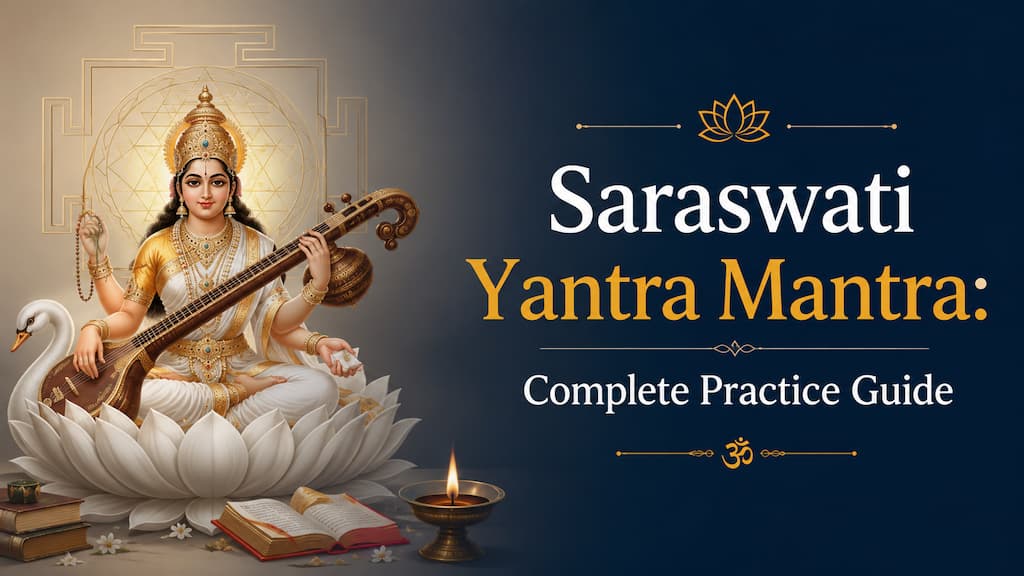
The Saraswati Yantra is a geometric diagram that encodes the specific vibrational pattern of Saraswati’s energy in visual form. The primary geometric elements:
| Geometric element | What it represents | Function |
|---|---|---|
| Central point (Bindu) | The source point of Saraswati’s energy : the undifferentiated intelligence before it takes form | The focal point for consciousness during mantra chanting |
| Central triangle (pointing up or down depending on tradition) | The Shakti triangle : the divine feminine creative power | Concentrates the mantra’s energy at the centre |
| Eight-petalled lotus | The eight directions : the mantra’s energy radiating outward into all dimensions of knowledge | Expands the yantra’s energetic influence into the surrounding space |
| Square outer frame (Bhupura) | The earth plane : where the yantra’s energy manifests in practical reality | Grounds the energy and anchors it in the physical space |
| Aim beej at the centre | Saraswati’s primary seed syllable : intelligence, speech, creative expression | The specific energetic signature of the deity |
The Three-Stage Saraswati Yantra Practice
Stage 1: Activation (One-Time)
How to Activate a New Saraswati Yantra
Best day: Wednesday (Mercury’s day : governs intelligence and speech) or Vasant Panchami (Saraswati Puja, typically in January-February)
What you need: The Saraswati Yantra. Yellow flowers (Saraswati’s colour). Ghee lamp. Clean yellow or white cloth.
Method:
1. Wash the yantra with water. Wipe clean with a white cloth.
2. Place on a clean yellow cloth, facing you (the yantra’s inscribed side facing toward you).
3. Light the ghee lamp. Offer yellow flowers at the yantra’s base.
4. Chant Om Aim Hreem Shreem Aim Saraswatyai Namah 108 times while looking at the central point (Bindu) of the yantra.
5. After completing 108 repetitions, sit in silence for 5 minutes with your eyes on the central point.
6. Place the yantra on the east wall of your study room at eye level. This completes the activation.
The intention of activation: The activation is not a magical ritual. It is the deliberate act of connecting your consciousness with the yantra through the mantra. You are establishing the relationship: this yantra is the physical anchor for Saraswati’s energy in this space, activated through this specific mantra. That established relationship is what makes the yantra active rather than inert.
Stage 2: Daily Practice (Ongoing)
Daily Saraswati Yantra Mantra Practice
Morning practice: Sit facing the yantra. Light the ghee lamp briefly. Chant Om Aim Hreem Shreem Aim Saraswatyai Namah 108 times while looking at the Bindu (central point) of the yantra. 10 to 15 minutes.
Before study sessions: Stand or sit before the yantra. Chant Om Aim Saraswatyai Namah 11 times. Begin studying. This brief activation before each study session integrates the yantra’s energy directly with the work you are about to do.
Study position: If possible, face the yantra while studying. The visual field of the yantra subtly supports the mental state needed for deep learning. Do not keep the yantra behind you or out of sight during study : it is not a charm worn passively but a tool used actively.
Stage 3: Renewal (Periodic)
The Saraswati Yantra should be renewed on Vasant Panchami (the annual Saraswati Puja festival) each year. On this day, remove the yantra from its position, clean it with water, and repeat the full activation practice (Stage 1). This annual renewal maintains the yantra’s energetic charge. A yantra that has not been renewed in several years functions significantly less effectively than one that receives the annual Panchami renewal.
The Mantra Explained
| Element | Meaning | Function |
|---|---|---|
| Om | Primordial sound of consciousness | Opens the mantra to the cosmic ground |
| Aim (first) | Saraswati’s primary beej : the seed of intelligence, speech and creative expression | Directly invokes Saraswati’s specific energy |
| Hreem | Mahalakshmi beej : creative power and manifestation | Adds manifesting power to the intelligence invocation |
| Shreem | Lakshmi beej : abundance and auspiciousness | Ensures the knowledge gained is used auspiciously |
| Aim (second) | Repetition of Saraswati’s beej for emphasis | Seals the beej combination with Saraswati’s energy |
| Saraswatyai | To Saraswati (dative case) | Directs the entire invocation to the specific deity |
| Namah | I bow, I surrender | Closes with surrender and receptivity |
From Our Practice
From Our Practice
When students preparing for important examinations come to me, I often recommend the Saraswati Yantra combined with the Aim mantra practice rather than the mantra alone. The difference between the two approaches : mantra alone versus yantra plus mantra : is the difference between carrying a charged battery and carrying a charged battery inside a device designed to use that charge. The mantra creates the energy; the yantra focuses it.
The most consistent result I observe from the combined practice is in the student’s quality of concentration during study: not the quantity of time spent studying but the depth of absorption during that time. Students who maintain the yantra in their study space and chant the activation mantra before each session consistently report that the same material becomes more accessible, stays retained better and integrates more fully with what they already know. This is exactly what the tradition describes as Saraswati’s specific grace: not more raw intelligence, but the organisation of existing intelligence into usable wisdom.
Frequently Asked Questions
❓ I have a Saraswati Yantra but never activated it. Can I activate it now even if I have had it for years?
Yes, absolutely. An unactivated yantra is simply an inert geometric object. Activation at any point establishes the energetic connection. Perform the full activation practice on the next Wednesday or on Vasant Panchami. The years of inactivity do not diminish the yantra’s potential for use. The activation begins its function from the moment of the ceremony.
❓ Which is more effective: a copper Saraswati Yantra or a silver one?
The tradition prescribes copper as the primary metal for Saraswati Yantra because copper is Venus’s metal in Vedic astrology, and Venus governs the arts, creative expression and the refinement of intelligence. Silver is the Moon’s metal : appropriate for mantras and yantras related to the Moon’s qualities (emotion, memory, imagination) but less specifically targeted for Saraswati’s domain. A correctly activated copper Saraswati Yantra is more appropriate than an unactivated silver one. Activation and correct use matter more than the specific metal.
❓ Can I keep the Saraswati Yantra in my bedroom?
The study room or workspace is strongly preferred. Saraswati’s energy is specifically associated with focused intellectual activity. Placing her yantra in a bedroom : associated with rest, sleep and romantic life : creates an energetic mismatch. If you have no separate study space, keep the yantra covered during sleep and uncover it when using it for study. Do not place any deity’s yantra in a space where intimate activity occurs.
❓ What is the difference between the Saraswati Yantra and the Vidya Yantra?
Both are used for educational success and knowledge. The Saraswati Yantra invokes Saraswati as a specific deity with all her classical qualities: speech, music, the Vedas, the swan as her vehicle. The Vidya Yantra (Vidya = knowledge) is a more general learning yantra not tied to a specific deity’s iconography. For students in the Hindu devotional tradition with a connection to Saraswati: the Saraswati Yantra. For practitioners who prefer non-deity-specific tools: the Vidya Yantra. Both work through the same principle of geometric energy concentration.
❓ Can I use the same Saraswati Yantra for both my children?
Yes. One yantra placed in a shared study space serves multiple users. The key is that each child who uses the space performs the brief activation before their study sessions (Om Aim Saraswatyai Namah 11 times). The yantra’s energy in the space is available to all who consciously engage with it through the mantra, regardless of whether they are the original installer or a subsequent user.
❓ How do I know if the Saraswati Yantra practice is working?
Three observable signs that the practice is established: the quality of your concentration during study improves (deeper absorption, fewer interruptions from the wandering mind), material you study becomes easier to recall in its structure and relationship to other material, and a quality of enjoyment in learning that may have been absent begins to appear or increase. The third sign is specifically Saraswati’s: her grace does not only make learning easier but makes it pleasurable. When study becomes something you look forward to rather than endure, Saraswati is present in the practice.
Install It This Wednesday
The next Wednesday is the day. Obtain a copper Saraswati Yantra. Follow the Stage 1 activation practice. Place it on the east wall of your study space. Begin the daily 108-repetition practice the following morning.
The mantra and the yantra are two languages describing the same reality: Saraswati’s energy of intelligence, organisation, expression and the joy of genuine learning. The mantra speaks it in sound. The yantra holds it in form. Together they establish Saraswati’s presence in your study space as a consistent, activatable reality rather than an occasional experience.
Sources
- Wikipedia : Yantra: geometric diagrams as concentrators of deity energy; the Bindu, lotus and Bhupura elements; copper as the primary metal for yantras
- Wikipedia : Saraswati: Aim beej as her primary seed syllable; knowledge, speech and the arts as her domain
- Tantric Yoga and the Wisdom Goddesses : David Frawley. Aim as the beej of Saraswati: speech, intelligence and creative expression in Tantric practice
- The Yantra and its Significance. Wisdomlib Tantric reference : Yantra definition and significance in the Tantric and Agamic tradition
Narendra Kumar Chaubey is a Jyotisha Acharya with over 30 years of experience, based in Bihar and serving clients across India in Vedic astrology, mantra shastra, Vastu and ritual practice.
He completed his formal training at Kameshwar Singh Darbhanga Sanskrit University (KSDSU), one of India’s oldest and most respected institutions for Vedic and Sanskrit scholarship, where he studied Jyotisha shastra, mantra vidya and related classical sciences. KSDSU’s tradition of rigorous Sanskrit education tracing directly to the Mithila region’s centuries-old pandit lineage forms the foundation of his practice.
Over three decades, Narendra Kumar Chaubey has worked with thousands of individuals and families across Bihar and across India, offering guidance in:
- Kundli (birth chart) analysis: Identifying karmic patterns, planetary periods and life path guidance through classical Jyotisha
- Palmistry (Hasta Samudrika): Reading the hand according to the classical Samudrika Shastra tradition
- Vastu Shastra: Assessment and correction of living and working spaces according to directional and elemental principles
- Mantra and Pooja vidhi: Performing and guiding all categories of puja, havan, and mantra sadhana for personal, family and business situations
- Predictive Jyotisha: Transit analysis, muhurta (auspicious timing) selection and remedial guidance
He works across four languages Sanskrit, Hindi, English and Bhojpuri making classical knowledge accessible to practitioners across educational backgrounds and regions.
His writing for ABMantra brings the precision of classical Vedic training to practical mantra guidance: not general advice but specific prescriptions grounded in shastra, lineage and 30 years of direct practice with real situations.
For more info follow on: