
Quick Answer
Gayatri Mantra ka arth (meaning in Hindi):
हम उस परमात्मा के दिव्य तेज का ध्यान करते हैं जो भूलोक, भुवर्लोक और स्वर्गलोक का आधार है, जो समस्त सृष्टि के प्रकाशक हैं और जो सबसे अधिक पूजनीय हैं। वह हमारी बुद्धि को सन्मार्ग पर प्रेरित करें।
English: We meditate on the divine radiance of Savitr who pervades the physical, mental and spiritual realms. May that divine light illuminate and inspire our intellect.
The mantra has 24 syllables across three lines of 8 syllables each. The three Mahavyahritis (Bhur Bhuvah Swah) are a prefix added later. The original verse from Rigveda 3.62.10 begins at Tat Savitur.
Who This Article Is For
This article is for you if: you chant the Gayatri Mantra daily but do not know what each word means in Hindi | you want to understand the deeper significance of each syllable before your practice | you have seen different translations and want to know which one is most accurate.
Also see: When to chant Gayatri Mantra: the 3 Sandhyas and best time guide and Who wrote the Gayatri Mantra: the complete historical answer
If you chant the Gayatri Mantra every morning without knowing what each word means in Hindi, you are doing half the practice. Understanding the meaning does not replace the vibration of the sound. But it creates a relationship between the sound and the mind that makes the practice significantly more powerful. This guide gives you the complete word-by-word meaning in Hindi, the deeper significance of each line, and the one thing most translations get wrong.
Here is what most Hindi meaning articles miss: the three words Bhur, Bhuvah and Swah are not part of the original Gayatri Mantra from the Rigveda. They are Mahavyahritis, cosmic sound syllables that were prefixed to the mantra in the Yajurveda tradition. Understanding this changes how you interpret the mantra entirely.
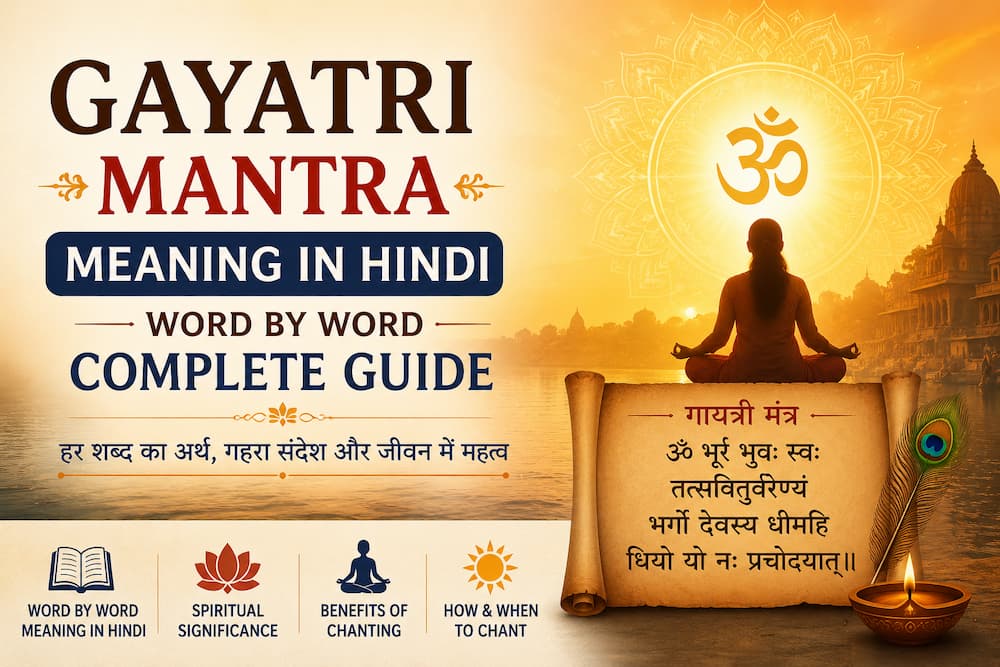
The Complete Gayatri Mantra: Full Text in Devanagari and Roman
Gayatri Mantra: Complete Text
Devanagari:
ॐ भूर्भुवः स्वः
तत्सवितुर्वरेण्यम्
भर्गो देवस्य धीमहि
धियो यो नः प्रचोदयात्॥
Roman transliteration:
Om Bhur Bhuvah Swah
Tat Savitur Varenyam
Bhargo Devasya Dhimahi
Dhiyo Yo Nah Prachodayat
Source: Rigveda 3.62.10 (core verse) + Yajurveda 36.3 (with Mahavyahritis)
Gayatri Mantra Meaning in Hindi: Word by Word
The mantra is traditionally divided into four parts. The table below gives the Hindi meaning (arth) of every single word.
| Word (Shabd) | Hindi Arth (Meaning) | Deeper Significance |
|---|---|---|
| ॐ (Om) | परमात्मा का मूल नाम। सृष्टि का आदि नाद। | The primordial sound from which all creation arises. A (Brahma), U (Vishnu), M (Shiva) united. Not translatable : experienced. |
| भूः (Bhur) | भूलोक : यह पृथ्वी, स्थूल शरीर, भौतिक जगत। | The physical realm. Also the Annamaya Kosha (physical body) of the practitioner. Represents existence (Sat). |
| भुवः (Bhuvah) | भुवर्लोक : वायुमंडल, प्राण, मानसिक जगत। दुःख नाशक। | The mental realm. Also the Pranamaya and Manomaya Kosha. Represents consciousness (Chit). Destroyer of suffering. |
| स्वः (Swah) | स्वर्गलोक : आत्मिक जगत, सुख स्वरूप, आनंद। | The spiritual realm. Also the Vijnanamaya and Anandamaya Kosha. Represents bliss (Ananda). Together Bhur Bhuvah Swah = Sat Chit Ananda. |
| तत् (Tat) | वह : उस परमात्मा का संकेत। जो वाणी और मन से परे है। | “That” : pointing to the Supreme Reality that cannot be named directly. Brahman. Beyond all concepts. |
| सवितुः (Savitur) | सविता देव का : सूर्य के प्रेरणाशक्ति स्वरूप का। | Of Savitr, the divine creative solar energy. Not the visible sun but the intelligence behind the sun. The force that sets all creation in motion. |
| वरेण्यम् (Varenyam) | वरने योग्य : सबसे उत्तम, सर्वश्रेष्ठ, पूजनीय। | Most worthy of being chosen, adored and worshipped. The superlative of excellence : nothing higher exists. |
| भर्गः (Bhargo) | दिव्य तेज : पापनाशक, शुद्ध प्रकाश स्वरूप। | The divine radiance that destroys ignorance and sin. Not ordinary light but the effulgence of pure consciousness. Sri Sathya Sai Baba described Bhargo as “the light that illumines the intellect.” |
| देवस्य (Devasya) | उस देव का : परमेश्वर का, दिव्य सत्ता का। | Of the divine. Devasya establishes the source: this radiance belongs to the Supreme, not to any limited being. |
| धीमहि (Dhimahi) | हम ध्यान करते हैं : हम मनन करते हैं। | We meditate, we contemplate, we absorb. The verb that makes this a meditation, not merely a prayer. First person plural : not I but we. |
| धियः (Dhiyo) | हमारी बुद्धि : विवेक, बोध, निर्णय शक्ति। | Our intellect, understanding and discriminating wisdom. Dhi is specifically the higher reasoning faculty, not ordinary thought. |
| यः (Yo) | जो : वह दिव्य प्रकाश जो। | Who, which. The relative pronoun connecting Savitr to the action of illuminating our intellect. |
| नः (Nah) | हमारी : हम सबकी। | Our. Again plural : this is a collective prayer of humanity, not an individual request. |
| प्रचोदयात् (Prachodayat) | प्रेरित करे : सन्मार्ग पर चलाए, प्रकाशित करे। | May it inspire, illuminate, propel. A benediction verb in the optative mood : expressing a heartfelt wish. The entire mantra builds to this final word: the prayer for divine guidance of the intellect. |
Line-by-Line Hindi Meaning (Arth): The Three Parts of the Mantra
The Gayatri Mantra has three structural parts. Understanding each part separately makes the complete meaning clear.
Part 1: Om Bhur Bhuvah Swah (ॐ भूर्भुवः स्वः)
Hindi arth: हम उस परमात्मा का आवाहन करते हैं जो भूलोक, भुवर्लोक और स्वर्गलोक : तीनों में व्याप्त हैं।
This is the invocation. The three Mahavyahritis represent the three dimensions of existence simultaneously: the physical world (Bhur), the mental-vital world (Bhuvah) and the spiritual world (Swah). Sri Sathya Sai Baba described Gayatri as having five faces and these three words as the second face : representing the five pranas (life forces) in their three expressions.
The important point most translations miss: these three words were not in the original Rigvedic verse. They were added in the Yajurveda Sandhyavandanam tradition. The original mantra from Rigveda 3.62.10 begins directly with Tat Savitur.
Part 2: Tat Savitur Varenyam Bhargo Devasya Dhimahi (तत्सवितुर्वरेण्यम् भर्गो देवस्य धीमहि)
Hindi arth: हम उस सविता देव के श्रेष्ठ दिव्य तेज का ध्यान करते हैं।
This is the meditation. The mantra identifies the object of contemplation precisely: not a vague “God” but specifically the divine radiance (Bhargo) of Savitr (the solar creative intelligence) that is the most worthy of all (Varenyam). The verb Dhimahi : we meditate : is the active component. This part is a statement of what is being done: the practitioner is absorbing, dwelling in, becoming saturated by the divine light of Savitr.
Part 3: Dhiyo Yo Nah Prachodayat (धियो यो नः प्रचोदयात्)
Hindi arth: वह हमारी बुद्धि को सन्मार्ग पर प्रेरित करे।
This is the prayer. Having meditated on the divine radiance, the mantra makes one specific request: illuminate our intellect (Dhi). Not wealth, not health, not protection. The intellect. This is the mantra’s precise purpose: the cultivation of discriminating wisdom (Viveka) that allows a person to distinguish truth from illusion, dharma from adharma, the real from the unreal.
What Makes This the Mother of All Mantras
The Gayatri Mantra is called Vedamata (mother of the Vedas) because in 24 syllables it contains the essence of all Vedic knowledge. Brahma himself is said to have declared in the Vedic texts that there is nothing more purifying in the three worlds than this mantra.
The specific request for illumination of the intellect rather than for any worldly benefit is what places this mantra above all others in the Vedic tradition. Every other blessing follows naturally from a purified and illuminated intellect. The mantra asks for the cause. All other benefits are the effect.
The Hindi Translation That Is Most Accurate
Different teachers have translated the Gayatri Mantra differently in Hindi. Here are the three most commonly cited versions and what distinguishes each:
| Teacher / Source | Hindi Translation | Key emphasis |
|---|---|---|
| Swami Vivekananda | हम उस सर्वशक्तिमान, सर्वव्यापी, भाप्रेरक, पापनाशक, दिव्यस्वरूप की उपासना करते हैं। वह हमारी बुद्धि को प्रेरित करे। | Emphasises the omnipotence of Savitr and the purifying function of Bhargo |
| Pandit Shriram Sharma Acharya (Gayatri Pariwar) | उस प्राणस्वरूप, दुखनाशक, सुखस्वरूप, श्रेष्ठ, तेजस्वी, पापनाशक, देवस्वरूप परमात्मा को हम अपनी अन्तरात्मा में धारण करें। वह परमात्मा हमारी बुद्धि को सन्मार्ग पर चलाये। | Most widely used Hindi translation in India today. Captures the three Mahavyahritis as Prana, Dukhanashak and Sukhaswarup |
| Sri Sathya Sai Baba | हम उस दिव्य प्रकाश का ध्यान करते हैं जो तीनों लोकों में व्याप्त है। वह ज्योति हमारी बुद्धि को प्रकाशित करे। | Simplest and most direct. Focuses on Bhargo as divine light (Jyoti) and Dhiyo as Buddhi. Suitable for daily use. |
For daily practice, Pandit Shriram Sharma Acharya’s translation is the most widely accepted in India. For philosophical study, Swami Vivekananda’s version carries more analytical depth.
How Understanding the Meaning Changes the Practice
Most practitioners chant the Gayatri Mantra as a sequence of sounds. Understanding the Hindi meaning converts it from sound repetition into conscious meditation.
The difference in practice is specific. When you reach Dhimahi (we meditate), you can consciously direct your awareness inward, toward the divine light you have just described in the first two lines. When you reach Prachodayat, you can release a specific intention: may my intellect be guided correctly in this decision, this relationship, this situation I am facing today.
A Practice Shift to Try Tomorrow
For the first 11 repetitions of your next practice, chant slowly enough to hold the Hindi meaning of each word in your mind as you say it. Bhur: I acknowledge my physical existence. Bhuvah: I acknowledge my mental existence. Swah: I acknowledge my spiritual existence. Tat: That supreme reality. Savitur: the creative solar intelligence. Varenyam: most worthy.
The remaining repetitions can return to the full rhythm of 108. But those first 11 will change the quality of everything that follows.
From Our Practice
From Our Practice
I chanted the Gayatri Mantra for four years before I understood what Dhimahi meant. I knew it was “we meditate” but I had not absorbed that the mantra was asking me to do something, not just say something. Dhimahi is a verb. An instruction. We meditate. Present tense. Active.
The day that shifted for me, I stopped saying the mantra and started doing it. The 108 repetitions took longer. The silence afterward was different. What the words meant in Hindi was not information I added on top of the practice. It was the practice.
Frequently Asked Questions
❓ I have been chanting the Gayatri Mantra for years without knowing its meaning. Does that reduce its effectiveness?
No. The vibrational effect of the mantra operates through sound regardless of intellectual understanding. This is documented in the Tantric tradition: the mantra’s power comes from its sound, not from comprehension of its meaning. However, understanding the meaning adds a layer of conscious intention that deepens the practice significantly. Both are valid. Knowing the meaning does not replace the sound. It adds to it.
❓ The translation I found says Bhargo means “sins destroyer” but you say it means “divine radiance.” Which is correct?
Both are accurate from different interpretive traditions. Bhargo (from the root Bhraj : to shine) literally means divine radiance or effulgence. The sin-destroying function is a consequence: just as light destroys darkness, the divine radiance destroys ignorance and its product, which the tradition calls sin (papa). The Sathya Sai Baba translation uses “divine light.” Pandit Shriram Sharma uses “pap nashak” (destroyer of sin). Both are pointing at the same reality from different angles.
❓ Why does the Gayatri Mantra ask only for illumination of the intellect? Why not ask for wealth, health or happiness?
Because in the Vedic understanding, an illuminated intellect is the cause from which all other blessings flow. A person with genuine Viveka (discriminating wisdom) makes correct decisions, lives dharmically, attracts the right conditions and avoids the causes of suffering. The mantra asks for the root. Wealth, health and happiness are branches. You do not need to ask for the branches if you have correctly nourished the root.
❓ What is the difference between Savitr and Surya in the Gayatri Mantra?
Savitr is the creative solar intelligence : the divine force that animates the sun and sets all creation in motion. Surya is the visible sun as it appears after sunrise. The Gayatri Mantra is addressed to Savitr, the intelligence behind the phenomenon, not to the visible phenomenon itself. This is why the mantra is most powerfully chanted before sunrise: at that hour, Savitr’s energy is rising without yet being fully manifest as the visible Surya.
❓ Is Om Bhur Bhuvah Swah part of the original Gayatri Mantra or was it added later?
It was added later. The original Gayatri Mantra from Rigveda 3.62.10 begins with Tat Savitur Varenyam. The three Mahavyahritis (Om Bhur Bhuvah Swah) were prefixed to the verse in the Yajurveda Sandhyavandanam tradition. As noted by academics, “the first line Om Bhur Bhuvah Svah is considered an invocation and is not technically part of the original Gayatri Mantra as it appears in the Upanishads.” The version most people chant today combines both traditions.
❓ Why is Dhimahi (we meditate) plural? Shouldn’t it be “I meditate”?
The plural is deliberate and significant. The Gayatri Mantra is not a personal prayer : it is a universal one. When you chant Dhimahi (we meditate), Nah (our intellect) and Prachodayat (may it guide us), you are chanting on behalf of all of humanity, not only yourself. This is why the tradition holds that chanting the Gayatri Mantra benefits not just the practitioner but all beings in their vicinity. The prayer is collective by design.
Begin With One Line Tomorrow
Before your next practice, write the Hindi meaning of each word on a piece of paper. Place it in front of you while you chant. For the first 11 repetitions, read the meaning of each word as you say it. After that, fold the paper and complete the remaining 97 repetitions in your normal rhythm.
Do this for three days. By the third day you will not need the paper. The meaning will have entered the practice, not as intellectual knowledge but as the living quality of each word as it moves through you.
The mantra has been asking you to illuminate your intellect every morning. Now you know what it has been saying.
Sources and Citations
- Gayatri Mantra: word-by-word meaning in English and Hindi. Mantra.Tips, April 2026. OM through Prachodayat syllable breakdown
- Gayatri Mantra: A Universal Prayer. Sri Sathya Sai International Organization. Five faces of Gayatri, Bhargo as divine light interpretation
- Gayatri Mantra: Hidden Meaning in Each Word. Glimpses of Divinity, March 2024. Mahavyahriti as invocation, not part of original Rigvedic verse
- Gayatri Pariwar. Word-for-word translation. Pandit Shriram Sharma Acharya’s Hindi translation and interpretation
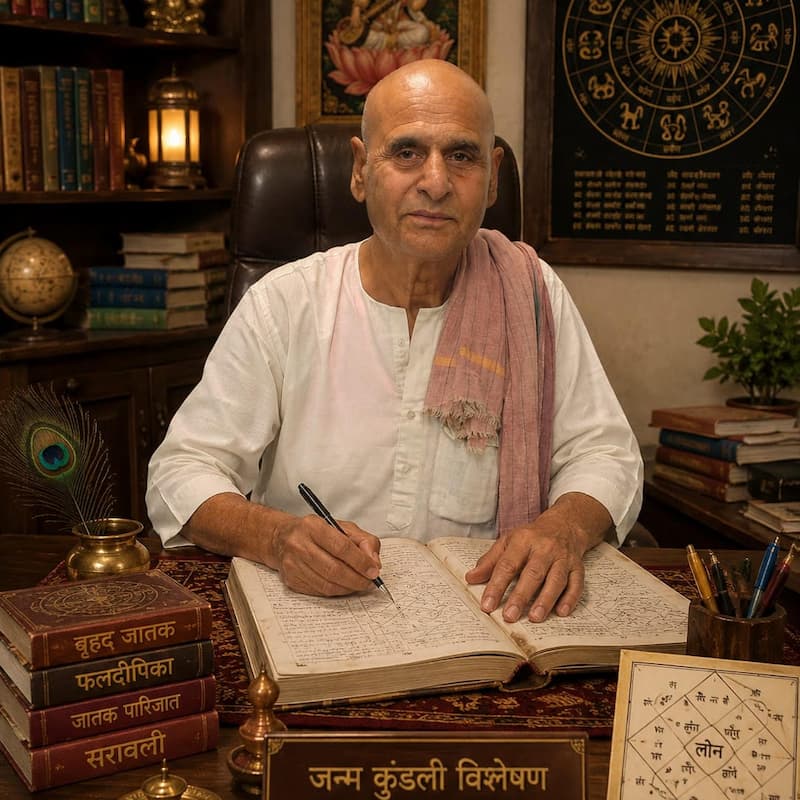
Narendra Kumar Chaubey is a Jyotisha Acharya with over 30 years of experience, based in Bihar and serving clients across India in Vedic astrology, mantra shastra, Vastu and ritual practice.
He completed his formal training at Kameshwar Singh Darbhanga Sanskrit University (KSDSU), one of India’s oldest and most respected institutions for Vedic and Sanskrit scholarship, where he studied Jyotisha shastra, mantra vidya and related classical sciences. KSDSU’s tradition of rigorous Sanskrit education tracing directly to the Mithila region’s centuries-old pandit lineage forms the foundation of his practice.
Over three decades, Narendra Kumar Chaubey has worked with thousands of individuals and families across Bihar and across India, offering guidance in:
- Kundli (birth chart) analysis: Identifying karmic patterns, planetary periods and life path guidance through classical Jyotisha
- Palmistry (Hasta Samudrika): Reading the hand according to the classical Samudrika Shastra tradition
- Vastu Shastra: Assessment and correction of living and working spaces according to directional and elemental principles
- Mantra and Pooja vidhi: Performing and guiding all categories of puja, havan, and mantra sadhana for personal, family and business situations
- Predictive Jyotisha: Transit analysis, muhurta (auspicious timing) selection and remedial guidance
He works across four languages Sanskrit, Hindi, English and Bhojpuri making classical knowledge accessible to practitioners across educational backgrounds and regions.
His writing for ABMantra brings the precision of classical Vedic training to practical mantra guidance: not general advice but specific prescriptions grounded in shastra, lineage and 30 years of direct practice with real situations.
For more info follow on: