
Quick Answer
Three mantras, three specific functions for memory and concentration:
For memory retention and recall:
Hayagriva Mantra : Om Hayagrivaya Namah (the horse-headed avatar of Vishnu, specific deity for memory and retention)
For concentration and focus during study:
Saraswati Beej Mantra : Om Aim Saraswatyai Namah (Aim is the beej of all intelligence and focused attention)
For deep understanding and comprehension:
Dakshinamurthi Mantra : Om Dakshinamurthaye Namah (Shiva as the silent teacher : invoked for understanding what you have memorised)
For all three simultaneously: Chant the Gayatri Mantra 108 times at Brahma Muhurta daily. It is the root mantra for all three functions.
Who This Article Is For
This article is for you if: you study for hours but cannot retain what you read | you understand material during study but forget it in exams | you can memorise facts but cannot understand how they connect | you are preparing for a competitive examination with a large volume of material to retain over a long period.
Also see: Mantra before exam: what to chant on the night before and morning of and Saraswati Mantra: complete meaning and practice guide
Poor memory and poor concentration are two different problems. Most mantra articles treat them as the same and give you one mantra for both. The tradition is more specific. Memory is the capacity to store and retrieve information. Concentration is the capacity to direct attention without distraction. Understanding is the capacity to see how pieces of information relate to each other. Each of these functions has a different deity and a different mantra in the Vedic tradition.
Here is what most mantra for memory articles miss: they recommend the Saraswati mantra for both memory and concentration without distinction. But Saraswati governs knowledge, speech and its expression. The specific deity for memory retention and recall in the Vedic tradition is Hayagriva : the horse-headed avatar of Vishnu, whose specific domain is the capacity to absorb and retain learned material. Chanting a Saraswati mantra when your problem is specifically poor retention rather than poor expression is addressing the wrong deity for the specific problem.
The Three Problems and Their Specific Mantras
| Your specific problem | Deity | Mantra | When to chant |
|---|---|---|---|
| You read but cannot retain. You forget what you studied by the next day. Recall fails under pressure. | Hayagriva | Om Hayagrivaya Namah | Before each study session. Daily 108 times at Brahma Muhurta. |
| You cannot concentrate. Mind wanders. You sit to study but cannot focus for more than 10 minutes. | Saraswati (Aim beej) | Om Aim Saraswatyai Namah | 21 times before each study session. Silently during study breaks. |
| You memorise facts but cannot understand how concepts connect. You recall but cannot apply. | Dakshinamurthi (Shiva as teacher) | Om Dakshinamurthaye Namah | After study sessions. 108 times in the evening. Promotes integration during sleep. |
| All three problems simultaneously. General intellectual weakness. | Gayatri (Savitr) | Gayatri Mantra 108 times | Brahma Muhurta daily. Long-term practice : builds over months. |
Mantra 1: Hayagriva : The Specific Memory Deity
Lord Hayagriva (Haya = horse, Griva = neck) is the horse-headed avatar of Vishnu. He is specifically described in the Vedic texts as the presiding deity of Veda (sacred knowledge), memory and intellectual absorption. His origin story in the Puranas establishes his authority over memory: when the Vedas were stolen from Brahma by the demon Hayasura, it was Hayagriva who recovered them and restored them to Brahma. He is the deity who retrieves lost knowledge. In the student context, he retrieves knowledge that has been learned but cannot be recalled.
Hayagriva Mantra for Memory
Short mantra (daily practice):
Om Hayagrivaya Namah
ॐ हयग्रीवाय नमः
Meaning: Om. Salutations to Hayagriva.
Full Hayagriva Mantra (for deeper practice):
Gyananandam Mayam Devam Nishpapam Shanta Vigraham
Aadhar Sarvam Vidyanam Hayagrivam Upasmahe
ज्ञानानन्दमयं देवं निष्पापं शान्तविग्रहम्।
आधारं सर्वविद्यानां हयग्रीवमुपास्महे॥
Meaning: We worship Hayagriva, the divine one who is made of knowledge and bliss, free from all sin, of peaceful form, the foundation of all learning.
When to chant: The short mantra before every study session. The full mantra once daily after completing the Saraswati Gayatri in the morning. South Indian students chant this specifically before science examinations and it is deeply embedded in that educational tradition.
What the tradition says it does: Chanting the Hayagriva Mantra daily before study sessions helps students absorb information more effectively and boosts ability to recall important details during examinations. The tradition associates Hayagriva specifically with the sharpening of memory and clarity of recall : not general intelligence but the specific mechanics of storage and retrieval.
Mantra 2: Saraswati Beej : For Concentration and Focus
Aim (ऐं) is the beej mantra of Saraswati and by extension the beej of all concentrated intellectual activity. The Tantric understanding of the Aim beej is precise: it is the vibrational seed of Vak (speech and its expression), of Buddhi (the discriminative intellect) and of Smriti (memory in its active recalled form). Chanting it 21 times before a study session creates a focused mental state by activating the Ajna chakra : the centre of focused attention and discriminative intelligence.
Saraswati Beej Mantra for Concentration
Sanskrit: Om Aim Saraswatyai Namah
Devanagari: ॐ ऐं सरस्वत्यै नमः
The concentration protocol:
Sit at your study desk before beginning. Close your eyes. Chant Om Aim Saraswatyai Namah 21 times at a pace of one repetition per breath. Open your eyes and begin studying. The 21-breath sequence takes approximately 3 minutes and creates a measurable shift in the quality of attention available for the following study period.
For chronic distraction: Set a timer for 25-minute focused study blocks. At the end of each block, chant the Aim beej alone (just the syllable Aim) 11 times silently. This resets the attention for the next block. This is the Vedic adaptation of what productivity research calls the Pomodoro technique : a 25-minute focus cycle with a structured reset.
Mantra 3: Dakshinamurthi : For Deep Understanding
Dakshinamurthi is Shiva in his aspect as the supreme teacher who transmits knowledge through silence. His iconography shows him as a young man sitting under a banyan tree, teaching four elderly rishis through silence rather than speech. The lesson: the deepest understanding is not the accumulation of facts but the integration of facts into a coherent understanding that transcends memorisation.
Dakshinamurthi Mantra for Understanding
Short mantra: Om Dakshinamurthaye Namah
Devanagari: ॐ दक्षिणामूर्तये नमः
Dakshinamurthi Dhyana Shloka:
Om Gurur Brahma Gurur Vishnu Gurur Devo Maheshwara
Guru Sakshat Param Brahma Tasmai Sri Gurave Namah
Why after study sessions: Dakshinamurthi promotes the integration of learned material during the rest and sleep period that follows studying. Neuroscience confirms that memory consolidation : the process of moving information from short-term to long-term storage : happens primarily during sleep. The tradition’s prescription to chant the Dakshinamurthi mantra in the evening after studying and before sleep aligns precisely with this mechanism. The mantra does not make you understand during study. It promotes the integration that produces understanding after study.
The Complete Daily Memory and Concentration Schedule
| Time | Practice | Count | Purpose |
|---|---|---|---|
| Brahma Muhurta (before sunrise) | Gayatri Mantra | 108 times | Long-term foundation: develops all three faculties over months of practice |
| Morning, after Gayatri | Hayagriva Mantra (full or short form) | 108 times or once (full mantra) | Daily memory activation for the study day ahead |
| Before each study session | Ganesha Mantra + Saraswati Beej | 11 times Ganesha, 21 times Saraswati Beej | Clearing obstacles, activating focused concentration |
| Every 25-minute study break | Aim beej alone, silently | 11 times | Resetting attention for the next study block |
| Evening, before sleep | Dakshinamurthi Mantra | 108 times | Promoting integration and consolidation of the day’s learning during sleep |
The 21-Day Consistency Rule
The tradition’s standard for establishing a mantra’s effect in the practitioner’s system is 21 consecutive days. For memory and concentration mantras specifically, practitioners typically report the first noticeable shift in their study experience between Day 10 and Day 14. The shift is not dramatic : it is the quality of the study session that changes first: less mind-wandering, easier entry into focused attention, more material retained after one reading rather than requiring multiple repetitions.
Do not assess whether the mantra is working before Day 21. The first two weeks are the establishment phase. Assessment belongs to Day 21 and beyond.
Which Mantra for Which Type of Student
| Student type | Primary mantra | Secondary mantra |
|---|---|---|
| Science and mathematics students (JEE, NEET, engineering) | Hayagriva Mantra daily (he specifically governs scientific knowledge retention) | Saraswati Beej for concentration during problem-solving sessions |
| Humanities and language students (UPSC, BA, MA) | Saraswati Gayatri daily (she governs speech, expression and humanities knowledge) | Dakshinamurthi in the evening for conceptual integration |
| Students with chronic attention issues (cannot sit still) | Saraswati Beej (Om Aim Saraswatyai Namah) as the primary mantra using the 25-minute block protocol | Ganesha Mantra before every session to clear the mental clutter |
| Students preparing for memory-intensive exams (history, law, medicine) | Hayagriva Mantra twice daily: morning and before each study session | Dakshinamurthi in the evening for integration |
From Our Practice
From Our Practice
A mother brought her son to me some years ago. He was in his final year of engineering and facing his end-semester examinations. His problem was specific: he understood his subjects during study : he could follow derivations, understand concepts, solve problems from worked examples. But during examinations, the same material felt unreachable. The concepts he had understood seemed to vanish the moment he was under pressure.
When I looked at his chart, Mercury was placed in the 12th house : the house of dissolution and hidden things. In this position, Mercury makes available what the person knows in quiet, comfortable settings but creates difficulty in accessing it under pressure or in public performance situations. This is a specific pattern I have seen many times.
I prescribed the Hayagriva Mantra 108 times daily before his morning study sessions, the Saraswati Beej 21 times before each study block and the Dakshinamurthi Mantra 108 times before sleep. I also recommended the Mercury mantra (Om Bum Budhaya Namah) on Wednesdays.
He maintained this for 40 days before his examinations. His report after the exams was precise: the material did not feel different during study. What was different was that inside the examination hall, he could access it. The 12th-house Mercury problem : knowledge present but unreachable under pressure : had not been eliminated. But it had been significantly reduced in its effect.
This is what I observe consistently: memory and concentration mantras do not add to what the student has learned. They remove the barriers to accessing it. For this student, 40 days of practice reduced a barrier that had been costing him performance he had genuinely earned through preparation.
Frequently Asked Questions
❓ I have very poor memory. I read something and forget it within an hour. Which mantra should I start with?
Start with the Hayagriva Mantra (Om Hayagrivaya Namah) 108 times daily at Brahma Muhurta. This is the specific mantra for memory retention and recall. Also begin the Gayatri Mantra if you are not already chanting it : the Gayatri develops all intellectual faculties including memory over a longer period. Give the Hayagriva practice 21 days before assessing its effect. Alongside the mantra practice, ensure your study sessions are followed by adequate sleep : sleep is when memory consolidation happens and no mantra overcomes a chronic sleep deficit.
❓ I can remember facts but I cannot understand how subjects connect. My memory is good but my comprehension is weak. Which mantra?
This is a Dakshinamurthi case. Good memory but weak integration of concepts is the specific domain of Dakshinamurthi : Shiva as the teacher who transmits understanding, not information. Chant the Dakshinamurthi Mantra (Om Dakshinamurthaye Namah) 108 times in the evening after studying and before sleep. The tradition prescribes the evening timing specifically because integration of learning into coherent understanding happens during sleep. Continue for 40 days minimum.
❓ Can these mantras help an adult professional, not just students?
Yes. The tradition makes no age restriction on memory and concentration mantras. Working professionals who need sharp memory and focused concentration for complex work : lawyers, doctors, analysts, executives managing large amounts of information : chant the Hayagriva and Saraswati mantras with the same benefit as students. The Aim beej protocol (21 repetitions before each work session, 11 at each break) is particularly practical for professionals who work in 25 to 45 minute focused blocks.
❓ Is there a specific time of day that these mantras work best?
Yes. Brahma Muhurta (approximately 90 minutes before sunrise, typically 4 to 6 AM) is the most effective time for the Gayatri and Hayagriva mantras. The sattvic quality of the atmosphere at this hour : low mental activity in the environment, stillness, pre-sunrise light : creates the optimal condition for intellectual mantras. Before each study session is the second-best timing for the Saraswati Beej. Evening before sleep is optimal for Dakshinamurthi. If Brahma Muhurta is not possible, any early morning quiet period before the day’s activity begins is the next best option.
❓ Do I need to know Sanskrit to benefit from these mantras?
No. Understanding the meaning of the mantra deepens the practice, as this article has explained for each mantra. But the vibrational effect of the sound : the effect on the nervous system of rhythmic, correctly pronounced Sanskrit syllables : operates independently of semantic understanding. Chant with best-effort pronunciation and with the knowledge of what the mantra does that this article provides. That combination of correct sound and informed intention is sufficient for the practice to produce its documented effects.
❓ My child (age 8 to 12) has difficulty concentrating in school. Which mantra can they chant?
The Saraswati Vandana (Saraswati Namastubhyam Varade Kamarupini Vidyarambham Karishyami Siddhir Bhavatu Me Sada) is the traditional mantra prescribed specifically for children before school and before study. Teach them to chant it once before opening their textbooks each day. For older children (10 to 12), the Saraswati Beej (Om Aim Saraswatyai Namah) 21 times before homework is practical and effective. The Gayatri Mantra can begin at the time of the sacred thread ceremony (Upanayana) for boys, or at any time for girls in the personal japa form.
Begin Before Tomorrow’s First Study Session
Tonight: learn the Hayagriva short mantra. Om Hayagrivaya Namah. Say it ten times slowly. That is two minutes.
Tomorrow, before your first study session: chant it 21 times. Then chant Om Aim Saraswatyai Namah 21 times. Then open your books.
Tomorrow evening, before sleep: Om Dakshinamurthaye Namah 21 times.
Do this for 21 days without exception. The tradition promises that the quality of your study experience will shift during this period. Not the volume of your effort : the quality of what each hour of effort produces. That is what these three mantras address: not how hard you study but how much of that effort becomes accessible knowledge when you need it.
Sources
- Best Mantra for Concentration. Mahakatha, January 2024. Neela Saraswati mantra for focus; Dakshinamurthi as cosmic knowledge deity; five mantras for concentration
- Powerful Vedic Mantras and Homas for Academic Success. AstroBhava, October 2024. Hayagriva Mantra sharpens memory and boosts recall; daily chanting before study sessions; Gyananandam Mayam Devam full mantra
- Saraswati Mantra for Wisdom and Super Power Memory. GuruKripa. Aim beej as Saraswati’s seed mantra; Aing (Tantrokt form); mantra enhances concentration and analytical abilities
- Powerful Mantras for Memory and Knowledge. GoLectures. Hayagriva mantra for true knowledge, concentration in studies, fluency in speech and mastery of debates; no special restrictions
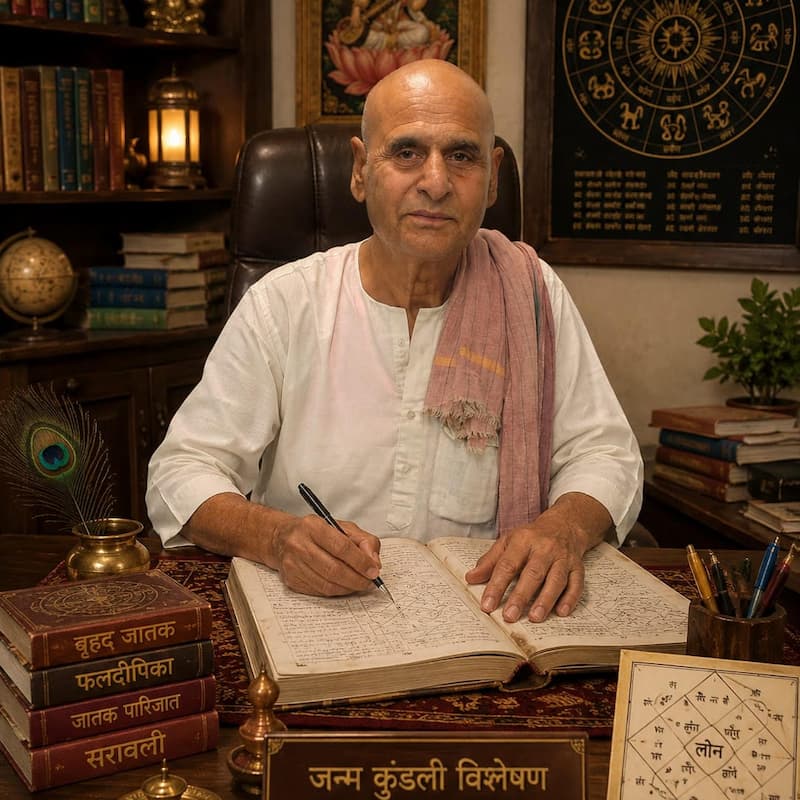
Narendra Kumar Chaubey is a Jyotisha Acharya with over 30 years of experience, based in Bihar and serving clients across India in Vedic astrology, mantra shastra, Vastu and ritual practice.
He completed his formal training at Kameshwar Singh Darbhanga Sanskrit University (KSDSU), one of India’s oldest and most respected institutions for Vedic and Sanskrit scholarship, where he studied Jyotisha shastra, mantra vidya and related classical sciences. KSDSU’s tradition of rigorous Sanskrit education tracing directly to the Mithila region’s centuries-old pandit lineage forms the foundation of his practice.
Over three decades, Narendra Kumar Chaubey has worked with thousands of individuals and families across Bihar and across India, offering guidance in:
- Kundli (birth chart) analysis: Identifying karmic patterns, planetary periods and life path guidance through classical Jyotisha
- Palmistry (Hasta Samudrika): Reading the hand according to the classical Samudrika Shastra tradition
- Vastu Shastra: Assessment and correction of living and working spaces according to directional and elemental principles
- Mantra and Pooja vidhi: Performing and guiding all categories of puja, havan, and mantra sadhana for personal, family and business situations
- Predictive Jyotisha: Transit analysis, muhurta (auspicious timing) selection and remedial guidance
He works across four languages Sanskrit, Hindi, English and Bhojpuri making classical knowledge accessible to practitioners across educational backgrounds and regions.
His writing for ABMantra brings the precision of classical Vedic training to practical mantra guidance: not general advice but specific prescriptions grounded in shastra, lineage and 30 years of direct practice with real situations.
For more info follow on: