
Quick Answer
Mahakal (Mahakala) is Shiva as the lord who transcends and destroys time. The primary mantras:
Mahakal Mool Mantra:
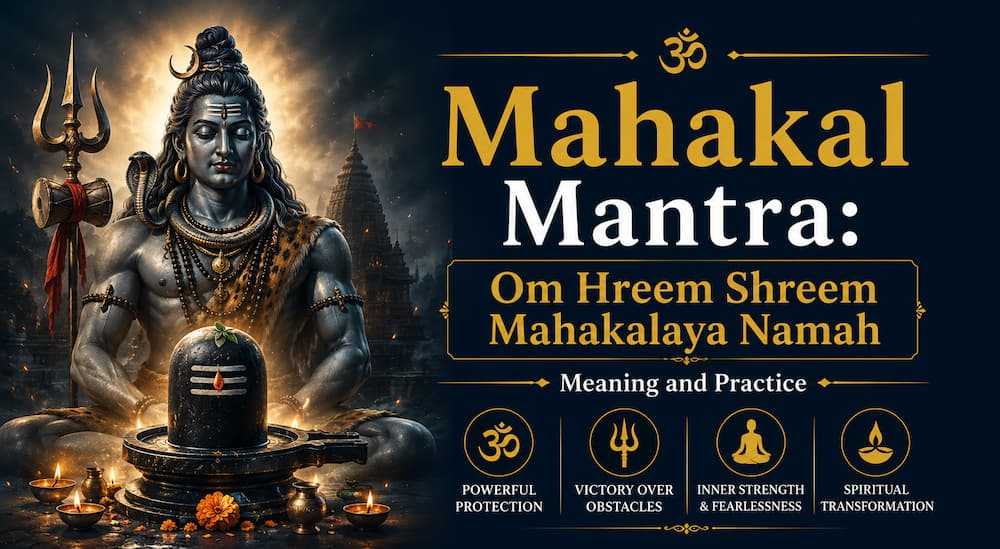
Om Hreem Shreem Mahakalaya Namah
ॐ ह्रीं श्रीं महाकालाय नमः : 108 times daily
For the Ujjain Mahakaleshwar Jyotirlinga specifically:
Om Namah Shivaya Mahakalaya Ujjainishaya Namah
ॐ नमः शिवाय महाकालाय उज्जैनीशाय नमः
Simple daily form: Om Mahakaleshwaraya Namah : 108 times on Mondays
Who This Article Is For
This article is for you if you want to know what Mahakal specifically represents and why he is different from other forms of Shiva | you want the correct Mahakal mantra with meaning | you have visited or want to visit the Mahakaleshwar Jyotirlinga at Ujjain and want to understand the mantra chanted there.
Also see: Rudra Mantra: the Maha Mrityunjaya and complete Shiva practice and Mahamrityunjaya Mantra: complete meaning and chanting guide
Mahakal is the most profound and most intimidating aspect of Shiva. Maha means great. Kala means time. Mahakal is the Great Time : the deity who both governs time and transcends it. Where ordinary Shiva mantras address the divine in his accessible, compassionate form, the Mahakal mantra addresses Shiva in his aspect as the destroyer of all time-bound existence, the one before whom even death dies.
Here is what most Mahakal mantra articles miss: they present Mahakal as simply another Shiva name with a slightly more intense energy. But Mahakal has a precise philosophical position in the tradition. Time (Kala) is the fundamental binding force of material existence : it is what makes birth and death inevitable, what makes all things temporary. Mahakal is the deity who transcends this binding force. Chanting his mantra is not chanting to a fierce Shiva. It is chanting to the quality of consciousness that is not subject to time. This understanding changes everything about how the mantra is approached and what it produces.
Who Is Mahakal
Mahakal appears in the Shaiva Puranas as Shiva’s most transcendent aspect. His primary temple is the Mahakaleshwar Jyotirlinga at Ujjain, Madhya Pradesh : one of the 12 Jyotirlingas (self-manifested Shiva shrines) and the only one facing south, which in the tradition signifies the Lord of the south direction: Yama (death). The deity who faces death’s direction is himself the master of death.
| Shiva aspect | Quality | Primary mantra |
|---|---|---|
| Shiva (auspicious) | The gentle, compassionate, meditative lord. Accessible. Responds to sincere devotion of all types. | Om Namah Shivaya |
| Rudra (fierce) | The storm, disease, destruction and healing. Addresses acute crisis, illness and protection. | Om Tryambakam Yajamahe (Maha Mrityunjaya) |
| Mahakal (lord of time) | The transcender of time and death itself. Beyond the limitations of the temporal world. Invoked for liberation from time-bound suffering, for depth of spiritual practice, for the transcendence that nothing material can provide. | Om Hreem Shreem Mahakalaya Namah |
| Bholenath (the simple-minded) | The easily pleased, the one who grants boons quickly to sincere devotees. The childlike divine who forgets offences immediately. | Om Namah Shivaya with simple devotion |
The Mahakal Mantra: Word by Word
Om Hreem Shreem Mahakalaya Namah
Sanskrit: Om Hreem Shreem Mahakalaya Namah
Devanagari: ॐ ह्रीं श्रीं महाकालाय नमः
Word by word:
Om: primordial invocation
Hreem: the Mahalakshmi beej : power, creative energy, the force that manifests
Shreem: the Lakshmi beej : auspiciousness, abundance. In the Mahakal context, Shreem represents the auspicious outcome of the destroyer’s action: after Mahakal destroys what is time-bound and ego-constructed, Shreem is what remains : the natural abundance of liberated consciousness.
Mahakalaya: to Mahakal (dative case)
Namah: I bow, I surrender
The pairing of Hreem and Shreem: This combination appears often in Shakta mantras. In the Mahakal context it creates a specific pairing: the fierceness and transformative power of the destroyer (Hreem) balanced by the auspicious outcome of destruction (Shreem). Mahakal does not destroy for its own sake. He destroys the time-bound to reveal the timeless. Hreem destroys. Shreem reveals what was always there.
The Ujjain Mahakaleshwar Mantra
Mahakaleshwar Jyotirlinga Mantra
Sanskrit: Om Namah Shivaya Mahakalaya Ujjainishaya Namah
Devanagari: ॐ नमः शिवाय महाकालाय उज्जैनीशाय नमः
Meaning: Salutations to Shiva. Salutations to Mahakal, the lord of Ujjaini (Ujjain).
Ujjaini: Ujjain is one of the seven sacred cities of India (Saptapuri) and was historically the reference point for the Indian prime meridian : the city that marked the centre of time measurement in ancient India. That the Lord of Time has his primary abode at the centre of ancient India’s time system is not coincidence in the tradition’s understanding.
When to use: This mantra is specifically for devotees of the Mahakaleshwar Jyotirlinga and for those who visit Ujjain. It is the mantra chanted during Bhasma Aarti : the famous early morning ritual at Ujjain where Shiva’s form is anointed with sacred ash.
What Mahakal Mantra Practice Produces
The tradition’s description of the Mahakal mantra’s effect is different from other Shiva mantras in a specific way. Most Shiva mantras produce Shiva’s qualities in the practitioner : calm, detachment, strength. The Mahakal mantra specifically works on the practitioner’s relationship with time.
- Fear of death: Mahakal is the deity who has conquered death. His mantra practice specifically addresses the deep, often unconscious fear of one’s own mortality. Practitioners consistently report that sustained Mahakal mantra practice produces a qualitative shift in their relationship with this fear : not the suppression of fear but the genuine recognition of what is deathless within oneself.
- Anxiety about the future: Future-anxiety is fundamentally time-anxiety : the suffering that comes from projecting the mind into a future that has not yet arrived. The Mahakal mantra addresses this by anchoring awareness in the timeless ground of consciousness that Mahakal represents.
- Depth of meditation: Serious meditators find the Mahakal mantra produces a depth of practice that other Shiva mantras do not. This is its traditional function: not protection or healing (Rudra’s domain) or grace and blessing (Shiva’s domain) but the depth of direct experience of that which time cannot touch.
From Our Practice
From Our Practice
I visited the Mahakaleshwar temple at Ujjain for the first time when I was in my twenties, during my years of study at KSDSU. The Bhasma Aarti : the early morning worship with sacred ash that represents the ashes of the cremation ground, Mahakal’s dwelling : is unlike any other puja I have witnessed in 30 years of practice. The Lord is adorned with ash from the cremation grounds. His devotees stand in darkness before sunrise, before time has begun the day, and chant his name into a silence so complete it feels like the silence before creation.
The mantra I prescribe most consistently from this tradition is the simple Om Hreem Shreem Mahakalaya Namah 108 times on Mondays, during the dark hours before sunrise if possible. The prescription is simple. The effect, for those who maintain it sincerely, is profound and different from every other Shiva mantra practice: a growing ease with impermanence, with the passage of what passes, with the ending of what ends. This is Mahakal’s specific gift. He does not take things away. He shows you what was already gone : what only appeared to be permanent : so that your awareness can rest in what genuinely is not subject to time.
Frequently Asked Questions
❓ Is Mahakal the same as Mahakali? I often see both mentioned together.
They are distinct but deeply related. Mahakal is Shiva as the male deity who transcends and governs time. Mahakali is the feminine form of the same principle : the Great Goddess in her time-transcending aspect. In the Shakta tradition, Mahakali is primary. In the Shaiva tradition, Mahakal is primary. In the Tantric tradition, they are understood as the two complementary aspects of the same timeless reality: consciousness (Mahakal/Shiva) and its power (Mahakali/Shakti). Chanting Mahakal mantra and Mahakali mantra together is a complete Tantric practice addressing both dimensions of the time-transcending divine.
❓ I am afraid of death. Will the Mahakal mantra help?
Yes : this is specifically one of its primary functions. Mahakal is the deity who has defeated death. The tradition holds that chanting his mantra consistently shifts the practitioner’s relationship with mortality from avoidance and fear toward the direct recognition of what is deathless in oneself. This is not the removal of the intellectual knowledge of death but the dissolving of the emotional charge around it. For this specific purpose, chant Om Hreem Shreem Mahakalaya Namah 108 times daily, ideally in the hours before sunrise when the quality of awareness is closest to the state Mahakal represents.
❓ Can I chant the Mahakal mantra if I am not a Shiva devotee?
Yes. The Mahakal mantra does not require prior Shiva devotion or initiation. What it does require is a genuine inquiry into what time-transcending consciousness means : at minimum, a genuine desire to work with the aspects of experience that feel permanent but are not, and to find what is genuinely not subject to time. Without this intention, the mantra functions as a general Shiva mantra, which is beneficial. With this intention, it functions at its designed depth.
❓ Should the Mahakal mantra only be chanted at night or cremation grounds?
No. The association of Mahakal with the cremation ground and with darkness is philosophical, not a practical instruction for home practice. Chant at Brahma Muhurta (before sunrise) for the most resonant practice : this liminal time when day has not yet begun corresponds naturally to Mahakal’s quality of the threshold between time and timelessness. Cremation ground practice (Smashan sadhana) is a specific advanced Tantric discipline with its own protocols, not the standard practice for householders.
❓ What is the significance of the Bhasma Aarti at Ujjain?
Bhasma means sacred ash : specifically the ash of the cremation ground in the Shaiva tradition. Shiva smears himself with this ash as a continuous reminder that all things return to ash, all form to formlessness, all time-bound existence to timelessness. The Bhasma Aarti at Mahakaleshwar performs this reminder in ritual form: before sunrise, before the day begins its time, Mahakal is adorned with ash and worshipped in his timeless form. Attending the Bhasma Aarti at Ujjain is considered one of the most powerful transformative practices in the Shaiva tradition. If you visit Ujjain, register for it in advance : seats are limited and allocated by prior registration.
❓ Can women chant the Mahakal mantra?
Yes, without restriction. The Mahakal mantra has no gender restriction in any Shaiva tradition. The Bhasma Aarti at Ujjain is attended by devotees of all genders. The home practice of Om Hreem Shreem Mahakalaya Namah 108 times is equally open to all practitioners.
Begin Before Sunrise
Set your alarm 30 minutes earlier than usual tomorrow. Sit in the dark or in dim light. Do not turn on bright lights. Allow your awareness to settle in the pre-dawn quiet.
Chant Om Hreem Shreem Mahakalaya Namah 108 times. Let each repetition land in silence before the next begins. This is not a race. Mahakal does not hurry. He is time’s master, not its servant.
This pre-dawn practice, maintained for one month, will show you something about consciousness in the liminal hours before day begins. What you discover is the beginning of what Mahakal’s mantra is designed to reveal.
Sources
- Wikipedia : Mahakala: classical description of Mahakal in Shaiva tradition, Puranic sources
- Wikipedia : Mahakaleshwar Jyotirlinga: Ujjain temple, south-facing significance, Bhasma Aarti
- Shiva Purana, Kotirudra Samhita : classical description of Mahakal and the 12 Jyotirlingas (Wisdomlib Shiva Purana database)
- Skanda Purana, Avantya Khanda : Ujjain as the sacred city of Mahakal and its cosmological significance as the ancient Indian meridian centre
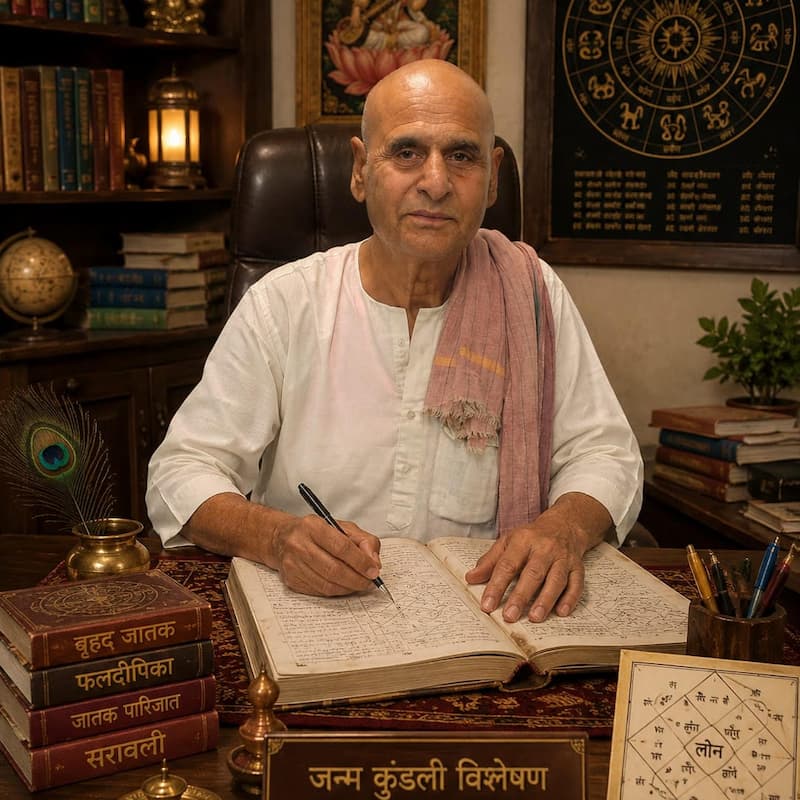
Narendra Kumar Chaubey is a Jyotisha Acharya with over 30 years of experience, based in Bihar and serving clients across India in Vedic astrology, mantra shastra, Vastu and ritual practice.
He completed his formal training at Kameshwar Singh Darbhanga Sanskrit University (KSDSU), one of India’s oldest and most respected institutions for Vedic and Sanskrit scholarship, where he studied Jyotisha shastra, mantra vidya and related classical sciences. KSDSU’s tradition of rigorous Sanskrit education tracing directly to the Mithila region’s centuries-old pandit lineage forms the foundation of his practice.
Over three decades, Narendra Kumar Chaubey has worked with thousands of individuals and families across Bihar and across India, offering guidance in:
- Kundli (birth chart) analysis: Identifying karmic patterns, planetary periods and life path guidance through classical Jyotisha
- Palmistry (Hasta Samudrika): Reading the hand according to the classical Samudrika Shastra tradition
- Vastu Shastra: Assessment and correction of living and working spaces according to directional and elemental principles
- Mantra and Pooja vidhi: Performing and guiding all categories of puja, havan, and mantra sadhana for personal, family and business situations
- Predictive Jyotisha: Transit analysis, muhurta (auspicious timing) selection and remedial guidance
He works across four languages Sanskrit, Hindi, English and Bhojpuri making classical knowledge accessible to practitioners across educational backgrounds and regions.
His writing for ABMantra brings the precision of classical Vedic training to practical mantra guidance: not general advice but specific prescriptions grounded in shastra, lineage and 30 years of direct practice with real situations.
For more info follow on: