
Quick Answer
The Baglamukhi Brahmastra Mantra is the most powerful of all Baglamukhi mantras : used specifically for neutralising enemies, winning court cases and stopping those who are actively causing harm through false speech, dishonest actions or black magic.
Primary Brahmastra Mantra:
Om Hleem Baglamukhi Shatrunam Vaacha Mukham Padam Stambhaya
Jihvam Keelaya Buddhim Vinashaya Hleem Om Swaha
Sanskrit:
ॐ ह्लीं बगलामुखी शत्रूणाम् वाचं मुखं पदं स्तंभय
जिह्वां कीलय बुद्धिं विनाशय ह्लीं ॐ स्वाहा
Method: Tuesday or Saturday evenings. Yellow haldi mala. Facing south. 108 times daily. 11,000 times for a complete Purashcharan.
Who This Article Is For
This article is for you if: you are in a court case or legal dispute and want the specific mantra the tradition prescribes for legal victory | you face active opposition from enemies using false speech, defamation or black magic against you | you already know the Baglamukhi Mula Mantra and want to understand when and how the Brahmastra is used instead | you want the complete lyrics with English meaning.
Important: The Brahmastra Mantra is for genuine self-protection against real harm. The tradition is explicit that using it against someone who is simply disagreeing with you, competing fairly, or exercising their legitimate rights produces karma for the practitioner. Honest self-assessment before beginning is essential.
Also see: Baglamukhi Mula Mantra: complete meaning and practice guide and Mantra for court case: complete legal victory practice
If you are searching for the Baglamukhi Brahmastra Mantra, you are likely in a specific and serious situation: a court case going against you, an enemy using false speech to damage your reputation, a workplace adversary operating through deception, or active black magic directed at you. The Brahmastra Mantra is the tradition’s most concentrated answer to these specific situations. Understanding what it does, how it differs from the standard Baglamukhi Mula Mantra, and the ethical framework within which it is prescribed will make the difference between a practice that produces genuine protection and one that creates further karmic entanglement.
What Is the Baglamukhi Brahmastra Mantra?
Brahmastra literally means the divine weapon named after Brahma : the most powerful weapon in the ancient Indian tradition. In the Mahabharata and Ramayana, the Brahmastra is the weapon that can destroy anything it is aimed at, invoked only in the most extreme situations of war and injustice. The Baglamukhi Brahmastra Mantra takes this name because it is the most complete and most powerful form of Baglamukhi’s mantra : the one that names every specific action she is being asked to perform against the source of harm.
Maa Baglamukhi is the eighth of the ten Mahavidyas (great wisdom goddesses). She is also called:
- Pitambaradevi : the yellow-clad goddess (yellow is her colour and the colour of turmeric, her primary offering)
- Shatrubuddhivinashini : the destroyer of the enemy’s intelligence and strategy
- Brahmastra Roopini : she who is herself the form of the Brahmastra weapon
- Stambhini : the one who immobilises, freezes and stops
Her specific power is Stambhana : the ability to stop, freeze and immobilise. She is the Shakti who halts speech, stops movement, paralyses strategy and freezes the momentum of what is causing harm. This Stambhana power is precisely what the Brahmastra Mantra invokes.
Baglamukhi Brahmastra Mantra at a Glance
| Detail | Information |
|---|---|
| Primary Brahmastra Mantra | Om Hleem Baglamukhi Shatrunam Vaacha Mukham Padam Stambhaya Jihvam Keelaya Buddhim Vinashaya Hleem Om Swaha |
| Sanskrit | ॐ ह्लीं बगलामुखी शत्रूणाम् वाचं मुखं पदं स्तंभय जिह्वां कीलय बुद्धिं विनाशय ह्लीं ॐ स्वाहा |
| Mula Mantra (general protection) | Om Hleem Baglamukhi Sarvadushtatam Vaacha Mukham Padam Stambhaya Jihvam Keelaya Keelaya Buddhim Vinashaya Hleem Om Swaha |
| Deity | Maa Baglamukhi (Pitambaradevi) : eighth of the ten Mahavidyas |
| Primary power | Stambhana : immobilisation of speech, movement and strategy |
| Best day | Tuesday (Mangalvaar) and Saturday (Shanivar) |
| Best time | Evening to night (especially midnight in acute situations) |
| Direction | South (direction of Yama : justice) |
| Mala | Haldi mala (turmeric-rubbed beads) : Baglamukhi’s specific mala |
| Daily count | 108 times (one mala round) |
| Purashcharan count | 11,000 repetitions for complete sadhana. For emergency: 1,008 in one night sitting. |
| Colour | Yellow clothing throughout the practice period |
| Offering | Yellow flowers, turmeric, ghee lamp |
| Companion practice | Jupiter Mantra (Om Brim Brihaspataye Namah) on Thursdays for legal victory |
Maa Baglamukhi Brahmastra Mantra Lyrics: Complete Text with English Meaning
The Primary Brahmastra Mantra
Om Hleem Baglamukhi Shatrunam Vaacha Mukham Padam Stambhaya Jihvam Keelaya Buddhim Vinashaya Hleem Om Swaha
Devanagari:
ॐ ह्लीं बगलामुखी शत्रूणाम् वाचं मुखं पदं स्तंभय
जिह्वां कीलय बुद्धिं विनाशय ह्लीं ॐ स्वाहा
Word by word meaning:
Om: primordial invocation
Hleem: Baglamukhi’s specific beej syllable : the sonic form of her Stambhana power
Baglamukhi: name of the goddess
Shatrunam: of my enemies (genitive plural)
Vaacha: speech : the enemy’s harmful words, false testimony, defamation
Mukham: face and expression : the confidence from which their opposition operates
Padam: steps and movement : their physical and strategic forward momentum
Stambhaya: immobilise, freeze, stop (imperative command)
Jihvam: the tongue : specifically the organ of speech used to harm
Keelaya: pin, nail, fix in place : more targeted and specific than Stambhaya
Buddhim: the intelligence and strategy being directed against you
Vinashaya: destroy, dissolve (this aspect of their functioning, not the person)
Hleem: repetition of the beej : sealing the invocation
Om: returning to the primordial ground
Swaha: I offer this to the fire : the Vedic completion that confirms and releases the intention
Complete meaning: O Baglamukhi : immobilise the speech, face and steps of my enemies; pin their tongue; destroy the intelligence they are directing against me. So be it.
The Full Brahmastra Mala Mantra Lyrics
The complete Brahmastra Mala Mantra (from the Shri Bagalatantra, as cited in the Brahmastra Mala Mantra text) is a much longer invocation used for extreme situations or formal sadhana. The shorter primary mantra above is the version used in daily practice. The full Mala Mantra is as follows:
Shri Bagalatantre Brahmastra Mala Mantra (Full Text)
Sanskrit:
ॐ नमो भगवति चामुण्डे नरकंक गृध्रोलूक परिवार सहिते
श्मशानप्रिये नररुधिरमांस चरु भोजन प्रिये
सिद्ध विद्याधर वृन्द वंदित चरणे
ब्रह्मेश विष्णु वरुण कुबेर भैरवी भैरव प्रिये
इन्द्रक्रोध विनिर्गत शरीरे
द्वादशादित्य चण्डप्रभे
अस्थि मुण्ड कपाल मालाभरणे
शीघ्रं दक्षिण दिशि आगच्छ आगच्छ, मानय मानय, नुद नुद,
सर्व शत्रुणां मारय मारय, चूर्णय चूर्णय,
आवेशय आवेशय, त्रुट त्रुट, त्रोटय त्रोटय,
स्फुट स्फुट, स्फोटय स्फोटय,
महाभूतान् जृम्भय जृम्भय,
ब्रह्मराक्षसान उच्चाटय उच्चाटय,
भूत प्रेत पिशाचान् मूर्च्छय मूर्च्छय,
मम शत्रुन उच्चाटय उच्चाटय, शत्रून चूर्णय चूर्णय,
सत्यं कथय कथय,…
सर्वदुष्टान् विनाशय विनाशय, हुं फट् स्वाहा।
ॐ ह्लीं बगलामुखी ये केचनापकारिणः सन्ति
तेषां वाचं मुखं स्तम्भय स्तम्भय
जिह्वां कीलय कीलय बुद्धिं विनाशय विनाशय
ह्रीं ॐ स्वाहा।
Transliteration:
Om Namo Bhagavati Chamunde Narakank Gridhroluk Parivaar Sahite
Shmashanpriye Narrudhirmans Charu Bhojanpriye
Siddh Vidyadhar Vrind Vandit Charane
Brahmesh Vishnu Varun Kuber Bhairavi Bhairav Priye
Indrakrodh Vinirgit Sharire
Dvaadashaditya Chandprabhe
Asthi Mund Kapaal Maalabharane
Shighrm Dakshin Dishi Agachha Agachha, Manay Manay, Nud Nud,
Sarv Shatrunam Maraya Maraya, Choornay Choornay,
Aaveshay Aaveshay, Trut Trut, Trotay Trotay,
Sphut Sphut, Sphotay Sphotay,
Mahabhootan Jrimbhay Jrimbhay,
Brahmarakshan Uchchatay Uchchatay,
Bhoot Pret Pishachan Moorchchay Moorchchay,
Mam Shatrun Uchchatay Uchchatay, Shatrun Choornay Choornay,
Satyam Kathay Kathay,…
Sarvadushtan Vinashay Vinashay, Hum Phat Swaha.
Om Hleem Baglamukhi Ye Kechanapakarinh Santi
Tesham Vacham Mukham Stambhaya Stambhaya
Jihvam Keelaya Keelaya Buddhim Vinashaya Vinashaya
Hreem Om Swaha.
Maa Baglamukhi Brahmastra Mala Mantra Benefits
The tradition’s documented benefits of the Baglamukhi Brahmastra Mantra, with the specific mechanism behind each:
| Benefit | What it does | Best for |
|---|---|---|
| Victory in court cases | Stambhaya Vaacha (immobilises the opponent’s speech) specifically targets false testimony, misleading arguments and the verbal aggression on which most legal attacks depend. When the opponent’s ability to present their case dishonestly is neutralised, the truth becomes easier to establish. | Civil disputes, criminal cases where false charges have been filed, family property disputes |
| Stopping enemies and opponents | Stambhaya Mukham Padam (freezes face and movement) neutralises the opponent’s confidence and forward momentum : the energy that drives active opposition. The tradition holds that the opponent begins to lose certainty in their own position. | Business competition using dishonest tactics, workplace enemies, political opponents |
| Removal of black magic | The Mala Mantra specifically addresses Bhoot Pret Pishachan (spirits used in black magic) and Brahmarakshasa (powerful negative entities). Baglamukhi’s power of freezing extends to the supernatural forces used against the practitioner. | When symptoms of black magic are present: unexplained illness, persistent misfortune, relationship breakdown without clear cause |
| Protection from defamation | Keelaya Jihvam (pin the tongue) specifically addresses the organ of speech : those who are spreading false information, malicious rumours, or damaging gossip about the practitioner. | Workplace defamation, social media attacks, false accusations in professional contexts |
| Neutralising enemy strategy | Vinashaya Buddhim (destroy the intelligence) specifically dissolves the strategic capacity being directed against the practitioner : the planning, scheming, and tactical thinking behind the opposition. | When an opponent is clearly using organised strategy against you: coordinated attacks, systematic undermining |
| Relief from poverty and misfortune caused by others | The tradition holds that when sustained bad fortune is caused by human or supernatural opposition rather than natural karma, the Brahmastra Mantra addresses the root cause : the opposing force itself : rather than just the symptoms. | Persistent unexplained misfortune, business failure despite correct effort, chronic financial obstruction |
Brahmastra Mantra vs Mula Mantra: The Critical Difference
This distinction is missing from every competitor article, and it is the most important thing to understand before choosing which mantra to use.
| Feature | Mula Mantra | Brahmastra Mantra |
|---|---|---|
| Key Sanskrit word | Sarvadushtatam : against all evil-doers in general | Shatrunam : specifically against identified enemies |
| Scope | General protection from all negative forces | Targeted protection against specific known opponents |
| Intensity | Strong protective energy | Maximum targeted intervention : the tradition’s most intense Stambhana practice |
| Best for | Daily practice, preventive protection, general Baglamukhi sadhana | Active, specific, current opposition causing genuine measurable harm |
| Karma consideration | Lower : general protection is broadly justified | Higher : requires genuine need and honest self-assessment |
| When to choose | Start here. If you are uncertain whether the Brahmastra is warranted, the Mula Mantra is always the right first choice. | Only when the Mula Mantra is insufficient for the specific active threat you are facing |
Understanding the Five Stambhana Actions
The Brahmastra Mantra names five specific actions of Baglamukhi applied to opponents. Understanding each one reveals what the mantra is actually asking for : and what it is not asking for.
| Sanskrit term | Literal meaning | What is being neutralised | What it is NOT asking for |
|---|---|---|---|
| Stambhaya Vaacha | Immobilise the speech | The opponent’s harmful words: false testimony, defamatory statements, misleading arguments in court | Not asking to make the opponent permanently mute or unable to speak at all |
| Stambhaya Mukham | Immobilise the face/expression | The opponent’s ability to project confidence and persuasiveness : the social presentation from which their opposition operates | Not asking for physical harm to the face |
| Stambhaya Padam | Immobilise the steps/movement | The opponent’s ability to proceed with their harmful plans; their physical momentum toward executing what they have planned against you | Not asking for the opponent to become physically paralysed |
| Keelaya Jihvam | Pin/nail the tongue | The organ of speech that is being used specifically against you : false rumours, damaging statements in court or before authority figures | Not permanent silencing; targeted to the specific harmful speech directed at you |
| Vinashaya Buddhim | Destroy the intelligence | The strategic capacity : the specific planning intelligence being used to coordinate the opposition against you. Not the person’s general intelligence but the aspect actively directed at harming you. | Not asking to permanently destroy the opponent’s mental capacity |
The Essential Ethical Boundary: Stambhana vs Maran
The Tantric tradition recognises six types of ritual actions (Shatkarma): Shanti (peace), Vashikarana (drawing under influence), Stambhana (immobilising), Vidveshana (creating discord), Ucchatana (driving away) and Maran (destroying/causing death).
The Brahmastra Mantra belongs firmly in the Stambhana category : neutralising, freezing and stopping harmful actions. It does NOT belong to the Maran category and is NOT a death-causing mantra. The tradition specifically prohibits Maran practices for householder practitioners and clearly separates Stambhana (legitimate self-protection) from Maran (causing harm).
Using the Brahmastra Mantra with the intention of causing death or severe physical harm to an opponent violates the tradition’s ethical boundaries and produces negative karma for the practitioner. The correct intention is: stop the harmful actions being directed at me : not: destroy the person directing them.
Complete Ritual Practice: The Baglamukhi Brahmastra Mantra Mala
What is the Brahmastra Mantra Mala?
The “Mala Mantra” in the context of Baglamukhi specifically refers to the practice of chanting the Brahmastra Mantra on a Haldi mala (mala made with turmeric-rubbed beads). Haldi (turmeric) is Baglamukhi’s specific offering material and the yellow colour of turmeric is her colour. The combination of the mantra chanted on the Haldi mala is the traditional Baglamukhi Brahmastra Mantra Mala practice.
The Complete Tuesday or Saturday Practice
Step-by-Step Brahmastra Mantra Practice
1. Preparation:
Bathe. Wear yellow clothing : yellow is Baglamukhi’s colour throughout the practice period. Light a ghee lamp. Place yellow flowers (marigold or yellow hibiscus) as offering. Prepare the Haldi mala : the mala rubbed with turmeric (haldi) which is Baglamukhi’s primary offering material.
2. Direction and timing:
Face south : the direction of Yama (justice) and the direction from which Baglamukhi is invoked. Evening to midnight is the preferred time. Tuesday and Saturday are the primary practice days for the Brahmastra.
3. Opening:
Ganesha mantra: Om Gam Ganapataye Namah : 11 times. Then Baglamukhi Gayatri: Om Baglamukhyai Vidmahe Stambhinyai Dhimahi Tanno Bagla Prachodayat : 11 times. These openings establish the devotional context before the more intense Brahmastra.
4. Sankalpa (resolution):
State your purpose clearly and honestly: the specific harm being done to you, by whom, and that you are seeking Maa Baglamukhi’s protection to stop it. This Sankalpa is the intention that directs the mantra’s energy.
5. Main practice:
Om Hleem Baglamukhi Shatrunam Vaacha Mukham Padam Stambhaya Jihvam Keelaya Buddhim Vinashaya Hleem Om Swaha : 108 times on the Haldi mala. If the opponent’s name is known, some traditions insert it (Amukhsya : meaning “of that person”) before Vaacha.
6. Closing:
Sit in silence for 5 minutes. Then: Om Baglamukhyai Namah : 21 times. Offer the flowers to flowing water or bury them : do not keep them in the house after the practice.
Duration: For ordinary situations: 108 times daily for 40 days. For court cases or serious opposition: 108 daily plus 1,008 times on each Tuesday during the case. For the complete Purashcharan: 11,000 repetitions.
Situation-Specific Protocols
| Situation | Protocol | Duration |
|---|---|---|
| Active court case | 108 times every morning (facing south). 1,008 times every Tuesday. On the morning of each hearing: 21 times before leaving home, then 3 times silently before entering the courtroom. Combine with Jupiter Mantra (Om Brim Brihaspataye Namah) every Thursday for the dharmic authority of law. | Continue throughout the case. Do not stop between hearings. |
| Workplace defamation | 108 times daily. On Tuesdays: 1,008 times. Also chant Om Aim Hreem Kleem Baglamukhyai Namah 108 times on Fridays for the positive influence that counterbalances the defensive Brahmastra practice. | Minimum 40 days. Continue as long as the active defamation continues. |
| Black magic removal | 108 times daily. On Saturdays: 1,008 times (Saturday intensifies the black magic removal dimension). Combine with Maha Mrityunjaya Mantra 21 times for protection and healing. | 21 days minimum. Repeat if symptoms persist. |
| General enemy neutralisation | 108 times every Tuesday on Haldi mala. This is the maintenance practice for ongoing opposition without a specific acute event. | 40 consecutive Tuesdays. |
| Complete Purashcharan (formal sadhana) | 11,000 repetitions ideally performed with a qualified Tantric teacher or at a Baglamukhi temple (Nalkheda, Datia or Bankhandi). Begin on Tuesday in Krishna Paksha (waning moon) Ashtami or Chaturdashi. Daily ritual: puja, Sankalpa, 108 daily count minimum, Homa (fire offering) at completion. | At 108 per day: approximately 102 days. Can be intensified with more daily rounds. |
Who Is Maa Baglamukhi: The Goddess Behind the Mantra
Maa Baglamukhi’s origin is described in the Swatantra Tantra: in Satyayuga, a massive storm arose that threatened all of creation. Even Lord Vishnu could not stop it. He meditated at the Haridra Sarovar (turmeric lake) in Saurashtra, invoking the supreme goddess Tripurasundari. From her divine radiance appeared Baglamukhi, who immobilised the storm with her specific power of Stambhana. This origin story is encoded in the mantra’s own structure: she who stopped the cosmic storm can stop whatever is threatening your life.
The Haridra Sarovar (turmeric lake) of her origin is why turmeric is her primary offering. The yellow colour throughout the practice : clothing, flowers, offerings : honours this origin story.
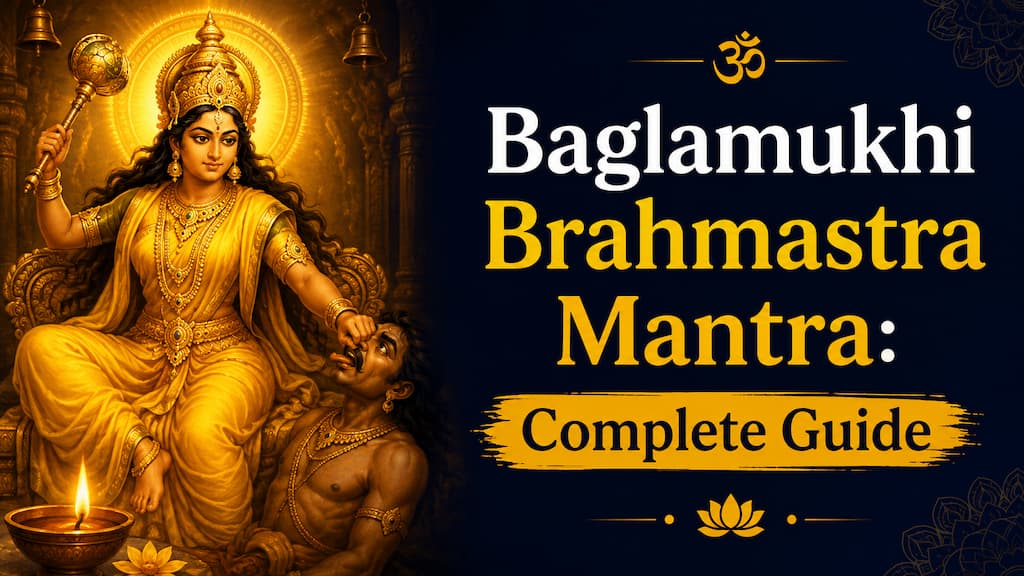
Her iconography is specific: she holds a golden club (mudgara) in one hand and grasps the tongue of a demon with the other hand. The grasped tongue is the visual representation of her Stambhana power over speech : she literally holds the tongue of what would harm and prevents it from moving. This same power is invoked in the Jihvam Keelaya line of the Brahmastra Mantra.
Primary Baglamukhi Temples in India
If you can visit any of these temples during your sadhana, chanting the Brahmastra Mantra 108 times at the temple significantly intensifies the practice:
- Pitambara Peeth, Datia (Madhya Pradesh): The most prominent Baglamukhi temple in North India. Huge number of legal cases are brought here for remedy each year.
- Nalkheda temple, Agar-Malwa (Madhya Pradesh): One of the oldest and most revered Baglamukhi temples.
- Bankhandi temple (Himachal Pradesh): Important Baglamukhi seat in the hill tradition.
- Baglamukhi temple, Kangra (Himachal Pradesh): Part of the cluster of Shakti Peethas in the Kangra valley.
From Our Practice
From Our Practice
Baglamukhi is the Jyotisha practitioner’s most frequently prescribed deity for clients facing legal disputes, false accusations and organised professional opposition. In 30 years of practice, the Brahmastra Mantra specifically is what I prescribe when the situation has moved beyond general protection into active, ongoing, identifiable harm.
The first question I always ask before prescribing the Brahmastra is not “what are they doing to you?” but “what are you doing that may have created this situation?” The Brahmastra Mantra, like Baglamukhi herself, works best when the practitioner is genuinely in the right : when the protection being sought is for genuine truth against genuine falsehood. When the situation is more ambiguous : when both parties have contributed to the conflict : I prescribe the Mula Mantra first and counsel the practitioner to address their own role in the situation honestly before invoking the more intense Brahmastra.
When the conditions genuinely warrant it, the combination I prescribe most consistently is: daily Brahmastra Mantra 108 times, Tuesday 1,008 times with Haldi mala, Jupiter Mantra on Thursdays for the dharmic authority dimension, and the Baglamukhi Gayatri before each practice session. This combination addresses the opposition from all dimensions: the targeted Stambhana of the Brahmastra, the dharmic authority of Jupiter, and the devotional grounding of the Gayatri.
The most important instruction I give to every practitioner of the Brahmastra: after completing your count, sit quietly and ask Baglamukhi to show you what you need to see about the situation. She is not only the goddess who stops enemies. She is the goddess who stops all falsehood : including the falsehoods we tell ourselves about why we are in conflict.
Frequently Asked Questions
❓ Is it ethical to chant the Baglamukhi Brahmastra Mantra against someone?
Yes, when the conditions are genuinely met: the opposition is real, ongoing, dishonest in its means and causing genuine identifiable harm. Self-protection through mantra practice is as ethically justified as self-defence. What the tradition specifically prohibits is using the Brahmastra against: fair competition, legitimate criticism, people who simply disagree with you, or people who have a genuine grievance against you. When in doubt, begin with the Mula Mantra (Sarvadushtatam, not Shatrunam) : it provides strong general protection without the targeted specificity that requires the Brahmastra’s ethical justification.
❓ I have a court case next week. It is too late to do 40 days of practice. What should I do?
For emergency pre-hearing practice: chant the Brahmastra Mantra 108 times every morning from now until the hearing. On Tuesday before the hearing: 1,008 times. On the morning of the hearing: 21 times. Before entering the courtroom: 3 times silently. Also chant Om Aim Baglamukhyai Namah 108 times in the evening. Begin the full 40-day practice immediately after the hearing regardless of outcome : legal cases often have multiple hearings and the sustained practice is more effective than emergency intensity.
❓ What is Hleem and why is it Baglamukhi’s specific beej?
Hleem (ह्लीं) is the unique beej syllable of Maa Baglamukhi : it does not appear in any other deity’s primary mantra. The tradition holds that Hleem specifically encodes the quality of Stambhana : the power to freeze, stop and immobilise. The phonetic structure: H (akasha tattva : the element of space that contains all), L (the movement of the tongue, specifically the organ Baglamukhi governs), and the ee-sound of sustained directed holding. Together, Hleem is both the invocation of Baglamukhi and the sonic encoding of her specific power in a single syllable. When you chant Hleem, you are not simply addressing the goddess by name : you are producing the specific vibration that the tradition holds activates her Stambhana power.
❓ Can women chant the Baglamukhi Brahmastra Mantra?
Yes, without restriction. Maa Baglamukhi is a Mahavidya : a great wisdom goddess. Women chanting her mantra are invoking the divine feminine in its protective aspect. There are no gender restrictions for the Brahmastra Mantra in any classical Tantric tradition. The Haldi mala practice is also open to women without restriction. Regarding practice during menstruation: many women continue the full practice throughout their cycle (consistent with the Kamakhya tradition’s affirmation of menstruation as sacred) while others pause the formal practice and maintain silent mental chanting. Follow your family tradition or personal practice preference.
❓ My workplace enemy is spreading false rumours about me. Is this specifically a Brahmastra situation?
Yes. The first specific action of the Brahmastra : Stambhaya Vaacha (immobilise the speech) : addresses exactly this. False rumours are the opponent’s speech being used to harm you. Begin the Brahmastra Mantra 108 times daily. On Tuesdays: 1,008 times. Address the situation practically simultaneously: document the false statements, address them through HR or management if appropriate, and maintain your own professional conduct with complete integrity. The mantra addresses the energetic and spiritual dimension. The practical professional response addresses the material dimension. Both are needed. Baglamukhi does not reward passive dependence on the mantra alone : she responds to practitioners who are also doing the necessary practical work.
❓ Do I need initiation (diksha) to chant the Baglamukhi Brahmastra Mantra?
For the shorter primary Brahmastra Mantra used in daily practice: the tradition does not require formal initiation for this level of practice. The sincere intention and correct method are the prerequisites. For the full Brahmastra Mala Mantra sadhana (the complete long text with Purashcharan of 11,000 repetitions): the classical Tantric guidance recommends receiving the mantra from a qualified Baglamukhi upasaka (practitioner) who has themselves completed the sadhana. This is because the complete Mala Mantra sadhana is a significant undertaking whose full protocol is best transmitted in person. If a qualified teacher is not available, the shorter primary mantra practiced sincerely with the correct method produces genuine results.
Begin This Tuesday
The next Tuesday evening is your starting point. Obtain a Haldi mala or Rudraksha mala if turmeric mala is not available. Light a ghee lamp. Offer yellow flowers. Face south.
Chant the Ganesha mantra 11 times. Then the Baglamukhi Gayatri 11 times. Then state your Sankalpa clearly and honestly. Then: Om Hleem Baglamukhi Shatrunam Vaacha Mukham Padam Stambhaya Jihvam Keelaya Buddhim Vinashaya Hleem Om Swaha : 108 times. Then 5 minutes of silence.
Return every Tuesday. Maintain 108 times daily in between. The Brahmastra Mantra, practiced with genuine honesty about the need and the situation, with correct method and consistent sincerity, is the tradition’s most specific and concentrated tool for the protection of the righteous against genuine harm.
Maa Baglamukhi does not ask for perfection. She asks for truth. Begin with the truth of your situation and the sincere request for her protection, and the mantra will do the rest.
Sources
- Wikipedia : Bagalamukhi: eighth of the ten Mahavidyas, Stambhana power, Hleem beej, classical depiction with mudgara and demon tongue, Pitambara name
- Shri Bagalatantra : classical Tantric source of the Brahmastra Mala Mantra text; origin story of Baglamukhi from the Haridra Sarovar in Saurashtra
- Shatkarma in the Tantric tradition : Kularnava Tantra and Tantrasara. The six Tantric actions: Shanti, Vashikarana, Stambhana, Vidveshana, Ucchatana and Maran; Stambhana as the appropriate action for practitioner self-protection
- Wikipedia : Mahavidya: the ten great wisdom goddesses; Baglamukhi as Brahmastra Roopini and Shatrubuddhivinashini
Narendra Kumar Chaubey is a Jyotisha Acharya with over 30 years of experience, based in Bihar and serving clients across India in Vedic astrology, mantra shastra, Vastu and ritual practice.
He completed his formal training at Kameshwar Singh Darbhanga Sanskrit University (KSDSU), one of India’s oldest and most respected institutions for Vedic and Sanskrit scholarship, where he studied Jyotisha shastra, mantra vidya and related classical sciences. KSDSU’s tradition of rigorous Sanskrit education — tracing directly to the Mithila region’s centuries-old pandit lineage — forms the foundation of his practice.
Over three decades, Narendra Kumar Chaubey has worked with thousands of individuals and families across Bihar and across India, offering guidance in:
- Kundli (birth chart) analysis — identifying karmic patterns, planetary periods and life path guidance through classical Jyotisha
- Palmistry (Hasta Samudrika) — reading the hand according to the classical Samudrika Shastra tradition
- Vastu Shastra — assessment and correction of living and working spaces according to directional and elemental principles
- Mantra and Pooja vidhi — performing and guiding all categories of puja, havan, and mantra sadhana for personal, family and business situations
- Predictive Jyotisha — transit analysis, muhurta (auspicious timing) selection and remedial guidance
He works across four languages — Sanskrit, Hindi, English and Bhojpuri — making classical knowledge accessible to practitioners across educational backgrounds and regions.
His writing for ABMantra brings the precision of classical Vedic training to practical mantra guidance: not general advice but specific prescriptions grounded in shastra, lineage and 30 years of direct practice with real situations.