
Quick Answer
The primary Rudra mantras:
Shatarudriya Namakam (opening verse chanted daily):
Namaste Rudra Manyava Utota Ishave Namah
Namaste Astu Dhanvane Bahubhyamutatave Namah
(Yajurveda, Krishna Yajurveda Samhita 4.5.1)
Rudra Beej / Maha Mrityunjaya for daily use:
Om Tryambakam Yajamahe Sugandhim Pushtivardhanam
Urvarukamiva Bandhanan Mrityor Mukshiya Maamritat
For Raudra (fierce) situations : protection and removal of disease:
Om Namah Shivaya (the Panchakshara) is the accessible daily equivalent of the full Rudra practice.
Who This Article Is For
This article is for you if you want to understand the difference between Rudra and Shiva and why there are specific Rudra mantras distinct from the Shiva mantras | you want to know the classical source and meaning of the Shatarudriya | you want the complete Rudra practice.
Also see: Om Namah Shivaya: complete meaning and practice and Mahakal Mantra: Shiva in his time-transcending form
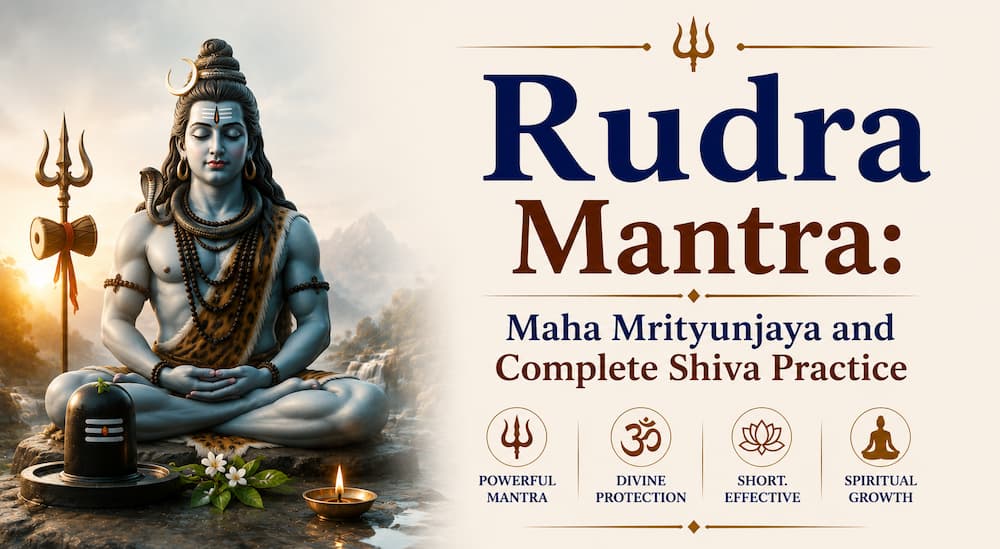
Rudra is the Vedic deity who preceded the later Puranic form of Shiva. Rudra is storm, fever, the howling wind and the terrifying aspect of divine force that simultaneously destroys and heals. Where Shiva is serene, meditative and accessible in his Puranic form, Rudra in the Rigveda and Yajurveda is fierce, unpredictable and awesome : the divine as raw, untamed force.
Here is what most Rudra mantra articles miss: Rudra and Shiva are not simply different names for the same thing. Rudra is the pre-Puranic Vedic form whose relationship to Shiva is one of evolution : Shiva absorbed Rudra’s qualities over centuries of tradition development. The Shatarudriya (the 100 names of Rudra in the Yajurveda) addresses a deity who is simultaneously lord of storms, lord of healing, lord of the forest and lord of medicine. This multi-dimensional quality of Rudra explains why Rudra mantras are specifically prescribed for healing, disease removal and the removal of sudden, violent or unexpected trouble : exactly the situations that storms represent.
The Classical Rudra: Key Texts
The primary Rudra texts are:
- Rigveda Rudra Hymn (RV 1.114): The oldest Vedic prayer to Rudra : asking for his healing herbs, his gentle form (Shiva = auspicious, gentle) and protection from his fierce arrow. This is the source of the name Shiva as an epithet meaning auspicious.
- Shatarudriya / Namakam (Yajurveda, Taittiriya Samhita 4.5): The 100 names of Rudra, chanted to acknowledge his presence in all forms of existence : in the fields, in the crossroads, in the soldiers, in the craftsmen. This is the foundation of the daily Rudra puja.
- Chamakam (Yajurveda, Taittiriya Samhita 4.7): The 100 blessings requested from Rudra after the Namakam is chanted. Together Namakam and Chamakam form Rudrashtadhyayi : the complete Rudra worship liturgy.
The Maha Mrityunjaya: The Most Important Rudra Mantra for Daily Practice
Maha Mrityunjaya Mantra : Rudra’s Healing Mantra
Sanskrit:
Om Tryambakam Yajamahe Sugandhim Pushtivardhanam
Urvarukamiva Bandhanan Mrityor Mukshiya Maamritat
Devanagari:
ॐ त्र्यम्बकं यजामहे सुगन्धिं पुष्टिवर्धनम्।
उर्वारुकमिव बन्धनान् मृत्योर्मुक्षीय मामृतात्॥
Source: Rigveda 7.59.12 : attributed to the seer Vasistha.
Word by word:
Tryambakam: the three-eyed one (Tri = three, Ambaka = eye) : Rudra-Shiva’s third eye representing transcendent perception
Yajamahe: we worship, we offer
Sugandhim: of sweet fragrance : the one who is fragrant with divine qualities
Pushtivardhanam: who increases (vardhana) nourishment and well-being (pushti)
Urvarukamiva: like a cucumber (urvaruka) ripe on the vine
Bandhanan: from the bondage (of disease, of death, of karma)
Mrityor: from death
Mukshiya: may you liberate, may you release
Maamritat: not from immortality : meaning: release me from death but not from liberation (Amrita = nectar of immortality; Maamritat = do not separate me from immortality)
The complete meaning: We worship the three-eyed Rudra who is fragrant and nourishes all beings. May he liberate us from death, as a ripe cucumber is freed from the bondage of its vine : but may he not separate us from immortality.
Practice: 108 times daily for health and protection. 1,008 times during illness or acute danger. Best time: Brahma Muhurta. Rudraksha mala.
The Panchakshara : Daily Accessible Rudra Mantra
Om Namah Shivaya : The Five-Syllable Rudra Mantra
Sanskrit: Om Namah Shivaya
Devanagari: ॐ नमः शिवाय
The five syllables Na Ma Shi Va Ya correspond to the five elements (earth, water, fire, air, space) in their evolved form. Shiva as the ground of the five elements is the cosmic reality that the Panchakshara addresses.
Relationship to Rudra: Shiva (the auspicious, gentle) is Rudra’s own name for his benevolent aspect. When Rudra’s devotees seek the deity’s accessible, compassionate form, they address him as Shiva. Om Namah Shivaya is Rudra addressed in his most approachable form. It contains all of the Shatarudriya’s intention in five syllables.
Practice: 108 times daily. Continuous informal chanting throughout the day. This is one of the few mantras the tradition recommends for continuous chanting in all activities.
Which Rudra Mantra for Which Situation
| Situation | Mantra | Count |
|---|---|---|
| Daily spiritual practice and protection | Om Namah Shivaya | 108 times daily, continuous informal chanting |
| Illness, disease, health crisis | Maha Mrityunjaya Mantra | 108 times daily, 1,008 in acute illness |
| Death of a loved one, grief | Maha Mrityunjaya on behalf of the departed | 1,008 times on the day of death, 108 times daily for 13 days |
| Protection from sudden danger | Om Tryambakam Yajamahe… (Maha Mrityunjaya) | 11 times when danger is sensed |
| Offering a complete Rudra puja | Namakam (Shatarudriya) followed by Chamakam | Full liturgy : requires qualified priest or traditional family practice |
| Spiritual practice for Shiva devotees | Om Namah Shivaya 108 times + Maha Mrityunjaya 108 times | Combined daily practice |
From Our Practice
From Our Practice
The Maha Mrityunjaya Mantra is the one I prescribe most consistently for health situations : my own and my clients’. It is the one mantra that has a clear Vedic source (Rigveda 7.59.12), a specific healing deity (Rudra as lord of healing herbs), a precise intention (liberation from disease and death rather than from immortality) and a clear method (108 times daily on rudraksha mala).
The most moving application I have witnessed was a family who chanted it continuously for 72 hours when their father was in critical condition following a cardiac event. 1,008 times per session, three family members rotating. The father recovered when the medical team had indicated minimal hope. I will not claim the mantra caused the recovery. I will say that the family’s quality of presence during that crisis : the composure, the focus, the absence of the panic that usually accompanies such situations : was directly sustained by the continuous Maha Mrityunjaya practice. And Rudra, as the lord who removes the fear of death even when death is present, was the appropriate deity for exactly that hour.
Frequently Asked Questions
❓ What is the difference between Rudra and Shiva? Are they the same?
They are related but distinct. Rudra is the older Vedic deity : storm god, healer, fierce and terrifying. Shiva is the later Puranic evolution of Rudra, incorporating his fierce qualities while developing the meditative, accessible, compassionate dimension. Shiva literally means auspicious or gentle : it was originally an epithet for Rudra’s benevolent aspect. Over centuries, Shiva absorbed Rudra completely. In practice: Rudra mantras (Shatarudriya, Maha Mrityunjaya) address the fierce, healing, protective dimension. Shiva mantras (Om Namah Shivaya) address the meditative, compassionate dimension. Both names invoke the same deity in different aspects.
❓ Can I chant the Maha Mrityunjaya for someone else’s health?
Yes. Chanting the Maha Mrityunjaya on behalf of a sick family member or loved one is one of the most traditional uses of the mantra. Chant with the clear intention that the benefit of the mantra extends to the named person. Begin with Om (the person’s name) Rupaya Maha Mrityunjaya Mantra Jaap Samarpit : meaning I dedicate this mantra practice to [name]. Then chant 108 times. Do this daily until the person recovers.
❓ Is there a Rudra mantra specifically for removing fear?
The Rudra Gayatri is specifically for this: Om Tatpurushaya Vidmahe Mahadevaya Dhimahi Tanno Rudra Prachodayat. It addresses Rudra in his Tatpurusha (the Supreme Being) aspect : Rudra as the overriding cosmic reality before whom all fears dissolve. Chant 108 times when experiencing persistent or acute fear. The Maha Mrityunjaya is also appropriate as it specifically addresses the root of all fears : the fear of death and loss.
❓ What is the Ekadasha Rudra (11 Rudras)?
The tradition describes 11 forms of Rudra (Ekadasha Rudra), each governing a specific dimension of cosmic function. They are: Kapali, Pingala, Bhima, Virupaksha, Vilohita, Shasta, Ajapada, Ahirbudhanya, Shambhu, Chanda and Bhava. In practice, the Shatarudriya (the 100 names) addresses all 11 forms simultaneously. For daily practice, the Maha Mrityunjaya and Om Namah Shivaya access all 11 Rudras through their single-mantra form.
❓ Can women chant the Maha Mrityunjaya Mantra?
Yes. The Maha Mrityunjaya has no gender restriction in any major Shaiva tradition. Women chant it for their own health, for their family’s health and on behalf of loved ones. The only traditional guidance about women and the formal Shatarudriya (the complete Rudrashtadhyayi liturgy) varies by regional tradition and family custom : for this formal liturgy consult the tradition of your own family or lineage. The Maha Mrityunjaya itself is universally open.
❓ Why is the Rudraksha mala specifically recommended for Rudra mantras?
The Rudraksha bead is the seed of the Elaeocarpus ganitrus tree, and the tradition holds that it was born from Rudra’s tears (Rudra = he who causes to weep, Aksha = eye). The Rudraksha is Rudra’s own substance : using it for his mantra creates a direct material link between the practitioner’s practice and the deity being invoked. Rudraksha beads also have well-documented electromagnetic properties that interact with the body’s own electromagnetic field. Using them for mantra practice is not merely symbolic.
Begin with the Maha Mrityunjaya
If you are new to Rudra practice, begin with the Maha Mrityunjaya Mantra : 108 times on a rudraksha mala every morning. This single mantra gives you access to Rudra’s complete healing and protection function in an accessible daily form.
If you are a devoted Shiva practitioner, add Om Namah Shivaya as a continuous informal practice throughout the day alongside the morning Maha Mrityunjaya. The combination : depth through the Maha Mrityunjaya, continuity through the Panchakshara : is the most complete accessible Rudra practice the tradition prescribes for householders.
Sources
- Rigveda 7.59.12 : Maha Mrityunjaya Mantra classical source (Vasistha’s hymn to Rudra). Tryambakam Yajamahe Sanskrit text.
- Rigveda 1.114 : the Rudra healing hymn; Shiva as Rudra’s benevolent epithet; healing herbs (Bheshaja) as Rudra’s gift. Wisdomlib Rigveda translations
- Yajurveda Taittiriya Samhita 4.5 : Shatarudriya / Namakam (the 100 names of Rudra). Taittiriya Samhita
- Om Namah Shivaya meaning and significance. Skanda Purana : Om Namah Shivaya as the Panchakshara of Shiva
- Maha Mrityunjaya benefits and method. Astrologer.com : 108 times daily, 1008 in illness, Rudraksha mala
- Skanda Purana on Om Namah Shivaya significance. Wisdomlib Skanda Purana : Panchakshara as daily Shiva-Rudra practice
Narendra Kumar Chaubey is a Jyotisha Acharya with over 30 years of experience, based in Bihar and serving clients across India in Vedic astrology, mantra shastra, Vastu and ritual practice.
He completed his formal training at Kameshwar Singh Darbhanga Sanskrit University (KSDSU), one of India’s oldest and most respected institutions for Vedic and Sanskrit scholarship, where he studied Jyotisha shastra, mantra vidya and related classical sciences. KSDSU’s tradition of rigorous Sanskrit education tracing directly to the Mithila region’s centuries-old pandit lineage forms the foundation of his practice.
Over three decades, Narendra Kumar Chaubey has worked with thousands of individuals and families across Bihar and across India, offering guidance in:
- Kundli (birth chart) analysis: Identifying karmic patterns, planetary periods and life path guidance through classical Jyotisha
- Palmistry (Hasta Samudrika): Reading the hand according to the classical Samudrika Shastra tradition
- Vastu Shastra: Assessment and correction of living and working spaces according to directional and elemental principles
- Mantra and Pooja vidhi: Performing and guiding all categories of puja, havan, and mantra sadhana for personal, family and business situations
- Predictive Jyotisha: Transit analysis, muhurta (auspicious timing) selection and remedial guidance
He works across four languages Sanskrit, Hindi, English and Bhojpuri making classical knowledge accessible to practitioners across educational backgrounds and regions.
His writing for ABMantra brings the precision of classical Vedic training to practical mantra guidance: not general advice but specific prescriptions grounded in shastra, lineage and 30 years of direct practice with real situations.
For more info follow on: