
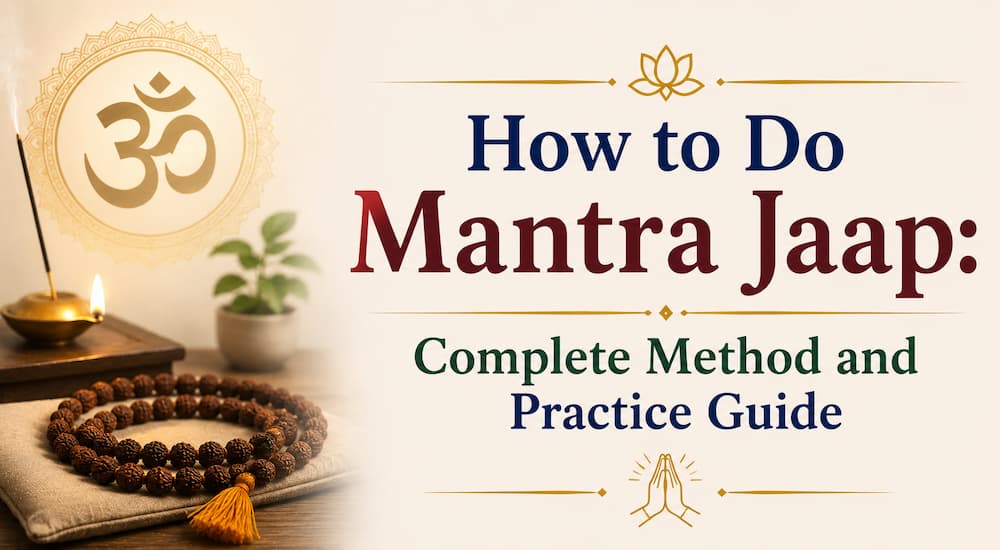

Quick Answer
Mantra Jaap in five steps:
- Choose your mantra : one primary mantra suited to your goal or daily spiritual practice
- Set the count : 108 repetitions (one mala round) is the standard daily practice
- Choose the time : Brahma Muhurta (before sunrise) is ideal; any consistent morning time works
- Sit correctly : spine straight, eyes closed, mala in right hand, counting from the bead next to the Meru (never crossing the Meru)
- Chant with attention : hear each word as you chant it. The practice is hearing the mantra, not merely producing it.
Who This Article Is For
This article is for you if you want to begin a mantra Jaap practice and need the complete method | you have been chanting but are unsure whether you are doing it correctly | you want to understand the difference between Jaap, Kirtan, Puja and other forms of mantra practice.
Also see: How to use a mala: the complete japa bead guide and Gayatri Mantra 108 times: benefits and complete method
Mantra Jaap (also spelled Japa) is the systematic repetition of a mantra a specific number of times : the foundational practice of the Vedic mantra tradition. The word Jaap comes from the Sanskrit Japa, meaning repetition, from the root Jap meaning to mutter or whisper. It is one of the oldest and most universally prescribed spiritual practices in the world, described across the Vedic texts, the Bhagavad Gita, the Yoga Sutras of Patanjali and the Puranas.
Here is what most Jaap guides miss: they give you the steps but not the essential principle. Jaap is not the mechanical production of a sound a specific number of times. The Gita describes Yajna of Japa (Jaap as the highest sacrifice) specifically because Jaap requires the alignment of three things simultaneously: Vak (speech : the sound of the mantra), Manas (mind : attention on the mantra’s meaning) and Prana (the breath that carries the sound). When all three align, Jaap becomes what the tradition calls Siddha Jaap : effective, complete, transformative. When only the tongue moves while the mind is elsewhere, it is called Vyartha Jaap : wasted repetition.
The Three Forms of Jaap
| Form | Sanskrit name | Description | Relative power |
|---|---|---|---|
| Audible, spoken aloud | Vachika Japa | Chanted at normal speaking volume. Best for beginners: pronunciation is easiest to monitor, and external sound helps sustain attention. | Good |
| Whispered | Upamsu Japa | Lips moving but inaudible to others. A more refined practice : the sound is more internal and the breath is more intentionally engaged. | Better |
| Silent, mental | Manasika Japa | The mantra is formed entirely in the mind : no vocal movement. Considered the most powerful form as all the energy goes inward. Difficult for beginners; develops naturally over months of practice. | Best |
Complete Method: Step by Step
Step 1: Preparation
- Bathe before the morning Jaap session. Cleanliness of body supports cleanliness of mind.
- Wear clean, comfortable clothes. Loose-fitting. Natural fibres if possible.
- Sit on a Kusha grass mat or a clean wool blanket. The insulating layer between the practitioner and the earth is traditional across all Indian spiritual practices : it prevents the dissipation of the subtle energy generated by the practice into the ground.
- Choose a dedicated space for your practice if possible. A consistent location builds a sattvic atmosphere over time that supports the practice.
Step 2: Posture
- Sit cross-legged if possible. Sukhasana (simple cross-legged) or Padmasana (lotus). If neither is comfortable, sit in a chair with both feet flat on the floor : the spine must be straight regardless of the sitting position.
- Spine straight. The Sushumna Nadi (the central energy channel of the subtle body) runs along the spine. A straight spine allows the energy generated by the practice to move upward through this channel rather than dissipating.
- Hands resting on the knees or in Jnana Mudra (thumb and index finger touching). The right hand holds the mala.
Step 3: Opening
Before beginning the Jaap count, chant Om three times audibly. This opens the practice by establishing the primordial sound from which all mantras emerge. If you have a specific opening mantra for your tradition (Pancha Tattva mantra for Vaishnava practice, Ganesha mantra for general practice), chant it once.
Step 4: The Jaap
- Begin with the bead next to the Meru bead. Roll it with the thumb and middle finger : the index finger does not touch the mala in most traditions.
- Chant one complete mantra per bead. Move to the next bead after completing the mantra.
- Do not cross the Meru bead. When you reach it, reverse direction and begin the next round in the opposite direction.
- Keep count if you are doing multiple rounds. A dedicated practice of specific round counts (3 rounds, 7 rounds, 16 rounds) is the formal Purashcharan practice.
The Most Important Principle: Hear the Mantra
The single most important instruction in Jaap practice is this: hear each word of the mantra as you chant it. Not produce it : hear it. Direct your attention to the sound of the mantra the moment it leaves your lips (or forms in your mind for mental Jaap). This is what the tradition means by Manana : the act of profound attention that transforms repetition into genuine practice.
When you notice the mind has wandered : that you have been thinking about tomorrow’s meeting or yesterday’s argument while your lips continued the count : this is normal. Simply return your attention to the sound of the mantra. The act of returning is itself the practice. It is the equivalent of the weight-bearing moment in physical exercise. Each return from distraction strengthens the capacity for sustained attention.
Step 5: Closing
After completing the count, sit in silence for 2 to 3 minutes. Do not immediately stand up or begin activity. This post-Jaap silence is when the sattvic field established by the practice settles into the practitioner’s system. Then offer the merit of the practice to all beings: Sarve Bhavantu Sukhinah (May all beings be happy) : three times. This completing prayer prevents the accumulation of spiritual pride and dedicates the practice’s benefit beyond the self.
Common Jaap Mistakes and How to Avoid Them
| Mistake | Effect | Correction |
|---|---|---|
| Rushing to complete the count | Produces Vyartha Japa (wasted repetition) : tongue moves but no alignment of Vak, Manas and Prana | Slow down. One breath per repetition is the natural pace for most mantras. |
| Mind consistently elsewhere | Reduces the practice to mechanical movement without spiritual contact | Start with fewer repetitions done with full attention rather than 108 done mechanically. Build to 108 as attention capacity develops. |
| Inconsistency : chanting on some days and skipping on others | Prevents the cumulative effect from establishing. Resets the practice’s momentum. | One sincere round daily is worth more than 10 rounds on weekends. Daily consistency is the single most important variable. |
| Starting multiple mantras simultaneously | Divides energy and prevents any single mantra from establishing deeply | One primary mantra for at least 40 days before adding a second. The tradition prescribes depth before breadth. |
| Chanting in an unclean state or after eating | The sattvic quality of the practice is reduced | Ideally chant before eating and after bathing. If this is not possible, rinse your face and hands and sit quietly for 2 minutes before beginning. |
How Long Does a Complete Jaap Take
At a natural, steady pace: one full round of 108 repetitions takes approximately 8 to 20 minutes depending on the mantra’s length and the practitioner’s pace. The Gayatri Mantra (24 syllables) at 108 repetitions takes 15 to 20 minutes. Om Namah Shivaya (5 syllables after Om) at 108 repetitions takes 8 to 10 minutes. The Maha Mrityunjaya (32 syllables) at 108 repetitions takes 20 to 25 minutes. Do not rush to fit the Jaap into less time than it takes. The pace is not separate from the practice; it is part of it.
From Our Practice
From Our Practice
When I was a student at KSDSU, my Guru gave us a single instruction for Jaap practice that I have not found improved upon in 30 years: “Do not chant the mantra. Let the mantra chant itself.” What he meant was this: stop trying to produce the mantra and instead create the conditions in which the mantra naturally arises. Correct posture creates one condition. The morning quiet creates another. The clean body and clear intention create a third. When these conditions are in place and you simply turn your attention to the mantra, it arises naturally and with a quality that deliberate effortful chanting never matches.
This is the difference between beginner Jaap and mature Jaap. The beginner works hard to make the mantra happen. The mature practitioner makes the conditions available and allows the mantra to happen. This distinction cannot be fully conveyed in an article : it is discovered through the consistent daily practice that produces it over months and years.
Frequently Asked Questions
❓ How many mantras should I chant per day as a beginner?
Begin with 1 round (108 repetitions) of a single mantra daily. This is the standard prescription for all beginning practitioners across all traditions. It is enough to establish the practice’s effect and sustainable enough to maintain consistently. The tradition’s guidance is clear: one sincere round daily for one year produces more transformation than 10 rounds done occasionally. After 40 days of consistent 1-round practice, add a second round if you want to deepen the practice. Build gradually from there.
❓ Can I do Jaap while walking or commuting?
Yes, with one important distinction. Formal Jaap : the seated, counted, dedicated practice : is different from informal continuous chanting (what is often called Nama Smarana or Ajapa Japa). Walking and commuting are appropriate for informal continuous chanting: repeating your mantra silently with whatever attention is available alongside the activity. This is valid and beneficial. It is not a substitute for the formal seated Jaap session, which is the core practice. Think of it as bonus practice throughout the day alongside the non-negotiable morning session.
❓ I lost count of my repetitions. Should I start over?
Not necessarily. The mala exists precisely to prevent this problem : the physical bead you are on when you lose count tells you where you are. If you genuinely do not know how many you have done, a common practice is to continue for what you estimate is the remaining count. Some traditions say: when in doubt, do extra. Others say: the intention of 108 is more important than the exact count. The most important thing is to continue the practice rather than becoming discouraged by a lost count.
❓ What is a Purashcharan and do I need to do one?
A Purashcharan is a specific prescribed total number of mantra repetitions considered the complete practice for a given mantra : typically equal to 10 times the number of syllables in the mantra multiplied by 1,000. For the Gayatri (24 syllables): 240,000 repetitions, which at 108 per day takes approximately 6 years. For Om Namah Shivaya (5 syllables): 50,000 repetitions. A Purashcharan is the lifetime formal commitment to a mantra, not a requirement for daily practice. You do not need to do a Purashcharan to benefit from daily Jaap. Think of the Purashcharan as the mountain; daily practice is the path up it.
❓ Should the mala touch the ground?
No. Traditional guidance is that the mala should not touch the floor. Keep it on your person or in a mala bag when not in use. When chanting, keep it at chest level or above : traditionally inside a mala bag so only the Meru bead is visible, preventing the mala from touching anything inappropriate. This is respectful treatment of the mala as a sacred object. A mala that has been used in dedicated practice for months or years accumulates the energy of that practice; treating it with care maintains that energetic quality.
❓ Can I chant Jaap after eating?
The traditional guidance is to chant before eating, not after : especially for the primary morning session. After eating, the body’s energy is directed toward digestion (fire energy concentrated in the stomach) which reduces the energy available for the subtle practice of mantra. If the only time you can chant is after a meal, wait at least 30 minutes, wash your hands and face, sit quietly for 2 minutes, and then begin. The practice done with these accommodations is still worthwhile, though the Brahma Muhurta pre-breakfast session remains the gold standard.
Begin Tomorrow Morning
Choose one mantra. Any mantra from this guide that resonates with you : Om Namah Shivaya if you are uncertain, the Gayatri Mantra if you want the foundational Vedic practice. Set an alarm for 20 minutes earlier than you normally wake. Place your mala beside your bed.
When the alarm sounds tomorrow: sit up. Do not check your phone. Sit cross-legged or in a chair with your back straight. Hold your mala. Chant Om three times. Begin the mantra count. 108 beads. When you reach the Meru bead: stop or reverse.
2 minutes of silence. Then begin your day.
Do this tomorrow. And the day after. And every day thereafter. The Bhagavad Gita’s description of Jaap as the highest Yajna (sacrifice) is not philosophical hyperbole. It is the accumulated testimony of thousands of years of practice. The practitioner who discovers what daily Jaap produces through their own sustained experience needs no other authority.
Sources
- Bhagavad Gita 10.25 : “Yajnanam japayajnosmi”: among all sacrifices I am Japa : Krishna’s statement on Jaap as the highest form of spiritual practice
- Wikipedia : Japa: the practice of mantra repetition, its forms and classical significance across Indian traditions
- Yoga Sutras of Patanjali 1.27-28 : Tasya Vacakah Pranavah (Om is the expression of Ishvara); Tajjapas tadartha bhavanam (repetition of Om with its meaning)
- Manusmriti 2.80-86 : on the three forms of Japa and their relative efficacy
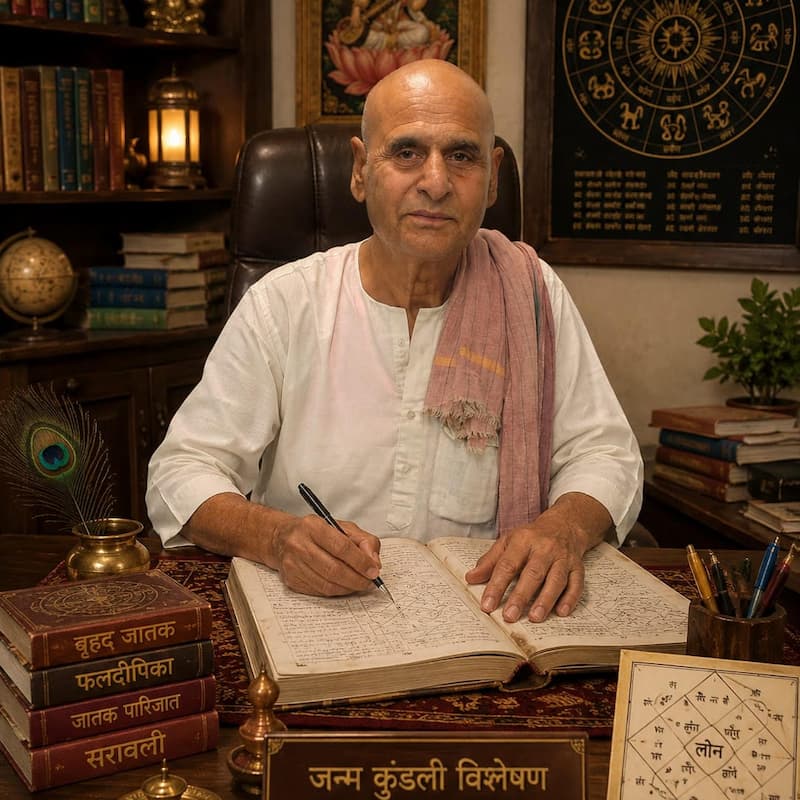
Narendra Kumar Chaubey is a Jyotisha Acharya with over 30 years of experience, based in Bihar and serving clients across India in Vedic astrology, mantra shastra, Vastu and ritual practice.
He completed his formal training at Kameshwar Singh Darbhanga Sanskrit University (KSDSU), one of India’s oldest and most respected institutions for Vedic and Sanskrit scholarship, where he studied Jyotisha shastra, mantra vidya and related classical sciences. KSDSU’s tradition of rigorous Sanskrit education tracing directly to the Mithila region’s centuries-old pandit lineage forms the foundation of his practice.
Over three decades, Narendra Kumar Chaubey has worked with thousands of individuals and families across Bihar and across India, offering guidance in:
- Kundli (birth chart) analysis: Identifying karmic patterns, planetary periods and life path guidance through classical Jyotisha
- Palmistry (Hasta Samudrika): Reading the hand according to the classical Samudrika Shastra tradition
- Vastu Shastra: Assessment and correction of living and working spaces according to directional and elemental principles
- Mantra and Pooja vidhi: Performing and guiding all categories of puja, havan, and mantra sadhana for personal, family and business situations
- Predictive Jyotisha: Transit analysis, muhurta (auspicious timing) selection and remedial guidance
He works across four languages Sanskrit, Hindi, English and Bhojpuri making classical knowledge accessible to practitioners across educational backgrounds and regions.
His writing for ABMantra brings the precision of classical Vedic training to practical mantra guidance: not general advice but specific prescriptions grounded in shastra, lineage and 30 years of direct practice with real situations.
For more info follow on: