
Quick Answer
How to use a mala in 5 steps:
- Hold the mala in the right hand, draped over the middle finger
- Begin with the bead immediately next to the Meru (head bead)
- Use the thumb to roll each bead toward you after each mantra repetition
- Do not use the index finger to touch the mala
- When you reach the Meru bead: stop (if one round is enough) or reverse direction (do not cross the Meru)
One complete round = 108 beads = 108 mantra repetitions.
Who This Article Is For
This article is for you if you have a mala and are unsure how to use it correctly | you want to understand which mala to choose for which mantra or deity | you want to know the traditional rules for mala care, storage and the significance of the 108 beads and the Meru.
Also see: How to do mantra jaap: the complete seated practice guide and Gayatri Mantra 108 times: benefits and daily practice
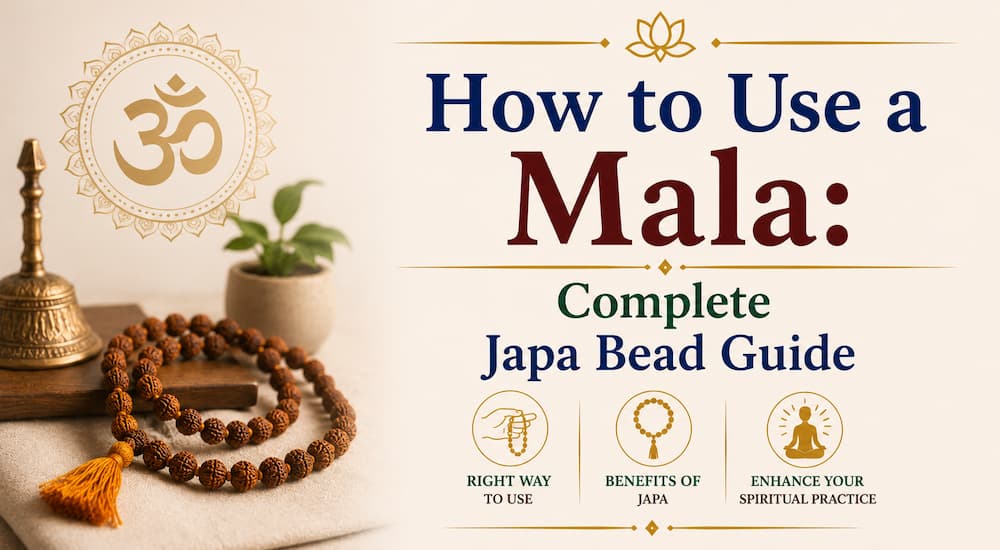
A mala (Sanskrit: mala = garland) is a string of beads used for counting mantra repetitions. It is the oldest and most universal tool of mantra practice in the Indian tradition : predating the rosary by centuries and used continuously from ancient Vedic times to the present day. Understanding how to use it correctly transforms it from a counting tool into an integrated part of the practice itself.
Here is what most mala guides miss: the mala is not merely a counting device. The tradition holds that a mala used consistently for a specific mantra accumulates the energy of that practice over time. A mala used for 1,000 repetitions contains less energetic charge than one used for 100,000. The mala kept in a bag and used with consistency becomes, in the tradition’s understanding, an energetically active object. This is why the traditional rules around mala care : not letting it touch the ground, not lending it, not crossing the Meru : are not arbitrary ritual: they protect the accumulated energy of the practice.
The Anatomy of a Mala
| Part | Sanskrit name | Description and significance |
|---|---|---|
| Main beads | Mani | 108 beads of equal size. 108 is the number of completeness in the Vedic tradition : the ratio of the Sun’s distance to its diameter, the number of Upanishads, the product of the 12 zodiac signs and 9 planets. |
| Head bead | Meru, Sumeru or Bindu | The one larger bead at the junction of the mala. Meru means the cosmic mountain at the centre of the universe. It is the starting and ending point of each round. Never cross the Meru : doing so reverses the energy accumulated in the round. |
| The knots | Granthi | The knots between beads in a traditionally strung mala. Granthi means knot or binding. They prevent the beads from touching each other and give each bead its individual count. Some malas have guru beads instead of simple knots at specific intervals. |
| The thread | Sutra | Sutra means thread in Sanskrit : the same word used for a philosophical aphorism (the thread that holds ideas). The thread of the mala holds the beads of practice together, as a philosophical sutra holds thoughts together. |
Step by Step: How to Use the Mala
The Complete Mala Technique
Hand placement: Hold the mala in the right hand. Drape it over the middle finger (or ring finger in some traditions : both are valid). The thumb is the active finger that rolls the beads. The index finger does not touch the mala : the tradition holds the index finger carries ego energy (it is the pointing finger, the finger of assertion) which is not appropriate for devotional practice.
Starting position: Begin with the bead immediately next to the Meru, not on the Meru itself. The Meru is the pivot point, not a counting bead.
The counting movement: After completing one full mantra, use the thumb to pull the bead toward you (toward the body, not away from it : pulling toward yourself means bringing the mantra’s energy toward you rather than pushing it away). Move to the next bead. Begin the next mantra.
Mala bag: Traditional practice keeps the mala inside a cloth bag (mala bag or gomukhi) with one opening for the hand and a smaller opening for the Meru bead to hang from. The bag keeps the mala from touching inappropriate surfaces and keeps the counting movement private : the tradition values the privacy of dedicated Jaap practice.
The Meru bead: When you reach the Meru bead, you have completed 108 repetitions. If you want to do another round, reverse direction : do not cross the Meru. Simply turn the mala around and begin moving in the other direction from the bead next to the Meru on the other side.
Count of rounds: Count completed rounds on the fingers of your left hand or in a dedicated practice notebook. Note the date, mantra and rounds completed. This record-keeping creates accountability and allows you to track the cumulative count of your practice.
Which Mala for Which Practice
| Mala material | Best for | Note |
|---|---|---|
| Rudraksha (seeds of Elaeocarpus ganitrus) | Shiva mantras, Maha Mrityunjaya, Rudra, general daily practice. The most universally recommended mala for daily practice. | Rudraksha beads have documented electromagnetic properties. The seed’s surface electrodes interact with the skin’s electromagnetic field. This is the most auspicious mala for all protective and Shaiva mantras. |
| Tulasi (Holy basil wood) | Vaishnava mantras: Om Namo Bhagavate Vasudevaya, Hare Krishna Maha Mantra, Om Namah Narayanaya. Sacred to Vishnu specifically. | The most auspicious mala for all Krishna and Vishnu mantras. ISKCON practitioners use Tulasi mala almost exclusively. |
| Sphatika (Clear quartz crystal) | Devi (Goddess) mantras: Gayatri, Saraswati, Lakshmi, Durga. Also for meditation practice generally. | Sphatika is considered cooling and sattvic : reduces heat (pitta) and agitation. The most appropriate mala for Gayatri Mantra practice at Brahma Muhurta. |
| Red coral | Mars mantras (Mangal Beej), Baglamukhi, any Shakta Tantric practice. Also for situations requiring courage and strength. | Coral is associated with Mars and with the Shakta tradition. Not appropriate for Satvic practices. |
| Sandalwood | General purpose, beginners, children. All mantras. | The most widely available and affordable traditional mala. The fragrance of sandalwood supports the sattvic quality of the practice space. Perfectly valid for all practices. |
| Haldi mala (turmeric-rubbed beads) | Baglamukhi Mantra specifically. Yellow is Baglamukhi’s colour. | The most appropriate mala for court case and enemy-related Baglamukhi sadhana. |
Mala Care: The Traditional Rules
- Do not let the mala touch the floor. The ground is considered the lowest energy level in the Vedic understanding of space. A mala that has accumulated practice energy should not be brought into contact with the lowest energy level.
- Do not lend your mala to others. The mala that is dedicated to personal practice accumulates the energy of that specific practitioner’s Jaap. Lending it transfers this energy and reduces its effectiveness for your own practice.
- Keep it in a mala bag. Protect it from contact with inappropriate objects and from public view. Privacy in practice is a value the tradition consistently prescribes.
- Clean it periodically. Rudraksha malas can be wiped with a clean damp cloth. Crystal malas can be placed in morning sunlight for a few hours to cleanse accumulated energy. Wooden malas can be oiled lightly with sandalwood or sesame oil to prevent cracking.
- What to do when a mala breaks. A mala that breaks during practice is not an omen. The beads should be collected and the mala restrung if possible. Some traditions prescribe that a broken mala should be replaced with a new one and the broken beads offered to a river. Do not be distressed by a broken mala.
From Our Practice
From Our Practice
The Rudraksha mala I use for my daily Maha Mrityunjaya and Gayatri practice is the same one my Guru gave me when I completed my studies at KSDSU : more than 25 years ago. It has been through thousands of rounds of Jaap in those years. It is kept in a small silk bag. It has not touched the floor in all that time, as far as I can recall.
The quality of this mala is difficult to describe without sounding hyperbolic. It has a weight and a presence in the hand that malas I have used for shorter periods do not have. Students who handle it during teaching sessions frequently report noticing this : a settled, grounded quality in the beads themselves.
I mention this not as a claim about the supernatural properties of beads but as a report of what consistent practitioners across all traditions observe: a mala used daily for years with sincere practice is a different object from a mala used occasionally. The tradition’s understanding of why this is so may or may not be literally true. But the observable fact is consistent and my own experience over 25 years of using this mala confirms it without ambiguity.
Treat your mala as if it were a gift from your practice. Because it is.
Frequently Asked Questions
❓ Why is the index finger not supposed to touch the mala?
The tradition holds that the index finger carries the energy of the ego and assertion : it is the pointing finger, used to indicate, direct and command. In Vedic mudra (gesture) science, the index finger is associated with the individual self (Jiva) and its tendency to assert itself as separate from the divine. Using it to count the mala would introduce this assertive ego energy into the devotional practice. The thumb, middle finger and ring finger are considered more appropriate because they carry the energies of divine fire, consciousness and surrender respectively. This is the tradition’s explanation : the practical effect of following it is a different quality of attention in the hand.
❓ Why does the mala have 108 beads and not 100?
108 is one of the most sacred numbers in the Vedic tradition for multiple converging reasons: it is the ratio of the distance between the Earth and Sun to the Sun’s diameter (approximately 108); the product of the 12 zodiac signs and the 9 planets (12 x 9 = 108); the count of the Upanishads in the classical enumeration; the number of marma (vital energy) points in the body; and the number of names in the primary Sahasranama (thousand-name) texts in shorter versions. The number 100 has no comparable resonance in the tradition’s cosmological understanding. 108 is completeness; 100 is merely round.
❓ Can I use the same mala for different mantras?
Technically yes, but the tradition recommends dedicating one mala to one primary mantra for serious sadhana. A mala that accumulates the energy of a specific mantra over hundreds of sessions develops a resonance with that mantra’s deity and quality. Using the same mala for completely different mantras mixes these energies. For daily practitioners: one Rudraksha mala for Shiva mantras, one Tulasi mala for Vaishnava mantras. If you have only one mala, use it for your primary mantra and introduce other mantras without the mala (counting on fingers or mentally).
❓ My mala broke. Is it a bad omen?
No. A mala breaking is not considered an omen of anything negative. It typically means the string has weakened through regular use, which is itself evidence of a consistent practice : something to be pleased about rather than concerned. Some traditions interpret a mala breaking as the mala having “absorbed” a negative energy that was directed at the practitioner : the breaking is the mala doing its protective job. Collect the beads, have them restrung if possible, or replace the mala. Offer the broken mala’s beads to a river or sacred fire as an act of completion.
❓ Can I wear my mala as a necklace?
Yes. Wearing the mala as a necklace is a valid practice across many Indian traditions, particularly for Rudraksha malas (Shiva devotees wear Rudraksha mala continuously as a sign of Shiva’s protection) and Tulasi malas (Vaishnava devotees wear Tulasi mala continuously as a sign of devotion to Vishnu-Krishna). A mala worn continuously becomes a protection and a constant reminder of the mantra practice. The practical guideline: remove it when bathing if the material might be damaged by water (check with the supplier), and do not take it to funerals or impure places without keeping it protected in a bag.
❓ How do I know which hand to use the mala in?
The right hand is the traditional hand for mala practice across virtually all Indian traditions. The right hand is the auspicious hand : the hand for giving, offering, eating and sacred action in Indian culture. Left-handed practitioners use the left hand without any tradition issue. The energy direction is what matters: pull each bead toward the body (toward yourself, representing bringing the mantra’s grace inward) rather than pushing away. This direction is consistent regardless of which hand you use.
Choose Your Mala and Begin
If you do not have a mala, a sandalwood mala is a good beginning choice : widely available, affordable, suitable for all mantras and traditions. Once you have a consistent daily practice with a specific mantra, you can acquire the specific mala most appropriate for that mantra’s tradition.
If you already have a mala, pick it up now. Find the Meru bead. Place the mala over your middle finger. Begin with the bead next to the Meru. Chant your mantra once. Roll the bead with your thumb toward you. Move to the next bead. This is the practice. Simple. Ancient. Available to you now.
Sources
- Wikipedia : Japamala: the japa mala, its history, 108-bead significance and use across Indian traditions
- Wikipedia : Rudraksha: Rudraksha bead properties, Shiva Purana references and electromagnetic research
- Wikipedia : 108 (number): the significance of 108 in Hindu, Buddhist and Vedic traditions
- Shiva Purana, Vidyeshwara Samhita : on Rudraksha mala, its significance and the rules of proper use in Shaiva practice
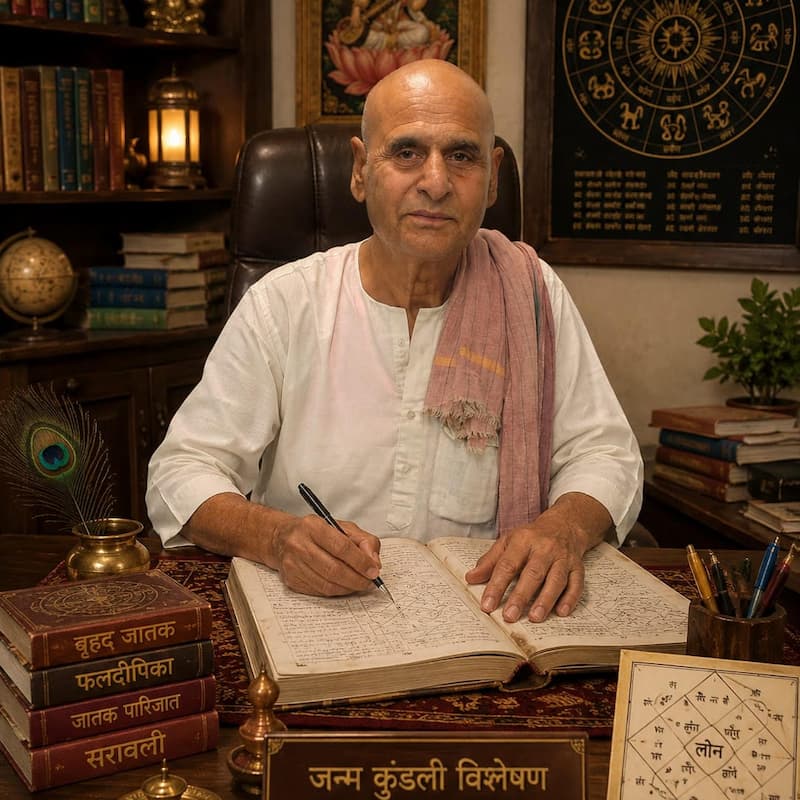
Narendra Kumar Chaubey is a Jyotisha Acharya with over 30 years of experience, based in Bihar and serving clients across India in Vedic astrology, mantra shastra, Vastu and ritual practice.
He completed his formal training at Kameshwar Singh Darbhanga Sanskrit University (KSDSU), one of India’s oldest and most respected institutions for Vedic and Sanskrit scholarship, where he studied Jyotisha shastra, mantra vidya and related classical sciences. KSDSU’s tradition of rigorous Sanskrit education tracing directly to the Mithila region’s centuries-old pandit lineage forms the foundation of his practice.
Over three decades, Narendra Kumar Chaubey has worked with thousands of individuals and families across Bihar and across India, offering guidance in:
- Kundli (birth chart) analysis: Identifying karmic patterns, planetary periods and life path guidance through classical Jyotisha
- Palmistry (Hasta Samudrika): Reading the hand according to the classical Samudrika Shastra tradition
- Vastu Shastra: Assessment and correction of living and working spaces according to directional and elemental principles
- Mantra and Pooja vidhi: Performing and guiding all categories of puja, havan, and mantra sadhana for personal, family and business situations
- Predictive Jyotisha: Transit analysis, muhurta (auspicious timing) selection and remedial guidance
He works across four languages Sanskrit, Hindi, English and Bhojpuri making classical knowledge accessible to practitioners across educational backgrounds and regions.
His writing for ABMantra brings the precision of classical Vedic training to practical mantra guidance: not general advice but specific prescriptions grounded in shastra, lineage and 30 years of direct practice with real situations.
For more info follow on: