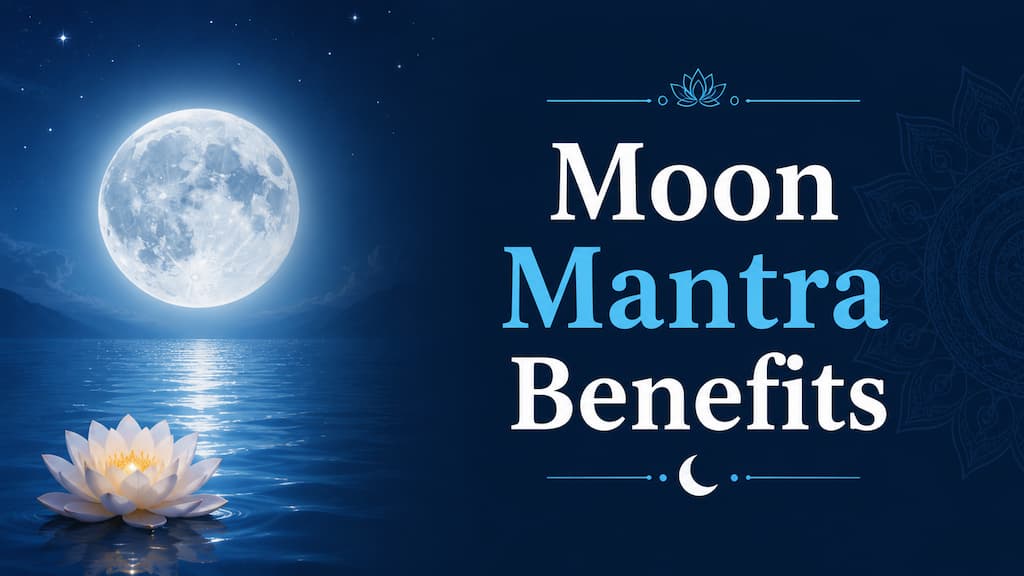

The moon mantra benefits begin with a simple recognition: your mind will not stop. The anxiety at 3am, the emotional swings that arrive without clear cause, the mood that shifts with the weather, the relationship sensitivities that feel disproportionate – these are Moon problems. In Vedic astrology, the Moon (Chandra) governs Manas – the emotional, receiving, relational mind. When it is well-placed and strong, the mind is steady, intuitive, nourishing and clear. When it is weak or afflicted, the mind becomes restless, fearful, hypersensitive and unable to find peace. The moon mantra benefits described in this guide work by directly strengthening this emotional mind – addressing the source of mental disturbance rather than its symptoms.
What Moon Mantra Practice Does: Benefits at a Glance
| Benefit | Which mantra most directly | Timeline |
|---|---|---|
| Mental peace and reduction of anxiety | Om Som Somaya Namah – the Soma (nourishing nectar) quality of the Moon directly addresses Manas restlessness | First shift: 7 to 14 days. Full stabilisation: 40 days. |
| Emotional stability and reduced mood swings | Chandra Beej Mantra (Om Shraam Shreem Shraum Sah Chandramase Namah) – the three beej syllables address the waxing, full and waning phases of emotional experience | 21 to 40 days of daily practice |
| Improved memory and concentration | Chandra Gayatri Mantra – specifically asks Chandra to illuminate and guide the Dhi (higher intelligence) | 40 days minimum |
| Better sleep quality | Om Som Somaya Namah – 21 times before sleep directly calms the Manas before the sleep state | Immediate to 7 days |
| Nurturing relationships and maternal harmony | Any Chandra mantra – Moon is Matrukaraka (significator of mother) and governs all nurturing bonds | 40 days |
| Remedy for weak or afflicted Moon in birth chart | Chandra Beej Mantra – the primary astrological remedy for Chandra-related chart issues | Ongoing – especially during Moon Mahadasha |
| Creativity and intuition | Chandra Beej Mantra and Dhyana Shloka – Moon governs the receptive, non-linear, creative intelligence | 40 days |
| Beauty, radiance and skin health | Moon governs bodily fluids and physical radiance – chanting on Purnima (full moon) amplifies this specifically | One full lunar cycle (30 days) |
Who Is Chandra Dev: The Moon in the Vedic Tradition
Chandra (the Moon) is one of the nine Navagrahas – the nine planetary deities of Vedic astrology. He is also the king of all plants (Oshadhipati – lord of herbs), lord of the tides, lord of the mind, and the carrier of Soma – the divine nectar that nourishes all living beings. He rides a silver chariot drawn by ten white horses across the night sky, and his twenty-seven wives are the twenty-seven Nakshatras (lunar mansions) – each night he visits one wife as he moves through the sky.
His birth is described in the Puranas as arising from the churning of the cosmic ocean (Samudra Manthan) – where he emerged along with Lakshmi, Dhanvantari and the divine nectar (Amrita). This origin explains why Moon mantras specifically address the nourishing, grace-giving, bliss-producing dimensions of life. Chandra carries the same Amrita (nectar of immortality) that emerged from that churning – and he distributes it through his rays to all beings each night.
His classical iconography: white-complexioned, dressed in white, holding a club and a lotus, seated on a white lotus or on his silver chariot. The crescent moon on Shiva’s head is specifically Chandra – Shiva wears the Moon as a crown to cool the fire of his cosmic consciousness.
What Moon Governs: Manas Explained
Most articles say “the Moon governs the mind.” This is correct but incomplete. Vedic psychology identifies four aspects of the inner instrument (Antahkarana) – and the Moon governs specifically one of them:
| Aspect | Sanskrit | Planet | What it does |
|---|---|---|---|
| Manas | मनस् | Moon | The receiving, sensing, emotional mind. Processes sensory input, experiences emotions, relates to others, fluctuates with experience. The mind that feels. |
| Buddhi | बुद्धि | Mercury | The discriminating intelligence. Analyses, calculates, communicates, decides. The mind that thinks. |
| Chitta | चित्त | Moon (deeper) | The stored impressions – deep memory, conditioning, the subconscious reservoir of past experience. |
| Ahamkara | अहंकार | Sun | The ego – the sense of individual identity, the “I” that claims ownership of experience. |
The Moon governs Manas – which means Moon afflictions produce emotional, relational and subconscious problems (not intellectual ones – those are Mercury’s domain). This is the key diagnostic distinction: if the difficulty is in thinking clearly, Mercury needs attention. If the difficulty is in feeling stable, relating to others, sleeping peacefully and managing emotional life – the Moon needs attention. Chandra mantra benefits work precisely because they address the Manas – the emotional receptive mind – directly.
All Four Moon Mantras: Complete Guide
Mantra 1: Chandra Beej Mantra – Primary Astrological Remedy
The three beej syllables explained – what no competitor article covers:
Shraam (श्रां): The initiating beej of Chandra’s energy. Shr = the consonant cluster that encodes the Moon’s shining quality (Shri = radiance, the same root as Lakshmi’s beej Shreem). The long Aa-sound of beginning and opening. This syllable corresponds to the waxing Moon – the energy of beginning, initiating, planting. Chanting Shraam invokes Chandra’s waxing quality: the beginning of emotional cycles, new relationships, new creative projects, the opening of the heart’s receptivity.
Shreem (श्रीं): The sustaining, nourishing, full beej. This is also Lakshmi’s primary beej – the sound of grace, abundance, beauty and fulfilled nourishment. In the context of the Chandra mantra, Shreem corresponds to the full Moon – maximum radiance, maximum emotional fullness, maximum creative and intuitive energy. Chanting Shreem invokes Chandra’s full-Moon quality: abundance, grace, beauty, emotional completeness and the blossoming of all that Shraam initiated.
Shraum (श्रौं): The completing, releasing beej. The au-diphthong carries the quality of culmination and graceful release. This corresponds to the waning Moon – the energy of completion, letting go, releasing what has been fulfilled, the transition from fullness back to receptivity. Chanting Shraum invokes Chandra’s releasing quality: the healthy dissolution of emotional patterns that have run their course, the graceful ending of cycles.
Think of Shraam, Shreem and Shraum as the heartbeat of your emotional life – beginning, fullness, release. The mantra chants your inner lunar rhythm back into balance.
Sah (सः): The identifying seal – connecting the three beej sounds specifically to Chandra.
Chandramase (चन्द्रमसे): To the Moon (dative case). Chandramas = the Moon, literally “the bearer of the nectar of bliss” (Chandra = shining, gladdening; Masa = that which is measured – the Moon measures time through its phases).
Namah: I bow, I surrender to this energy.
Complete meaning: Through the three-phase energy of Chandra (waxing/Shraam, full/Shreem, waning/Shraum), I bow to the Moon – the bearer of the nectar of bliss.
When to chant: 108 times daily. Monday mornings (Brahma Muhurta). Purnima (full moon): 1,008 times ideally. During Moon Mahadasha: daily without exception.
Mantra 2: Om Som Somaya Namah – The Daily Accessible Mantra
Word by word:
Som (सों): The beej sound of Soma – the Moon’s specific identity as the nourishing nectar-bearer. Soma in the Rigveda is both a divine plant whose pressed juice was consumed in sacred rituals and the Moon itself as the source of divine nourishment. Som encodes this nourishing, nectar-giving quality directly.
Somaya: To Soma – to the Moon as the divine nourisher, the source of emotional and physical sustenance.
Namah: I bow.
Why this mantra is uniquely powerful for emotional healing: The Soma quality is specifically the quality of being nourished – being fed at the deepest level. When the Manas (emotional mind) is suffering, what it needs most is not stimulation or analysis but nourishment. Om Som Somaya Namah directly invokes the Moon’s nourishing quality – the divine Soma that feeds the emotional mind the way water feeds a plant. This is why it specifically helps with loneliness, emotional depletion, the feeling of not being loved or cared for, and the 3am anxiety that arises when the emotional body has been running on empty.
When to chant: Before sleep (21 times minimum – immediately calms the Manas before the sleep state). Monday mornings 108 times. Whenever anxiety arises – even 3 times silently in the moment of distress.
Mantra 3: Chandra Dhyana Shloka – Meditation Verse
नमामि शशिनं भक्त्या शम्भोर्मुकुटभूषणम्।।
Namami Shashinam Bhaktya Shambhor Mukuta Bhushanam
Meaning: I bow with devotion to the Moon (Shashinam) – white as curds (Dadhi), white as a conch shell (Shankha), white as snow (Tushara), born from the ocean of milk (Kshirodarnava Sambhavam), who serves as the crown ornament (Mukuta Bhushanam) of Lord Shiva (Shambhu).
How to use this: Chant once at the beginning of any Moon practice as the meditation verse – establishing the visual image of Chandra Dev before the main Japa begins. Visualise the Moon as a radiant white figure, seated on a white lotus, cool and luminous as moonlight itself. The description of his whiteness is the dhyana (meditation image) – pure, cool, nourishing, luminous.
Mantra 4: Chandra Gayatri Mantra
तन्नो चन्द्रः प्रचोदयात्।।
Tanno Chandrah Prachodayat
Meaning: We know (Vidmahe) Kshiraputra – the son of the milk ocean (Chandra, who arose from the churning of the Kshirasagara). We meditate (Dhimahi) on Amritatva – the principle of immortal nectar and bliss that Chandra carries. May that Chandra illuminate and guide (Prachodayat) our intellect (Tanno).
Key words: Kshiraputra = son of the milk ocean – the specific Puranic identity of the Moon. Amritatva = the quality of Amrita – deathlessness, the nectar that sustains life. The Gayatri asks specifically that the Moon’s Amrita quality illuminate the practitioner’s intelligence – the cooling, nourishing, life-sustaining nectar quality applied to the mind.
When to chant: 11 times on Monday mornings as the opening practice. Students specifically benefit from the Gayatri’s illumination of the Dhi – the higher intelligence.
Moon Mantra Benefits: The Mechanism Behind Each
Mental Peace and Anxiety Relief
The Soma quality invoked in Om Som Somaya Namah is the direct antidote to Vata-excess anxiety – the restless, ungrounded, non-stop mental activity that the Ayurvedic tradition connects to a depleted Moon in the chart. When the Moon is weakened (by debilitation, eclipse, or being overwhelmed by malefic planets), the Manas loses its natural cooling, settling quality and becomes restless. The mantra reintroduces the Soma – the nourishing nectar – into the practitioner’s energy field through vibrational resonance with Chandra’s own quality. The result is not sedation but genuine grounding of the emotional mind.
Emotional Stability and Reduced Mood Swings
The Chandra Beej Mantra’s three-syllable sequence (Shraam/Shreem/Shraum) works specifically on emotional cyclicality. The Moon’s nature is cyclical – it waxes and wanes in a 30-day rhythm that mirrors the natural rhythm of human emotional life. When the Moon is afflicted, this natural cycle becomes distorted: the practitioner swings between emotional extremes without the natural settling that the waning phase should bring. The Beej Mantra, by encoding all three phases (Shraam/Shreem/Shraum), reintroduces the complete lunar rhythm into the practitioner’s emotional life – restoring the natural cadence of feeling, processing and releasing.
The 15 Chandra Kalas and Why Purnima Is Most Potent
The Moon has 15 Kalas – 15 aspects or energies that correspond to the 15 tithis (lunar days) of each fortnight. On Amavasya (new moon), only 1 Kala is present – the Moon is at its least radiant. On Purnima (full moon), all 15 Kalas are simultaneously present – the Moon is at its most complete. This is why Moon mantra practice on Purnima is considered 15 times more potent than the same practice on any other day: all 15 aspects of Chandra’s energy are available simultaneously. The tradition prescribes 1,008 repetitions of the Chandra Beej Mantra on Purnima specifically for this reason.
Weak Moon vs Afflicted Moon: Different Problems, Different Practice
| Condition | Signs in life | What the mantra does | Primary prescription |
|---|---|---|---|
| Weak Moon (low Shadbala, waning phase, in enemy signs – Capricorn, Scorpio) |
Lack of emotional self-confidence, difficulty nurturing oneself or others, poor memory, pale or dull complexion, disturbed sleep, feeling emotionally empty or depleted | Strengthens Chandra’s positive qualities – builds the capacity for genuine emotional nourishment and self-sustaining stability | Chandra Beej Mantra 108 times daily. Monday fast (white foods only). White pearl (Moti) after chart assessment. |
| Afflicted Moon – Visha Yoga (Moon conjunct Saturn) |
Chronic depression, emotional heaviness, feeling unsupported, difficulty experiencing joy, sadness that arrives without clear cause, heavy emotional burden | The nourishing Soma quality counterbalances Saturn’s drying, contracting influence on the Moon – reintroducing lightness and emotional warmth where Saturn has created coldness and constriction | Om Som Somaya Namah 108 times before sleep. Saturday: Maha Mrityunjaya Mantra 108 times alongside Chandra Mantra. Monday morning Chandra Beej 108 times. |
| Afflicted Moon – Shakata Yoga (Moon conjunct Rahu) |
Anxiety and irrational fears, emotional confusion, difficulty distinguishing genuine feeling from illusion, obsessive patterns around relationships or security, restless mind that cannot settle | Chandra’s grounding, settling, nourishing quality provides the stable emotional ground that Rahu’s disturbing influence removes. The mantra helps the practitioner distinguish genuine feeling (Manas) from Rahu-generated mental noise | Chandra Beej Mantra 108 daily. Saturday-Sunday: Rahu Beej Mantra alongside. Eclipse periods: 1,008 Chandra mantras. |
| Moon Mahadasha (10-year Vimshottari period) |
All Moon themes become dominant: home and family situations activate, mother’s health becomes a focus, emotional sensitivity increases, creative and intuitive capacities peak (if Moon is well-placed) or emotional difficulties intensify (if afflicted) | During Moon Mahadasha, the Chandra Beej Mantra functions as the primary Mahadasha harmoniser – aligning the practitioner with their Moon’s most positive qualities and reducing the intensity of its challenging ones | 108 times daily without exception throughout the Mahadasha. Purnima: 1,008 times. Monday fast throughout the Mahadasha period. |
Complete Monday and Purnima Practice
Best time: Monday (Soma-vara – the Moon’s day) in Brahma Muhurta (before sunrise). Purnima evening – ideally outdoors where moonlight falls directly on you while chanting.
Offerings for Chandra: White flowers (white jasmine, white lotus, or white roses – Chandra’s colour is white throughout). Milk – offer a small amount of milk before the Moon’s image before chanting. White sandalwood paste (Safed Chandan). Rice – Chandra’s grain. Silver vessel if available (Chandra’s metal is silver).
Monday practice:
- Brahma Muhurta or sunrise. Bathe. White clothing.
- Chant the Dhyana Shloka once: Dadhishankhatusharabham Kshirodarnava Sambhavam…
- Om Som Somaya Namah – 11 times as the opening.
- Chandra Beej Mantra – 108 times on white crystal or silver mala.
- Chandra Gayatri – 11 times as the closing.
- Offer milk and white flowers. Sit in silence for 3 minutes.
- Monday donation: rice, white cloth, or silver to those in need – Chandra’s specific Monday charity.
Purnima practice:
- After moonrise. If possible: sit outdoors in moonlight.
- Dhyana Shloka once.
- Chandra Beej Mantra – 1,008 times (10 mala rounds). At minimum: 108 times.
- Offer milk directly to the moonlight – the traditional Chandra Arghya: hold a copper or silver vessel of milk up toward the moon and offer it while chanting Om Som Somaya Namah.
- The Purnima Arghya (water or milk offering to the Moon) is the most important single practice in the entire Chandra mantra tradition. It is the direct, physical offering to Chandra as he shines at his most complete.
From Our Practice
In 30 years of Jyotisha practice, the Moon is the planet whose affliction I see most frequently in clients who come with what they describe as “I don’t know what is wrong – I just don’t feel right.” This is the characteristic presentation of a Manas problem: not a specific external situation causing the difficulty, but a quality of inner life that has become depleted, restless or heavy. The Chandra Mantra is the first prescription in these cases – before any other remedy.
The specific observation I make consistently is this: the Om Som Somaya Namah mantra chanted 21 times before sleep produces the fastest experiential response of any mantra in my practice. Most practitioners report noticeable improvement in sleep quality and in the quality of waking – specifically the emotional tone of the first few minutes after waking – within 7 days of consistent practice. This matters because the first emotional state of the morning is the Moon’s specific territory. A well-functioning Manas wakes with natural equanimity. A depleted or afflicted Manas wakes already anxious, already burdened. The mantra, practiced at sleep, works through the sleep state on the Chitta – the deeper storehouse of impressions – and the morning quality shifts as a result.
For Visha Yoga clients (Moon-Saturn) specifically: the Chandra Mantra alone is never sufficient. Saturn’s contracting influence on the Moon requires its own attention. The combination I prescribe consistently is: Om Som Somaya Namah 21 times before sleep every night, Chandra Beej Mantra 108 times on Monday mornings, and Maha Mrityunjaya Mantra 108 times on Saturday evenings. The three together address the Moon’s nourishment (Somaya Namah), the Moon’s strengthening (Beej), and Saturn’s specific contribution to the Moon’s distress (Mrityunjaya, which is the primary Shiva mantra for Saturn’s most severe expressions).
Frequently Asked Questions
- Wikipedia – Chandra: the Moon deity in Hindu astrology, Soma as the divine nectar, the 27 Nakshatras as Chandra’s wives, his emergence from the Samudra Manthan, iconography and classical names
- Wikipedia – Navagraha: the Moon’s role in Vedic astrology as Manas-karaka (significator of the mind), Monday as Soma-vara, the Moon’s exaltation in Taurus and debilitation in Scorpio
- Brihat Parashara Hora Shastra – the Moon as Manah-karaka (significator of the emotional mind); Visha Yoga (Moon-Saturn conjunction); Shakata Yoga (Moon-Rahu); Moon Mahadasha duration (10 years in Vimshottari system); Pearl as Moon’s gemstone
- Rigveda – Soma as both the divine nectar pressed from a sacred plant in Vedic ritual and the Moon as the cosmic distributor of divine nourishment (Amrita); the 15 Chandra Kalas corresponding to the 15 lunar tithis
Navagraha Mantra: meaning and benefits of all 9 planet mantras
Adityaya Somaya Mangalaya: the collective Navagraha mantra – Somaya is the Moon
Maha Mrityunjaya Mantra meaning, benefits and how to chant correctly
Janmashtami Puja Vidhi and Mantra: complete Krishna Janmashtami worship guide
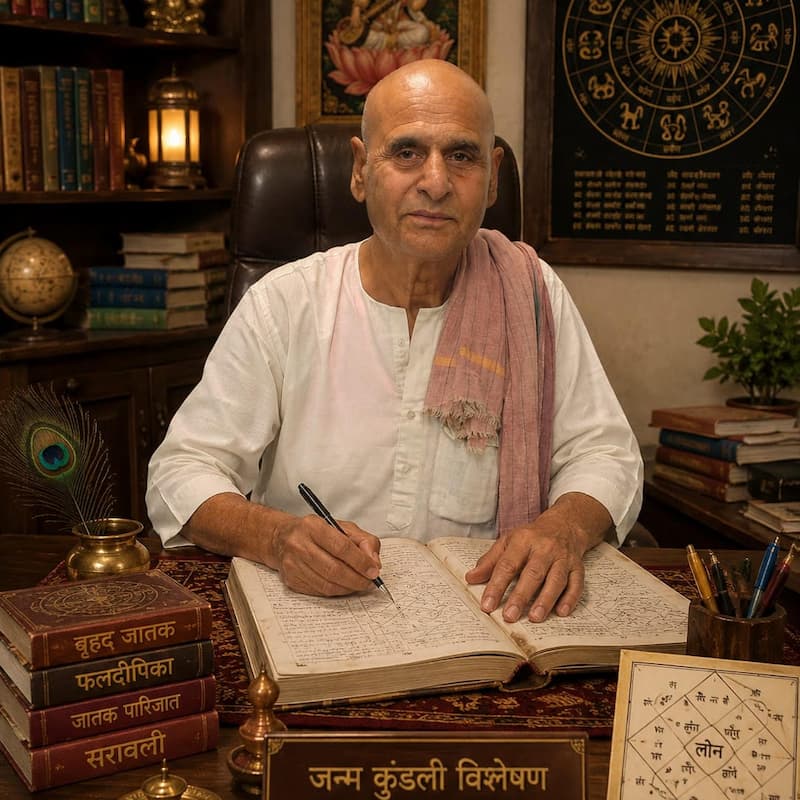
Narendra Kumar Chaubey is a Jyotisha Acharya with over 30 years of experience, based in Bihar and serving clients across India in Vedic astrology, mantra shastra, Vastu and ritual practice.
He completed his formal training at Kameshwar Singh Darbhanga Sanskrit University (KSDSU), one of India’s oldest and most respected institutions for Vedic and Sanskrit scholarship, where he studied Jyotisha shastra, mantra vidya and related classical sciences. KSDSU’s tradition of rigorous Sanskrit education tracing directly to the Mithila region’s centuries-old pandit lineage forms the foundation of his practice.
Over three decades, Narendra Kumar Chaubey has worked with thousands of individuals and families across Bihar and across India, offering guidance in:
- Kundli (birth chart) analysis: Identifying karmic patterns, planetary periods and life path guidance through classical Jyotisha
- Palmistry (Hasta Samudrika): Reading the hand according to the classical Samudrika Shastra tradition
- Vastu Shastra: Assessment and correction of living and working spaces according to directional and elemental principles
- Mantra and Pooja vidhi: Performing and guiding all categories of puja, havan, and mantra sadhana for personal, family and business situations
- Predictive Jyotisha: Transit analysis, muhurta (auspicious timing) selection and remedial guidance
He works across four languages Sanskrit, Hindi, English and Bhojpuri making classical knowledge accessible to practitioners across educational backgrounds and regions.
His writing for ABMantra brings the precision of classical Vedic training to practical mantra guidance: not general advice but specific prescriptions grounded in shastra, lineage and 30 years of direct practice with real situations.
For more info follow on: