


Every Tuesday and Saturday morning, an estimated 50 million people walk to a Hanuman temple before sunrise. No announcement organised this. No institution coordinates it. It happens because the tradition works and the tradition is specific: Tuesday for Mars, Saturday for Saturn, and Hanuman as the bridge between the two most demanding planets in the Vedic sky.
The reason these two days matter is not arbitrary custom. It is Jyotish Vedic astrology. Each day of the week is ruled by a specific planet. Tuesday is ruled by Mars (Mangal). Saturday is ruled by Saturn (Shani). Both planets can create serious difficulties when afflicted in a birth chart. And Hanuman has a direct, specific relationship with both not as a general protector but through precise mythological events that created obligations between him and these planetary forces.
This guide covers the Jyotish reason each day matters, the specific story behind the Hanuman-Saturn relationship, the full puja sequence for Tuesday morning and Saturday morning separately, what mantras to chant and in what order, and which planetary difficulties each day’s practice specifically addresses. If you have been chanting on Tuesday and Saturday without knowing why, this article will change the quality of that practice.
For all Hanuman Mantras with Sanskrit, meaning and full chanting guides, see: Hanuman Mantra Meaning, Types, Benefits and How to Chant.
Why Tuesday Is the Primary Day for Hanuman Mantra
Three facts converge on Tuesday to make it Hanuman’s primary day biographical, planetary and theological.
1. Lord Hanuman Was Born on a Tuesday
Lord Hanuman was born on the full moon day of the Hindu month of Chaitra which tradition records as a Tuesday. This is why Hanuman Jayanti, his birthday, always falls on the Chaitra Purnima. The day of the week carries the energy of its ruling planet from sunrise to sunrise. Being born under Tuesday means Hanuman carries the qualities of Mars from birth: courage, vitality, determination, the warrior quality that cuts through obstacles without hesitation.
Source: Hanuman’s birth on Chaitra Purnima is consistent across Valmiki Ramayana (birth narrative), regional temple traditions and the Hanuman Jayanti date calculation in the Hindu calendar.
2. Tuesday Is Ruled by Mars and Mars Is Hanuman’s Planet
In Jyotish, Tuesday (Mangalvar) is ruled by Mangal the planet Mars. Mars governs: physical courage and strength, action and vitality, the capacity to fight through obstacles, red (Hanuman’s colour), and the warrior quality. Every one of these is simultaneously a quality of Hanuman. He is Mahavira the great warrior. His body is vajra-strong. He acts without hesitation. He is depicted in red. He destroys every obstacle placed before his mission.
Chanting Hanuman mantra on Tuesday does not merely invoke Hanuman it invokes Hanuman in alignment with his planetary ruler. The vibration is doubled. This is why the tradition says Tuesday Hanuman practice is not more intense than other days in the way that Saturday practice is for Saturn problems it is simply the correct alignment. Like watering a plant at the time when it is most receptive.
Source: Brihat Parashara Hora Shastra Mars (Mangal) day and planetary governance. Tuesday’s association with Mars and its connection to Hanuman’s qualities is referenced across classical Jyotish texts.
3. Mangalvar Means ‘The Auspicious Day’
The word Mangalvar comes from Mangal, which means auspicious, lucky, good. And Hanuman is described as Mangal Murti (the embodiment of auspiciousness) in the very last full verse of the Hanuman Chalisa: Pawan Tanay Sankat Haran, Mangal Murti Roop. Tuesday is the auspicious day, Hanuman is the auspicious form. The alignment is not poetic it is structural.
Why Saturday Is the Second Day for Hanuman Mantra: The Hanuman-Shani Story
The Saturday-Hanuman connection is specific, contractual and the most important piece of Jyotish knowledge every Hanuman practitioner should understand. It is not a general claim that Hanuman is good for Saturn. It is a specific promise made by Shani Devata himself.
The Story: Hanuman Freed Shani from Ravana’s Prison
When Hanuman was searching Lanka for Sita, he heard cries coming from a dark underground room. Inside, he found Shani Devata Saturn himself imprisoned by Ravana. The asura king had captured Shani because Shani’s gaze was causing difficulties in Ravana’s Lanka. Ravana kept him locked away so his sight could not harm the demons.
Hanuman freed Shani. But Shani’s gaze fell on Hanuman as he emerged from captivity, and Shani’s nature being what it is, his sight began to affect Hanuman who experienced the typical symptoms of Shani’s influence, including discomfort and delay. Hanuman compressed Shani between two boulders. Shani, in great pain, appealed for release. He made an explicit promise in exchange: I will never cause harm to those who worship Lord Hanuman on Saturdays. They will be freed from my negative effects.
This is not a general principle about Hanuman being good for Saturn. It is a specific vow made under specific circumstances by Shani himself. This is why classical Jyotish texts prescribe Saturday Hanuman worship for Saturn-related difficulties they are not offering generic advice. They are citing Shani’s own promise.
Source: The Hanuman-Shani story appears across multiple Puranic traditions and is referenced in classical Jyotish texts. It is the foundational justification for Saturday Hanuman worship as a Saturn remedy in Brihat Parashara Hora Shastra.
When Saturday Practice Is Especially Urgent
Not everyone faces a Saturn problem at all times. But these situations make Saturday Hanuman practice specifically important:
• Sade Sati Saturn’s 7.5-year transit over the natal Moon. The single most commonly difficult astrological period in a person’s life.
• Shani Mahadasha Saturn’s major period in the Vimshottari dasha system. Can last up to 19 years.
• Shani Antardasha Saturn’s sub-period within another planet’s major period.
• Saturn transiting the 12th, 1st or 2nd house from your natal Moon (Sade Sati active).
• Saturn conjunct or aspecting the ascendant, Sun or Moon in the birth chart natal affliction.
• General experience of persistent delays, frustration, chronic difficulty or a sense of carrying the weight of consequences from past actions.
If you do not have a Jyotish chart or do not know your Saturn position, the simplest rule is: if life consistently feels heavier and more obstructed than it should, Saturday Hanuman practice is always appropriate. Saturn’s influence in Kalyug is pervasive and Hanuman’s Saturday practice is the most widely accessible remedy for it.
Tuesday Hanuman Mantra Puja: Complete Sequence from Brahma Muhurta
The Tuesday morning Hanuman puja has a specific sequence that most practitioners follow. The sequence below is the standard form adjust the counts to your available time, but do not skip steps or reorder them.
| TUESDAY (MANGALVAR) | Mars (Mangal) | Primary Hanuman Day Colour: Red or saffron Offerings: Red flowers, sindoor, laddoo, ghee diya, gugal incense Time: Brahma Muhurta (4:35 AM) to before noonBegin new sadhanas on this day only |
| Time | Step | What to Do and Why |
| 4:35 – 5:23 AM | Brahma Muhurta | Wake, bathe, wear red or saffron. Light the ghee diya and gugal incense before sitting. The space before sunrise carries a sattvic quality that amplifies every mantra chanted in it. |
| 5:23 – 6:00 AM | Opening invocation | Hanuman Dhyana Shloka Manojavam Marutatulyavegam… recited 3 times with eyes closed, visualising Hanuman’s golden form. |
| 6:00 – 6:45 AM | Main practice | Om Hanumate Namah 108 times on a rudraksha or tulsi mala. Then Hanuman Chalisa 1, 3, 7 or 11 times depending on your commitment level that day. |
| 6:45 – 7:00 AM | Closing sequence | Sankat Mochan Hanuman Ashtakam 1 time. Then Hanuman Aarti 1 time with the diya waved before the image. Offer laddoo or jaggery as prasad. |
| After puja | Prasad | Eat the prasad yourself and distribute to family members. Avoid non-vegetarian food, alcohol, onion and garlic through the full Tuesday. |
The full sequence takes approximately 45 minutes at the standard pace (one Chalisa recitation). For 11 Chalisa recitations the extended Tuesday practice allow 2 to 2.5 hours. The most common approach among working practitioners: 108 Mool Mantra repetitions and one Chalisa on weekday Tuesdays, and the full 11-Chalisa practice on Tuesday when it falls on a holiday or day off.
Saturday Hanuman Mantra Puja: Complete Sequence for Saturn Remedy
The Saturday Hanuman puja differs from Tuesday’s in three specific ways: the sesame oil lamp, the brief acknowledgement of Shani before beginning the Hanuman practice, and the sindoor offering. These additions are not decorative they complete the energetic circuit of Saturday’s specific purpose.
| SATURDAY (SHANIVAR) | Saturn (Shani) | Sade Sati Remedy Day Colour: Dark blue, black or saffron Offerings: Red flowers, sindoor, sesame seeds (til), sesame oil lamp, laddoo Time: Before sunrise to noonDo not begin new commitments on Saturday use this day for remedy and service |
| Time | Step | What to Do and Why |
| Before sunrise | Bath and preparation | Bathe before sunrise. Wear dark blue, black, or saffron all are appropriate for Saturday. Light a sesame oil lamp (tel ka diya) specifically on Saturday alongside the ghee diya. |
| Sunrise | Saturn acknowledgement | Begin by briefly acknowledging Shani: Om Shanaischaraya Namah 7 times. This completes the energetic circuit of Saturn’s day before moving to Hanuman. |
| Main practice | Hanuman practice | Om Hanumate Namah 108 times. The Hanuman Chalisa 1 or 3 times. For Sade Sati or Shani Dasha: 7 recitations of the Chalisa on Saturday is a classical prescription. |
| Additional offering | Sindoor offering | Apply sindoor to the Hanuman image with your right thumb. Offer sesame seeds (til) Shani’s specific offering at the base of the image. This satisfies both Hanuman and Saturn simultaneously. |
| Closing | Hanuman Aarti | Complete the Saturday practice with the Hanuman Aarti. The Saturday Aarti is considered more protective than other days the combined Hanuman-Saturn energy is at peak on this day. |
One detail that matters: the sesame oil lamp on Saturday is specifically for Shani, not for Hanuman. Place two diyas one ghee diya for Hanuman and one sesame oil diya for Shani. Light the Shani diya first, briefly acknowledge Saturn (Om Shanaischaraya Namah, 7 times), then light the Hanuman diya and begin the main practice. This sequencing completes both relationships correctly.
From our practice: The quality of a Saturday Hanuman practice is different from Tuesday in a way that is hard to describe precisely but is unmistakeable once you have maintained both consistently. Tuesday practice has an energetic, upward quality it builds something. Saturday practice has a releasing, settling quality it removes something. By the third or fourth week of consistent Tuesday-Saturday practice, you begin to feel these two different movements clearly. Tuesday deposits. Saturday withdraws. Together they create a rhythm that mirrors the nature of the week itself: building forward on Tuesday, clearing and resting on Saturday. This rhythm, held consistently for 40 days, is one of the most stabilising practices available in the Hanuman tradition.
Hanuman Mantra on Tuesday and Saturday: Jyotish Remedy Guide
This table maps each Saturn and Mars-related difficulty to the specific Hanuman practice prescribed in classical Jyotish texts. Use it as a reference when your or a family member’s situation calls for a targeted practice.
| Planet | Dosha/Period | Day | Mantra | Why This Works |
| Mars (Mangal) | Mangal Dosh, Mars Mahadasha, weak Mars in chart | Tuesday | Om Hanumate Namah (Tuesday) + Hanuman Gayatri Mantra | Tuesday is Mars’s day. Hanuman’s energy directly resonates with Mars courage, physical strength, vitality. Chanting on Tuesday specifically addresses Mars-ruled qualities and difficulties. |
| Saturn (Shani) | Sade Sati, Shani Mahadasha, Shani Antardasha | Saturday | Om Hanumate Namah (108 times, Saturday) + Hanuman Chalisa (7 times) | Shani saved by Hanuman from Ravana’s captivity. Shani’s explicit promise: those who worship Hanuman on Saturday will be freed from his negative effects. Most direct Saturn remedy in classical Jyotish. |
| Rahu | Rahu Mahadasha, confusion, sudden upheaval | Tuesday (primary) | Hanuman Rudra Mantra + Bajrang Baan (crisis) or Beej Mantra (40-day sadhana) | Hanuman’s Rudra aspect dissolves Rahu’s illusions. Rahu is an enemy of the Sun and Hanuman is the Sun’s beloved disciple. The Rudra form of Hanuman specifically addresses Rahu’s domain. |
| Ketu | Ketu Mahadasha, detachment, spiritual crisis | Tuesday or Saturday | Hanuman Mool Mantra + Sankat Mochan Mantra | Ketu represents sudden spiritual disruption. Hanuman’s Sankatmochan quality is specifically relevant he enters Patala (Ketu’s domain) and retrieves. The Sankat Mochan Mantra is the most direct Ketu practice. |
Source: Brihat Parashara Hora Shastra (planetary remedies). Multiple Navagraha Stotra collections. Classical Jyotish prescription for Hanuman worship on Tuesday and Saturday is consistent across all major astrological texts.
For the complete Hanuman Beej Mantra guide with the 40-day sadhana the most intensive Saturn and Rahu remedy see: Hanuman Beej Mantra Meaning, Benefits and 40-Day Sadhana Guide.
Tuesday vs Saturday: Quick Reference
| Element | Tuesday (Mangalvar) | Saturday (Shanivar) |
| Ruling planet | Mars (Mangal) | Saturn (Shani) |
| Hanuman’s significance | Birthday, Mars qualities, auspicious day | Shani’s promise Saturn remedy |
| Primary mantra | Om Hanumate Namah (108 times) | Om Hanumate Namah (108 times) + sesame oil lamp |
| Chalisa count | 11 times (extended), 1 time (daily) | 7 times (Saturn remedy), 1 time (daily) |
| Special offering | Red flowers, sindoor, laddoo | Sindoor + sesame seeds (til) + sesame oil diya |
| Colour to wear | Red or saffron | Dark blue, black or saffron |
| Best for | New sadhanas, courage, strength, Mars/Mangal dosha | Sade Sati, Shani Dasha, Saturn-related delays |
| Begin new sadhana? | Yes Tuesday only | No Saturday is for remedy and service |
Conclusion
Most people who chant on Tuesday and Saturday know it works. Fewer know why. The difference matters not for philosophical reasons but for practical ones. When you understand that Tuesday is aligned with Hanuman’s own planet and his birthday, your Tuesday practice carries a different quality of intention. When you understand that the Saturday practice is built on Shani’s explicit personal promise rather than a vague hope, the Saturday Chalisa feels less like a ritual and more like a direct conversation with the planet that is currently making your life difficult.
One commitment worth making: choose one day either Tuesday or Saturday and observe it without exception for 11 consecutive weeks. Not a 40-day sadhana, not a major vow. Just 11 weeks of showing up on that one day, with the full sequence, at the right time. At the end of the 11 weeks you will understand the Tuesday-Saturday practice from the inside rather than from a guide. And from that point you will not need the guide.
Jai Bajrang Bali.
FAQs About Hanuman Mantra on Tuesday and Saturday
Why is Tuesday the best day for Hanuman mantra?
Three reasons converge on Tuesday. First, in Jyotish, Tuesday (Mangalvar) is ruled by Mars, and Hanuman embodies precisely the qualities Mars governs: physical strength, courage, vitality and the warrior quality that cuts through obstacles. Second, Lord Hanuman was born on a Tuesday the full moon day of Chaitra month, which tradition records as a Tuesday. Third, the name Mangalvar comes from Mangal, meaning auspicious and Hanuman is described as Mangal Murti (the embodiment of auspiciousness) in the closing verse of the Hanuman Chalisa. These three together make Tuesday not merely a custom but a genuine alignment of planetary, biographical and theological significance.
Why is Saturday also important for Hanuman worship?
Saturday is ruled by Saturn (Shani), who is the most feared of the Navagrahas the nine planetary forces in Jyotish. The specific story is this: when Hanuman was searching Lanka for Sita, he heard cries from a dark room. He found Shani Devata imprisoned there by Ravana. Hanuman freed him. Shani, in gratitude, made an explicit promise: those who worship Hanuman on Saturdays will be rescued from my painful effects. This direct pledge is why Saturday Hanuman worship for Saturn remedies is prescribed across virtually every classical Jyotish text. It is not a general ‘Hanuman is good’ claim it is a specific contractual relationship between two specific deities.
Which is more important Tuesday or Saturday for Hanuman?
Tuesday is Hanuman’s primary day it is his birthday, his planet day, and the day to begin any new Hanuman practice. Saturday is the more powerful of the two specifically for Saturn-related difficulties. For a person with no particular Saturn affliction, Tuesday is the day to emphasise. For a person in Sade Sati or Shani Mahadasha, Saturday practice is equally or more urgent. The ideal is to practise on both days Tuesday as the primary devotional day and Saturday as the specific Saturn remedy day. Many practitioners do 11 Chalisa recitations on Tuesday and 7 on Saturday.
What should I eat and avoid on Tuesday and Saturday Hanuman puja days?
For Tuesday: avoid non-vegetarian food, alcohol, onion and garlic. Many practitioners observe a partial fast eating only once, or eating only fruit and milk. Red-coloured foods (red lentils, red rice, red apples) are considered auspicious on Tuesday. For Saturday: avoid non-vegetarian food and alcohol. Sesame seeds (til) and sesame oil are specifically associated with Saturn and are both offered to Hanuman on Saturday and consumed as part of the prasad. Avoid starting new projects or making major decisions on Saturday traditional Jyotish guidance holds Saturday as a day for rest, service and reflection rather than initiation.
Can I start a 40-day Hanuman sadhana on Saturday?
No. The 40-day Hanuman sadhana must be begun on a Tuesday. This is one of the few hard rules of the tradition with no flexibility. Tuesday is Hanuman’s primary day and his birthday beginning the sadhana on his day sets the correct energetic foundation. Beginning on Saturday is considered inauspicious for a new commitment because Saturday is Saturn’s day of restriction and limitation, not initiation and expansion. If the next Tuesday is two weeks away, wait. The two-week preparation period itself is valuable use it to decide clearly what specific intention you will hold for the 40 days.
How many times should I chant Hanuman Chalisa on Tuesday vs Saturday?
The classical counts for Tuesday: 11 times (standard dedicated practice), or 1 time (daily minimum). For specific desires or sadhana: 21 or 108 times. For Saturday: 7 times is the specific Saturday count associated with Saturn remediation 7 is Saturn’s number in Vedic numerology. 1 time is the daily minimum. For Sade Sati specifically: 7 Chalisa recitations every Saturday for 7 consecutive months is a traditional prescription from Jyotish practitioners. 7 recitations takes approximately 90 minutes a significant but entirely manageable commitment once per week.
Is there a specific time to chant on Tuesday morning?
Brahma Muhurta the period from approximately 4:35 AM to 5:23 AM (90 minutes before sunrise) is the most auspicious time for all Hanuman mantra practice and is particularly powerful on Tuesday. Sunrise itself is the second best time. For those who cannot manage Brahma Muhurta, any time before noon on Tuesday is considered auspicious. The tradition discourages beginning the weekly Hanuman practice after noon on Tuesday the planetary strength of Mars peaks in the morning hours and diminishes after midday. Evening practice on Tuesday is acceptable as a supplement to morning practice but not as a substitute.
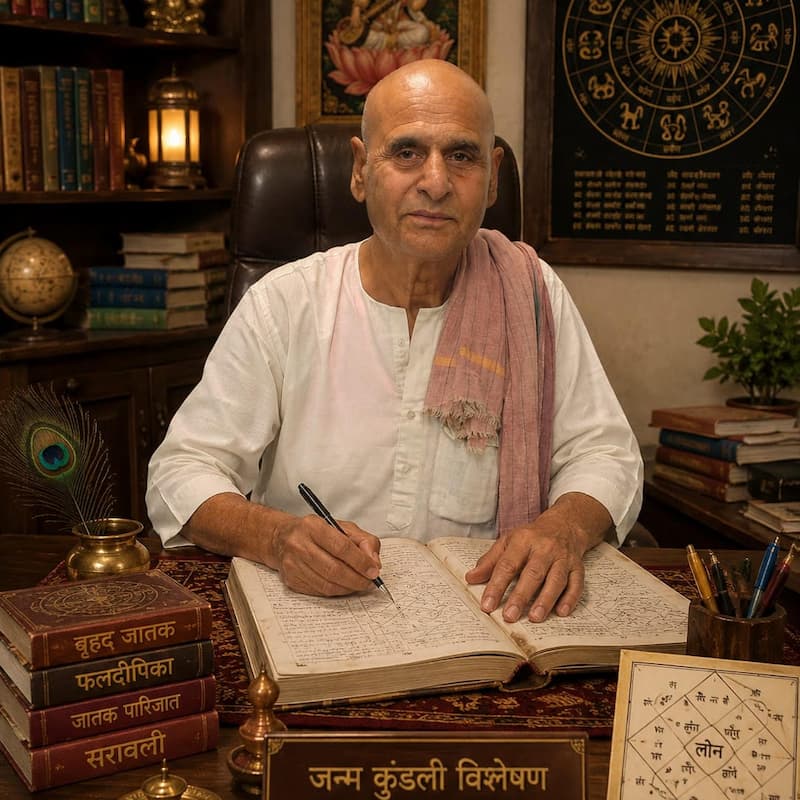
Narendra Kumar Chaubey is a Jyotisha Acharya with over 30 years of experience, based in Bihar and serving clients across India in Vedic astrology, mantra shastra, Vastu and ritual practice.
He completed his formal training at Kameshwar Singh Darbhanga Sanskrit University (KSDSU), one of India’s oldest and most respected institutions for Vedic and Sanskrit scholarship, where he studied Jyotisha shastra, mantra vidya and related classical sciences. KSDSU’s tradition of rigorous Sanskrit education tracing directly to the Mithila region’s centuries-old pandit lineage forms the foundation of his practice.
Over three decades, Narendra Kumar Chaubey has worked with thousands of individuals and families across Bihar and across India, offering guidance in:
- Kundli (birth chart) analysis: Identifying karmic patterns, planetary periods and life path guidance through classical Jyotisha
- Palmistry (Hasta Samudrika): Reading the hand according to the classical Samudrika Shastra tradition
- Vastu Shastra: Assessment and correction of living and working spaces according to directional and elemental principles
- Mantra and Pooja vidhi: Performing and guiding all categories of puja, havan, and mantra sadhana for personal, family and business situations
- Predictive Jyotisha: Transit analysis, muhurta (auspicious timing) selection and remedial guidance
He works across four languages Sanskrit, Hindi, English and Bhojpuri making classical knowledge accessible to practitioners across educational backgrounds and regions.
His writing for ABMantra brings the precision of classical Vedic training to practical mantra guidance: not general advice but specific prescriptions grounded in shastra, lineage and 30 years of direct practice with real situations.
For more info follow on: